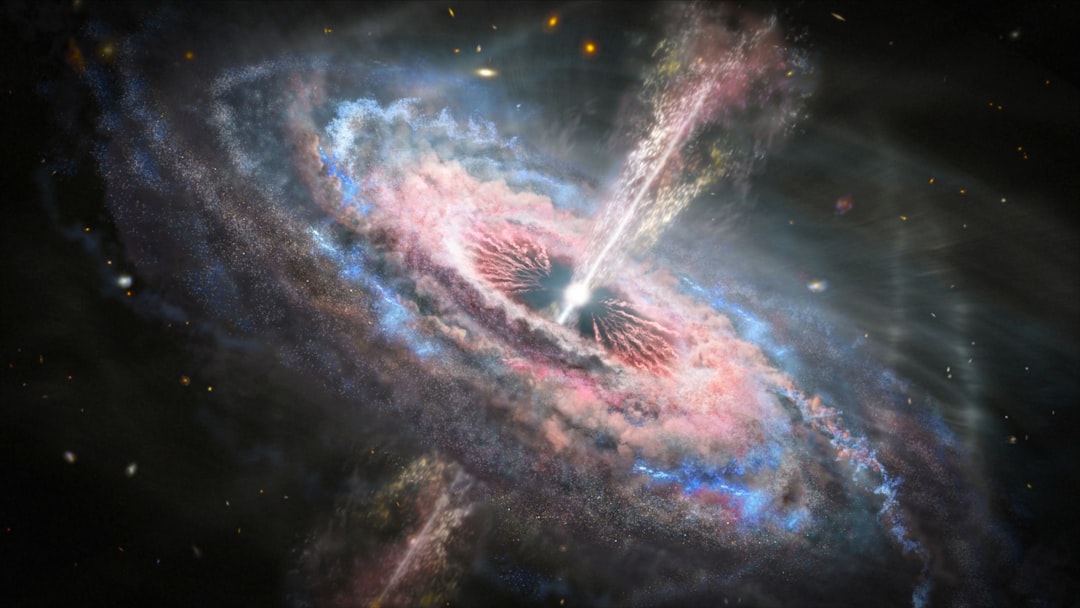
Quantum mechanics and general relativity stand as two of the most significant pillars of modern physics, each offering profound insights into the workings of the universe. Quantum mechanics, with its foundation in the behavior of subatomic particles, reveals a world governed by probabilities and uncertainties. It challenges classical notions of determinism, suggesting that at the smallest scales, reality is not as straightforward as it appears.
On the other hand, general relativity, formulated by Albert Einstein, revolutionized the understanding of gravity, portraying it not as a force but as a curvature of spacetime caused by mass. This theory has been instrumental in explaining large-scale cosmic phenomena, from the orbits of planets to the dynamics of galaxies. The intersection of these two theories becomes particularly intriguing when considering black holes.
These enigmatic entities, formed from the remnants of massive stars, embody the extremes of both quantum mechanics and general relativity. While general relativity provides a framework for understanding their formation and structure, quantum mechanics introduces complexities that challenge traditional views.
Key Takeaways
- Quantum mechanics and general relativity offer fundamentally different descriptions of black holes, leading to significant theoretical conflicts.
- Quantum mechanics introduces concepts like Hawking radiation and the information paradox, challenging classical views of black holes.
- General relativity describes black holes with singularities and event horizons, emphasizing the warping of spacetime.
- Efforts to unify these theories, such as quantum gravity and string theory, aim to resolve contradictions in black hole physics.
- Understanding black holes is crucial for advancing physics and cosmology, with future research focusing on integrating quantum mechanics and general relativity.
The Nature of Black Holes according to Quantum Mechanics
From the perspective of quantum mechanics, black holes present a unique set of challenges and paradoxes. One of the most significant implications is the concept of superposition, where particles can exist in multiple states simultaneously until observed. This principle raises questions about what happens to information when it falls into a black hole.
According to quantum theory, information cannot be destroyed; however, the classical view of black holes suggests that anything crossing the event horizon is lost forever. This contradiction has led to what is known as the information paradox, a dilemma that continues to perplex physicists. Moreover, quantum mechanics introduces the idea of entanglement, where particles become interconnected in such a way that the state of one instantly influences the state of another, regardless of distance.
This phenomenon suggests that black holes could be more than mere voids in space; they might play a role in a larger quantum network. Some theorists propose that black holes could act as conduits for information transfer across vast distances, challenging the conventional understanding of their isolation. Thus, from a quantum perspective, black holes are not just endpoints but potentially vital components in the fabric of reality.
The Nature of Black Holes according to General Relativity
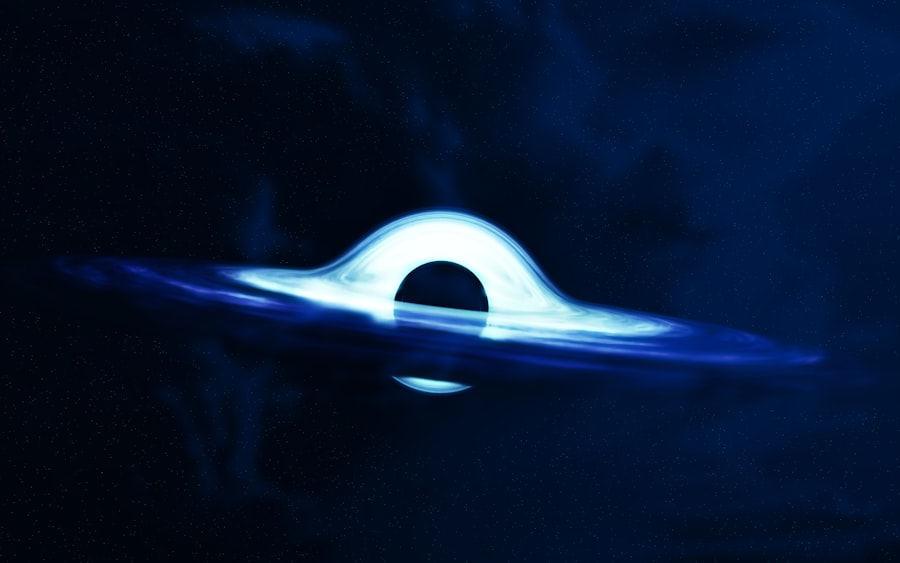
In stark contrast to quantum mechanics, general relativity offers a more classical view of black holes, focusing on their gravitational effects and geometric properties. According to Einstein’s theory, a black hole is formed when a massive star exhausts its nuclear fuel and collapses under its own gravity. This collapse leads to an infinitely dense point known as a singularity, surrounded by an event horizon—the boundary beyond which nothing can escape.
The event horizon marks a critical threshold; once crossed, all paths lead inexorably toward the singularity. General relativity describes black holes as solutions to Einstein’s field equations, which relate the geometry of spacetime to the distribution of mass and energy. These equations predict various types of black holes, including Schwarzschild black holes (non-rotating) and Kerr black holes (rotating).
The implications of these solutions extend beyond mere theoretical constructs; they have been confirmed through astronomical observations, such as the detection of gravitational waves from colliding black holes and imaging their shadows using advanced telescopes. Thus, general relativity provides a robust framework for understanding the structure and behavior of black holes within the cosmos.
The Clash between Quantum Mechanics and General Relativity in Understanding Black Holes
| Aspect | Quantum Mechanics | General Relativity | Conflict/Challenge |
|---|---|---|---|
| Fundamental Description | Describes physics at microscopic scales using wavefunctions and probabilities | Describes gravity as curvature of spacetime caused by mass and energy | Quantum mechanics does not incorporate gravity; general relativity is classical and non-quantized |
| Black Hole Singularity | Predicts quantum effects near singularities but lacks a complete theory of quantum gravity | Predicts singularities with infinite density and zero volume inside black holes | Singularity is a breakdown point for general relativity; quantum effects expected but not fully understood |
| Event Horizon | Quantum theory predicts Hawking radiation emitted near the event horizon | Event horizon is a boundary beyond which nothing can escape, no radiation predicted | Hawking radiation implies black holes can evaporate, conflicting with classical view of eternal black holes |
| Information Paradox | Quantum mechanics requires information to be conserved | General relativity suggests information is lost inside black holes | Contradiction leads to the black hole information paradox, unresolved in current physics |
| Mathematical Framework | Uses quantum field theory and probabilistic operators | Uses differential geometry and tensor calculus | Incompatibility in merging frameworks to describe black holes consistently |
| Current Research Approaches | String theory, loop quantum gravity, holographic principle | Classical solutions like Schwarzschild and Kerr metrics | Efforts to develop a quantum theory of gravity to unify both descriptions |
The divergence between quantum mechanics and general relativity becomes particularly pronounced when examining black holes. While general relativity treats them as regions where spacetime is warped beyond recognition, quantum mechanics insists on the preservation of information. This fundamental clash raises profound questions about the nature of reality itself.
If information is lost within a black hole, it contradicts one of the core tenets of quantum theory—that information cannot be destroyed. This conflict has led to intense debates among physicists regarding the true nature of black holes. Some propose that black holes may not be entirely black; instead, they could emit radiation due to quantum effects near the event horizon—a concept known as Hawking radiation.
Others suggest that information might be encoded on the event horizon itself, leading to theories such as holography. These discussions highlight not only the complexities inherent in understanding black holes but also the broader implications for reconciling two foundational theories that describe vastly different scales of existence.
Quantum Mechanics’ Approach to Black Holes: Information Paradox and Hawking Radiation
The information paradox remains one of the most contentious issues in theoretical physics concerning black holes. Stephen Hawking’s groundbreaking work introduced the idea that black holes are not entirely black; they can emit radiation due to quantum effects near their event horizons. This radiation arises from virtual particle pairs that spontaneously form in empty space.
When one particle falls into the black hole while its partner escapes, it results in a net loss of mass for the black hole over time—a process that leads to its eventual evaporation. However, this phenomenon raises critical questions about information retention. If a black hole evaporates completely through Hawking radiation, what happens to the information contained within it?
The implications are staggering: if information is lost forever, it would violate fundamental principles of quantum mechanics. Various theories have emerged in attempts to resolve this paradox, including ideas about “black hole complementarity,” which posits that different observers may perceive different realities regarding information retention. Nevertheless, no consensus has been reached, leaving physicists grappling with one of the most profound mysteries in contemporary science.
General Relativity’s Approach to Black Holes: Singularities and Event Horizons
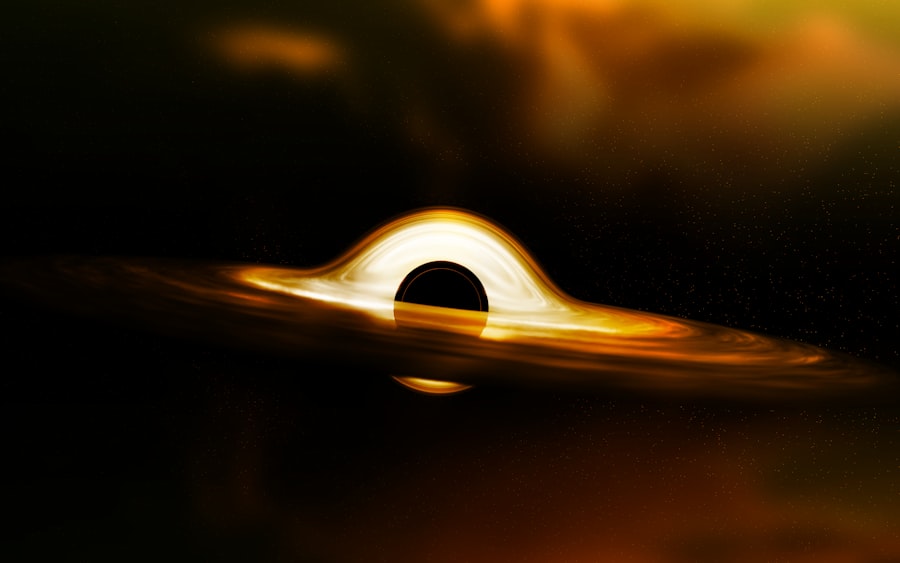
In contrast to quantum mechanics’ focus on information and radiation, general relativity emphasizes the geometric aspects of black holes—specifically singularities and event horizons. A singularity represents a point where gravitational forces compress matter to infinite density, leading to breakdowns in our understanding of physics as we know it. At this juncture, classical laws cease to apply, and predictions become impossible.
The event horizon serves as a critical boundary; it delineates regions where escape is impossible due to extreme gravitational pull. General relativity’s treatment of singularities raises philosophical questions about the nature of reality itself. If singularities exist at the core of black holes, what does this imply about our understanding of spacetime?
Furthermore, how do these singularities interact with quantum phenomena? While general relativity provides a robust framework for describing gravitational interactions on cosmic scales, it struggles to account for behaviors observed at quantum levels—highlighting an essential gap in our understanding.
Attempts to Unify Quantum Mechanics and General Relativity in Understanding Black Holes
The quest for unification between quantum mechanics and general relativity has been a driving force in theoretical physics for decades. Various approaches have emerged in an attempt to bridge this divide and provide a coherent framework for understanding phenomena like black holes. One prominent avenue is loop quantum gravity, which seeks to quantize spacetime itself by treating it as a network of discrete loops rather than a continuous fabric.
This approach aims to reconcile gravitational effects with quantum principles while preserving key features from both theories. Another significant effort involves exploring modifications to general relativity or incorporating additional dimensions into existing frameworks. String theory has gained traction as a potential unifying theory by positing that fundamental particles are not point-like but rather one-dimensional strings vibrating at different frequencies.
This perspective allows for a richer tapestry of interactions and could provide insights into how gravity operates at quantum scales. However, despite these promising avenues, no definitive theory has emerged that successfully reconciles all aspects of both quantum mechanics and general relativity.
Quantum Gravity: A Potential Solution to the Clash
Quantum gravity represents an ambitious endeavor aimed at merging quantum mechanics with general relativity into a single cohesive framework. By addressing both gravitational interactions and quantum phenomena simultaneously, researchers hope to unlock new insights into fundamental questions surrounding black holes and other cosmic mysteries. Various approaches exist within this field, including loop quantum gravity and causal set theory—each offering unique perspectives on how spacetime might behave at its most fundamental level.
One promising aspect of quantum gravity is its potential to resolve issues related to singularities within black holes. By quantizing spacetime itself, some theorists suggest that singularities may be avoided altogether or transformed into more manageable structures that align with our understanding of quantum mechanics. This shift could lead to new insights into how matter behaves under extreme conditions and provide clarity on issues like information retention within black holes.
String Theory and Its Role in Resolving the Clash
String theory has emerged as one of the leading candidates for unifying quantum mechanics and general relativity due to its inherent flexibility and capacity for incorporating additional dimensions beyond our familiar three-dimensional space. By proposing that fundamental particles are actually tiny vibrating strings rather than point-like entities, string theory opens up new avenues for understanding gravitational interactions at quantum scales. In relation to black holes, string theory offers intriguing possibilities for resolving paradoxes such as information loss and singularities.
For instance, some models suggest that information may be preserved through intricate patterns encoded within strings or through interactions with higher-dimensional branes—hypothetical objects within string theory’s framework. While string theory remains largely theoretical and unproven experimentally, its mathematical elegance and potential implications continue to inspire physicists seeking answers to some of science’s most profound questions.
The Importance of Understanding Black Holes in the Context of Quantum Mechanics and General Relativity
Understanding black holes is not merely an academic exercise; it holds profound implications for our comprehension of the universe itself. As natural laboratories for testing fundamental theories like quantum mechanics and general relativity under extreme conditions, black holes provide unique opportunities for exploration and discovery. By unraveling their mysteries, physicists can gain insights into how these two seemingly disparate frameworks might coexist or even complement each other.
Moreover, studying black holes can shed light on broader cosmological questions regarding the nature of spacetime, gravity, and the origins of structure in the universe. As researchers continue to probe deeper into these enigmatic entities—through observational advancements like gravitational wave detection or theoretical explorations involving quantum gravity—they inch closer toward unlocking secrets that could reshape humanity’s understanding of reality itself.
Future Directions and Implications for Physics and Cosmology
The future directions in exploring black holes promise exciting developments across both theoretical physics and cosmology. As technology advances—enabling more precise measurements and observations—scientists are poised to gather data that could either support or challenge existing theories regarding black holes’ nature and behavior. Upcoming missions aimed at studying gravitational waves or imaging event horizons will likely yield new insights into these cosmic phenomena.
Furthermore, ongoing research into unifying frameworks like string theory or loop quantum gravity may eventually lead to breakthroughs that reconcile long-standing conflicts between quantum mechanics and general relativity. Such advancements could revolutionize not only our understanding of black holes but also fundamental concepts related to spacetime itself—potentially reshaping humanity’s grasp on reality as we know it. In conclusion, while significant challenges remain in reconciling quantum mechanics with general relativity—especially concerning black holes—the pursuit continues unabated among physicists worldwide.
The journey toward understanding these cosmic enigmas promises not only intellectual rewards but also profound implications for humanity’s place within an ever-expanding universe.
The ongoing debate between quantum mechanics and general relativity, particularly in the context of black holes, has led to fascinating insights and theories in modern physics. For a deeper understanding of this complex relationship, you can explore the article on cosmic ventures that discusses the implications of black holes on our understanding of the universe. Check it out here: Quantum Mechanics vs General Relativity: The Black Hole Dilemma.
WATCH THIS! The Paradox That Broke Physics: Quantum vs. Black Holes
FAQs
What is quantum mechanics?
Quantum mechanics is a fundamental theory in physics that describes the behavior of particles at the smallest scales, such as atoms and subatomic particles. It explains phenomena that classical physics cannot, including wave-particle duality, quantization of energy, and uncertainty principles.
What is general relativity?
General relativity is a theory of gravitation developed by Albert Einstein. It describes gravity not as a force but as the curvature of spacetime caused by mass and energy. This theory explains large-scale phenomena such as the motion of planets, black holes, and the expansion of the universe.
How do quantum mechanics and general relativity differ?
Quantum mechanics governs the behavior of very small particles and incorporates probabilistic outcomes, while general relativity explains the gravitational interaction of massive objects and the structure of spacetime on a large scale. The two theories operate in different domains and use different mathematical frameworks.
Why is it challenging to combine quantum mechanics and general relativity?
The main challenge is that quantum mechanics and general relativity are based on fundamentally different principles and mathematical structures. Quantum mechanics is probabilistic and operates in a fixed spacetime background, whereas general relativity is deterministic and treats spacetime as dynamic and curved. Reconciling these differences into a single consistent theory remains an open problem in physics.
What role do black holes play in the conflict between quantum mechanics and general relativity?
Black holes are regions of spacetime with extremely strong gravity where general relativity predicts singularities—points of infinite density. Quantum mechanics suggests that information cannot be destroyed, leading to paradoxes such as the black hole information paradox. Studying black holes highlights the incompatibilities between the two theories and motivates the search for a quantum theory of gravity.
What is the black hole information paradox?
The black hole information paradox arises because general relativity predicts that information falling into a black hole is lost forever, while quantum mechanics asserts that information must be conserved. This contradiction challenges our understanding of physics and suggests that a new theory combining both frameworks is needed.
Are there any theories that attempt to unify quantum mechanics and general relativity?
Yes, several approaches aim to unify the two, including string theory and loop quantum gravity. These theories attempt to describe gravity at the quantum level and resolve inconsistencies between quantum mechanics and general relativity, especially in extreme environments like black holes.
Why is understanding the relationship between quantum mechanics and general relativity important?
Understanding how quantum mechanics and general relativity fit together is crucial for explaining phenomena where both quantum effects and strong gravity are significant, such as inside black holes and during the early moments of the universe. A unified theory could provide deeper insights into the fundamental nature of reality.