
Quantum entanglement, a phenomenon described by Erwin Schrödinger as “the characteristic trait of quantum mechanics, the one that enforces its entire departure from classical lines of thought,” has long puzzled physicists. This fundamental quantum mechanical effect, where two or more particles become linked in such a way that they share the same fate regardless of the distance separating them, presents a profound challenge to classical intuitions about locality and reality. Recent theoretical advancements suggest that entanglement might offer a crucial key to understanding some of the deepest mysteries in physics, particularly the emergence of spacetime itself. The idea that entanglement could be intrinsically tied to the fabric of reality has propelled it from a perplexing curiosity to a potential bedrock of quantum gravity theories.
Quantum entanglement is not merely a strong correlation between particles; it is a non-local connection that defies classical explanation. When two particles are entangled, their quantum states are intertwined. Measuring a property of one particle, such as its spin or polarization, instantly influences the state of the other, regardless of the spatial separation between them. This instantaneous influence, famously dubbed “spooky action at a distance” by Albert Einstein, directly contradicts the principle of local realism, which posits that physical effects are bound by the speed of light and and attributes definite properties to objects independent of observation.
The concept was first rigorously explored by Einstein, Boris Podolsky, and Nathan Rosen in their 1935 EPR paradox paper, which argued that quantum mechanics must be incomplete because entanglement implied either non-locality or a hidden variable theory. Subsequent experiments, notably those of John Bell and later Alain Aspect, Anton Zeilinger, and John Clauser, have overwhelmingly demonstrated the non-local nature of entanglement, ruling out local hidden variable theories. This experimental validation solidified entanglement’s place as a fundamental reality of the quantum world.
Defining Entanglement and Its Properties
Entanglement arises when two or more quantum systems interact in such a way that their individual quantum states cannot be described independently of the others. Instead, they must be described as a single, composite system. A simple analogy involves two coins tossed simultaneously. If one lands heads, the other might be tails due to shared initial conditions. However, in entanglement, the outcome of the second coin is determined instantaneously upon observation of the first, even if the coins were tossed in different galaxies and were in a superposition of both heads and tails until measured.
Key properties of entanglement include:
- Non-locality: Entangled particles influence each other instantaneously, regardless of distance, apparently violating the speed limit of light. However, this “information” cannot be used to transmit classical information faster than light.
- Indivisibility: The quantum state of an entangled system cannot be factorized into the product of the individual states of its constituent particles. They are inextricably linked.
- Purity: A maximally entangled state is typically a pure state, meaning it cannot be expressed as a probabilistic mixture of other states.
Experimental Verification and Bell’s Inequalities
John Stewart Bell’s groundbreaking work in the 1960s provided a theoretical framework to test the predictions of local hidden variable theories against those of quantum mechanics. Bell’s inequalities are mathematical expressions that must hold true if local realism is a valid description of reality. Quantum mechanics, conversely, predicts violations of these inequalities, implying the existence of non-local correlations.
Numerous experiments have since been conducted, beginning with those by Aspect in the early 1980s, which demonstrated definitive violations of Bell’s inequalities. Subsequent experiments have closed various “loopholes” (e.g., the detection loophole, locality loophole, and freedom-of-choice loophole), strengthening the evidence for non-local entanglement. These experimental results leave little doubt about the existence of genuinely non-local correlations in the quantum realm, laying the groundwork for its potential role in fundamental physics.
Recent research has explored the intriguing concept of emergent spacetime arising from quantum entanglement, suggesting that the fabric of spacetime itself may be a product of quantum correlations rather than a fundamental backdrop. For a deeper understanding of this fascinating topic, you can read more in the related article available at this link. This article delves into the implications of such theories and how they challenge our traditional views of reality and the universe.
Entanglement and Holography
The holographic principle, originating from black hole thermodynamics and string theory, proposes that the description of a volume of space can be encoded on a lower-dimensional boundary. This audacious idea suggests that our three-dimensional universe might be a holographic projection of information residing on a two-dimensional surface, much like a hologram creates a 3D image from a 2D plate. Entanglement has emerged as a crucial component in understanding this principle, particularly within the context of the Anti-de Sitter/Conformal Field Theory (AdS/CFT) correspondence.
The AdS/CFT correspondence, a duality between a gravitational theory in an Anti-de Sitter spacetime and a quantum field theory on its boundary, provides a concrete realization of the holographic principle. It suggests that a quantum gravitational theory in a bulk spacetime (AdS) is equivalent to a quantum field theory without gravity on its boundary (CFT). In this correspondence, entanglement plays a pivotal role in establishing the connection between the two descriptions.
The ER=EPR Conjecture
A profoundly speculative but highly influential idea is the ER=EPR conjecture, proposed by Leonard Susskind and Juan Maldacena. This conjecture posits that two maximally entangled particles (EPR) are connected by a non-traversable wormhole, or Einstein-Rosen bridge (ER). This conjecture suggests a deep equivalence between entanglement and geometry, intimating that the very fabric of spacetime geometry might be a manifestation of entanglement.
Consider two black holes that formed from the collapse of an entangled pair of particles. According to the ER=EPR conjecture, these black holes are connected by a wormhole. This connection, however, is not a traversable shortcut through spacetime; it is a manifestation of the entanglement shared between the black holes. This proposal attempts to explain how spacetime can emerge from entanglement, bridging the gap between quantum mechanics and general relativity.
Entanglement Wedge and Bulk Reconstruction
Within the AdS/CFT framework, the concept of an “entanglement wedge” further illuminates the connection between entanglement and geometry. An entanglement wedge is a region of the bulk spacetime (AdS) that can be reconstructed from the entanglement properties of a corresponding region on the boundary (CFT). More specifically, the Ryu-Takayanagi formula (and its generalization, the Hubeny-Rangamani-Takayanagi formula) relates the entanglement entropy of a region in the boundary CFT to the area of a minimal surface in the bulk AdS spacetime that terminates at the boundary of that region.
This formula implies that the geometric properties of the bulk spacetime, such as its connectivity and curvature, are encoded in the entanglement patterns of the boundary quantum field theory. As you increase the entanglement between different regions of the boundary, you effectively “grow” the bulk spacetime, leading to a more connected and elaborate geometry. Conversely, disentangling regions on the boundary can lead to the collapse or disconnection of parts of the bulk. This provides a direct mathematical link between the quantum information encoded in entanglement and the classical geometry of spacetime.
Spacetime as an Entanglement Network
The idea that spacetime itself might emerge from a network of entangled quantum bits (qubits) is gaining traction. This perspective suggests that reality, at its most fundamental level, is not a continuous, smooth manifold as described by general relativity, but rather a discrete structure built upon quantum information. Entanglement, in this view, is the “glue” that binds these fundamental constituents together, giving rise to the smooth, classical spacetime we perceive.
One way to visualize this is to imagine spacetime as a vast, intricate tapestry. Each thread in this tapestry represents a quantum degree of freedom, and the knots connecting these threads are instances of entanglement. The stronger and more pervasive the entanglement, the more robust and continuous the fabric of spacetime appears. Disrupting entanglement would be akin to cutting threads, potentially leading to tears or holes in the fabric of reality, or even its complete disintegration.
It From Bit: The Role of Quantum Information
John Archibald Wheeler, a pioneering figure in quantum gravity, famously coined the phrase “It from Bit,” suggesting that every “it”—every particle, every field of force, even the spacetime continuum itself—derives its function, its meaning, and its very existence entirely from binary choices, from bits. In the context of quantum entanglement, these “bits” can be thought of as fundamental units of quantum information (qubits).
If spacetime truly emerges from entanglement, then the properties of spacetime, such as its dimensionality, curvature, and causal structure, would ultimately be determined by the patterns and strength of entanglement among these elementary qubits. A universe with strong, widespread entanglement might manifest as a robust and connected spacetime, while a universe with weak or sparse entanglement might appear fragmented or non-existent in a macroscopical sense. This perspective challenges the notion of spacetime as a fundamental backdrop and instead proposes it as an emergent property of quantum information.
Disentanglement and Spacetime Disruption
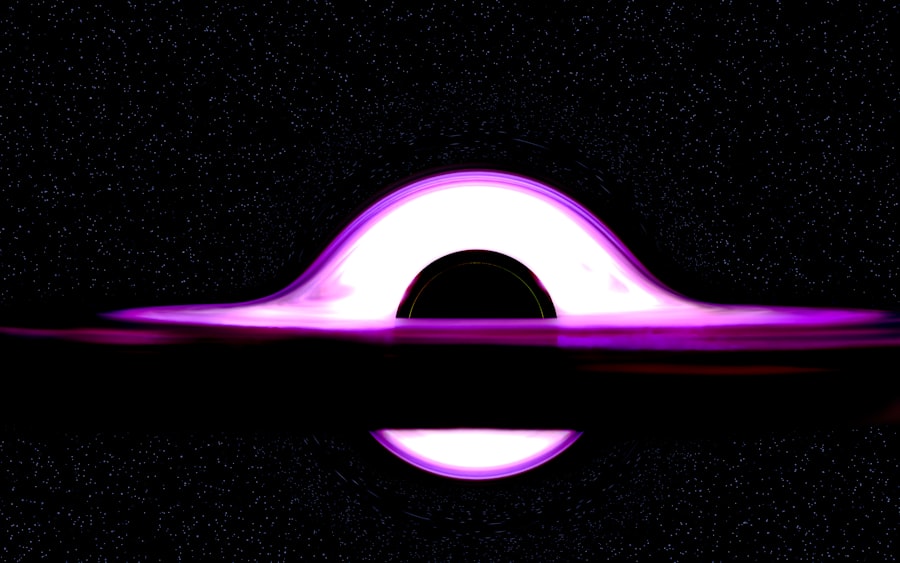
If entanglement is indeed the scaffolding of spacetime, then its disruption or decay could have profound cosmological implications. Theoretical models suggest that extreme disentanglement might lead to the breakdown of spacetime as we know it. For instance, in black holes, the intense gravitational field and the scrambling of information could be interpreted as a form of extreme entanglement-driven spacetime disruption.
The information paradox associated with black holes, for example, could be reinterpreted through the lens of entanglement. As matter falls into a black hole, its information becomes highly entangled with the radiation emitted (Hawking radiation). If this entanglement is not properly accounted for—perhaps leading to a complete disentanglement from the interior of the black hole—it could imply a breakdown of the smooth spacetime continuum near the event horizon. This idea links the mysteries of black holes, information loss, and the nature of spacetime in a compelling manner.
Challenges and Future Directions
While the entanglement-spacetime connection offers a promising avenue for quantum gravity, it is important to acknowledge the significant theoretical and experimental challenges that remain. This field is still in its nascent stages, and many questions require deeper investigation.
One of the primary challenges is to move beyond the highly idealized Anti-de Sitter spacetime with its negative cosmological constant, which is not representative of our universe, which has a positive cosmological constant (de Sitter spacetime). Extending these concepts to de Sitter space, which is generally believed to describe our accelerating universe, is a crucial but exceedingly difficult task.
The Absence of a Complete Theory of Quantum Gravity
The fundamental hurdle is the absence of a complete and consistent theory of quantum gravity. Both general relativity and quantum mechanics are incredibly successful in their respective domains, but they fundamentally clash when attempting to describe phenomena at the Planck scale, where gravity becomes as strong as other quantum forces.
The entanglement-spacetime relationship offers a pathway towards such a theory, by suggesting that gravity itself, and thus spacetime, is an emergent phenomenon rather than a fundamental force. This shifts the focus from quantizing gravity directly to understanding how spacetime arises from a more fundamental quantum substrate. However, developing a full mathematical and conceptual framework that can consistently describe this emergence remains an open problem.
Experimental Verification in Cosmology
Another significant challenge lies in the realm of experimental verification. Entanglement, while experimentally confirmed at microscopic scales, is incredibly difficult to observe or manipulate at cosmological scales. Detecting imprints of entanglement in the early universe, or observing how disentanglement might manifest as macroscopic spacetime effects, is currently beyond our technological capabilities.
However, theoretical predictions linking entanglement patterns to observable cosmological phenomena, such as primordial gravitational waves or anisotropies in the cosmic microwave background, could offer indirect experimental probes. For example, if the early universe was dominated by a highly entangled quantum fluid, its unique signatures might be detectable in future cosmological observations. The development of new theoretical tools to make such predictions, alongside advancements in observational astronomy and cosmology, will be crucial.
Recent research has explored the fascinating concept of emergent spacetime arising from quantum entanglement, suggesting that the fabric of spacetime itself may be a byproduct of quantum interactions. This idea challenges traditional notions of spacetime as a fundamental backdrop and opens up new avenues for understanding the universe. For a deeper dive into this intriguing topic, you can read more in this related article on the subject of quantum entanglement and its implications for spacetime here.
Philosophical Implications
| Metric | Description | Typical Values / Range | Relevance to Emergent Spacetime |
|---|---|---|---|
| Entanglement Entropy | Measure of quantum entanglement between subsystems | 0 to log(dim(Hilbert space)) | Quantifies the amount of entanglement that can give rise to geometric connectivity in spacetime |
| Mutual Information | Information shared between two quantum subsystems | 0 to 2 × min(entanglement entropy of subsystems) | Used to probe correlations that relate to spacetime connectivity |
| Ryu-Takayanagi Surface Area | Area of minimal surface in AdS space related to entanglement entropy | Varies with subsystem size and geometry | Connects entanglement entropy to geometric quantities in holographic spacetime |
| Quantum Circuit Complexity | Number of quantum gates needed to prepare a state | Depends on system size and state complexity | Proposed to relate to spacetime volume or action in emergent geometry |
| Correlation Length | Distance over which quantum correlations decay | From zero to system size | Determines scale of emergent geometric features |
| Entanglement Spectrum | Eigenvalues of reduced density matrix of a subsystem | Distribution varies with system and state | Encodes detailed structure of entanglement influencing emergent geometry |
The idea that spacetime emerges from entanglement holds profound philosophical implications, pushing us to reconsider our most basic assumptions about the nature of reality. If spacetime is not a fundamental entity but rather an emergent property, our understanding of gravity, causality, and even existence itself must be re-evaluated.
This paradigm shift moves away from a reductionist view, where spacetime is a given backdrop, towards a more relational and informational understanding of the universe. It suggests that relationships—specifically quantum entanglement—are primary, and that the spatial and temporal dimensions we perceive are derivative.
The Nature of Reality and Observer Dependence
If spacetime is emergent, then its properties might, to an extent, be context-dependent or even observer-dependent. This harks back to the interpretational challenges of quantum mechanics itself, where the act of measurement plays a crucial role in defining reality. If spacetime itself is built upon quantum information, then the way we collectively interact with and observe the universe could influence its large-scale structure.
This is not to say that observers directly “create” the universe, but rather that the information-theoretic processes inherent in observation and interaction are fundamental to the manifestation of spacetime. This deepens the mystery of the wave function collapse and the measurement problem, extending their implications to the very fabric of existence.
Time as an Emergent Phenomenon
Perhaps one of the most radical implications is the possibility that time itself is an emergent phenomenon, intrinsically linked to entanglement. While general relativity treats time as a fundamental dimension, its role in quantum gravity is notoriously problematic. Many quantum gravity theories suggest that “true” time, as a measurable coordinate, might not exist at the most fundamental level.
If spacetime emerges from entanglement, then the unidirectional flow of time could be a macroscopic approximation, built upon the irreversible processes of entanglement dynamics. The increase in entanglement entropy in an evolving quantum system could correlate with the arrow of time, suggesting that the expansion and evolution of spacetime are intertwined with the development of entanglement across the universe. This perspective has the potential to unify our understanding of time, information, and the cosmos’s evolution.
In conclusion, the investigation into quantum entanglement as the foundation of spacetime represents one of the most exciting and challenging frontiers in theoretical physics. While many questions remain unanswered, the theoretical connections between entanglement, holography, and the structure of reality provide a compelling framework for understanding the universe at its most fundamental level. The journey from “spooky action at a distance” to the potential blueprint of spacetime highlights the remarkable progression of scientific thought and the relentless pursuit of understanding the fundamental fabric of existence.
▶️ WARNING: The Universe Just Hit Its Limit
FAQs
What is emergent spacetime in the context of quantum entanglement?
Emergent spacetime refers to the idea that the fabric of spacetime itself arises from more fundamental quantum phenomena, particularly quantum entanglement. Instead of spacetime being a fixed background, it is viewed as a construct that emerges from the entangled states of quantum systems.
How does quantum entanglement contribute to the concept of spacetime?
Quantum entanglement creates correlations between particles that are not limited by classical notions of distance. These correlations can be mathematically related to the geometric properties of spacetime, suggesting that the connectivity and structure of spacetime may be a manifestation of underlying entangled quantum states.
What theories support the idea of spacetime emerging from quantum entanglement?
Theories such as the AdS/CFT correspondence in string theory and approaches in quantum gravity propose that spacetime geometry can be derived from entanglement patterns in a lower-dimensional quantum field theory. These frameworks provide a mathematical basis for understanding spacetime as an emergent phenomenon.
Why is the concept of emergent spacetime important in physics?
Emergent spacetime offers a potential resolution to the conflict between general relativity and quantum mechanics by suggesting that spacetime is not fundamental but arises from quantum processes. This perspective could lead to a unified theory of quantum gravity and deepen our understanding of the universe’s fundamental nature.
Are there experimental evidences supporting emergent spacetime from quantum entanglement?
Currently, emergent spacetime is primarily a theoretical concept supported by mathematical models and indirect evidence. Direct experimental verification remains challenging due to the scales involved, but ongoing research in quantum information theory and high-energy physics aims to find observable signatures consistent with this idea.