
Cosmology, the scientific study of the universe’s origin, evolution, and eventual fate, captivates the imagination of many. As you delve into this field, you will find that it encompasses a vast array of questions about the nature of existence itself.
It is a discipline that combines elements of physics, astronomy, and philosophy, inviting you to ponder profound questions about space, time, and the very fabric of reality. As you explore cosmology, you will encounter a rich tapestry of theories and models that have evolved over centuries. The quest to understand the universe has led to groundbreaking discoveries and revolutionary ideas.
Each advancement builds upon the last, creating a dynamic landscape where new insights challenge established beliefs. This article will guide you through the traditional models of cosmology, the challenges they face, and the emergence of new theories that continue to reshape our understanding of the universe.
Key Takeaways
- Cosmology is the study of the origin, evolution, and eventual fate of the universe.
- Traditional cosmological models, such as the Big Bang theory, have faced challenges in explaining certain phenomena, leading to the emergence of new theories.
- Dark matter and dark energy play a crucial role in shaping the universe, despite being largely mysterious and undetectable.
- Quantum cosmology and the concept of the multiverse have opened up new possibilities for understanding the universe at its most fundamental level.
- New observational techniques and technologies have revolutionized our ability to study the universe, leading to exciting implications for the origin and fate of the universe.
Traditional Cosmological Models
Historically, cosmological models have been shaped by the prevailing scientific paradigms of their time. The geocentric model, which placed Earth at the center of the universe, dominated ancient thought until the heliocentric model proposed by Copernicus shifted perspectives. As you study these early models, you will appreciate how they laid the groundwork for modern cosmology.
The introduction of Newtonian physics further advanced our understanding, leading to the formulation of a universe governed by gravitational forces. The 20th century marked a significant turning point with the advent of Einstein’s theory of general relativity. This revolutionary framework provided a new lens through which to view the cosmos, suggesting that massive objects warp spacetime and influence the motion of celestial bodies.
The Friedmann-Lemaître-Robertson-Walker (FLRW) metric emerged from this theory, offering a mathematical description of an expanding universe. As you engage with these traditional models, you will recognize their importance in shaping contemporary cosmological thought and how they serve as a foundation for ongoing research.
Challenges to Traditional Cosmology
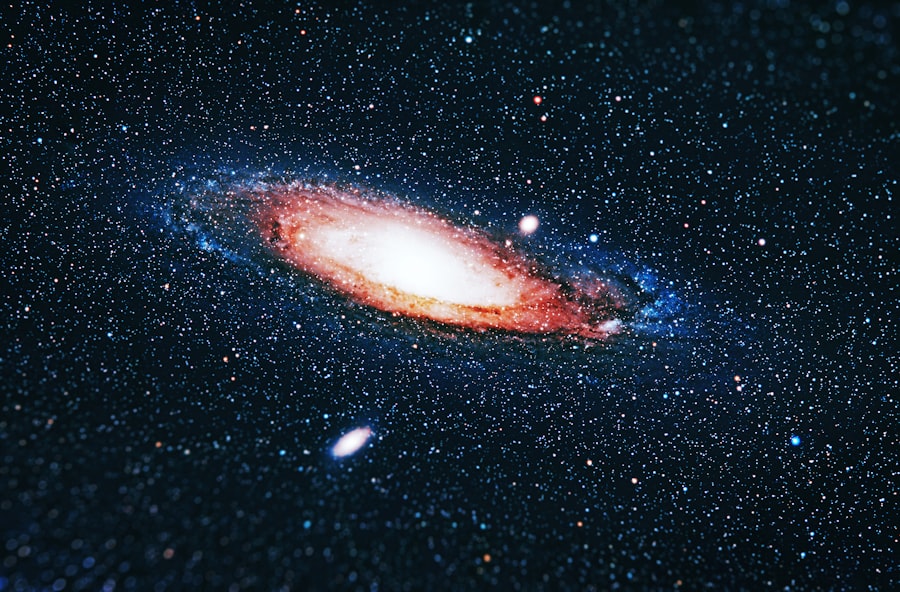
Despite their foundational significance, traditional cosmological models face numerous challenges that have prompted scientists to reevaluate their assumptions. One major issue is the observed acceleration of the universe’s expansion, which contradicts earlier predictions based on gravitational forces alone. This phenomenon has led to the introduction of dark energy as a potential explanation, yet its true nature remains elusive.
As you delve into these challenges, you will see how they highlight the limitations of existing models and the need for new frameworks. Another challenge arises from discrepancies in measurements of cosmic parameters, such as the Hubble constant. Different methods yield conflicting results, raising questions about our understanding of cosmic expansion and the age of the universe.
These inconsistencies compel researchers to scrutinize traditional models and consider alternative explanations. As you navigate these complexities, you will gain insight into the dynamic nature of scientific inquiry and how challenges can drive progress in cosmological research.
Emergence of New Cosmological Theories
| Theory | Scientist | Year |
|---|---|---|
| Big Bang Theory | Georges Lemaître | 1927 |
| Steady State Theory | Fred Hoyle | 1948 |
| Inflationary Theory | Alan Guth | 1980 |
In response to the challenges faced by traditional cosmology, new theories have emerged that seek to provide alternative explanations for observed phenomena. One such theory is inflationary cosmology, which posits that a rapid expansion occurred in the early universe, smoothing out irregularities and explaining the uniformity observed in the cosmic microwave background radiation. As you explore this concept, you will appreciate how it addresses some of the shortcomings of earlier models while introducing new questions about the nature of inflation itself.
Another intriguing development is the concept of cyclic cosmology, which suggests that the universe undergoes infinite cycles of expansion and contraction. This idea challenges the notion of a singular beginning and end, inviting you to consider a more complex view of cosmic history. As these new theories gain traction, they illustrate how scientific understanding is not static but rather an evolving narrative shaped by ongoing research and discovery.
The Role of Dark Matter and Dark Energy
Dark matter and dark energy are two critical components that play a significant role in contemporary cosmology. Dark matter, which does not emit or interact with electromagnetic radiation, is believed to make up approximately 27% of the universe’s total mass-energy content. Its presence is inferred from gravitational effects on visible matter and cosmic structures.
As you investigate dark matter’s role in shaping galaxies and large-scale structures, you will come to understand its importance in explaining phenomena that cannot be accounted for by ordinary matter alone. Conversely, dark energy accounts for about 68% of the universe’s energy density and is thought to be responsible for its accelerated expansion. This mysterious force remains one of the most profound enigmas in modern cosmology.
As you delve deeper into these concepts, you will encounter various hypotheses regarding their nature and implications for our understanding of fundamental physics. The interplay between dark matter and dark energy continues to be a focal point for researchers seeking to unlock the secrets of the cosmos.
Quantum Cosmology and the Multiverse
Quantum cosmology represents an exciting frontier in our quest to understand the universe at its most fundamental level. By applying principles from quantum mechanics to cosmological models, researchers are exploring concepts such as wave function collapse and quantum fluctuations in spacetime. This approach challenges classical notions of determinism and invites you to consider a universe where probabilities play a crucial role in shaping reality.
The multiverse theory is one intriguing outcome of quantum cosmology. It posits that our universe may be just one of many existing simultaneously, each with its own distinct physical laws and constants. As you contemplate this idea, you may find yourself grappling with profound philosophical implications regarding existence and reality itself.
The multiverse concept not only expands our understanding of what constitutes a universe but also raises questions about our place within it.
New Observational Techniques and Technologies
Advancements in observational techniques and technologies have revolutionized our ability to study the cosmos. Telescopes equipped with cutting-edge instruments allow astronomers to capture unprecedented details about distant galaxies, stars, and cosmic phenomena. As you explore these advancements, you will discover how innovations such as adaptive optics and space-based observatories have enhanced our understanding of celestial objects.
Moreover, gravitational wave astronomy has opened a new window into the universe, enabling scientists to detect ripples in spacetime caused by catastrophic events like black hole mergers. This groundbreaking field has already provided valuable insights into phenomena that were previously inaccessible through traditional observational methods. As you engage with these new technologies, you will appreciate how they continue to push the boundaries of our knowledge and expand our understanding of cosmic events.
Implications for the Origin and Fate of the Universe
The ongoing developments in cosmology have profound implications for our understanding of both the origin and fate of the universe. Theories such as inflationary cosmology provide insights into how the universe began from an incredibly hot and dense state, while dark energy raises questions about its ultimate fate.
” These considerations also lead to philosophical inquiries about existence itself.
If our universe is just one among many in a multiverse scenario, what does that mean for concepts like creation and purpose? As you reflect on these implications, you will recognize that cosmology is not merely a scientific endeavor but also a profound exploration of humanity’s place in an ever-expanding cosmos.
The Impact on Astrophysical Research
The evolving landscape of cosmology has significant ramifications for astrophysical research as a whole. As new theories emerge and observational techniques advance, researchers are compelled to reevaluate existing paradigms across various fields within astrophysics. For instance, studies on galaxy formation must now account for dark matter’s influence more rigorously than ever before.
Additionally, interdisciplinary collaboration has become increasingly vital as cosmologists work alongside particle physicists, astronomers, and mathematicians to tackle complex questions about the universe’s nature. This collaborative spirit fosters innovation and encourages diverse perspectives that enrich our understanding of cosmic phenomena. As you engage with this interconnected web of research, you will appreciate how advancements in one area can lead to breakthroughs in others.
Future Directions in Cosmology
Looking ahead, several exciting directions await exploration within cosmology. The quest for a unified theory that reconciles general relativity with quantum mechanics remains a tantalizing goal for physicists. Such a theory could provide deeper insights into fundamental questions about spacetime and gravity at both cosmic and subatomic scales.
Moreover, as observational technologies continue to improve, we can expect new discoveries that challenge existing models and inspire fresh theories. The search for exoplanets within habitable zones may also yield insights into life’s potential beyond Earth, further enriching our understanding of cosmic evolution. As you consider these future directions, you will recognize that cosmology is an ever-evolving field where each discovery opens new avenues for inquiry.
The Ever-Evolving Nature of Cosmological Understanding
In conclusion, your journey through cosmology reveals an intricate tapestry woven from centuries of inquiry and discovery. From traditional models that laid foundational principles to emerging theories that challenge established beliefs, each step forward enriches our understanding of the universe’s nature. The interplay between dark matter and dark energy continues to shape contemporary research while quantum cosmology invites us to ponder profound questions about existence itself.
As new observational techniques unveil previously hidden aspects of the cosmos, we stand on the brink of exciting discoveries that promise to reshape our understanding further. The future holds immense potential for exploration as we seek answers to age-old questions about our origins and ultimate fate within this vast expanse we call home. Embracing this ever-evolving nature of cosmological understanding allows us not only to appreciate our place in the universe but also inspires curiosity about what lies beyond our current grasp.
In recent years, the field of cosmology has experienced significant shifts, challenging long-held theories and opening new avenues for exploration. One such pivotal moment is discussed in an insightful article on My Cosmic Ventures, which delves into the implications of these changes for our understanding of the universe. The article highlights groundbreaking research and theories that are reshaping the landscape of cosmology, offering a fresh perspective on the cosmos. For a deeper dive into these transformative developments, you can read the full article by visiting My Cosmic Ventures.
FAQs
What is cosmology?
Cosmology is the scientific study of the origin, evolution, and eventual fate of the universe. It seeks to understand the large-scale structure and dynamics of the universe as a whole.
What is the major shift in cosmology?
The major shift in cosmology refers to significant changes or advancements in our understanding of the universe, such as new discoveries, breakthroughs in theories, or paradigm shifts in the field.
What are some examples of major shifts in cosmology?
Examples of major shifts in cosmology include the discovery of the expanding universe, the development of the Big Bang theory, the discovery of dark matter and dark energy, and the confirmation of the existence of gravitational waves.
How do major shifts in cosmology impact our understanding of the universe?
Major shifts in cosmology can lead to a deeper understanding of the fundamental nature of the universe, its origins, and its evolution. They can also lead to new insights into the nature of space, time, and the fundamental forces of the universe.
What are some current areas of research and potential future major shifts in cosmology?
Current areas of research in cosmology include the study of cosmic microwave background radiation, the search for dark matter and dark energy, and the exploration of the early universe. Potential future major shifts in cosmology could include the discovery of new fundamental particles, the resolution of the dark matter and dark energy mysteries, and the development of a more complete theory of quantum gravity.