Black holes have long captivated the imagination of scientists and the general public alike. These enigmatic cosmic entities, formed from the remnants of massive stars that have undergone gravitational collapse, possess gravitational fields so intense that nothing, not even light, can escape their grasp. The concept of a black hole challenges the very fabric of our understanding of physics, particularly in the realms of general relativity and quantum mechanics.
As researchers delve deeper into the mysteries of the universe, black holes emerge as pivotal players in the cosmic narrative, influencing galaxy formation and evolution. The study of black holes is not merely an academic pursuit; it has profound implications for our understanding of the universe. They serve as natural laboratories for testing theories of gravity and spacetime, and their presence can illuminate the dynamics of surrounding matter.
As scientists strive to measure the mass of these elusive objects, they unlock insights into their formation, growth, and the role they play in the broader cosmic landscape. Understanding black holes is essential for piecing together the intricate puzzle of the universe’s history and structure.
Key Takeaways
- Black holes are regions in space where the gravitational pull is so strong that nothing, not even light, can escape.
- Measuring the mass of black holes is crucial for understanding their impact on the universe and the objects around them.
- Direct methods for measuring black hole mass include observing the motion of stars and gas around the black hole.
- Indirect methods for measuring black hole mass involve studying the effects of black holes on their surrounding environment.
- Stellar orbits around black holes and X-ray emissions are important indicators for determining black hole mass.
The Importance of Measuring Black Hole Mass
Measuring the mass of black holes is crucial for several reasons.
By determining a black hole’s mass, astronomers can better understand its formation process and its evolutionary path.
For instance, the mass can provide clues about whether a black hole formed from a single massive star or through the merger of smaller black holes. This knowledge is vital for constructing models of stellar evolution and galaxy formation. Moreover, black hole mass measurements are instrumental in exploring the relationship between black holes and their host galaxies.
Observations suggest a correlation between the mass of supermassive black holes at galactic centers and the properties of their host galaxies, such as bulge mass and stellar velocity dispersion. By accurately measuring black hole masses, researchers can investigate this relationship further, shedding light on how these colossal entities influence galactic dynamics and evolution over cosmic time.
Direct Methods for Measuring Black Hole Mass
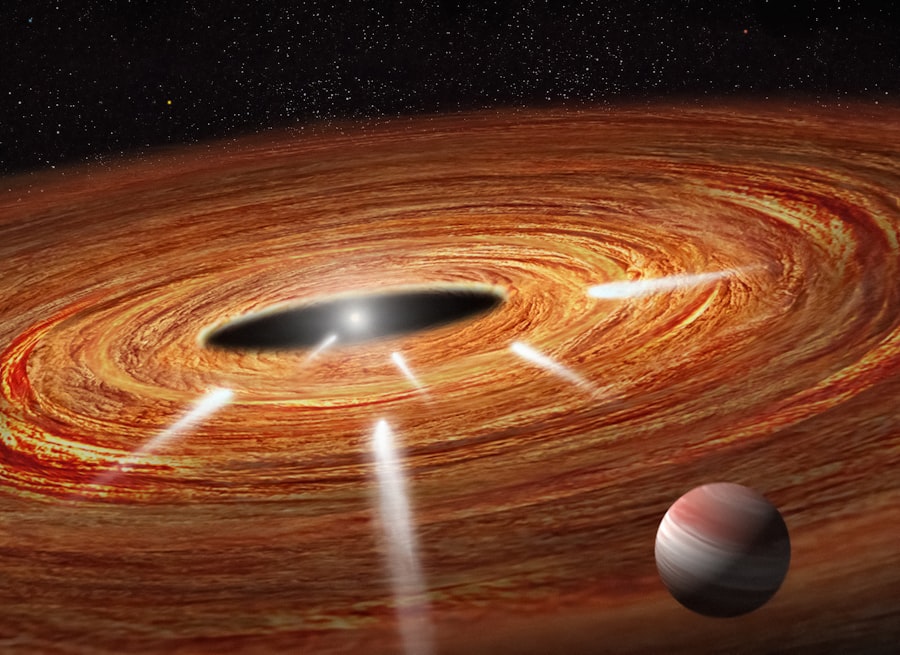
Direct methods for measuring black hole mass typically involve observing the motion of stars or gas in close proximity to the black hole. One of the most straightforward techniques is to track the orbits of stars around a supermassive black hole at the center of a galaxy. By applying Kepler’s laws of motion, astronomers can calculate the mass of the black hole based on the orbital characteristics of these stars.
The speed at which a star orbits provides critical information about the gravitational influence exerted by the black hole. Another direct method involves measuring the velocity dispersion of gas clouds near a black hole. When gas falls toward a black hole, it accelerates and emits radiation, which can be detected by telescopes.
By analyzing the Doppler shifts in this emitted light, astronomers can infer the velocity of the gas and subsequently estimate the mass of the black hole using similar principles as those applied to stellar orbits. These direct methods provide valuable insights into black hole masses but often require precise measurements and long-term observations.
Indirect Methods for Measuring Black Hole Mass
| Method | Observables | Advantages | Disadvantages |
|---|---|---|---|
| Gas kinematics | Gas velocity dispersion, gas rotation curve | Applicable to active galaxies, provides mass distribution | Requires high resolution, limited to certain types of galaxies |
| Stellar dynamics | Stellar velocity dispersion, stellar orbits | Applicable to quiescent galaxies, provides precise mass measurement | Requires high resolution, limited to certain types of galaxies |
| Time lags in AGN variability | Time delay between continuum and emission line variations | Applicable to active galaxies, independent of galaxy orientation | Requires long-term monitoring, limited to certain types of AGN |
In addition to direct methods, astronomers employ various indirect techniques to estimate black hole masses. One prominent approach involves studying the effects of gravitational waves produced during black hole mergers. When two black holes collide, they generate ripples in spacetime that can be detected by observatories like LIGO and Virgo.
By analyzing these gravitational waves, scientists can infer the masses of the merging black holes, providing a unique perspective on their properties. Another indirect method relies on examining the luminosity of active galactic nuclei (AGN), which are powered by accreting supermassive black holes. The brightness of an AGN can be correlated with its mass through empirical relationships established from observations.
By measuring the luminosity and applying these correlations, astronomers can estimate the mass of the central black hole without directly observing it. While indirect methods may introduce uncertainties, they offer valuable insights into black hole populations across different environments.
Stellar Orbits and Black Hole Mass
The study of stellar orbits around black holes has proven to be one of the most effective ways to measure their masses directly. In particular, observations of stars orbiting supermassive black holes in galactic centers have provided some of the most compelling evidence for their existence. For instance, in our own Milky Way galaxy, stars such as S2 have been tracked over many years as they orbit around Sagittarius A*, the supermassive black hole at its center.
By analyzing these orbits, astronomers can determine not only the mass of Sagittarius A* but also gain insights into its spin and other properties. The precision required for these measurements is significant; astronomers often rely on advanced techniques such as adaptive optics to correct for atmospheric distortions when observing distant stars. The data collected allows researchers to apply Newtonian mechanics or general relativity to calculate the mass based on orbital parameters like period and distance from the black hole.
X-ray Emission and Black Hole Mass
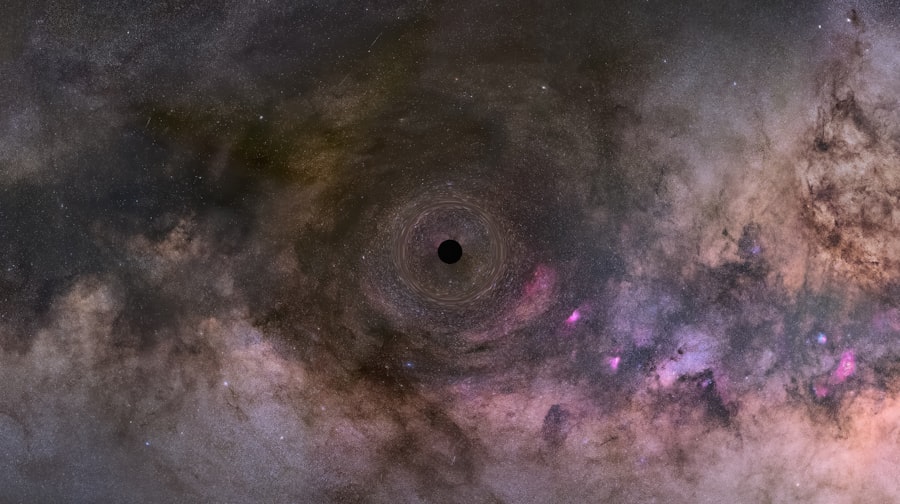
X-ray emissions provide another avenue for measuring black hole masses, particularly in cases where gas is accreting onto a black hole. As matter spirals inward, it heats up due to friction and gravitational forces, emitting X-rays in the process. By studying these emissions, astronomers can glean information about both the accretion process and the mass of the black hole itself.
One common approach involves analyzing X-ray spectra from accreting black holes in binary systems or active galactic nuclei. The characteristics of these spectra can reveal details about the velocity and density of the infalling material. By applying models that relate X-ray luminosity to black hole mass, researchers can estimate how massive these objects are based on their X-ray output.
This method has been particularly useful for identifying intermediate-mass black holes that are challenging to detect through other means.
Gravitational Lensing and Black Hole Mass
Gravitational lensing offers yet another innovative method for estimating black hole masses. When light from a distant object passes near a massive body like a black hole, it bends due to gravity, creating multiple images or distortions of that object. By studying these lensing effects, astronomers can infer properties about both the lensing object (the black hole) and the background source.
This technique has been employed in various contexts, including observations of quasars lensed by foreground galaxies containing supermassive black holes. By analyzing how light is bent around these massive objects, researchers can derive estimates for their masses based on general relativity principles. Gravitational lensing not only provides insights into individual black holes but also contributes to our understanding of dark matter distribution in galaxies.
Measuring Supermassive Black Hole Mass in Galaxies
Supermassive black holes reside at the centers of most galaxies, including our own Milky Way. Measuring their masses is essential for understanding their role in galaxy formation and evolution. Techniques such as stellar dynamics and gas kinematics have been instrumental in this endeavor.
For instance, by observing stars orbiting around a central supermassive black hole, astronomers can apply dynamical models to estimate its mass accurately. Additionally, researchers have utilized scaling relations between supermassive black holes and their host galaxies to infer masses indirectly. These relationships suggest that more massive galaxies tend to harbor more massive central black holes.
By measuring properties such as bulge luminosity or stellar velocity dispersion in a galaxy, astronomers can estimate its central black hole’s mass using established correlations.
Measuring Intermediate and Stellar-mass Black Hole Mass
While supermassive black holes are well-studied, intermediate-mass and stellar-mass black holes present unique challenges for measurement due to their relative scarcity and different formation mechanisms. Stellar-mass black holes typically form from collapsing massive stars during supernova events, while intermediate-mass black holes may arise from mergers or other processes in dense stellar environments. To measure stellar-mass black holes, astronomers often rely on binary systems where one component is visible while the other is obscured by its companion’s gravity.
By observing the motion of stars in these systems or analyzing X-ray emissions from accreting material, researchers can estimate their masses with reasonable accuracy. Intermediate-mass black holes are more elusive; however, recent advancements in gravitational wave astronomy have opened new avenues for detecting them through mergers with other black holes.
Challenges and Limitations in Measuring Black Hole Mass
Despite advancements in techniques for measuring black hole masses, several challenges persist that complicate these efforts. One significant limitation is related to distance; many black holes are located billions of light-years away, making precise measurements difficult due to faintness or resolution constraints. Observational uncertainties can lead to significant variations in estimated masses.
Additionally, different methods may yield inconsistent results due to underlying assumptions or model dependencies. For instance, while stellar dynamics provide robust estimates for supermassive black holes, they may not be as reliable for smaller or more distant objects where observational data is limited. Furthermore, factors such as gas dynamics or environmental influences can introduce complexities that challenge straightforward interpretations.
Future Prospects in Measuring Black Hole Mass
The future holds great promise for improving measurements of black hole masses through technological advancements and innovative observational strategies. The advent of next-generation telescopes equipped with enhanced sensitivity will enable astronomers to probe fainter objects and gather more detailed data on distant galaxies harboring supermassive black holes. Moreover, ongoing developments in gravitational wave astronomy will continue to revolutionize our understanding of binary systems involving stellar-mass and intermediate-mass black holes.
As more events are detected and analyzed, researchers will refine their models and improve mass estimates across different populations. In summary, measuring black hole masses remains a dynamic field at the intersection of observational astronomy and theoretical physics. As scientists continue to unravel these cosmic mysteries, they will not only enhance our understanding of individual black holes but also contribute to broader insights into galaxy formation and evolution throughout cosmic history.
To understand the methods used to measure black hole mass, it’s essential to explore various astronomical techniques and their applications. A related article that delves into this topic can be found at My Cosmic Ventures, where you can learn about the latest advancements in astrophysics and the tools scientists use to study these enigmatic objects in the universe.
WATCH THIS! The Invisible Threat: A Rogue Black Hole Headed for Our Solar System?
FAQs
What is a black hole?
A black hole is a region in space where the gravitational pull is so strong that nothing, not even light, can escape from it.
Why is it important to measure the mass of a black hole?
Measuring the mass of a black hole helps scientists understand its properties and behavior, as well as its impact on the surrounding environment.
How do scientists measure the mass of a black hole?
Scientists measure the mass of a black hole by observing the motion of objects, such as stars or gas, around the black hole. This can be done using techniques such as spectroscopy and astrometry.
What are some of the techniques used to measure the mass of a black hole?
Some of the techniques used to measure the mass of a black hole include studying the orbital motion of stars or gas around the black hole, analyzing the gravitational lensing effect, and observing the X-ray emissions from the accretion disk around the black hole.
What are the units used to measure the mass of a black hole?
The mass of a black hole is typically measured in solar masses, where one solar mass is equal to the mass of our Sun (approximately 2 x 10^30 kilograms).
What are some of the challenges in measuring the mass of a black hole?
Challenges in measuring the mass of a black hole include the extreme distances involved, the complex interactions with surrounding matter, and the limitations of current observational techniques.