Jupiter’s moon Europa has long captivated the imagination of scientists and space enthusiasts alike. As one of the largest moons in the solar system, Europa is slightly smaller than Earth’s moon but possesses a unique and intriguing surface that sets it apart from its celestial neighbors. Its icy exterior, marked by a network of cracks and ridges, hints at the dynamic processes occurring beneath its frozen shell.
The moon orbits Jupiter at a distance of approximately 670,900 kilometers, completing a full revolution every 3.5 days. This close proximity to the gas giant subjects Europa to intense gravitational forces, which play a crucial role in shaping its geological features. The allure of Europa lies not only in its striking appearance but also in the tantalizing possibility that it harbors a subsurface ocean beneath its icy crust.
This ocean, believed to be in contact with the moon’s rocky mantle, raises profound questions about the potential for life beyond Earth. As scientists continue to study Europa, they are increasingly drawn to the idea that this distant moon may hold the key to understanding the conditions necessary for life to exist elsewhere in the universe. The exploration of Europa is not merely an academic pursuit; it represents humanity’s quest to answer one of the most profound questions: Are we alone in the cosmos?
Key Takeaways
- Europa, one of Jupiter’s moons, has long been a target of scientific interest due to the possibility of a subsurface ocean.
- The discovery of Europa’s subsurface ocean has opened up new possibilities for the search for extraterrestrial life within our own solar system.
- Scientists are working to understand the composition of Europa’s ocean, which is believed to be salty and potentially harbor the necessary ingredients for life.
- The potential for life on Europa is a tantalizing prospect, with the moon’s subsurface ocean offering a potentially habitable environment.
- Missions to explore Europa’s ocean face numerous challenges, but hold the promise of unlocking the secrets of this alien world and potentially finding evidence of extraterrestrial life.
The Discovery of Europa’s Subsurface Ocean
The hypothesis of a subsurface ocean on Europa emerged from a series of observations made by various spacecraft, most notably NASA’s Galileo orbiter, which studied Jupiter and its moons from 1995 to 2003. Galileo’s data revealed that Europa’s surface is relatively young and geologically active, suggesting that some form of internal heat is at work. The presence of chaotic terrain, characterized by disrupted ice blocks and ridges, further indicated that the moon’s icy crust is being influenced by forces from below.
In addition to surface observations, magnetic field measurements taken by Galileo provided compelling evidence for a subsurface ocean. The spacecraft detected variations in Europa’s magnetic field that could only be explained by the presence of a conductive layer beneath the ice—most likely a salty ocean. This groundbreaking discovery ignited interest in Europa as a prime candidate for astrobiological studies, as it suggested that the moon could possess the necessary ingredients for life: liquid water, energy sources, and essential chemical compounds.
Understanding the Composition of Europa’s Ocean
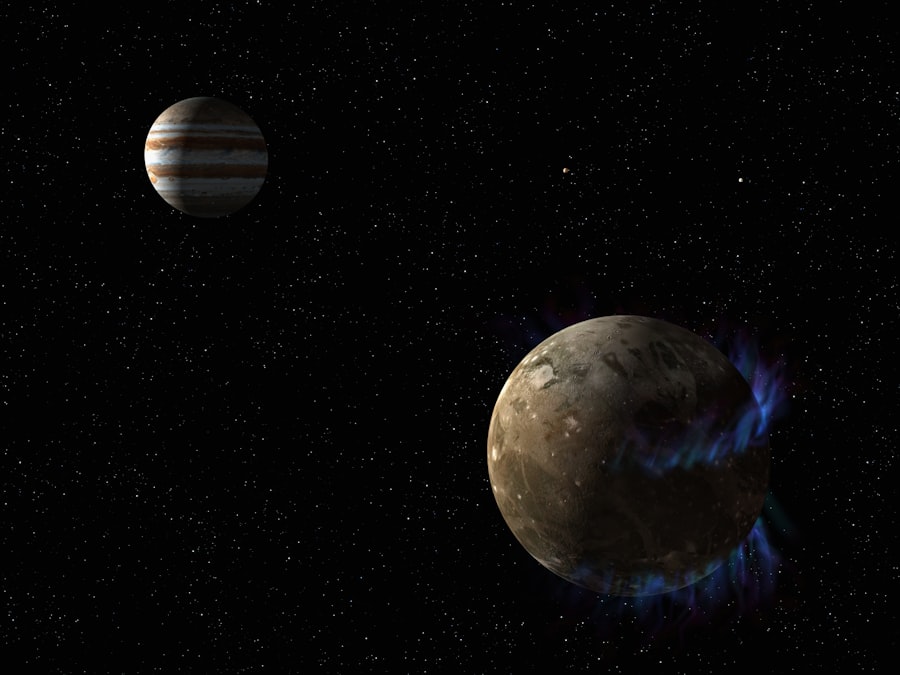
To comprehend the potential for life in Europa’s subsurface ocean, scientists have focused on understanding its composition. The ocean is believed to be composed primarily of salty water, with estimates suggesting it may contain more than twice the amount of water found on Earth.
In addition to water, researchers speculate that Europa’s ocean may contain various salts and minerals, including magnesium sulfate and sodium chloride. These compounds could play a crucial role in supporting microbial life by providing essential nutrients and facilitating biochemical reactions. Furthermore, the interaction between the ocean and the moon’s rocky interior may produce hydrothermal vents similar to those found on Earth, which are known to host diverse ecosystems thriving in extreme conditions.
Understanding the chemical makeup of Europa’s ocean is vital for assessing its habitability and determining whether it could support life forms akin to those on our planet.
The Potential for Life on Europa
| Metrics | Data |
|---|---|
| Surface Temperature | -160°C |
| Thickness of Ice Crust | 10-30 kilometers |
| Possible Subsurface Ocean | Yes |
| Potential for Life | High |
The prospect of life existing in Europa’s subsurface ocean has sparked intense scientific interest and debate. The combination of liquid water, energy sources from tidal heating due to gravitational interactions with Jupiter, and a potentially rich chemical environment creates an enticing scenario for astrobiologists. While no direct evidence of life has been found on Europa, researchers draw parallels between its conditions and those found in extreme environments on Earth where life thrives.
For instance, hydrothermal vents on the ocean floor support diverse ecosystems that rely on chemosynthesis rather than photosynthesis. These ecosystems exist in complete darkness and are fueled by chemical reactions between seawater and minerals released from the Earth’s crust. If similar processes occur in Europa’s ocean, it raises the possibility that microbial life could exist in isolation from sunlight, relying instead on chemical energy derived from interactions with the moon’s rocky mantle.
The search for life on Europa is not just about finding extraterrestrial organisms; it is also about understanding the resilience and adaptability of life itself.
Missions to Explore Europa’s Ocean
Recognizing the significance of Europa in the search for extraterrestrial life, space agencies have proposed several missions aimed at exploring this enigmatic moon. NASA’s upcoming Europa Clipper mission is set to launch in the 2020s and will conduct detailed reconnaissance of Europa’s ice shell and subsurface ocean. Equipped with a suite of scientific instruments, including ice-penetrating radar and spectrometers, the Clipper will gather data on the moon’s surface composition, geology, and potential habitability.
In addition to NASA’s efforts, other space agencies have expressed interest in exploring Europa. The European Space Agency (ESA) has proposed the Jupiter Icy Moons Explorer (JUICE) mission, which aims to study not only Europa but also Ganymede and Callisto—two other moons of Jupiter believed to harbor subsurface oceans. By conducting flybys and detailed observations, these missions will enhance our understanding of these icy worlds and their potential for supporting life.
Challenges of Exploring Europa’s Ocean

Despite the excitement surrounding missions to explore Europa, significant challenges remain. One of the primary obstacles is the harsh environment surrounding Jupiter and its moons. The intense radiation belts generated by Jupiter pose a serious threat to spacecraft electronics and instruments.
Any mission targeting Europa must be designed to withstand this radiation while ensuring data integrity throughout its journey. Another challenge lies in accessing Europa’s subsurface ocean. The thick ice crust covering the moon presents a formidable barrier that must be penetrated to reach the liquid water below.
However, these technologies are still in development stages and require extensive testing before they can be deployed successfully.
The Role of Europa’s Ocean in Understanding the Origins of Life
Europa’s subsurface ocean holds immense potential for shedding light on the origins of life not only within our solar system but also beyond it. By studying this alien environment, scientists hope to gain insights into how life might arise under different conditions. The presence of liquid water combined with energy sources creates an intriguing laboratory for examining fundamental biological processes.
Research into extremophiles—organisms that thrive in extreme conditions on Earth—has provided valuable clues about how life might adapt to harsh environments similar to those found on Europa. By understanding these adaptations, researchers can develop models predicting how life could emerge in extraterrestrial settings. Furthermore, studying Europa’s ocean may help answer questions about whether life’s building blocks are common throughout the universe or if they are unique to Earth.
Europa’s Ocean and its Implications for Astrobiology
The implications of discovering life in Europa’s ocean would be profound for astrobiology as a field. It would challenge existing paradigms about where and how life can exist, expanding our understanding of habitability beyond Earth-like conditions. The discovery of even microbial life would suggest that life is more resilient than previously thought and may exist in diverse forms across various celestial bodies.
Moreover, finding life on Europa would have philosophical implications for humanity’s place in the universe. It would prompt reevaluations of our understanding of life’s uniqueness and raise questions about how we define intelligence and consciousness. Such discoveries could foster a greater appreciation for biodiversity on Earth while igniting curiosity about other potentially habitable worlds waiting to be explored.
Europa’s Ocean and its Potential for Human Exploration
As technology advances and our understanding of space travel improves, discussions about human exploration of Europa have begun to emerge. While sending humans to this distant moon presents numerous challenges—such as radiation exposure and long-duration space travel—the potential rewards are significant. A human presence on Europa could facilitate more extensive exploration than robotic missions alone.
Human explorers could conduct experiments directly on-site, analyze samples from both the surface and subsurface environments, and adapt their strategies based on real-time observations. This flexibility would enhance our ability to study Europa’s ocean comprehensively and respond to unexpected findings or challenges during exploration.
The Future of Europa’s Ocean Exploration
The future of exploring Europa’s ocean appears promising as interest continues to grow within the scientific community and among space agencies worldwide. Upcoming missions like NASA’s Europa Clipper and ESA’s JUICE will pave the way for deeper investigations into this intriguing moon’s potential habitability. These missions will not only provide critical data about Europa but also lay the groundwork for future endeavors aimed at uncovering its secrets.
As technology evolves, new methods for exploring icy worlds will likely emerge, enabling more ambitious missions that could include landers or even crewed missions in the distant future. The ongoing research into Europa’s ocean will undoubtedly contribute significantly to humanity’s understanding of life beyond Earth while inspiring generations to come.
The Significance of Europa’s Ocean in the Search for Extraterrestrial Life
In conclusion, Jupiter’s moon Europa stands as a beacon of hope in humanity’s quest to understand whether we are alone in the universe. Its subsurface ocean presents an extraordinary opportunity to explore conditions that may foster life beyond our planet. As scientists continue their investigations into this icy world, they are not only seeking answers about extraterrestrial life but also unraveling fundamental questions about existence itself.
The exploration of Europa’s ocean represents a convergence of scientific inquiry, technological innovation, and philosophical reflection—a journey into uncharted territories that could redefine our understanding of life across the cosmos. As missions unfold and new discoveries emerge, Europa will undoubtedly remain at the forefront of astrobiological research, inspiring curiosity and wonder about what lies beyond our home planet.
Recent studies have unveiled fascinating insights into the hidden ocean beneath the icy surface of Jupiter’s moon, Europa. This discovery has sparked a surge of interest in the potential for extraterrestrial life within our solar system. For those intrigued by the mysteries of space and the possibilities of life beyond Earth, a related article on Europa’s secret ocean can be found on My Cosmic Ventures. This article delves deeper into the scientific findings and the implications of such a discovery. To explore more about this captivating topic, visit the article by clicking here.
WATCH THIS! The Secret Ocean of Europa: Why NASA is Hunting for Alien Life Beneath the Ice
FAQs
What is the article about?
The article is about the discovery of a secret ocean beneath the surface of Jupiter’s moon.
Which moon of Jupiter has a secret ocean?
The moon in question is Europa, one of Jupiter’s largest moons.
How was the secret ocean discovered?
The ocean was discovered through observations made by the Hubble Space Telescope, which detected water vapor plumes erupting from the surface of Europa.
Why is the discovery of a secret ocean on Europa significant?
The discovery is significant because it increases the likelihood of finding extraterrestrial life within our own solar system, as the presence of liquid water is a key ingredient for life as we know it.
What are the implications of the secret ocean on Europa?
The presence of a liquid water ocean on Europa has implications for future space exploration missions, as it may provide a potential habitat for microbial life and could inform our understanding of the potential for life beyond Earth.
What are the next steps in exploring Europa’s secret ocean?
Future missions, such as NASA’s Europa Clipper, are being planned to further explore Europa and its subsurface ocean. These missions aim to study the composition of the ocean and assess its potential habitability.