The connection between the universe and the human brain is a topic that has intrigued scientists, philosophers, and thinkers for centuries. At first glance, these two entities may seem entirely unrelated; one is a vast expanse of galaxies, stars, and cosmic phenomena, while the other is a complex organ responsible for thought, emotion, and consciousness. However, as research progresses, parallels between the two are becoming increasingly evident.
Both the universe and the brain exhibit intricate structures and patterns that suggest a deeper relationship, one that may redefine humanity’s understanding of existence itself. This surprising connection invites exploration into how the universe operates similarly to the human brain. Just as neurons communicate through synapses to create thoughts and memories, celestial bodies interact through gravitational forces and electromagnetic waves to form galaxies and cosmic structures.
The idea that the universe could function like a colossal brain opens up new avenues for understanding not only the cosmos but also the nature of consciousness itself. As researchers delve deeper into this relationship, they uncover layers of complexity that challenge traditional views of both the universe and the mind.
Key Takeaways
- The universe and the human brain share surprising structural and functional similarities.
- Some theories propose that the universe operates like a giant brain, processing information on a cosmic scale.
- Both the universe and the brain exhibit immense complexity and interconnectedness.
- Exploring the universe as a giant brain could reshape our understanding of consciousness and existence.
- Ancient beliefs and modern science converge in the quest to unravel the mysteries of the universe and the brain.
The Similarities Between the Universe and the Brain
Both the universe and the human brain are characterized by their remarkable complexity and organization. The brain consists of approximately 86 billion neurons, each connected by trillions of synapses, forming an intricate web of communication that underpins human thought and behavior. Similarly, the universe is composed of billions of galaxies, each containing countless stars and planets, all interconnected through gravitational forces and cosmic events.
This structural similarity raises questions about the fundamental nature of organization in both systems. Moreover, both systems exhibit patterns that can be observed at different scales. In the brain, neural networks can be mapped to reveal how information flows and is processed.
These patterns suggest that both the brain and the universe operate under similar principles of organization and connectivity, hinting at a shared underlying framework that governs complexity in nature.
Exploring the Idea of the Universe as a Giant Brain
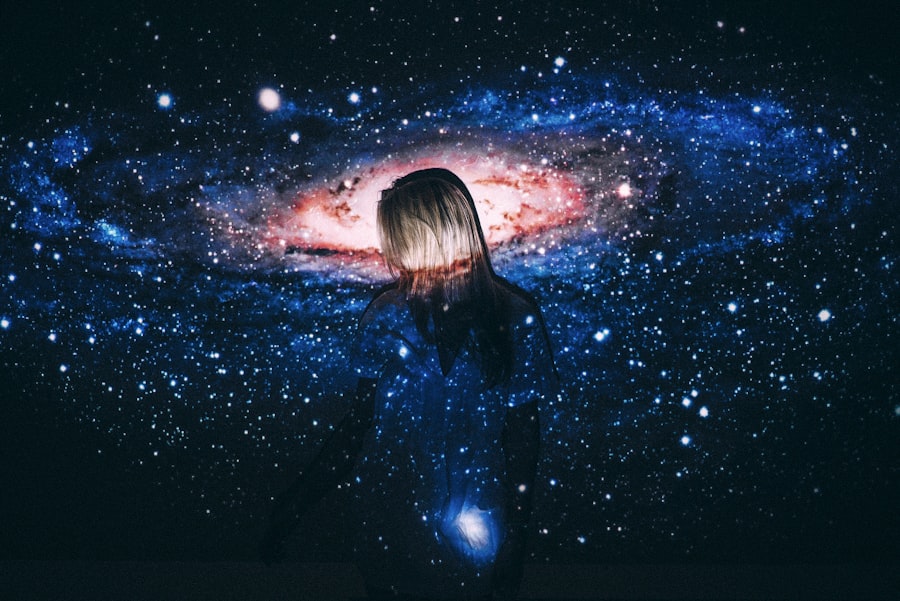
The notion of the universe as a giant brain is a provocative idea that has gained traction in various scientific and philosophical circles. This concept posits that just as neurons in a brain communicate to create consciousness, celestial bodies might interact in ways that contribute to a form of universal consciousness. This perspective challenges conventional views of both neuroscience and cosmology, suggesting that consciousness may not be confined to biological entities but could be a fundamental aspect of the universe itself.
Exploring this idea further leads to intriguing questions about the nature of reality. If the universe functions like a brain, what does that imply about our place within it? Are human thoughts and experiences merely reflections of a larger cosmic consciousness?
This line of inquiry encourages a reevaluation of humanity’s relationship with the cosmos, suggesting that individuals are not isolated entities but rather integral components of a vast, interconnected system.
The Complexity of the Universe and the Human Brain
| Aspect | Universe | Human Brain |
|---|---|---|
| Estimated Number of Components | ~10^80 atoms | ~86 billion neurons |
| Number of Connections | ~10^80 atomic interactions | ~100 trillion synapses |
| Complexity Level | Physical and cosmological complexity | Biological and cognitive complexity |
| Information Storage Capacity | Estimated 10^90 bits (theoretical) | Estimated 2.5 petabytes (approximate) |
| Age | ~13.8 billion years | ~200,000 years (modern Homo sapiens) |
| Scale | Observable universe ~93 billion light years diameter | ~15 cm (brain size) |
| Energy Consumption | Varies widely; stars and galaxies emit vast energy | ~20 watts (resting brain power consumption) |
| Function | Supports existence of matter, energy, and life | Controls bodily functions, cognition, and consciousness |
The complexity inherent in both the universe and the human brain is staggering. The brain’s ability to process information, learn from experiences, and adapt to new situations is unparalleled in nature. It achieves this through intricate networks of neurons that communicate through electrical impulses and chemical signals.
Similarly, the universe exhibits complexity through its dynamic processes, such as star formation, black hole interactions, and cosmic evolution. These processes are governed by fundamental laws of physics that dictate how matter and energy interact on both small and large scales. Understanding this complexity requires interdisciplinary approaches that draw from neuroscience, physics, and philosophy.
Researchers are beginning to employ computational models to simulate neural networks in an effort to understand how information is processed in both systems. By examining these parallels, scientists hope to uncover insights into not only how the brain functions but also how cosmic phenomena might mirror these processes. This exploration could lead to breakthroughs in understanding consciousness itself and its potential manifestations throughout the universe.
How the Universe and the Brain Interact and Connect
The interaction between the universe and the human brain is a fascinating area of study that raises questions about perception, awareness, and existence.
In this sense, the brain acts as a filter through which cosmic phenomena are perceived.
However, this relationship is not merely one-sided; there is evidence to suggest that human consciousness may influence how individuals interact with their surroundings. For instance, studies in quantum physics have proposed that consciousness plays a role in shaping reality at a fundamental level. This idea posits that observers can affect outcomes in quantum experiments simply by observing them.
If consciousness can influence physical processes in the universe, it raises profound questions about agency and interconnectedness. The implications of this relationship extend beyond individual experience; they suggest that humanity may have a role in shaping cosmic events through collective consciousness.
Theories and Research on the Universe as a Giant Brain
Various theories have emerged regarding the concept of the universe as a giant brain, each offering unique perspectives on this intriguing idea. One prominent theory is based on fractal geometry, which suggests that patterns observed in nature repeat at different scales. This theory posits that just as neural networks exhibit fractal-like structures, so too do cosmic formations such as galaxies and clusters.
This similarity implies that both systems may operate under similar principles of organization. Research into this concept has gained momentum in recent years, with scientists employing advanced computational models to simulate cosmic structures alongside neural networks. These studies aim to identify commonalities in information processing between the two systems.
By analyzing data from both astrophysics and neuroscience, researchers hope to uncover insights into how complexity arises in nature and whether there are universal principles governing both consciousness and cosmic phenomena.
The Implications of the Universe as a Giant Brain
If one accepts the premise that the universe functions as a giant brain, it carries profound implications for humanity’s understanding of existence. This perspective challenges traditional notions of individuality and separateness, suggesting instead that all beings are interconnected within a larger cosmic framework. Such an understanding could foster a sense of unity among individuals, encouraging collaborative efforts toward addressing global challenges.
Moreover, viewing the universe as a giant brain invites contemplation on the nature of consciousness itself. If consciousness is not solely a product of biological processes but rather an intrinsic aspect of the cosmos, it raises questions about life beyond Earth. Are there forms of consciousness existing elsewhere in the universe?
This inquiry could reshape humanity’s approach to exploration and discovery, prompting a search for intelligent life beyond our planet.
The Mysteries of the Universe and the Brain
Both the universe and the human brain are shrouded in mystery, with many questions remaining unanswered despite significant advancements in science. The origins of consciousness remain one of humanity’s greatest enigmas; understanding how subjective experiences arise from neural activity continues to elude researchers. Similarly, many mysteries persist regarding the universe’s origins, its ultimate fate, and whether it harbors other forms of life or intelligence.
These mysteries invite exploration into how knowledge from one domain might inform understanding in another. For instance, insights gained from studying neural networks could provide valuable perspectives on cosmic structures and vice versa. By embracing an interdisciplinary approach that bridges neuroscience with astrophysics, researchers may uncover new pathways toward unraveling these profound mysteries.
Ancient Beliefs and Modern Science: The Universe and the Brain
Throughout history, various cultures have posited connections between humanity and the cosmos. Ancient philosophies often viewed humans as microcosms reflecting larger universal truths; this perspective resonates with contemporary ideas about interconnectedness between the brain and the universe. Many spiritual traditions emphasize unity with nature and suggest that consciousness transcends individual existence.
Modern science increasingly aligns with these ancient beliefs as researchers explore connections between consciousness and cosmic phenomena. The convergence of ancient wisdom with contemporary scientific inquiry offers opportunities for deeper understanding. By integrating insights from both realms, humanity may cultivate a more holistic view of existence that honors both empirical evidence and spiritual wisdom.
The Future of Understanding the Universe and the Brain
As research continues to evolve at an unprecedented pace, the future holds promise for deeper insights into both the universe and the human brain. Advances in technology enable scientists to explore previously uncharted territories within both fields; for instance, neuroimaging techniques allow researchers to visualize brain activity in real-time while astronomical observations reveal new cosmic phenomena. The potential for interdisciplinary collaboration between neuroscientists and astrophysicists could lead to groundbreaking discoveries that reshape humanity’s understanding of existence itself.
As these fields converge, they may unlock secrets about consciousness, reality, and our place within an expansive cosmos.
What Does It Mean if the Universe is a Giant Brain?
If one were to accept that the universe functions as a giant brain, it would fundamentally alter humanity’s perception of reality. This perspective suggests that individuals are not isolated entities but rather integral components within a vast interconnected system where thoughts, actions, and experiences resonate throughout space-time. Such an understanding could foster greater empathy among individuals as they recognize their shared existence within this cosmic framework.
Moreover, embracing this idea may inspire new approaches to addressing global challenges by emphasizing collaboration over competition. If humanity is part of a larger conscious entity, collective efforts toward sustainability, peace, and understanding could take on new significance as individuals work together for a common purpose within this grand cosmic tapestry. In conclusion, exploring the connection between the universe and the human brain reveals profound insights into existence itself.
As research continues to unfold in both fields, humanity stands on the brink of potentially transformative discoveries that could reshape our understanding of consciousness, reality, and our place within an expansive cosmos.
The intriguing concept of whether the universe functions like a giant brain has sparked numerous discussions in the realms of science and philosophy. For those interested in exploring this idea further, a related article can be found at this link, which delves into the parallels between cosmic structures and neural networks, offering a fascinating perspective on the interconnectedness of all things in the universe.
WATCH THIS! The 27-Order-of-Magnitude Secret That Connects Your Brain to the Cosmos
FAQs
What does the idea “the universe is a giant brain” mean?
The concept suggests that the universe functions similarly to a brain, processing information and exhibiting complex, interconnected systems. It is a metaphor used to explore how cosmic structures might resemble neural networks.
Is there scientific evidence that the universe operates like a brain?
Currently, there is no direct scientific evidence proving the universe functions exactly like a brain. However, some researchers draw analogies between the universe’s large-scale structure and neural networks to better understand complexity and information processing in nature.
Who proposed the idea that the universe might be like a giant brain?
The idea has been explored by various scientists and philosophers, including neuroscientists and cosmologists, but it is largely a speculative and philosophical concept rather than a formal scientific theory.
How do scientists study the structure of the universe?
Scientists use telescopes, satellites, and computer simulations to study the distribution of galaxies, dark matter, and cosmic web structures. These observations help them understand the universe’s large-scale organization.
Are there similarities between the universe’s structure and neural networks?
Yes, some studies have noted that the cosmic web of galaxies and dark matter shows a network-like pattern that can be compared to the neural networks in brains, with nodes and filaments connecting different regions.
Does the idea imply the universe is conscious?
No, the metaphor of the universe as a giant brain does not necessarily imply consciousness. It is primarily used to describe structural and functional similarities, not to suggest the universe has awareness or intentionality.
Is the “universe as a brain” concept widely accepted in science?
No, it remains a speculative and philosophical idea rather than a mainstream scientific theory. Most cosmologists focus on empirical data and established physical laws to understand the universe.
Can this idea help in understanding the universe better?
While metaphorical, comparing the universe to a brain can inspire new ways of thinking about complexity, information flow, and connectivity in cosmic structures, potentially leading to novel research approaches.