
The concept of a black hole horizon has captivated the imagination of scientists and the public alike for decades. This enigmatic boundary, often referred to as the event horizon, marks the point of no return for anything that ventures too close to a black hole. Once an object crosses this threshold, it is inexorably drawn into the black hole’s gravitational grip, unable to escape.
The black hole horizon serves as a critical feature in the study of these cosmic phenomena, representing not only a physical boundary but also a profound challenge to our understanding of the laws of physics. As researchers delve deeper into the nature of black holes, the event horizon emerges as a focal point for theoretical exploration and observational inquiry. The implications of this boundary extend beyond mere astrophysical curiosity; they touch upon fundamental questions regarding the nature of space, time, and gravity.
The black hole horizon stands at the intersection of general relativity and quantum mechanics, prompting scientists to reconsider established paradigms and explore new frontiers in theoretical physics.
Key Takeaways
- Black hole horizons mark the boundary beyond which nothing can escape, central to black hole theory.
- Observations support the existence of horizons, but their exact nature remains debated among scientists.
- Some argue the horizon acts as a physical wall, while others see it as a mathematical boundary without physical substance.
- Alternative theories challenge traditional views, proposing different explanations for horizon phenomena.
- Ongoing research aims to resolve these debates and deepen understanding of black hole horizons.
Theoretical Understanding of Black Hole Horizon
The theoretical framework surrounding black hole horizons is rooted in Einstein’s theory of general relativity, which describes gravity as the curvature of spacetime caused by mass. According to this theory, a black hole forms when a massive star exhausts its nuclear fuel and collapses under its own gravity. The event horizon is defined as the boundary surrounding the black hole, beyond which no information or matter can escape.
This boundary is not merely a physical surface; it represents a fundamental shift in the behavior of spacetime itself. In addition to general relativity, quantum mechanics introduces complexities that challenge traditional notions of the event horizon. The interplay between these two theories raises questions about what happens to information that falls into a black hole.
The so-called “information paradox” suggests that information may be lost forever, contradicting the principles of quantum mechanics that assert information cannot be destroyed. This paradox has led to intense debate among physicists, as they seek to reconcile these conflicting views and develop a more comprehensive understanding of black hole horizons.
Observational Evidence of Black Hole Horizon
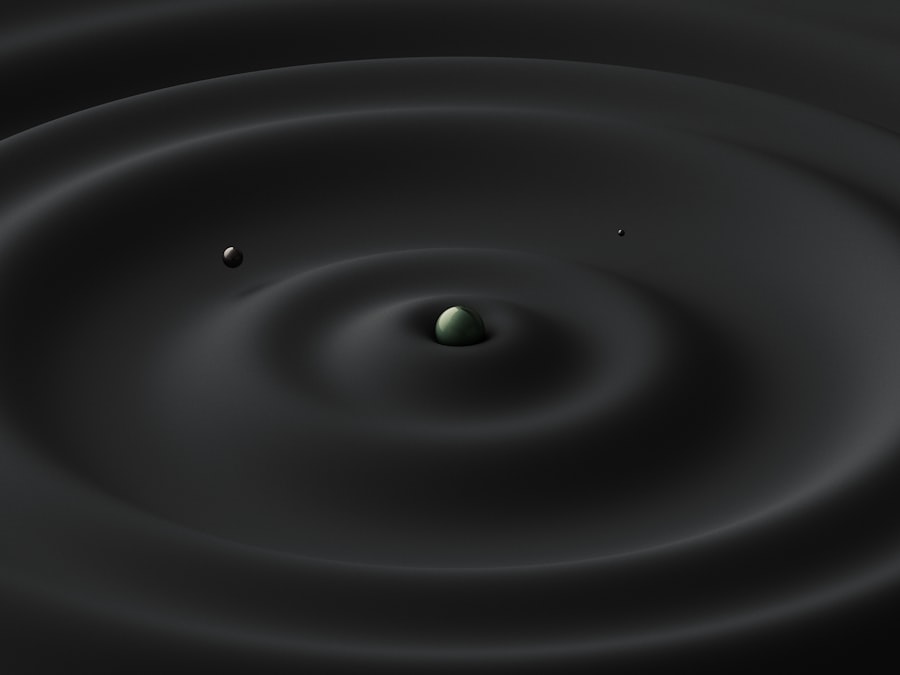
Observational evidence for black hole horizons has grown significantly in recent years, bolstered by advancements in technology and observational techniques. One of the most compelling pieces of evidence came from the Event Horizon Telescope (EHT) collaboration, which produced the first-ever image of a black hole’s shadow in 2019. This groundbreaking achievement provided visual confirmation of the existence of black holes and their event horizons, offering a glimpse into the mysterious regions surrounding these cosmic giants.
In addition to direct imaging, astronomers have also gathered indirect evidence through the study of gravitational waves. The detection of gravitational waves from colliding black holes has provided insights into their properties and behaviors, including the dynamics surrounding their event horizons. These observations have not only confirmed the existence of black holes but have also reinforced the theoretical predictions regarding their horizons, further solidifying our understanding of these enigmatic structures.
Mathematical Description of Black Hole Horizon
| Metric | Description | Mathematical Expression |
|---|---|---|
| Event Horizon Radius (Schwarzschild Radius) | Radius of the event horizon for a non-rotating, uncharged black hole | 2GM / c² |
| Surface Gravity (κ) | Acceleration due to gravity at the horizon | c⁴ / (4GM) |
| Horizon Area (A) | Surface area of the event horizon | 4π (2GM / c²)² = 16π G² M² / c⁴ |
| Hawking Temperature (T_H) | Temperature associated with black hole radiation | ħ c³ / (8π G M k_B) |
| Entropy (S) | Entropy proportional to horizon area | k_B c³ A / (4 G ħ) |
| Kerr Horizon Radius (Outer) | Radius of the outer horizon for a rotating black hole | GM / c² + sqrt((GM / c²)² – (J / M c)²) |
| Kerr Horizon Radius (Inner) | Radius of the inner horizon for a rotating black hole | GM / c² – sqrt((GM / c²)² – (J / M c)²) |
The mathematical description of black hole horizons is rooted in complex equations derived from general relativity. The Schwarzschild solution, for instance, describes a non-rotating black hole and provides a framework for understanding its event horizon. In this model, the event horizon is located at a specific radius known as the Schwarzschild radius, which is directly proportional to the mass of the black hole.
This mathematical formulation allows physicists to predict various properties of black holes, including their gravitational pull and the behavior of objects near their horizons. For rotating black holes, known as Kerr black holes, the mathematics becomes even more intricate. The Kerr solution incorporates angular momentum into the equations, resulting in a more complex structure that includes an outer event horizon and an inner Cauchy horizon.
These mathematical descriptions not only enhance our understanding of black holes but also provide essential tools for exploring their implications in theoretical physics and cosmology.
The Debate about the Nature of Black Hole Horizon
The nature of black hole horizons has sparked considerable debate within the scientific community. Some physicists argue that event horizons should be viewed as physical walls that separate regions of spacetime, while others contend that they are merely mathematical constructs with no tangible existence. This debate touches upon fundamental questions about reality and perception in physics, challenging researchers to reconsider their assumptions about what constitutes a physical boundary.
Proponents of the idea that event horizons are physical walls argue that they represent a definitive limit beyond which no information can escape. This perspective aligns with classical interpretations of black holes and emphasizes the role of gravity in shaping spacetime. Conversely, critics argue that viewing event horizons as physical entities may lead to misconceptions about their nature and function.
They suggest that event horizons are better understood as emergent phenomena arising from the underlying structure of spacetime rather than as distinct physical barriers.
Arguments for Black Hole Horizon as a Physical Wall

Supporters of the notion that black hole horizons are physical walls present several compelling arguments. First and foremost, they point to the observable effects that event horizons have on surrounding matter and radiation. For instance, as matter spirals into a black hole, it emits X-rays and other forms of radiation due to extreme gravitational forces.
This behavior suggests that there is indeed a boundary beyond which no escape is possible, reinforcing the idea that event horizons function as physical barriers. Additionally, proponents argue that the thermodynamic properties associated with black holes lend credence to their status as physical walls. The laws of thermodynamics applied to black holes suggest that they possess entropy and temperature, leading to the formulation of concepts such as Hawking radiation.
This radiation implies that black holes can emit particles despite their event horizons, further complicating our understanding but also supporting the idea that these horizons have tangible implications for physical processes.
Arguments against Black Hole Horizon as a Physical Wall
On the other hand, critics of the idea that black hole horizons are physical walls present alternative viewpoints grounded in theoretical considerations. They argue that event horizons may not represent true boundaries but rather regions where our understanding of physics breaks down. According to this perspective, the singularity at the center of a black hole represents a point where current theories fail to provide coherent descriptions, suggesting that event horizons may be artifacts of our mathematical models rather than concrete entities.
Moreover, some theorists propose that quantum effects could lead to a different understanding of event horizons altogether.
This view challenges traditional notions of causality and locality in physics and opens up new avenues for exploring the fundamental nature of reality.
Alternative Explanations for Black Hole Horizon
In light of ongoing debates about the nature of black hole horizons, several alternative explanations have emerged within the scientific community. One such explanation involves the concept of “fuzzballs,” which posits that black holes do not possess event horizons at all but rather consist of complex structures made up of strings or other fundamental entities. In this model, what appears to be an event horizon is merely an illusion created by the intricate interactions occurring at microscopic scales.
Another alternative involves considering black holes as “holographic” entities, where information about their internal states is encoded on their surfaces rather than being lost within them. This idea aligns with theories such as holographic duality and suggests that our understanding of space and time may need to be fundamentally reimagined in light of quantum mechanics.
Implications of Black Hole Horizon as a Physical Wall
The implications of viewing black hole horizons as physical walls extend far beyond theoretical discussions; they resonate throughout various fields of physics and cosmology. If event horizons are indeed physical barriers, this could have profound consequences for our understanding of information transfer and causality in the universe. It raises questions about what happens to information that crosses this boundary and whether it can ever be recovered or reconstructed.
Furthermore, recognizing event horizons as physical entities could influence theories related to quantum gravity and unify disparate aspects of modern physics. It may lead researchers to develop new frameworks for understanding how gravity interacts with quantum mechanics and could ultimately contribute to a more comprehensive theory that reconciles these two pillars of contemporary physics.
Future Research and Exploration of Black Hole Horizon
As research into black holes continues to evolve, future explorations will undoubtedly focus on unraveling the mysteries surrounding their horizons. Upcoming observational missions utilizing advanced telescopes and gravitational wave detectors will provide new data that could shed light on the nature of event horizons and their role in cosmic phenomena. Additionally, theoretical advancements in quantum gravity may offer fresh insights into how these boundaries function within the broader context of spacetime.
Collaborative efforts among physicists from various disciplines will be essential in addressing unresolved questions about black hole horizons. By integrating perspectives from astrophysics, quantum mechanics, and cosmology, researchers can work towards developing a more unified understanding that transcends traditional boundaries within physics.
The Continuing Mystery of Black Hole Horizon
The mystery surrounding black hole horizons remains one of the most intriguing challenges in modern physics. As scientists grapple with questions about their nature—whether they are physical walls or mere mathematical constructs—the quest for understanding continues unabated. The interplay between theoretical exploration and observational evidence will undoubtedly shape future discussions about these enigmatic boundaries.
As researchers push forward into uncharted territories within theoretical physics and cosmology, they will undoubtedly uncover new layers of complexity surrounding these cosmic phenomena—further enriching humanity’s understanding of the universe and its fundamental laws.
In exploring the intriguing concept of whether the black hole horizon acts as a physical wall, it is essential to consider various perspectives on the nature of black holes and their event horizons. A related article that delves into the mysteries of black holes can be found on My Cosmic Ventures, which discusses the implications of black hole physics and the boundaries of our understanding. For more insights, you can read the article [here](https://www.mycosmicventures.com/).
WATCH THIS! The Paradox That Broke Physics: Quantum vs. Black Holes
FAQs
What is a black hole horizon?
The black hole horizon, also known as the event horizon, is the boundary surrounding a black hole beyond which nothing, not even light, can escape the gravitational pull of the black hole.
Is the black hole horizon a physical wall?
No, the black hole horizon is not a physical wall. It is a theoretical boundary in spacetime, not a solid surface or barrier. Objects crossing the horizon do not encounter a physical obstacle but rather enter a region where escape is impossible.
Can anything be observed at the black hole horizon?
From an outside observer’s perspective, objects falling toward the horizon appear to slow down and fade due to gravitational time dilation and redshift. However, the horizon itself emits no light or signals and cannot be directly observed as a physical surface.
What happens to matter that crosses the black hole horizon?
Once matter crosses the event horizon, it inevitably moves toward the black hole’s singularity, where densities become extremely high. The exact fate of matter inside the horizon is still a subject of theoretical research.
Does the concept of a black hole horizon change in different theories?
Yes, some advanced theories in quantum gravity and string theory suggest modifications to the classical notion of the event horizon, such as the firewall hypothesis, which proposes a high-energy zone at the horizon. However, these ideas remain speculative and are not confirmed.
Why is the black hole horizon important in physics?
The event horizon is crucial for understanding black hole thermodynamics, information paradoxes, and the nature of spacetime under extreme gravity. It marks the limit of observable influence from the black hole.
Can the black hole horizon be detected or measured?
While the horizon itself cannot be directly observed, its effects can be inferred through observations of black hole behavior, such as gravitational waves, accretion disk emissions, and the shadow of the black hole imaged by the Event Horizon Telescope.