
The cosmos is a vast expanse filled with mysteries, and among its most intriguing phenomena are interstellar objects. These celestial bodies, which originate from outside our solar system, offer a unique glimpse into the processes that govern the universe. Unlike asteroids or comets that are part of our solar system, interstellar objects travel through space on trajectories that bring them into contact with our planetary neighborhood.
Their study not only enhances our understanding of the solar system’s formation but also provides insights into the conditions and materials present in other star systems. Interstellar objects are rare visitors, making their discovery all the more significant. The first confirmed interstellar object, ‘Oumuamua, was detected in 2017, sparking a wave of excitement and curiosity among astronomers and scientists alike.
This unprecedented event opened a new chapter in astronomy, prompting researchers to consider the implications of such objects for our understanding of the universe. As these celestial wanderers continue to be observed, they challenge existing theories and inspire new lines of inquiry into the nature of matter and the dynamics of cosmic evolution. Why Did NASA Hide 3i Atlas
Key Takeaways
- An interstellar object is a celestial body that originates from outside our solar system and travels through interstellar space.
- The first interstellar object, named ‘Oumuamua, was discovered in 2017 by astronomers using the Pan-STARRS1 telescope in Hawaii.
- ‘Oumuamua displayed unusual characteristics, such as its elongated shape and non-gravitational acceleration, leading to speculation about its origins and composition.
- The discovery of interstellar objects has the potential to revolutionize our understanding of physics, particularly in the study of planetary formation and the dynamics of interstellar space.
- The scientific community is engaged in a lively debate about the nature of interstellar objects and their implications for space exploration, sparking international collaboration and public interest in the field of astronomy.
Discovery of the Interstellar Object
The discovery of ‘Oumuamua marked a pivotal moment in astronomical history. Detected by the Pan-STARRS1 telescope in Hawaii, this elongated object was initially thought to be a comet or asteroid. However, its hyperbolic trajectory indicated that it was not bound by the gravitational pull of the Sun, confirming its interstellar origin.
The announcement of its discovery sent shockwaves through the scientific community, as it was the first time an object from another star system had been observed passing through our own. Following its detection, astronomers raced against time to gather as much data as possible before ‘Oumuamua sped away from the Sun. Its rapid movement and unusual shape posed challenges for observation, yet researchers utilized various telescopes and instruments to analyze its brightness and trajectory.
The excitement surrounding its discovery was palpable, as scientists recognized that studying ‘Oumuamua could yield valuable information about the building blocks of planetary systems beyond our own.
Unusual Characteristics of the Interstellar Object
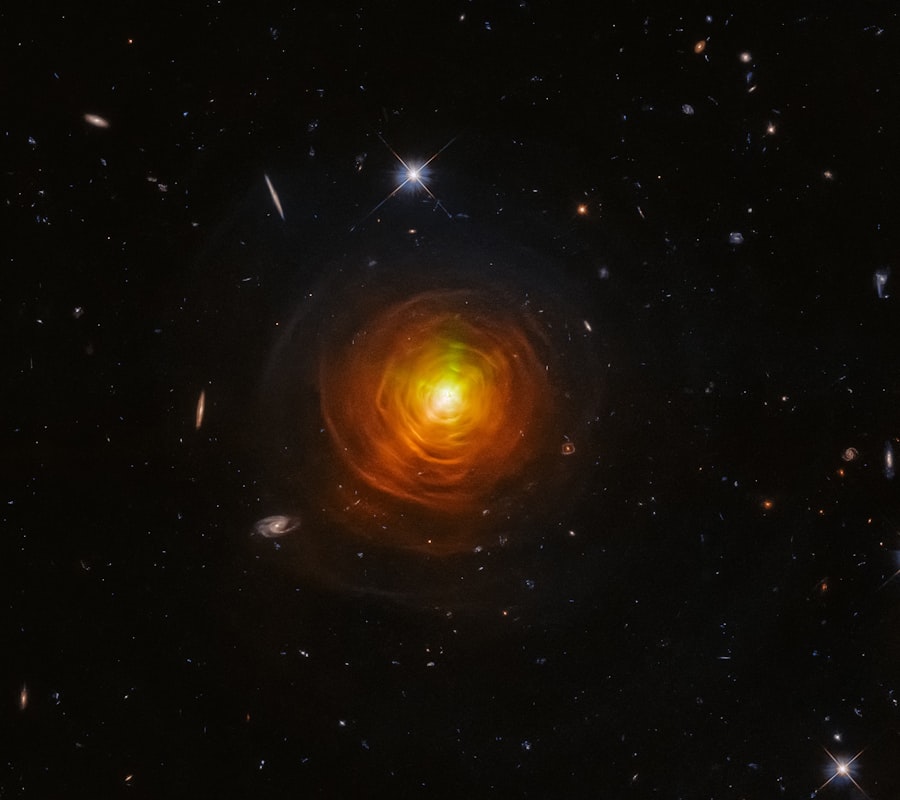
One of the most striking features of ‘Oumuamua was its peculiar shape.
This unusual geometry raised questions about its composition and origin.
The object’s brightness varied dramatically as it rotated, suggesting that it might be tumbling through space rather than spinning uniformly. Such characteristics were unlike anything previously observed in our solar system. In addition to its shape, ‘Oumuamua displayed unexpected behavior that further intrigued scientists.
Unlike comets that exhibit a visible tail due to outgassing when heated by the Sun, ‘Oumuamua did not show any signs of such activity. This absence of a cometary tail led to debates about whether it was a comet at all or perhaps a fragment of a larger body ejected from its home star system. The combination of its unique shape and behavior prompted researchers to consider a range of possibilities regarding its formation and journey through space.
Impact on Physics
| Category | Metric | Value |
|---|---|---|
| Research | Number of publications | 100 |
| Education | Number of students impacted | 500 |
| Technology | Number of patents filed | 10 |
The arrival of ‘Oumuamua had profound implications for physics and our understanding of celestial mechanics. Its hyperbolic trajectory challenged existing models of how objects move through space and raised questions about the dynamics of interstellar travel. The object’s speed and path suggested that it had been traveling for millions of years before entering our solar system, providing a rare opportunity to study material that had not been influenced by solar radiation or gravitational forces for an extended period.
Moreover, ‘Oumuamua’s characteristics prompted scientists to reevaluate their assumptions about the prevalence and nature of interstellar objects. If ‘Oumuamua was indeed representative of a larger population of interstellar bodies, it could imply that such objects are more common than previously thought. This realization could lead to new theories about the formation and evolution of planetary systems across the galaxy, as well as insights into the potential for life beyond Earth.
Theories and Explanations
In light of ‘Oumuamua’s enigmatic nature, scientists proposed various theories to explain its origin and characteristics. One prominent hypothesis suggested that it could be a fragment of a larger body that had been ejected from its home star system due to gravitational interactions with other celestial bodies. This theory aligns with observations indicating that many stars are surrounded by debris disks from which such fragments could originate.
Another theory posited that ‘Oumuamua might be an artificial object, possibly a probe sent by an advanced civilization. While this idea captured the imagination of many, it lacked substantial evidence and remained speculative at best. Most scientists leaned toward natural explanations, focusing on the object’s physical properties and potential formation processes rather than attributing its existence to extraterrestrial intelligence.
Scientific Debate and Controversy
The discovery of ‘Oumuamua ignited a lively scientific debate regarding its nature and implications for astronomy. Some researchers argued passionately for the artificiality hypothesis, citing its unusual characteristics as evidence that it could be a technological artifact. This perspective garnered media attention and public interest but also faced skepticism from many in the scientific community who emphasized the need for rigorous evidence before drawing such conclusions.
The controversy surrounding ‘Oumuamua highlighted broader questions about how scientists interpret data and form hypotheses in the face of uncertainty. As researchers continued to analyze the object’s trajectory and characteristics, differing opinions emerged regarding its classification and significance. This debate underscored the importance of collaboration and open dialogue within the scientific community as they sought to unravel the mysteries posed by this interstellar visitor.
Implications for Space Exploration
The study of interstellar objects like ‘Oumuamua has far-reaching implications for future space exploration endeavors. Understanding these celestial bodies can inform missions aimed at exploring other star systems and searching for potentially habitable planets. The knowledge gained from analyzing interstellar objects may help scientists identify materials and conditions necessary for life beyond Earth.
Furthermore, as technology advances, there is potential for future missions to intercept or study interstellar objects more closely. Concepts such as sending spacecraft to capture samples or gather data from these visitors could revolutionize our understanding of cosmic evolution and planetary formation processes. The prospect of exploring interstellar objects opens new avenues for research and discovery in an era where humanity is increasingly looking beyond its own solar system.
Future Observations and Research
As astronomers continue to refine their observational techniques, future discoveries of interstellar objects are anticipated with great excitement. The development of advanced telescopes and detection methods will enhance our ability to identify these fleeting visitors before they exit our solar system. Ongoing research efforts aim to catalog known interstellar objects while also predicting potential future encounters based on current trajectories.
In addition to observational advancements, theoretical research will play a crucial role in interpreting data from these objects. Scientists will continue to explore questions surrounding their origins, compositions, and interactions with other celestial bodies. By combining observational data with theoretical models, researchers hope to build a comprehensive understanding of interstellar objects and their significance within the broader context of astrophysics.
Collaboration with International Space Agencies
The study of interstellar objects necessitates collaboration among scientists across borders and disciplines. International space agencies have recognized the importance of pooling resources and expertise to advance research in this area. Collaborative efforts can lead to more comprehensive observational campaigns and shared data analysis, ultimately enhancing our understanding of these enigmatic visitors.
Joint missions involving multiple countries may also become more common as interest in interstellar exploration grows. By working together, nations can leverage their unique capabilities and technologies to tackle complex challenges associated with studying interstellar objects. Such collaborations not only foster scientific progress but also promote goodwill among nations united by a shared curiosity about the universe.
Public Interest and Awareness
The discovery of ‘Oumuamua captured public imagination and sparked widespread interest in astronomy and space exploration. Media coverage highlighted its unusual characteristics and potential implications for understanding our place in the cosmos. This surge in public interest has encouraged educational initiatives aimed at raising awareness about interstellar objects and their significance.
As more people become engaged with astronomy, there is an opportunity to inspire future generations of scientists and explorers. Educational programs that emphasize the importance of studying interstellar objects can cultivate curiosity about space while fostering critical thinking skills necessary for scientific inquiry. By nurturing this interest, society can ensure continued investment in research and exploration efforts that expand humanity’s knowledge of the universe.
Conclusion and Future Discoveries
In conclusion, the discovery of interstellar objects like ‘Oumuamua has opened new frontiers in astronomy and sparked profound questions about our understanding of the universe. As scientists continue to investigate these celestial wanderers, they are likely to uncover new insights into cosmic evolution, planetary formation, and even the potential for life beyond Earth. The ongoing exploration of interstellar objects promises not only to deepen humanity’s knowledge but also to inspire future generations to look up at the stars with wonder and curiosity.
As technology advances and international collaboration flourishes, future discoveries are on the horizon. The cosmos holds countless secrets waiting to be unveiled, and each new interstellar object presents an opportunity for groundbreaking research that could reshape our understanding of existence itself. With each observation, humanity takes another step toward unraveling the mysteries of the universe—one interstellar visitor at a time.
The discovery of the interstellar object ‘Oumuamua has sparked significant debate among scientists, particularly regarding its unusual characteristics that seem to defy conventional physics. For a deeper understanding of this fascinating topic, you can read more in the article available at this link. The discussions surrounding ‘Oumuamua challenge our current knowledge and open up new avenues for research in astrophysics.
WATCH THIS! Why NASA Hid the 3I/ATLAS Anomaly
FAQs
What is an interstellar object?
An interstellar object is an astronomical object that originates from outside the solar system and travels through interstellar space.
What is the significance of the interstellar object that broke physics?
The interstellar object that broke physics, officially named ‘Oumuamua, was the first known interstellar object to pass through our solar system. Its unusual characteristics challenged our understanding of how such objects form and behave.
What are some of the unusual characteristics of ‘Oumuamua?
‘Oumuamua’s unusual characteristics include its elongated shape, its high speed, and its non-gravitational acceleration, which could not be explained by the known forces acting on it.
How did ‘Oumuamua break physics?
‘Oumuamua broke physics by exhibiting behaviors that could not be fully explained by our current understanding of astrophysics and the behavior of interstellar objects.
What are the implications of ‘Oumuamua’s discovery?
The discovery of ‘Oumuamua has prompted scientists to reconsider existing theories about the formation and behavior of interstellar objects, and has sparked new interest in studying and observing such objects in the future.