
Black holes have long captivated the imagination of scientists and the general public alike. These enigmatic cosmic entities, characterized by their immense gravitational pull, are regions in space where the gravitational force is so strong that nothing, not even light, can escape from them. The concept of a black hole challenges the very fabric of our understanding of physics, particularly the laws of gravity and the nature of time and space.
As researchers delve deeper into the mysteries of the universe, black holes emerge as pivotal players in the cosmic drama, influencing the formation and evolution of galaxies and stars. The term “black hole” was first coined in the 1960s, but the idea has roots that trace back to the early 18th century when the British natural philosopher John Michell speculated about “dark stars” whose gravity was so strong that light could not escape. Since then, advancements in theoretical physics and observational astronomy have transformed black holes from mere theoretical constructs into well-supported entities within our universe.
They are classified into several categories, including stellar black holes, supermassive black holes, and intermediate black holes, each with unique characteristics and formation processes. Understanding black holes is not just an academic pursuit; it holds profound implications for our comprehension of the universe’s structure and fate.
Key Takeaways
- Black holes are regions in space where the gravitational pull is so strong that nothing, not even light, can escape.
- Black holes are formed when massive stars collapse under their own gravity, or when two smaller black holes merge.
- Black holes grow by accreting matter from their surroundings, such as gas and dust, which forms an accretion disk around the black hole.
- Gravity plays a crucial role in the growth of black holes, as it pulls in surrounding matter and allows the black hole to increase in mass.
- Black holes can interact with surrounding matter, emitting powerful jets of radiation and affecting the evolution of galaxies.
Formation of Black Holes
The formation of black holes is a complex process that typically begins with the life cycle of massive stars. When a star exhausts its nuclear fuel, it can no longer support itself against gravitational collapse. For stars with a mass greater than approximately three times that of the Sun, this collapse leads to a supernova explosion, an event that expels the outer layers of the star while leaving behind a dense core.
If this core’s mass exceeds a certain threshold, it will continue to collapse under its own gravity, ultimately forming a black hole. There are also other pathways to black hole formation. For instance, primordial black holes may have formed in the early universe due to density fluctuations shortly after the Big Bang.
These black holes could vary significantly in size and mass compared to their stellar counterparts. Additionally, black holes can form through the merger of neutron stars or other black holes, leading to even more massive entities. Each formation scenario contributes to the diverse population of black holes observed throughout the cosmos.
Accretion of Matter

Once formed, black holes can grow by accreting matter from their surroundings. This process involves drawing in gas, dust, and other celestial debris that comes too close to their gravitational grasp. As matter spirals toward a black hole, it forms an accretion disk—a swirling mass of material that heats up due to friction and gravitational forces.
This disk emits intense radiation, often making black holes detectable even from vast distances. The accretion process is not uniform; it can vary significantly based on the environment surrounding the black hole. In regions with abundant material, such as in dense star clusters or near other celestial bodies, black holes can rapidly accumulate mass.
Conversely, in more isolated areas of space, their growth may be slower. The rate at which a black hole accretes matter can influence its characteristics and behavior, leading to different observational signatures that astronomers can study.
Role of Gravity in Black Hole Growth
| Aspect | Details |
|---|---|
| Gravity’s Role | Gravity plays a crucial role in the growth of black holes by pulling in surrounding matter and energy. |
| Accretion Disk | Gravity causes matter to form an accretion disk around the black hole, which eventually gets pulled into the black hole. |
| Event Horizon | Gravity is responsible for the formation of the event horizon, the point of no return for matter falling into the black hole. |
| Black Hole Growth | As more matter and energy are pulled in by gravity, the black hole grows in mass and size. |
Gravity plays a fundamental role in the growth and evolution of black holes. The immense gravitational pull exerted by a black hole not only attracts nearby matter but also influences the motion of stars and gas in its vicinity.
As a black hole grows larger, its gravitational field becomes stronger, allowing it to capture even more material. Moreover, gravity is responsible for the formation of structures within galaxies. The presence of a supermassive black hole at a galaxy’s center can affect star formation rates and the distribution of stars throughout the galaxy.
This interplay between gravity and matter is crucial for understanding how galaxies evolve and how they are structured on cosmic scales. The gravitational influence of black holes extends far beyond their immediate vicinity, impacting the broader galactic environment.
Interaction with Surrounding Matter
The interaction between black holes and surrounding matter is a dynamic and often violent process. As matter approaches a black hole, it experiences extreme tidal forces due to the intense gravitational gradient. This can lead to phenomena such as spaghettification, where objects are stretched and compressed as they near the event horizon—the boundary beyond which nothing can escape a black hole’s grasp.
Additionally, these interactions can result in powerful jets of energy being ejected from the poles of a rotating black hole. These jets are formed when some material in the accretion disk is accelerated away from the black hole at nearly the speed of light. Such jets can have significant effects on their surroundings, influencing star formation in nearby regions and contributing to the overall energy output of galaxies.
The study of these interactions provides valuable insights into both black hole behavior and the processes governing galactic evolution.
Black Hole Mergers
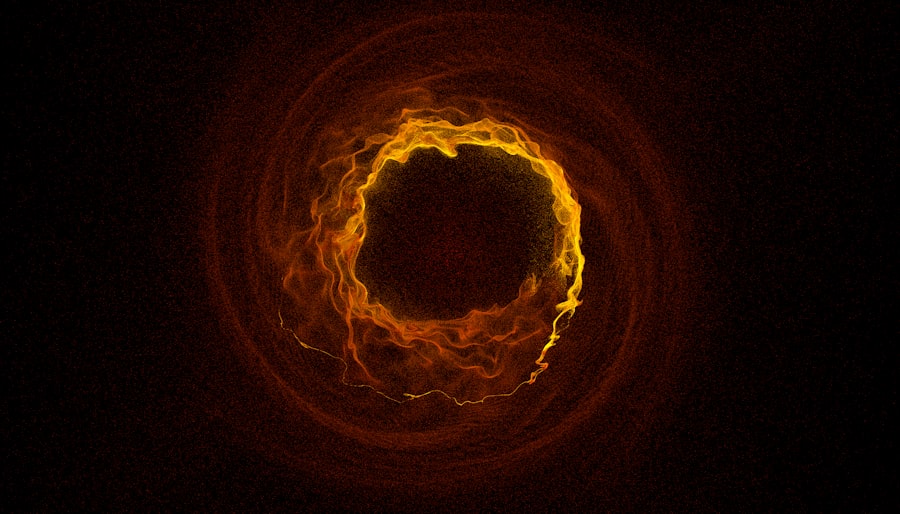
Black hole mergers represent one of the most dramatic events in astrophysics. When two black holes come close enough to each other—often as a result of gravitational interactions within binary systems—they can spiral inward due to the emission of gravitational waves. As they approach one another, they lose energy through these waves until they eventually collide and merge into a single, more massive black hole.
The detection of gravitational waves from such mergers has opened a new window into understanding these cosmic phenomena. The first direct observation of gravitational waves by LIGO in 2015 confirmed the existence of binary black hole mergers and provided evidence for their frequency in the universe. Each merger event carries information about the masses and spins of the original black holes, offering insights into their formation histories and populations across cosmic time.
Supermassive Black Holes
Supermassive black holes are among the most fascinating objects in astrophysics, typically found at the centers of galaxies. These colossal entities can possess masses equivalent to millions or even billions of suns. Their formation remains an area of active research; theories suggest they may have originated from the merging of smaller black holes or through direct collapse from massive gas clouds in the early universe.
The presence of supermassive black holes has profound implications for galaxy formation and evolution. They influence star formation rates and can regulate the growth of their host galaxies through feedback mechanisms that involve energy output from accretion processes or jets. Understanding supermassive black holes is crucial for piecing together the history of galaxies and their development over billions of years.
Active Galactic Nuclei
Active Galactic Nuclei (AGN) are regions surrounding supermassive black holes that exhibit extraordinary luminosity due to intense accretion processes. These regions can outshine entire galaxies and are often observed as quasars or blazars depending on their orientation relative to Earth. The energy emitted by AGN arises from matter falling into supermassive black holes at high rates, resulting in powerful radiation across various wavelengths—from radio waves to gamma rays.
The study of AGN provides critical insights into both black hole physics and galaxy evolution. By examining their properties, astronomers can learn about the growth rates of supermassive black holes and their impact on surrounding galaxies. AGN also serve as important markers for understanding cosmic evolution since they can be detected at great distances, allowing researchers to probe conditions in the early universe.
Role of Dark Matter
Dark matter plays an essential role in shaping the universe’s structure but remains one of its greatest mysteries. While it does not interact with electromagnetic forces—making it invisible—its gravitational effects are evident on large scales. The relationship between dark matter and black holes is an area of ongoing research; some theories suggest that dark matter could influence how galaxies form and evolve around supermassive black holes.
In particular, dark matter halos may provide additional gravitational wells that facilitate gas accumulation around supermassive black holes, enhancing their growth over time. Understanding this relationship could shed light on both dark matter’s nature and its role in cosmic evolution alongside visible matter.
Observational Evidence of Black Hole Growth
Observational evidence for black hole growth has surged in recent years due to advancements in technology and techniques in astronomy. Instruments such as space-based telescopes and ground-based observatories have enabled scientists to detect various signatures associated with black holes—ranging from X-ray emissions from accretion disks to gravitational waves from mergers. One significant breakthrough came with the Event Horizon Telescope’s imaging of a black hole’s shadow in 2019, providing direct visual evidence for their existence.
Such observations not only confirm theoretical predictions but also allow researchers to study properties like mass, spin, and accretion rates more accurately than ever before.
Implications for the Universe
The study of black holes carries profound implications for our understanding of the universe as a whole. They serve as laboratories for testing fundamental theories of physics, including general relativity and quantum mechanics. The interactions between black holes and their environments offer insights into galaxy formation, star evolution, and even cosmic inflation.
Moreover, as researchers continue to unravel the mysteries surrounding these enigmatic objects, they may uncover new physics that challenges existing paradigms or leads to groundbreaking discoveries about dark matter and energy.
Black holes, the enigmatic giants of the universe, have long fascinated scientists and astronomers with their immense gravitational pull and mysterious growth patterns. Recent studies have shed light on the mechanisms behind their rapid expansion, suggesting that black holes grow by accreting mass from their surroundings and merging with other black holes. An intriguing article on this topic can be found on My Cosmic Ventures, which delves into the latest research and theories explaining how these cosmic behemoths reach such colossal sizes. For more detailed insights, you can read the full article by visiting My Cosmic Ventures.
WATCH THIS! 🌌The Biggest Black Hole Is A LIE
FAQs
What is a black hole?
A black hole is a region in space where the gravitational pull is so strong that nothing, not even light, can escape from it. This occurs when a massive star collapses under its own gravity.
How do black holes grow so big?
Black holes can grow in size by accreting matter from their surroundings. As matter falls into a black hole, it forms an accretion disk around the black hole, which heats up and emits radiation. This process can lead to the black hole growing in mass and size over time.
What is the role of supermassive black holes in the growth of galaxies?
Supermassive black holes, which can be millions or even billions of times the mass of the sun, are thought to play a key role in the growth and evolution of galaxies. They are believed to influence the formation of stars and the dynamics of gas within galaxies.
How do black holes affect their surrounding environment?
Black holes can have a significant impact on their surrounding environment. Their strong gravitational pull can distort the paths of nearby objects, and their accretion disks can emit powerful radiation and jets of high-energy particles.
Can black holes merge and grow even larger?
Yes, black holes can merge with each other if they are in close proximity. When two black holes merge, the resulting black hole has a mass that is greater than the sum of the masses of the original black holes, leading to the growth of a larger black hole.