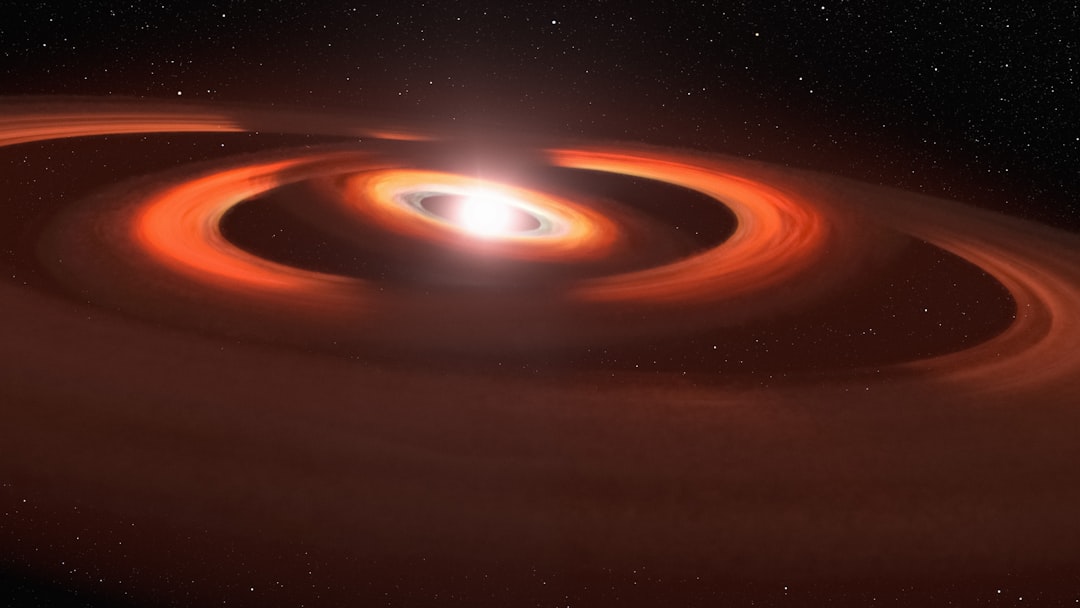
Gravitational focusing is a fascinating phenomenon that occurs when the gravitational field of a massive object, such as a star or a black hole, influences the trajectory of nearby celestial bodies. This effect can significantly alter the paths of objects traveling through space, drawing them closer to the massive body and potentially leading to dramatic consequences. The concept of gravitational focusing is not only crucial for understanding the dynamics of our universe but also plays a vital role in the study of astrophysics and space exploration.
As humanity ventures further into the cosmos, comprehending the implications of gravitational focusing becomes increasingly important. The significance of gravitational focusing extends beyond mere theoretical interest; it has practical implications for space missions and the safety of spacecraft. As scientists and engineers design missions to explore distant planets, moons, and asteroids, they must account for the gravitational influences of various celestial bodies.
Understanding how gravitational focusing operates can help predict potential hazards and optimize trajectories, ensuring that missions are successful and safe. In this article, the complexities of gravitational focusing will be explored, particularly in relation to black holes and their profound effects on surrounding objects.
Key Takeaways
- Gravitational focusing can significantly impact the trajectory of celestial bodies in space.
- Black holes possess an immense gravitational pull that can affect nearby objects and alter their paths.
- Space exploration faces potential risks from black holes, and understanding their gravitational pull is crucial for mission safety.
- Gravitational focusing plays a key role in astrophysics and can lead to theoretical scenarios of black hole encounters.
- Recent discoveries and research are focused on mitigating the risk of black holes in space missions and navigating the perils of gravitational focusing.
Understanding Black Holes and their Gravitational Pull
Black holes are among the most enigmatic and powerful entities in the universe. Formed from the remnants of massive stars that have undergone gravitational collapse, black holes possess an incredibly strong gravitational pull that can warp spacetime itself. This intense gravitational force is so powerful that not even light can escape once it crosses the event horizon, the boundary surrounding a black hole.
The study of black holes has captivated astronomers and physicists alike, as they challenge our understanding of fundamental physics and the nature of reality. The gravitational pull of a black hole is not uniform; it varies depending on the distance from its center. Objects that venture too close to a black hole experience extreme tidal forces, which can lead to spaghettification—a process where objects are stretched and compressed due to the differential gravitational forces acting on them.
This phenomenon illustrates the immense power of black holes and highlights the potential dangers they pose to nearby celestial bodies. As researchers continue to investigate these cosmic giants, they uncover new insights into their formation, behavior, and impact on their surroundings.
The Potential Risk of Black Holes in Space

The existence of black holes in space presents a unique set of risks for both natural celestial bodies and human-made spacecraft. While many black holes are located far from Earth, their influence can extend over vast distances, affecting objects that come within their gravitational reach. The potential risk associated with black holes is not merely theoretical; it has real implications for space exploration and our understanding of cosmic dynamics.
As humanity pushes the boundaries of space travel, awareness of these risks becomes paramount. One significant concern is the possibility of spacecraft inadvertently entering the gravitational influence of a black hole. Such an encounter could lead to catastrophic consequences, including loss of communication, navigation errors, or even complete destruction of the spacecraft.
Additionally, natural celestial bodies like asteroids or comets could be drawn into a black hole’s gravitational field, resulting in unpredictable trajectories that could pose threats to other objects in space. Understanding these risks is essential for developing strategies to mitigate potential dangers associated with black holes.
Gravitational Focusing and its Impact on Nearby Objects
| Object | Distance from Gravitational Source | Impact |
|---|---|---|
| Asteroid | 100,000 km | Deflected from its original path |
| Comet | 500,000 km | Altered trajectory towards the gravitational source |
| Spacecraft | 1,000,000 km | Experiences gravitational assist for increased speed |
Gravitational focusing plays a crucial role in determining how nearby objects interact with massive celestial bodies like black holes. When an object approaches a massive body, its trajectory can be altered due to the gravitational pull exerted by that body. This effect can lead to an increase in the object’s velocity as it is drawn closer, potentially resulting in collisions or other interactions with other celestial bodies in its vicinity.
The implications of gravitational focusing are profound, as they can influence the dynamics of entire star systems. For instance, when a star passes near a black hole, its path may be significantly altered due to gravitational focusing. This alteration can lead to increased interactions with other stars or even result in the star being captured by the black hole itself.
Such events can have cascading effects on the surrounding stellar environment, leading to changes in star formation rates and the distribution of matter in space. By studying these interactions, astronomers gain valuable insights into the complex relationships between celestial bodies and the forces that govern their movements.
How Black Holes Can Affect the Trajectory of Celestial Bodies
The influence of black holes on the trajectories of celestial bodies is a subject of great interest within astrophysics. When an object approaches a black hole, its path can be dramatically altered due to the intense gravitational forces at play. This alteration can result in various outcomes, including slingshot effects that propel objects away from the black hole at high speeds or capture scenarios where objects become trapped within the black hole’s gravitational field.
The dynamics involved in these interactions are complex and depend on several factors, including the mass of the black hole, the velocity of the approaching object, and its angle of approach. For example, if a star passes close enough to a supermassive black hole at the center of a galaxy, it may be flung out into intergalactic space or drawn into an orbit around the black hole. Such events not only reshape individual trajectories but also have broader implications for galactic evolution and structure.
The Dangers of Gravitational Focusing in Space Exploration
As humanity embarks on ambitious space exploration missions, understanding the dangers posed by gravitational focusing becomes increasingly critical. Spacecraft traveling through regions populated by massive celestial bodies must navigate carefully to avoid unintended encounters with black holes or other gravitationally influential objects. The potential for gravitational focusing to alter a spacecraft’s trajectory poses significant challenges for mission planners and engineers.
One major concern is that even small deviations in trajectory caused by gravitational focusing can lead to catastrophic outcomes. A spacecraft designed to explore distant planets may find itself veering off course due to unexpected gravitational influences, resulting in missed targets or collisions with other objects in space. To mitigate these risks, mission planners must incorporate advanced modeling techniques that account for gravitational interactions when designing flight paths.
This proactive approach is essential for ensuring the safety and success of future space missions.
Theoretical Scenarios of Black Hole Encounters
Theoretical scenarios involving encounters with black holes provide valuable insights into potential risks associated with these cosmic phenomena. One such scenario involves a spacecraft inadvertently approaching a black hole during its journey through space. As it nears the event horizon, gravitational forces would begin to dominate its trajectory, leading to an inevitable fate unless corrective measures are taken swiftly.
Another intriguing scenario involves a star passing close to a supermassive black hole at the center of a galaxy. In this case, gravitational focusing could dramatically alter the star’s path, potentially leading to its capture by the black hole or being flung into intergalactic space at high velocities. Such events not only highlight the dangers posed by black holes but also underscore their role in shaping galactic dynamics and evolution.
Mitigating the Risk of Black Holes in Space Missions
To ensure safe navigation through regions populated by black holes and other massive celestial bodies, scientists and engineers are developing strategies to mitigate risks associated with gravitational focusing. One approach involves advanced trajectory planning that incorporates detailed models of gravitational influences from nearby objects. By simulating various scenarios and accounting for potential deviations caused by gravitational focusing, mission planners can design safer flight paths for spacecraft.
Additionally, ongoing research into detection methods for identifying nearby black holes is crucial for enhancing safety during space missions. By improving our ability to detect these massive entities from great distances, scientists can provide early warnings for spacecraft operating in their vicinity. This proactive approach allows for timely adjustments to trajectories and helps ensure that missions remain on course while minimizing risks associated with gravitational focusing.
The Role of Gravitational Focusing in Astrophysics
Gravitational focusing is not only relevant for space exploration; it also plays a significant role in astrophysics research. By studying how massive objects influence the trajectories of nearby celestial bodies, scientists gain insights into fundamental questions about cosmic evolution and structure formation. Gravitational focusing helps explain phenomena such as galaxy formation, star clusters’ dynamics, and even the distribution of dark matter throughout the universe.
Furthermore, understanding gravitational focusing allows researchers to refine models of cosmic interactions and improve predictions about future events in space. As new observational data becomes available through advanced telescopes and instruments, scientists can test their theories against real-world observations, leading to deeper insights into the workings of our universe.
Recent Discoveries and Research on Black Hole Risk
Recent discoveries in astrophysics have shed light on the risks associated with black holes and their gravitational influence on surrounding objects. Observations from advanced telescopes have revealed previously unknown black holes lurking within our galaxy and beyond, prompting researchers to reevaluate existing models of cosmic dynamics. These findings underscore the importance of ongoing research into black holes’ properties and their potential impact on nearby celestial bodies.
Moreover, advancements in computational modeling have enabled scientists to simulate complex interactions involving black holes more accurately than ever before. These simulations provide valuable insights into how gravitational focusing operates under various conditions and help identify potential risks associated with future space missions. As research continues to evolve, it becomes increasingly clear that understanding black holes’ behavior is essential for navigating the challenges posed by their immense gravitational pull.
Navigating the Perils of Gravitational Focusing in Space
In conclusion, navigating the perils associated with gravitational focusing is crucial for both our understanding of astrophysics and our endeavors in space exploration. As humanity continues to push boundaries beyond Earth’s atmosphere, awareness of how massive celestial bodies like black holes influence nearby objects becomes paramount. The risks posed by these enigmatic entities necessitate careful planning and innovative strategies to ensure safe navigation through regions where their gravitational pull reigns supreme.
By advancing our knowledge of gravitational focusing and its implications for celestial dynamics, scientists can better prepare for future challenges in space exploration while deepening our understanding of the universe’s intricate workings. As research progresses and new discoveries emerge, humanity stands poised to unlock further mysteries surrounding black holes and their profound impact on cosmic evolution—an endeavor that promises to reshape our understanding of existence itself.
Gravitational focusing is a phenomenon that can significantly increase the risk associated with black holes, as it can draw in nearby objects and increase the likelihood of collisions. For a deeper understanding of this concept and its implications, you can read more in the related article on our website. Check it out here: Gravitational Focusing and Black Hole Risks.
WATCH THIS! The Invisible Threat: A Rogue Black Hole Headed for Our Solar System?
FAQs
What is gravitational focusing black hole risk?
Gravitational focusing black hole risk refers to the potential danger posed by the gravitational pull of a black hole on nearby objects, such as stars, planets, or other celestial bodies. This gravitational pull can cause these objects to be drawn towards the black hole, leading to potential collisions or disruptions in their orbits.
How does gravitational focusing black hole risk occur?
Gravitational focusing black hole risk occurs due to the immense gravitational force exerted by a black hole. This force can cause nearby objects to be attracted towards the black hole, increasing the likelihood of collisions or disruptions in their trajectories.
What are the potential consequences of gravitational focusing black hole risk?
The potential consequences of gravitational focusing black hole risk include the disruption of orbits of nearby celestial bodies, potential collisions between objects, and the potential destruction or absorption of these objects by the black hole.
How do scientists study and assess gravitational focusing black hole risk?
Scientists study and assess gravitational focusing black hole risk through observations of the behavior of nearby celestial bodies, as well as through theoretical models and simulations of the gravitational forces exerted by black holes. They also use telescopes and other instruments to observe the effects of black holes on their surrounding environment.
Can gravitational focusing black hole risk impact Earth?
While the risk of gravitational focusing by a black hole is a fascinating area of study, the likelihood of a black hole directly impacting Earth is extremely low. The closest known black hole to Earth is located over 1,000 light-years away, and poses no immediate risk to our planet.