The Gaia satellite, launched by the European Space Agency (ESA) in December 2013, represents a monumental leap in the field of astrometry and celestial mapping. Designed to create a three-dimensional map of our galaxy, Gaia is equipped with advanced technology that allows it to measure the positions, distances, and motions of over a billion stars with unprecedented precision. This ambitious mission aims not only to enhance our understanding of the Milky Way but also to shed light on the broader cosmos.
By collecting vast amounts of data, Gaia is poised to revolutionize the way astronomers study stellar evolution, galactic dynamics, and the overall structure of the universe. The satellite’s primary objective is to chart the positions of stars with an accuracy that surpasses previous missions. By doing so, Gaia provides insights into the formation and evolution of the Milky Way, offering a glimpse into its past and future.
The data collected by Gaia is invaluable for researchers, as it serves as a foundation for numerous studies across various fields of astronomy. As scientists continue to analyze this wealth of information, they uncover new phenomena and deepen their understanding of the universe’s intricate workings.
Key Takeaways
- Gaia Satellite is a space observatory launched by the European Space Agency to create a 3D map of the Milky Way and track the positions and movements of stars.
- The discovery of a black hole in the Milky Way was made possible by the Gaia Satellite, marking the first time a stellar-mass black hole has been directly detected in our galaxy.
- Gaia Satellite’s precise measurements of star positions and movements have revolutionized our understanding of the Milky Way and the universe, leading to groundbreaking discoveries in astronomy.
- Black holes are mysterious cosmic objects with gravitational forces so strong that nothing, not even light, can escape from them, and Gaia Satellite’s data has contributed to our understanding of their formation and behavior.
- The discovery of the black hole in the Milky Way has had a profound impact on astrophysics, providing new insights into the nature of black holes and their role in the evolution of galaxies.
The Discovery of the Black Hole
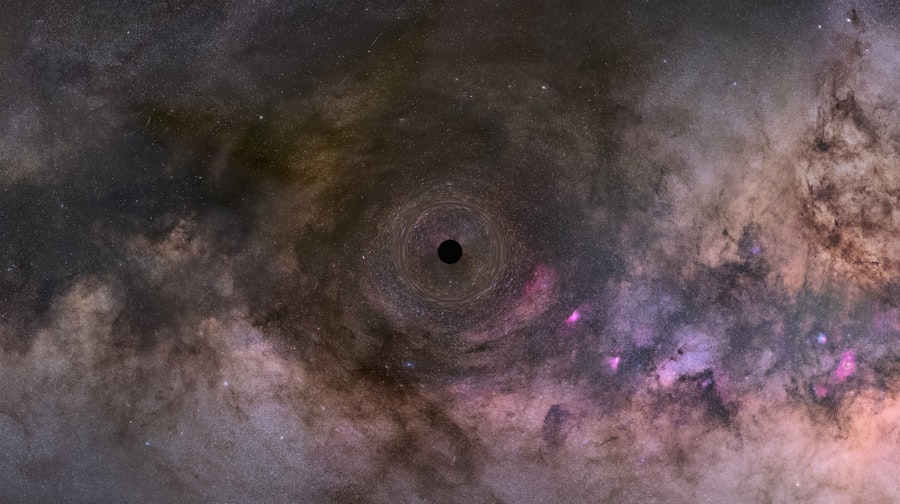
In recent years, one of the most significant discoveries attributed to Gaia’s data is the identification of a black hole lurking within our galaxy. This groundbreaking finding has captivated the scientific community and sparked widespread interest among both astronomers and the general public. The black hole, located in a region known as V404 Cygni, was detected through its gravitational influence on nearby stars and gas clouds.
By analyzing the motion of these celestial bodies, researchers were able to infer the presence of this enigmatic object, which had previously eluded detection. The discovery of this black hole not only confirms existing theories about their existence but also raises new questions about their formation and behavior. Black holes are known to be regions in space where gravity is so strong that nothing, not even light, can escape their grasp.
Understanding their properties and how they interact with surrounding matter is crucial for advancing knowledge in astrophysics. The identification of V404 Cygni serves as a reminder of the mysteries that still lie within our galaxy and highlights the importance of continued exploration and observation.
Gaia Satellite’s Role in Astronomy
Gaia’s role in modern astronomy cannot be overstated. By providing precise measurements of stellar positions and movements, it has become an essential tool for astronomers seeking to unravel the complexities of the universe. The satellite’s ability to monitor over a billion stars allows researchers to study stellar populations, track their evolution, and understand their interactions within the Milky Way.
This comprehensive dataset enables scientists to create detailed models of galactic dynamics and offers insights into phenomena such as star formation and stellar death. Moreover, Gaia’s contributions extend beyond mere mapping; it has also facilitated the discovery of new celestial objects, including exoplanets and asteroids. By analyzing variations in brightness and motion, astronomers can identify previously unknown bodies within our solar system and beyond.
The satellite’s ongoing observations continue to enrich our understanding of cosmic structures and processes, making it an indispensable asset in contemporary astrophysics.
Understanding Black Holes
| Aspect | Metric |
|---|---|
| Definition | A region of spacetime where gravity is so strong that nothing, not even light, can escape |
| Formation | Result from the remnants of massive stars collapsing under their own gravity |
| Types | Stellar black holes, Intermediate black holes, Supermassive black holes |
| Size | Can range from a few times the mass of the sun to millions of times the mass of the sun |
| Event Horizon | The boundary surrounding a black hole beyond which nothing can escape |
Black holes remain one of the most intriguing subjects in astrophysics, captivating both scientists and enthusiasts alike. These mysterious entities are formed when massive stars exhaust their nuclear fuel and collapse under their own gravity. The resulting singularity creates a region where spacetime is warped to such an extent that escape becomes impossible for anything that ventures too close.
Understanding black holes involves delving into complex theories of general relativity and quantum mechanics, as they challenge our fundamental perceptions of space and time. The study of black holes encompasses various types, including stellar black holes, supermassive black holes found at the centers of galaxies, and intermediate black holes that bridge the gap between the two. Each type presents unique characteristics and behaviors that researchers strive to comprehend.
For instance, supermassive black holes can have masses equivalent to millions or even billions of suns, influencing the dynamics of entire galaxies. As scientists continue to explore these enigmatic objects, they uncover new insights into their formation, growth, and impact on cosmic evolution.
The Impact of the Discovery
The discovery of a black hole within our galaxy has profound implications for astrophysics and our understanding of cosmic phenomena.
This finding challenges existing models and encourages scientists to refine their theories regarding how black holes interact with surrounding matter and influence star formation.
Furthermore, this discovery has sparked renewed interest in black hole research across various disciplines. It has prompted collaborations among astronomers worldwide, leading to innovative observational strategies and theoretical frameworks aimed at unraveling the mysteries surrounding these cosmic giants. As researchers delve deeper into the implications of this discovery, they are likely to uncover additional insights that could reshape our understanding of the universe.
Gaia Satellite’s Technology
The technological advancements embedded within Gaia are pivotal to its success as a celestial observatory. The satellite is equipped with a sophisticated astrometric instrument known as the astrometric payload, which includes two telescopes that work in tandem to capture images of stars with remarkable precision. This dual-telescope system allows Gaia to measure stellar positions with an accuracy that was previously unattainable.
In addition to its astrometric capabilities, Gaia employs a cutting-edge photometer that measures the brightness of stars across multiple wavelengths.
The combination of these advanced technologies allows Gaia to gather an unprecedented amount of data, making it a cornerstone for contemporary astronomical research.
Black Holes in the Milky Way
The Milky Way is home to numerous black holes, each contributing to the intricate tapestry of our galaxy’s structure. While some are well-studied stellar black holes formed from collapsing stars, others are supermassive black holes residing at galactic centers. The presence of these enigmatic objects influences not only their immediate surroundings but also the overall dynamics of the Milky Way.
Research into black holes within our galaxy has revealed fascinating insights into their distribution and behavior. For instance, studies suggest that there may be thousands of stellar black holes scattered throughout the Milky Way, many of which remain undetected due to their elusive nature. Understanding their locations and interactions with other celestial bodies is crucial for piecing together the history and evolution of our galaxy.
Gaia Satellite’s Future Discoveries
As Gaia continues its mission, astronomers anticipate a wealth of future discoveries that will further enhance our understanding of the cosmos. The satellite’s ongoing observations will likely lead to the identification of additional black holes, as well as other celestial phenomena such as neutron stars and exotic stellar remnants. Each new finding contributes to a more comprehensive picture of galactic dynamics and stellar evolution.
Moreover, Gaia’s data will serve as a foundation for future research initiatives aimed at exploring fundamental questions about dark matter, dark energy, and the overall structure of the universe. As scientists analyze this vast dataset, they will undoubtedly uncover new patterns and relationships that could reshape our understanding of cosmic processes.
Black Hole Research and Exploration
The field of black hole research is rapidly evolving, driven by advancements in observational technology and theoretical frameworks. As astronomers gain access to more precise data from missions like Gaia, they are better equipped to explore fundamental questions about these enigmatic objects. Collaborative efforts among researchers worldwide have led to innovative approaches for studying black holes, including gravitational wave detection and high-energy astrophysics.
Exploration into black holes also extends beyond observational studies; theoretical physicists are actively working to reconcile general relativity with quantum mechanics in an effort to understand what occurs at singularities. This interdisciplinary approach fosters a deeper comprehension of black holes’ nature and their implications for fundamental physics.
Gaia Satellite’s Contribution to Astrophysics
Gaia’s contributions extend far beyond its immediate mission objectives; it has become a cornerstone for modern astrophysics. By providing an extensive catalog of stellar data, Gaia enables researchers to test existing theories and develop new models that explain cosmic phenomena. Its impact is felt across various fields within astronomy, from stellar dynamics to cosmology.
The satellite’s ability to measure distances with unparalleled accuracy has profound implications for determining cosmic scales and understanding galactic structures. As researchers continue to analyze Gaia’s data, they are likely to uncover new insights that will shape future explorations in astrophysics.
The Significance of the Discovery
The discovery of a black hole within our galaxy is not merely an academic achievement; it represents a significant milestone in humanity’s quest for knowledge about the universe. This finding underscores the importance of continued exploration and observation in unraveling cosmic mysteries. As scientists build upon this discovery, they are likely to uncover additional insights that will deepen our understanding of black holes and their role in shaping galaxies.
Ultimately, Gaia’s contributions extend beyond individual discoveries; they foster a broader appreciation for the complexities of the universe and humanity’s place within it. As researchers continue to explore the cosmos armed with data from Gaia, they embark on a journey that promises to unveil new wonders and challenge existing paradigms in astrophysics for generations to come.
The Gaia satellite has made significant strides in black hole detection, providing astronomers with unprecedented data to identify these elusive cosmic entities. For further insights into the implications of Gaia’s findings and the broader context of black hole research, you can read more in this related article on cosmic exploration: My Cosmic Ventures.
WATCH THIS! The Invisible Threat: A Rogue Black Hole Headed for Our Solar System?
FAQs
What is the Gaia satellite?
The Gaia satellite is a space observatory launched by the European Space Agency (ESA) in 2013. Its primary mission is to create a 3D map of the Milky Way galaxy by measuring the positions, distances, and motions of stars with unprecedented accuracy.
How does the Gaia satellite detect black holes?
The Gaia satellite can detect black holes indirectly by observing the gravitational effects they have on nearby stars. As a black hole pulls on a star, it causes the star to move in a characteristic way that can be detected by Gaia’s instruments.
What recent black hole detection has the Gaia satellite made?
In 2018, the Gaia satellite detected a pair of previously unknown black holes in a distant galaxy. This discovery was made by observing the movements of stars around these black holes and inferring the presence of the black holes based on their gravitational influence.
Why is the detection of black holes important?
The detection of black holes is important for advancing our understanding of the universe and the role of black holes in shaping galaxies and cosmic structures. It also provides valuable data for testing theories of gravity and general relativity.
What are the implications of Gaia’s black hole detection for astrophysics?
The detection of black holes by the Gaia satellite provides astrophysicists with valuable data to study the properties and behavior of black holes in distant galaxies. This can lead to new insights into the formation and evolution of galaxies, as well as the nature of black holes themselves.