
The Fractal Aggregate Comet Model represents a significant advancement in the understanding of comet formation and behavior. This model posits that comets are not merely solid bodies but rather complex structures formed from a multitude of smaller particles that aggregate in a fractal manner. The implications of this model extend beyond the mere classification of comets; they touch upon the fundamental processes that govern the formation of celestial bodies in the solar system.
By examining the intricate relationships between these particles, researchers can gain insights into the conditions present in the early solar system and how they contributed to the development of comets. The introduction of the Fractal Aggregate Comet Model has sparked renewed interest in the study of comets, as it challenges traditional views that often oversimplified their structure. This model emphasizes the importance of scale and complexity, suggesting that the behavior and characteristics of comets can be better understood through a lens that appreciates their fractal nature.
As scientists delve deeper into this model, they uncover new layers of understanding regarding the physical and chemical processes that shape these enigmatic celestial objects. Why Did NASA Hide 3i Atlas
Key Takeaways
- The Fractal Aggregate Comet Model proposes a new way of understanding the formation and behavior of comets in space.
- Comets are believed to be made up of fractal aggregates, which are complex, irregular structures formed by the accumulation of smaller particles.
- Fractal aggregates play a crucial role in the formation of comets, influencing their structure, composition, and behavior as they travel through space.
- Understanding the behavior of comets in space is essential for space exploration, and the Fractal Aggregate Comet Model provides valuable insights into their dynamics.
- The Fractal Aggregate Comet Model has the potential to revolutionize space exploration and our understanding of the origins of the solar system, with applications in astrophysics and beyond.
The Formation and Structure of Comets
Comets are often described as “dirty snowballs,” composed primarily of ice, dust, and rocky materials. Their formation is believed to occur in the outer regions of the solar system, where low temperatures allow for the accumulation of volatile compounds. As these materials coalesce under the influence of gravity, they form a nucleus that can range in size from a few hundred meters to several kilometers in diameter.
The structure of a comet is not uniform; rather, it is characterized by a heterogeneous mix of materials that reflect its complex history. The nucleus of a comet is surrounded by a coma, a cloud of gas and dust that forms when the comet approaches the Sun. As solar radiation heats the nucleus, volatile substances sublimate, creating this glowing envelope.
The interaction between the solar wind and the coma leads to the formation of a tail that can stretch millions of kilometers away from the comet. This dynamic behavior highlights the intricate relationship between a comet’s structure and its environment, setting the stage for a deeper exploration of how fractal aggregates contribute to these processes.
The Role of Fractal Aggregates in Comet Formation
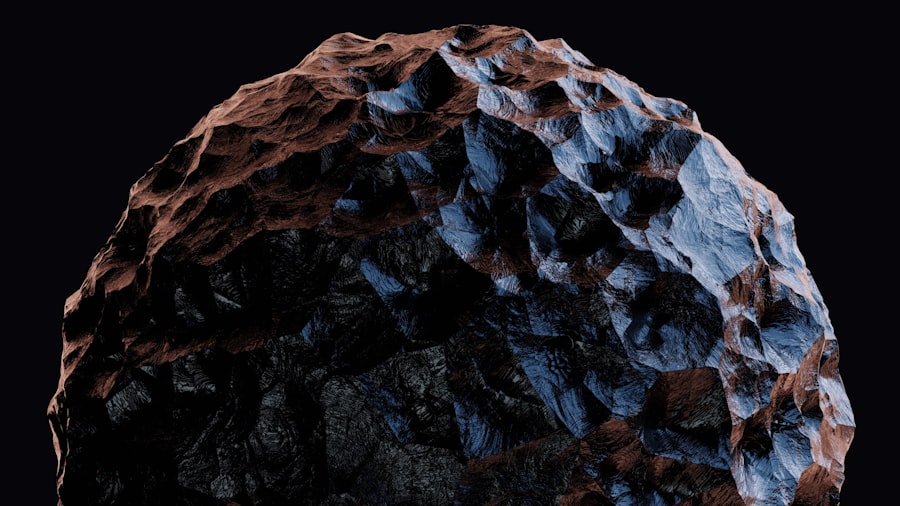
Fractal aggregates play a crucial role in the formation of comets by influencing how particles come together to form larger structures. In essence, fractals are patterns that repeat at different scales, and this concept can be applied to understand how smaller particles cluster and bond under varying conditions. The aggregation process is not random; it is governed by physical forces such as gravity, electrostatic interactions, and van der Waals forces.
These forces dictate how particles interact and ultimately determine the size and shape of the resulting cometary nucleus. The fractal nature of these aggregates means that they can exhibit unique properties that differ from those of their individual components. For instance, a collection of small particles may have a lower density than expected due to the voids created between them.
This characteristic can affect how comets behave as they travel through space, influencing their thermal properties and how they respond to solar radiation. By studying these aggregates, scientists can gain insights into the conditions under which comets formed and how their structures evolved over time.
Understanding the Behavior of Comets in Space
| Comet Name | Orbital Period (years) | Eccentricity | Perihelion Distance (AU) | Aphelion Distance (AU) |
|---|---|---|---|---|
| Halley’s Comet | 76 | 0.967 | 0.587 | 35.1 |
| Comet 67P/Churyumov-Gerasimenko | 6.45 | 0.641 | 1.243 | 5.682 |
| Comet Hale-Bopp | 2380 | 0.995 | 0.914 | 369.0 |
The behavior of comets in space is a fascinating area of study that reveals much about their composition and interactions with other celestial bodies. As comets travel through the solar system, they experience various forces that can alter their trajectories and physical characteristics. The gravitational pull from planets can deflect their paths, while interactions with solar radiation can lead to changes in their surface structure.
Understanding these behaviors is essential for predicting cometary activity and potential impacts on Earth. The Fractal Aggregate Comet Model provides a framework for understanding these behaviors by emphasizing the importance of particle interactions within comets. The model suggests that the unique structural properties of fractal aggregates can influence how comets respond to external forces.
For example, a comet with a loosely bound structure may be more susceptible to disintegration when subjected to intense solar radiation or gravitational forces than one with a more compact structure. This insight allows researchers to develop more accurate models for predicting comet behavior and assessing potential risks associated with near-Earth objects.
The Impact of Fractal Aggregate Comet Model on Space Exploration
The Fractal Aggregate Comet Model has significant implications for space exploration, particularly in terms of mission planning and risk assessment. Understanding the complex structures and behaviors of comets can inform decisions about spacecraft design, trajectory planning, and landing strategies. For instance, missions aimed at studying comet nuclei must consider the potential for fragmentation or outgassing events that could pose risks to spacecraft.
Moreover, this model enhances our ability to interpret data collected from past missions to comets, such as ESA’s Rosetta mission to Comet 67P/Churyumov-Gerasimenko. By applying insights from the Fractal Aggregate Comet Model, scientists can better understand the observations made during these missions and refine their hypotheses about comet formation and evolution. This knowledge not only enriches our understanding of comets but also informs future exploration endeavors aimed at unraveling the mysteries of our solar system.
Applications of Fractal Aggregate Comet Model in Astrophysics
The applications of the Fractal Aggregate Comet Model extend beyond comet studies; they also have broader implications for astrophysics as a whole. By providing a new perspective on how celestial bodies form and evolve, this model can be applied to other areas of research, such as planetary formation and the study of interstellar dust clouds. The principles underlying fractal aggregation may help scientists understand how various materials coalesce under different environmental conditions across the universe.
Additionally, this model can aid in developing simulations that explore cosmic phenomena at different scales. By incorporating fractal principles into computational models, researchers can create more accurate representations of how matter behaves in space over time. This approach could lead to new discoveries about the origins of celestial bodies and their interactions within galaxies, ultimately enhancing our understanding of the universe’s evolution.
Challenges and Controversies Surrounding the Fractal Aggregate Comet Model
Despite its promising insights, the Fractal Aggregate Comet Model is not without its challenges and controversies. One significant issue lies in validating its predictions against observational data. While theoretical models can provide valuable frameworks for understanding complex phenomena, they must be rigorously tested against empirical evidence to gain acceptance within the scientific community.
Researchers face difficulties in obtaining high-resolution data on comet structures due to their often unpredictable behavior and remote locations. Moreover, there are competing theories regarding comet formation that challenge the validity of the Fractal Aggregate Comet Model. Some scientists argue for alternative models that emphasize different mechanisms or processes involved in comet formation.
This ongoing debate highlights the need for continued research and collaboration among scientists to reconcile differing viewpoints and develop a more comprehensive understanding of cometary science.
The Future of Fractal Aggregate Comet Model Research
The future of research surrounding the Fractal Aggregate Comet Model appears promising as advancements in technology continue to enhance observational capabilities. Upcoming missions aimed at studying comets will likely provide new data that can be used to refine this model further. As scientists gather more information about cometary structures and behaviors, they will be better equipped to test hypotheses related to fractal aggregation.
Additionally, interdisciplinary collaboration will play a crucial role in advancing research on this model. By bringing together experts from various fields—such as astrophysics, materials science, and computational modeling—scientists can develop innovative approaches to studying comets and their formation processes. This collaborative effort may lead to breakthroughs that deepen our understanding of not only comets but also broader cosmic phenomena.
Comparing Fractal Aggregate Comet Model with Other Theories of Comet Formation
In examining the Fractal Aggregate Comet Model, it is essential to compare it with other prevailing theories of comet formation. Traditional models often emphasize gravitational collapse or accretion processes as primary mechanisms for forming cometary nuclei. While these models have provided valuable insights into comet formation, they may not fully account for the complexities observed in actual comet structures.
The Fractal Aggregate Comet Model offers an alternative perspective by focusing on how smaller particles aggregate into larger structures through fractal processes. This approach allows for a more nuanced understanding of how various forces interact during formation, potentially leading to different outcomes than those predicted by traditional models. By comparing these theories, researchers can identify strengths and weaknesses in each approach, ultimately contributing to a more comprehensive understanding of cometary science.
Potential Implications of Fractal Aggregate Comet Model for Understanding the Origins of the Solar System
The implications of the Fractal Aggregate Comet Model extend beyond individual comets; they also offer insights into the origins of the solar system itself. By studying how comets formed through fractal aggregation processes, scientists can glean information about the conditions present in the early solar system when these bodies were created. This knowledge may shed light on how planets formed and evolved alongside comets.
Furthermore, understanding comet formation through this model could provide clues about the distribution of materials within the solar system during its infancy. The composition and structure of comets may reflect broader trends in material distribution across protoplanetary disks, offering valuable insights into planetary formation processes on a cosmic scale.
The Significance of Fractal Aggregate Comet Model in Advancing Our Understanding of Space
In conclusion, the Fractal Aggregate Comet Model represents a significant advancement in our understanding of comets and their role within the solar system. By emphasizing the importance of fractal aggregation processes in comet formation, this model challenges traditional views and opens new avenues for research. Its implications extend beyond individual comets; they touch upon fundamental questions regarding planetary formation, material distribution, and cosmic evolution.
As scientists continue to explore this model through observational data and interdisciplinary collaboration, they will undoubtedly uncover new insights that deepen our understanding of not only comets but also broader astrophysical phenomena. The significance of the Fractal Aggregate Comet Model lies not only in its ability to explain existing observations but also in its potential to inspire future exploration endeavors aimed at unraveling the mysteries of our universe.
The fractal aggregate comet model provides a fascinating framework for understanding the complex structures and behaviors of comets as they travel through space. For a deeper exploration of this topic, you can read more about the implications of fractal structures in celestial bodies in our related article on mycosmicventures.com. This article delves into the significance of fractal geometry in astrophysics and its applications in modeling various cosmic phenomena.
WATCH THIS! Why NASA Hid the 3I/ATLAS Anomaly
FAQs
What is a fractal aggregate comet model?
A fractal aggregate comet model is a theoretical model used to describe the structure and formation of comets. It suggests that comets are composed of loosely bound aggregates of smaller particles, which are arranged in a fractal-like pattern.
How does the fractal aggregate comet model explain the formation of comets?
According to the fractal aggregate comet model, comets are formed from the accumulation of smaller particles, such as dust and ice, in the early solar system. These particles gradually come together to form larger aggregates, which then continue to grow through collisions and accretion.
What evidence supports the fractal aggregate comet model?
Observations of comets, as well as laboratory experiments and simulations, provide evidence for the fractal aggregate comet model. For example, the irregular shapes and porous structures of comets, as well as the presence of different materials within them, are consistent with the predictions of the model.
How does the fractal aggregate comet model differ from other comet formation models?
The fractal aggregate comet model differs from other models, such as the pebble accretion model, in its emphasis on the hierarchical and fractal-like structure of comets. It also accounts for the presence of different materials within comets and their porous nature, which are not fully explained by other models.
What are the implications of the fractal aggregate comet model for our understanding of the early solar system?
The fractal aggregate comet model provides insights into the processes that shaped the early solar system, including the formation of comets and other small bodies. It also has implications for our understanding of the distribution and composition of materials in the solar system, as well as the potential role of comets in delivering water and organic molecules to Earth.