
The constants of the universe are fundamental quantities that govern the behavior of physical phenomena. These constants, such as the speed of light in a vacuum, the gravitational constant, and Planck’s constant, play a crucial role in shaping the laws of physics as we understand them. They are not merely arbitrary numbers; rather, they are intrinsic to the structure of the universe itself.
For instance, the speed of light, approximately 299,792 kilometers per second, is not just a measure of how fast light travels; it also influences the relationship between space and time, as articulated in Einstein’s theory of relativity. Similarly, the gravitational constant determines the strength of gravitational attraction between masses, influencing everything from the orbits of planets to the formation of galaxies. These constants are often viewed as the building blocks of the universe.
Their values appear to be finely tuned to allow for the existence of matter, energy, and life as we know it. If any of these constants were altered even slightly, the universe might be drastically different—perhaps inhospitable to life or unable to support complex structures. This delicate balance raises profound questions about why these constants have the values they do and what implications this has for our understanding of reality.
Key Takeaways
- The universe’s fundamental constants are crucial for the existence of matter and life.
- Fine-tuning refers to the precise values of these constants that allow the universe to support complexity.
- The anthropic principle suggests that the universe’s constants appear fine-tuned because only such a universe can harbor observers.
- Understanding fine-tuning challenges current physics and inspires various theoretical explanations, including multiverse theories.
- Fine-tuning has significant implications for cosmology, the search for extraterrestrial life, and philosophical and theological discussions.
The Importance of Fine-Tuning
Fine-tuning refers to the precise adjustments of these constants that allow for a universe capable of supporting life. The concept suggests that if any of the fundamental constants were changed by even a fraction, the universe might not exist in a form that could sustain life. For example, if the strong nuclear force were slightly weaker, atomic nuclei would not hold together, preventing the formation of atoms necessary for matter.
Conversely, if it were slightly stronger, stars would burn out too quickly for life to develop. This remarkable precision has led scientists and philosophers alike to ponder whether our universe is unique or part of a broader multiverse where different constants might yield different realities. The implications of fine-tuning extend beyond mere curiosity; they challenge our understanding of existence itself.
The fact that our universe appears so perfectly calibrated raises questions about chance versus design. Is it merely a coincidence that the constants align so favorably for life? Or does this suggest a deeper underlying principle or mechanism at work?
The importance of fine-tuning lies not only in its scientific implications but also in its capacity to inspire wonder and inquiry about the nature of existence.
The Anthropic Principle
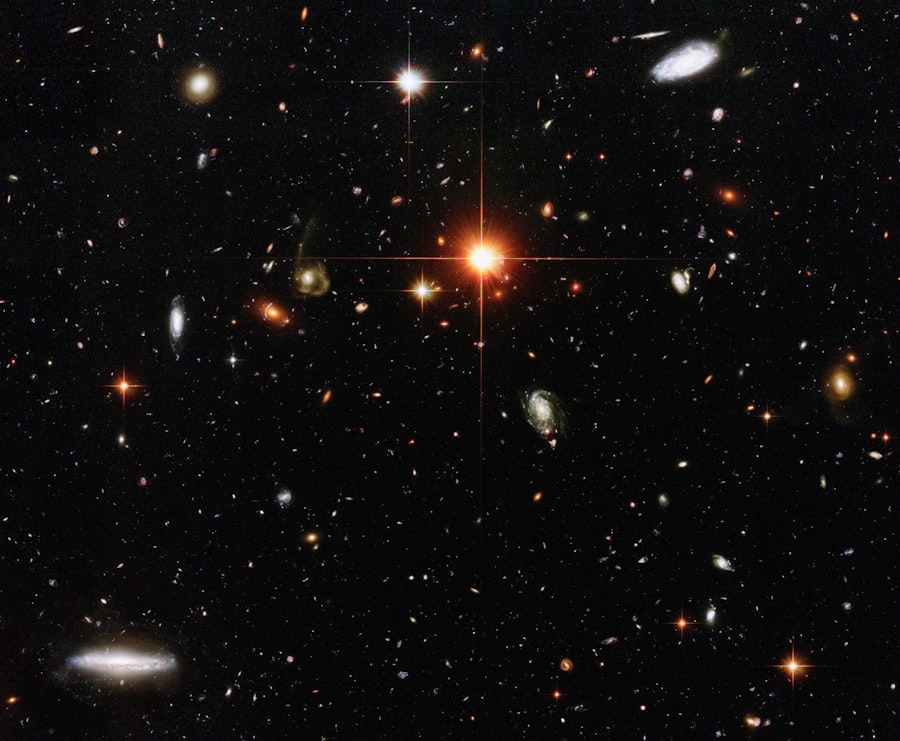
The anthropic principle is a philosophical consideration that seeks to explain why the universe’s physical constants are conducive to life. It posits that the universe must have properties that allow for observers—like humans—to exist and contemplate these very properties. In its simplest form, the anthropic principle suggests that we observe the universe in its current state because if it were different, we would not be here to observe it at all.
This principle can be divided into two main forms: the weak anthropic principle and the strong anthropic principle. The weak anthropic principle merely states that the observed values of physical constants are conditioned by the fact that life exists to observe them. In contrast, the strong anthropic principle posits that the universe must have properties that inevitably lead to the emergence of intelligent life.
This distinction raises intriguing questions about purpose and design in the cosmos. While some scientists embrace the weak anthropic principle as a useful framework for understanding fine-tuning, others find themselves grappling with the implications of a universe seemingly designed for life.
The Role of the Constants in the Laws of Physics
The constants of nature serve as essential parameters within the laws of physics, shaping everything from atomic interactions to cosmic phenomena. They provide a framework through which scientists can formulate theories and make predictions about how matter and energy behave under various conditions. For instance, in quantum mechanics, Planck’s constant plays a pivotal role in determining the scale at which quantum effects become significant.
Similarly, in cosmology, the Hubble constant is crucial for understanding the rate at which the universe is expanding. These constants are not static; they are deeply intertwined with our understanding of fundamental forces such as electromagnetism and gravity. Their values influence how particles interact and how structures form in the universe.
As researchers delve deeper into particle physics and cosmology, they continue to explore how variations in these constants could lead to different physical laws altogether. This exploration not only enhances scientific knowledge but also deepens appreciation for the intricate tapestry that constitutes reality.
The Challenge of Understanding Fine-Tuning
| Constant | Symbol | Value | Role in Universe | Fine-Tuning Sensitivity | Effect of Variation |
|---|---|---|---|---|---|
| Gravitational Constant | G | 6.67430 × 10⁻¹¹ m³·kg⁻¹·s⁻² | Determines strength of gravity | High | Too strong: rapid collapse of matter; too weak: no star formation |
| Speed of Light | c | 299,792,458 m/s | Limits speed of information and energy | Moderate | Variation affects causality and energy relations |
| Planck Constant | h | 6.62607015 × 10⁻³⁴ J·s | Sets quantum scale | High | Changes quantum behavior, affecting chemistry and stability |
| Cosmological Constant | Λ | ~1.1 × 10⁻⁵² m⁻² | Drives accelerated expansion of universe | Very High | Too large: universe expands too fast for galaxy formation |
| Fine-Structure Constant | α | ~1/137 | Determines strength of electromagnetic interaction | High | Variation disrupts atomic structure and chemistry |
| Proton-to-Electron Mass Ratio | μ | ~1836 | Influences molecular chemistry | Moderate | Changes affect molecular bonding and life chemistry |
Understanding fine-tuning presents a formidable challenge for scientists and philosophers alike. The precise values of fundamental constants raise questions about their origins and whether they are truly fixed or subject to change. One significant challenge lies in distinguishing between mere coincidence and meaningful patterns within these values.
While some argue that fine-tuning is evidence of a purposeful design, others contend that it could be an artifact of our limited perspective within a vast multiverse. Moreover, fine-tuning invites scrutiny from various scientific disciplines, including physics, cosmology, and philosophy. Each field offers unique insights but also faces its own limitations in addressing this complex issue.
For instance, while physicists may focus on mathematical models and empirical data, philosophers might explore metaphysical implications and existential questions. This interdisciplinary approach is essential for grappling with fine-tuning’s profound implications for our understanding of reality.
Theoretical Explanations for Fine-Tuning
Several theoretical frameworks have emerged to explain fine-tuning within the context of modern physics. One prominent explanation is the multiverse theory, which posits that our universe is just one among countless others, each with its own set of physical constants. In this scenario, it is not surprising that at least one universe—ours—has conditions suitable for life.
The multiverse theory provides a potential resolution to fine-tuning by suggesting that variations in constants across different universes could account for our unique circumstances.
String theory suggests that there may be additional dimensions beyond our observable three-dimensional space, leading to a landscape of possible physical laws and constants.
In this framework, fine-tuning could arise from selecting specific configurations within this vast landscape that allow for life-supporting conditions.
Observational Evidence for Fine-Tuning
Observational evidence supporting fine-tuning comes from various fields within astrophysics and cosmology. For instance, studies examining cosmic microwave background radiation reveal uniformity across vast distances in space, suggesting a finely tuned initial state following the Big Bang. Additionally, observations of distant galaxies and their formation provide insights into how specific conditions have allowed for complex structures to emerge over billions of years.
Moreover, researchers have identified specific thresholds for certain physical constants beyond which life as we know it would be impossible. For example, astrophysical models indicate that if the ratio of electromagnetic force to gravitational force were altered even slightly, stars would either burn too quickly or fail to ignite altogether. Such findings lend credence to the notion that our universe is indeed finely tuned for life.
Implications for Cosmology and Astrophysics
The implications of fine-tuning extend far beyond philosophical musings; they significantly impact cosmology and astrophysics as fields of study. Understanding why certain constants have their specific values can lead to breakthroughs in theoretical physics and enhance predictive models regarding cosmic evolution. For instance, insights into fine-tuning may inform research on dark matter and dark energy—two enigmatic components believed to constitute much of the universe’s mass-energy content.
Furthermore, fine-tuning challenges scientists to refine their models and explore new avenues of inquiry. As researchers grapple with these complexities, they may uncover new relationships between fundamental forces or even discover previously unknown physical phenomena. This ongoing exploration not only enriches scientific knowledge but also deepens humanity’s understanding of its place within an expansive cosmos.
Fine-Tuning and the Search for Extraterrestrial Life
The concept of fine-tuning has profound implications for astrobiology and the search for extraterrestrial life. If certain physical constants are indeed finely tuned to support life, it raises questions about how common or rare such conditions might be across the universe. The search for habitable exoplanets often focuses on identifying those with conditions similar to Earth—specifically those located within their star’s habitable zone where liquid water can exist.
However, fine-tuning suggests that even slight variations in fundamental constants could render planets inhospitable despite being located in favorable zones. This realization complicates efforts to identify potential extraterrestrial habitats and underscores the need for a nuanced understanding of life’s requirements across diverse environments. As scientists continue their quest for signs of life beyond Earth, they must grapple with both the possibilities and limitations imposed by fine-tuning.
Philosophical and Theological Implications
The discussion surrounding fine-tuning inevitably intersects with philosophical and theological considerations about existence and purpose. For many thinkers, fine-tuning raises profound questions about whether there is an underlying intelligence or design behind the universe’s structure. Some argue that such precision points toward a creator or higher power responsible for orchestrating conditions conducive to life.
Conversely, others contend that attributing fine-tuning solely to divine intervention may overlook naturalistic explanations rooted in scientific inquiry. This tension between faith-based perspectives and empirical reasoning invites ongoing dialogue among philosophers, theologians, and scientists alike. Ultimately, fine-tuning serves as a catalyst for exploring humanity’s deepest questions about existence while fostering interdisciplinary collaboration across diverse fields.
Future Directions in Fine-Tuning Research
As research into fine-tuning continues to evolve, several promising directions emerge on the horizon. Advances in observational technology may enable scientists to gather more precise data regarding cosmic phenomena and fundamental constants. Improved telescopes and instruments could enhance our understanding of distant galaxies’ formation processes or provide insights into dark matter’s role in shaping cosmic structures.
Additionally, interdisciplinary collaboration will be crucial in addressing fine-tuning’s complexities comprehensively. By integrating insights from physics, philosophy, cosmology, and theology, researchers can foster richer discussions about existence’s nature while exploring potential explanations for fine-tuning phenomena. In conclusion, fine-tuning remains one of science’s most intriguing puzzles—a conundrum that invites inquiry across disciplines while challenging humanity’s understanding of its place within an expansive cosmos.
As researchers continue their quest for answers regarding fundamental constants’ origins and implications, they will undoubtedly uncover new insights that deepen appreciation for both science’s wonders and life’s mysteries.
Fine-tuning the constants of the universe is a fascinating topic that explores the delicate balance required for life to exist.