
As you delve into the fascinating world of quantum physics, you may encounter the concept of quantum foam, a term that evokes images of a frothy, dynamic structure underlying the very fabric of reality. Coined by physicist John Wheeler in the 1960s, quantum foam refers to the idea that spacetime is not a smooth continuum but rather a turbulent, ever-changing entity at the smallest scales. This notion challenges our classical understanding of the universe, suggesting that at the Planck scale—approximately \(10^{-35}\) meters—spacetime is subject to fluctuations that can have profound implications for our understanding of physics.
The idea of quantum foam invites you to reconsider the nature of reality itself.
This perspective opens up new avenues for exploring fundamental questions about the universe, such as the nature of gravity, the origins of black holes, and the very beginnings of time itself.
As you journey through this article, you will uncover the theoretical foundations of quantum foam, its relationship with key principles in physics, and its potential implications for future research.
Key Takeaways
- Quantum foam is a theoretical concept that describes the turbulent and fluctuating nature of spacetime at very small scales.
- The theoretical basis of quantum foam lies in the principles of quantum mechanics and general relativity, which suggest that spacetime is not smooth and continuous, but rather composed of tiny, ever-changing bubbles and fluctuations.
- Quantum foam is believed to be the fundamental fabric of spacetime, influencing the behavior of particles and the structure of the universe at the smallest scales.
- Quantum foam is closely related to the uncertainty principle, as it introduces inherent uncertainty and fluctuations in the measurements of spacetime properties.
- Quantum foam has significant implications for the study of black holes, as it may influence their formation, behavior, and eventual evaporation.
Theoretical Basis of Quantum Foam
To grasp the concept of quantum foam, it is essential to understand its theoretical underpinnings. At its core, quantum foam arises from the principles of quantum mechanics and general relativity. Quantum mechanics introduces the idea that particles can exist in multiple states simultaneously, leading to inherent uncertainties in their properties.
General relativity, on the other hand, describes gravity as the curvature of spacetime caused by mass. When these two theories intersect, they reveal a complex interplay that gives rise to the notion of quantum foam. You might find it intriguing that quantum foam is often associated with the Planck scale, where the effects of both quantum mechanics and gravity become significant.
At this minuscule scale, spacetime is thought to be subject to fluctuations that create a “foamy” structure. These fluctuations can be visualized as tiny bubbles or vortices that pop in and out of existence, challenging our conventional understanding of a smooth spacetime continuum. This theoretical framework not only reshapes your perception of reality but also raises questions about how these fluctuations might influence larger cosmic phenomena.
Quantum Foam and the Fabric of Spacetime
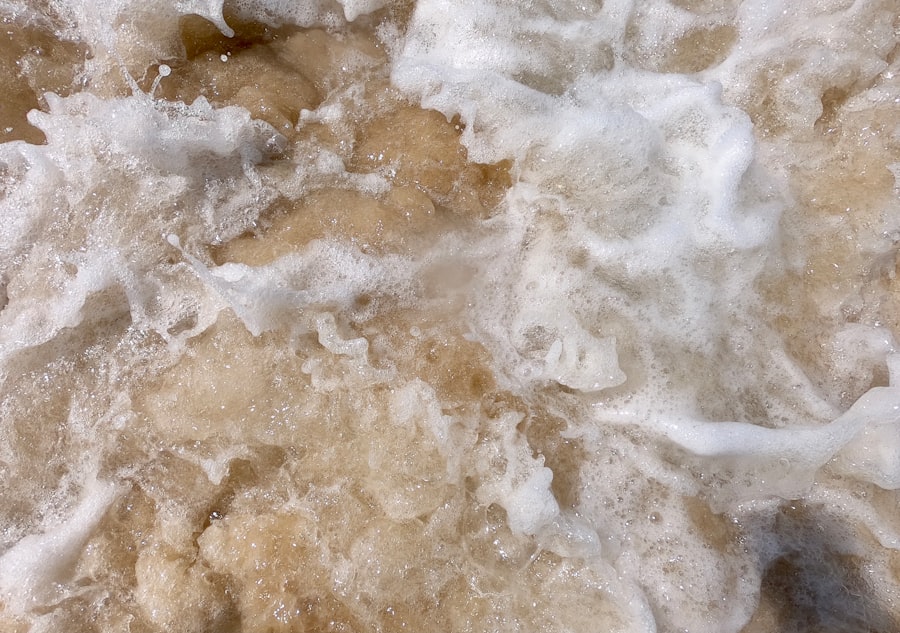
As you explore the relationship between quantum foam and spacetime, it becomes clear that this concept fundamentally alters your understanding of how the universe operates. Traditionally, spacetime has been viewed as a rigid framework within which events occur. However, with the introduction of quantum foam, you are invited to consider a more fluid and dynamic model.
In this view, spacetime is not merely a passive stage but an active participant in the unfolding drama of existence. The implications of this perspective are profound. If spacetime is indeed “foamy,” then it suggests that events at the quantum level can have cascading effects on larger scales.
For instance, fluctuations in spacetime could influence the behavior of particles and fields, leading to phenomena that challenge our current models of physics. This interconnectedness between quantum foam and spacetime invites you to ponder how these tiny fluctuations might ripple through the cosmos, affecting everything from atomic interactions to the formation of galaxies.
Quantum Foam and the Uncertainty Principle
| Concept | Description |
|---|---|
| Quantum Foam | A concept in quantum mechanics that suggests that spacetime is not smooth and continuous, but rather fluctuates at very small scales. |
| Uncertainty Principle | A fundamental principle in quantum mechanics that states that certain pairs of physical properties, such as position and momentum, cannot be simultaneously known to arbitrary precision. |
| Quantum Fluctuations | Small, temporary changes in the amount of energy in a point in space, arising from the uncertainty principle and giving rise to the concept of quantum foam. |
The uncertainty principle, a cornerstone of quantum mechanics formulated by Werner Heisenberg, states that certain pairs of physical properties cannot be simultaneously known with arbitrary precision. This principle has far-reaching implications for your understanding of quantum foam. As you consider how uncertainty manifests at the Planck scale, it becomes evident that quantum foam embodies this principle in a tangible way.
In essence, quantum foam represents a realm where uncertainty reigns supreme. The fluctuations in spacetime mean that particles cannot have well-defined positions or momenta at this scale. Instead, they exist in a state of constant flux, embodying the very essence of uncertainty.
This realization prompts you to reflect on how these fundamental uncertainties might influence larger physical systems and contribute to phenomena such as particle interactions and gravitational effects.
Quantum Foam and Black Holes
The relationship between quantum foam and black holes is another captivating aspect of this concept. Black holes are regions in spacetime where gravity is so intense that nothing can escape their grasp. As you explore this connection, you may find it fascinating to consider how quantum foam could play a role in the formation and behavior of black holes.
One intriguing possibility is that quantum fluctuations at the event horizon—the boundary surrounding a black hole—could lead to phenomena such as Hawking radiation. This theoretical prediction suggests that black holes can emit radiation due to quantum effects near their event horizons, ultimately leading to their slow evaporation over time. As you contemplate this interplay between quantum foam and black holes, you are encouraged to consider how these ideas might reshape our understanding of gravity and information loss in black hole physics.
Quantum Foam and the Big Bang

The origins of the universe are shrouded in mystery, but quantum foam offers a unique lens through which to examine the Big Bang. As you reflect on this monumental event, consider how fluctuations in spacetime could have played a crucial role in shaping the early universe. The chaotic nature of quantum foam may have contributed to the rapid expansion known as cosmic inflation, which occurred shortly after the Big Bang.
In this context, you might find it compelling to think about how quantum foam could have influenced the distribution of matter and energy in the nascent universe. The tiny fluctuations present in quantum foam may have seeded the formation of galaxies and large-scale structures we observe today. By connecting quantum foam with the Big Bang, you are invited to explore how these fundamental concepts intertwine to create a cohesive narrative about the origins and evolution of our universe.
Experimental Evidence for Quantum Foam
While much of the discussion surrounding quantum foam is theoretical, researchers are actively seeking experimental evidence to support its existence. As you delve into this area, you may find it intriguing that various approaches are being explored to probe the nature of spacetime at extremely small scales. One promising avenue involves high-energy particle collisions conducted at facilities like CERN’s Large Hadron Collider (LHC).
These experiments aim to detect signatures of quantum foam by observing how particles behave under extreme conditions. For instance, researchers are investigating whether deviations from expected particle interactions could indicate underlying fluctuations in spacetime. Additionally, advancements in technology may allow scientists to explore gravitational waves and their potential connections to quantum foam.
As you consider these experimental efforts, you are reminded that uncovering evidence for quantum foam could revolutionize our understanding of fundamental physics.
Quantum Foam and Quantum Gravity
The quest for a theory of quantum gravity—a framework that unifies general relativity with quantum mechanics—has long been a holy grail for physicists. In this pursuit, quantum foam emerges as a critical concept that may bridge these two seemingly disparate realms. As you explore this intersection, you may find it fascinating to consider how understanding quantum foam could lead to breakthroughs in our comprehension of gravity at microscopic scales.
One approach to developing a theory of quantum gravity involves examining how spacetime behaves under extreme conditions influenced by quantum foam. By studying these interactions, researchers hope to uncover insights into phenomena such as singularities and the behavior of gravity at very small distances. As you engage with these ideas, you are encouraged to reflect on how advancements in our understanding of quantum foam could pave the way for a more comprehensive theory that reconciles gravity with quantum mechanics.
Applications of Quantum Foam in Physics
The implications of quantum foam extend beyond theoretical considerations; they also hold potential applications across various fields within physics. As you explore these applications, consider how insights gained from studying quantum foam could inform advancements in technology and our understanding of fundamental processes. For instance, researchers are investigating how principles derived from quantum foam might influence developments in quantum computing and information theory.
The inherent uncertainties associated with quantum foam could provide new avenues for harnessing information at unprecedented speeds and efficiencies. Additionally, understanding spacetime fluctuations may lead to innovations in fields such as cosmology and astrophysics, where researchers seek to unravel mysteries related to dark matter and dark energy.
Challenges and Controversies in Quantum Foam Research
Despite its intriguing potential, research into quantum foam is not without challenges and controversies. As you navigate this landscape, you may encounter debates surrounding the interpretation and implications of quantum foam within established frameworks of physics. One significant challenge lies in reconciling different theoretical approaches—such as string theory and loop quantum gravity—that offer competing perspectives on spacetime’s fundamental nature.
The Planck scale is incredibly small, making direct observations exceedingly difficult with current technology. As researchers strive to develop innovative methods for probing these scales, they must also contend with philosophical questions about what constitutes evidence in theoretical physics.
Engaging with these challenges invites you to consider not only the scientific aspects but also the broader implications for our understanding of reality.
The Future of Quantum Foam Research
Looking ahead, the future of quantum foam research holds immense promise as scientists continue to explore its implications across various domains within physics. As technology advances and experimental techniques improve, you may witness breakthroughs that deepen our understanding of spacetime’s fundamental nature. In particular, ongoing efforts to develop unified theories that incorporate both general relativity and quantum mechanics will likely shed light on unresolved questions surrounding gravity and spacetime fluctuations.
As researchers collaborate across disciplines—combining insights from theoretical physics with experimental data—the potential for transformative discoveries becomes increasingly tangible. You are invited to remain engaged with this evolving field as it unfolds, offering new perspectives on some of humanity’s most profound questions about existence itself. In conclusion, your exploration into quantum foam reveals a rich tapestry woven from theoretical insights and experimental endeavors that challenge conventional notions about reality.
From its roots in fundamental physics to its potential applications across various fields, quantum foam serves as a reminder that our understanding of the universe is still evolving—inviting curiosity and wonder as we seek answers to some of life’s most profound mysteries.
Quantum foam, a concept introduced by physicist John Wheeler, refers to the idea that at the smallest scales of the universe, space-time is not smooth but rather frothy and turbulent due to quantum fluctuations. This intriguing notion suggests that the very fabric of the universe is constantly in flux, with particles popping in and out of existence. For those interested in exploring more about the fascinating implications of quantum foam and its role in the broader context of quantum mechanics and cosmology, a related article can be found on