Jupiter, the largest planet in the solar system, is not only renowned for its immense size and striking bands of color but also for its remarkable collection of moons. With over 79 known moons, Jupiter’s satellite system is a fascinating subject of study for astronomers and planetary scientists alike. Among these moons, four stand out due to their unique characteristics and geological features: Io, Europa, Ganymede, and Callisto.
Collectively known as the Galilean moons, these celestial bodies were discovered by Galileo Galilei in 1610 and have since become focal points for understanding the complexities of planetary geology and the potential for extraterrestrial life. The Galilean moons present a diverse array of geological phenomena, each offering insights into the processes that shape celestial bodies. Io is famous for its extreme volcanic activity, while Europa is characterized by its icy surface and subsurface ocean.
Ganymede, the largest moon in the solar system, boasts a unique combination of geological features, and Callisto presents a more heavily cratered landscape. Together, these moons provide a rich tapestry of geological history and ongoing processes that continue to intrigue scientists and inspire future exploration.
Key Takeaways
- Jupiter’s moons have diverse geology and potential for life
- Io is the most geologically active body in the solar system
- Io’s volcanic activity is driven by tidal heating from Jupiter
- Europa’s surface features suggest a subsurface ocean and potential for life
- Ganymede is the largest moon in the solar system and shows evidence of tectonic activity
- Callisto has a varied geology with impact craters and ancient plains
- Future exploration will focus on understanding the geology and potential for life on Jupiter’s moons
The Geology of Io
Io, the innermost of the Galilean moons, is a world defined by its intense geological activity. Its surface is dotted with hundreds of volcanoes, some of which are among the most active in the solar system. The geology of Io is primarily shaped by tidal heating, a phenomenon caused by the gravitational pull exerted by Jupiter and the other Galilean moons.
This gravitational interaction generates immense internal heat, leading to the moon’s dynamic surface and constant reshaping. The surface of Io is a vibrant mosaic of colors, with sulfur and sulfur dioxide giving it a yellowish hue, while darker regions are composed of silicate rock. The geological features on Io include vast lava plains, towering volcanic mountains, and extensive lava flows that can stretch for hundreds of kilometers.
The constant volcanic activity not only alters the landscape but also contributes to a thin atmosphere composed mainly of sulfur dioxide. This unique geological environment makes Io one of the most intriguing bodies in the solar system for studying volcanic processes and their implications for planetary evolution.
The Volcanic Activity on Io
The volcanic activity on Io is nothing short of extraordinary. With over 400 active volcanoes, Io is the most volcanically active body in the solar system. The eruptions on Io can be incredibly powerful, with some reaching heights of up to 500 kilometers into space.
These eruptions are primarily driven by the intense heat generated from tidal forces, which cause the moon’s interior to remain molten and facilitate the movement of magma to the surface. One of the most notable volcanic features on Io is Loki Patera, a massive volcanic depression that is home to one of the largest lava lakes in the solar system. Observations from spacecraft such as Galileo and Juno have revealed that Loki Patera undergoes periodic changes in brightness, indicating ongoing volcanic activity beneath its surface.
The eruptions on Io not only reshape its landscape but also contribute to its thin atmosphere, as gases released during volcanic events escape into space. This continuous cycle of eruption and atmospheric loss makes Io a prime candidate for studying volcanic processes in extraterrestrial environments.
The Surface Features of Europa
| Surface Feature | Description |
|---|---|
| Ridges | Long, linear features caused by tectonic processes |
| Craters | Impact scars from collisions with space debris |
| Lineae | Dark, linear features possibly related to subsurface water |
| Lenticulae | Irregularly shaped, bright or dark regions on the surface |
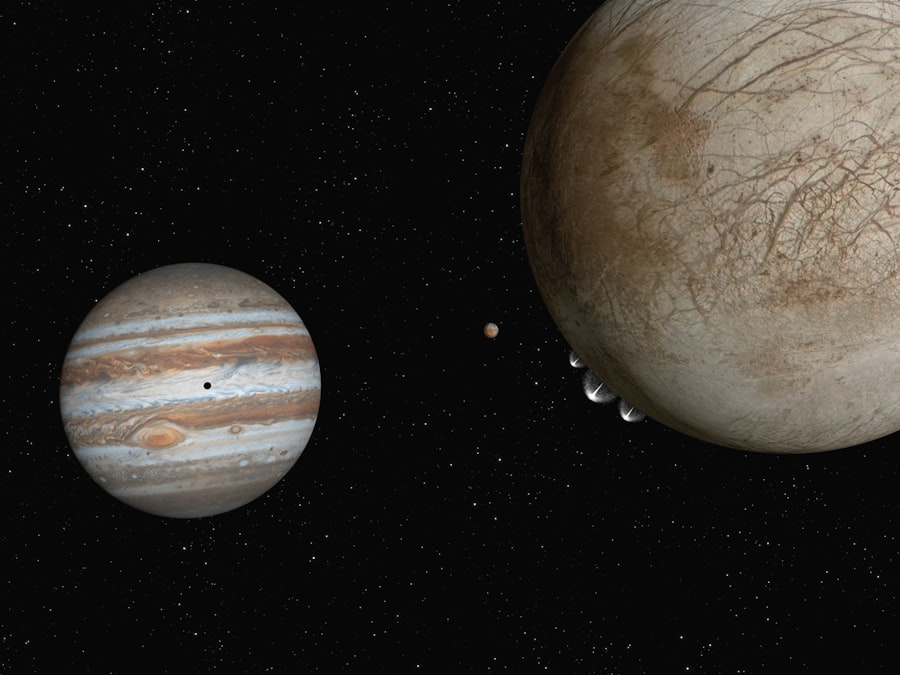
Europa, the second Galilean moon, presents a stark contrast to its volcanic neighbor Io. Its surface is primarily composed of water ice, which has been shaped by a variety of geological processes. The most striking features on Europa’s surface are its linear ridges and cracks, which suggest that the icy crust is floating on a subsurface ocean.
This ocean is believed to be in contact with Europa’s rocky mantle, creating conditions that may be conducive to life. The surface features of Europa are not only visually captivating but also scientifically significant. The presence of chaos terrain—regions where the ice has broken apart and been reassembled—indicates that there may be active geological processes at work beneath the surface.
Additionally, plumes of water vapor have been detected erupting from Europa’s surface, further supporting the idea that there is an ocean beneath the ice. These features make Europa one of the most promising locations in the search for extraterrestrial life within our solar system.
The Potential for Life on Europa
The potential for life on Europa has captivated scientists for decades. The existence of a subsurface ocean beneath its icy crust raises intriguing questions about habitability. This ocean may contain more than twice the amount of water found on Earth, providing a vast environment where life could potentially thrive.
The interaction between this ocean and Europa’s rocky mantle could create chemical reactions similar to those that support life in Earth’s deep-sea hydrothermal vents. Moreover, the detection of organic compounds on Europa’s surface adds another layer to its potential for hosting life. These compounds are essential building blocks for life as we know it and suggest that Europa may have the necessary ingredients for biological processes.
Future missions aimed at exploring Europa will focus on understanding its ocean’s composition and searching for signs of life, making it a key target in astrobiology research.
Ganymede: The Largest Moon in the Solar System
Ganymede stands out not only as one of Jupiter’s moons but also as the largest moon in the entire solar system. With a diameter greater than that of Mercury, Ganymede possesses a unique combination of geological features that make it an intriguing subject for study. Its surface is characterized by a mix of two types of terrain: bright regions marked by ridges and grooves and darker areas filled with impact craters.
The geological history of Ganymede is complex, shaped by both internal processes and external impacts. Its icy crust is believed to cover a subsurface ocean, similar to Europa, which raises questions about its potential habitability. Ganymede’s magnetic field is another fascinating aspect; it is the only moon known to generate its own magnetic field, likely due to a partially liquid iron or iron-sulfide core.
This unique feature sets Ganymede apart from other moons and adds to its scientific significance.
The Tectonic Activity on Ganymede
Ganymede’s surface displays evidence of tectonic activity that has shaped its landscape over millions of years. The presence of ridges and grooves suggests that tectonic forces have caused the icy crust to stretch and crack, creating a complex network of features. These tectonic processes may be driven by the gravitational interactions with Jupiter and other Galilean moons, similar to what occurs on Io.
The bright regions on Ganymede are thought to be younger than the darker areas filled with craters, indicating that tectonic activity has played a significant role in resurfacing parts of the moon. This ongoing geological activity provides insights into Ganymede’s internal structure and thermal evolution. Understanding these tectonic processes is crucial for piecing together Ganymede’s geological history and assessing its potential for hosting life.
Callisto: A Moon with a Varied Geology
Callisto, the outermost Galilean moon, presents a different geological profile compared to its siblings. Its surface is heavily cratered and shows little evidence of recent geological activity, making it one of the oldest landscapes in the solar system. The lack of significant tectonic or volcanic activity suggests that Callisto has remained relatively unchanged over billions of years.
The presence of large impact basins indicates that it has experienced significant collisions throughout its history. Additionally, some scientists believe that Callisto may harbor a subsurface ocean beneath its icy crust, similar to Europa and Ganymede.
This possibility adds an intriguing dimension to Callisto’s geological profile and raises questions about its potential habitability.
Impact Craters on Callisto
The impact craters on Callisto provide valuable insights into its geological history and evolution. With an estimated age of over four billion years, Callisto’s surface bears witness to countless collisions with asteroids and comets. The craters vary in size and shape, with some being relatively small while others are massive basins that dominate large portions of the moon’s surface.
One notable feature is Valhalla, one of the largest impact basins in the solar system, measuring approximately 4,000 kilometers in diameter. Surrounding this basin are concentric rings formed by the shock waves generated during the impact event. The preservation of these craters indicates that Callisto has experienced minimal geological resurfacing since their formation, providing scientists with a unique opportunity to study ancient impacts and their effects on celestial bodies.
Comparing the Geology of Jupiter’s Moons
The Galilean moons present a fascinating study in contrasts when it comes to their geology.
Meanwhile, Ganymede showcases tectonic features alongside its vast size, while Callisto offers a heavily cratered landscape that speaks to its ancient history.
These differences highlight how various geological processes can shape celestial bodies under different conditions. Tidal heating plays a crucial role in Io’s volcanism, while Europa’s icy shell may be influenced by internal ocean dynamics. Ganymede’s tectonic activity suggests an active interior despite its size, whereas Callisto’s heavily cratered surface reflects a more stable environment over time.
By comparing these moons’ geology, scientists can gain insights into planetary formation and evolution across our solar system.
The Future of Geology Exploration on Jupiter’s Moons
The future exploration of Jupiter’s moons holds great promise for advancing our understanding of planetary geology and astrobiology. Upcoming missions such as NASA’s Europa Clipper aim to investigate Europa’s ice shell and subsurface ocean in detail while searching for signs of habitability. Additionally, ESA’s Jupiter Icy Moons Explorer (JUICE) mission will study Ganymede, Callisto, and Europa to uncover their geological histories and potential for life.
These missions will employ advanced instruments capable of analyzing surface compositions, mapping geological features, and detecting subsurface oceans or ice layers. As technology continues to evolve, scientists hope to unlock more secrets about these fascinating moons and their roles within our solar system’s broader context. The exploration of Jupiter’s moons promises not only to enhance our knowledge of planetary geology but also to deepen our understanding of life’s potential beyond Earth.
Jupiter’s moons have long fascinated scientists due to their diverse geological features, which range from volcanic activity on Io to the icy crust of Europa. A related article that delves into the intriguing geology of these celestial bodies can be found on My Cosmic Ventures. This article explores the dynamic processes shaping the moons’ surfaces and the potential for subsurface oceans, particularly on Europa, which could harbor conditions suitable for life. For more in-depth insights, you can read the full article by visiting My Cosmic Ventures.
WATCH THIS! The Secret Ocean of Europa: Why NASA is Hunting for Alien Life Beneath the Ice
FAQs
What is the geology of Jupiter’s moons?
Jupiter’s moons have a diverse range of geological features, including impact craters, volcanic activity, and tectonic processes. Each moon has its own unique geological history and composition.
What are some examples of geological features on Jupiter’s moons?
Some examples of geological features on Jupiter’s moons include the large impact basins on Callisto, the volcanic activity on Io, and the tectonic features on Europa.
What causes the geological activity on Jupiter’s moons?
The geological activity on Jupiter’s moons is primarily driven by tidal forces from Jupiter and the other moons. These forces cause heating and deformation of the moons’ interiors, leading to volcanic activity, tectonic processes, and other geological features.
How do scientists study the geology of Jupiter’s moons?
Scientists study the geology of Jupiter’s moons using a combination of spacecraft observations, remote sensing data, and computer modeling. Missions such as the Galileo spacecraft and the upcoming Europa Clipper mission have provided valuable data on the geology of these moons.
What can the study of Jupiter’s moons’ geology tell us about the solar system?
Studying the geology of Jupiter’s moons can provide insights into the formation and evolution of the solar system. It can also help scientists understand the potential for habitability on other worlds, as well as the processes that drive geological activity in planetary bodies.