
Astronomy, the scientific study of celestial bodies and the universe as a whole, has captivated human imagination for centuries. From the ancient civilizations that gazed at the stars to modern-day scientists utilizing advanced telescopes and space probes, the quest to understand the cosmos has been a fundamental aspect of human curiosity. Astrobiology, a relatively new interdisciplinary field, merges the principles of astronomy with biology to explore the potential for life beyond Earth.
This burgeoning discipline seeks to answer profound questions about the existence of extraterrestrial life and the conditions necessary for life to thrive in the vast expanse of the universe. The intersection of these two fields has led to groundbreaking discoveries and theories that challenge our understanding of life itself. As astronomers uncover new planets and celestial phenomena, astrobiologists analyze these findings to assess their implications for life beyond our planet.
The synergy between astronomy and astrobiology not only enhances our knowledge of the universe but also deepens our appreciation for the delicate balance that sustains life on Earth. Together, they form a dynamic partnership that propels humanity’s quest to answer one of its most enduring questions: Are we alone in the universe?
Key Takeaways
- Astronomy provides essential tools and knowledge for understanding the potential for life beyond Earth.
- The search for extraterrestrial life focuses on identifying habitable planets and conditions suitable for life.
- Water is a critical factor in astrobiology, as it is essential for life as we know it.
- Studying extreme environments on Earth helps scientists understand where life might exist elsewhere in the universe.
- Advances in technology are driving future discoveries in both astronomy and astrobiology, expanding our understanding of life’s origins and existence.
The Search for Extraterrestrial Life
The search for extraterrestrial life is one of the most exhilarating endeavors in modern science. It encompasses a wide range of activities, from analyzing data collected by space missions to developing theoretical models that predict where life might exist beyond Earth. Scientists have long speculated about the possibility of life on other planets, driven by the realization that the universe is vast and diverse.
The discovery of extremophiles—organisms that thrive in extreme conditions on Earth—has further fueled this interest, suggesting that life could potentially exist in environments previously thought to be inhospitable. Various missions have been launched with the primary goal of finding signs of life beyond our planet. The Mars rovers, for instance, have been equipped with sophisticated instruments designed to detect organic compounds and analyze soil samples for microbial life.
Similarly, missions to the icy moons of Jupiter and Saturn, such as Europa and Enceladus, aim to explore subsurface oceans that may harbor life. The search for extraterrestrial intelligence (SETI) also plays a crucial role in this quest, employing radio telescopes to listen for signals from advanced civilizations. Each of these efforts contributes to a growing body of evidence that suggests life may be more common in the universe than previously thought.
The Role of Astronomy in Astrobiology
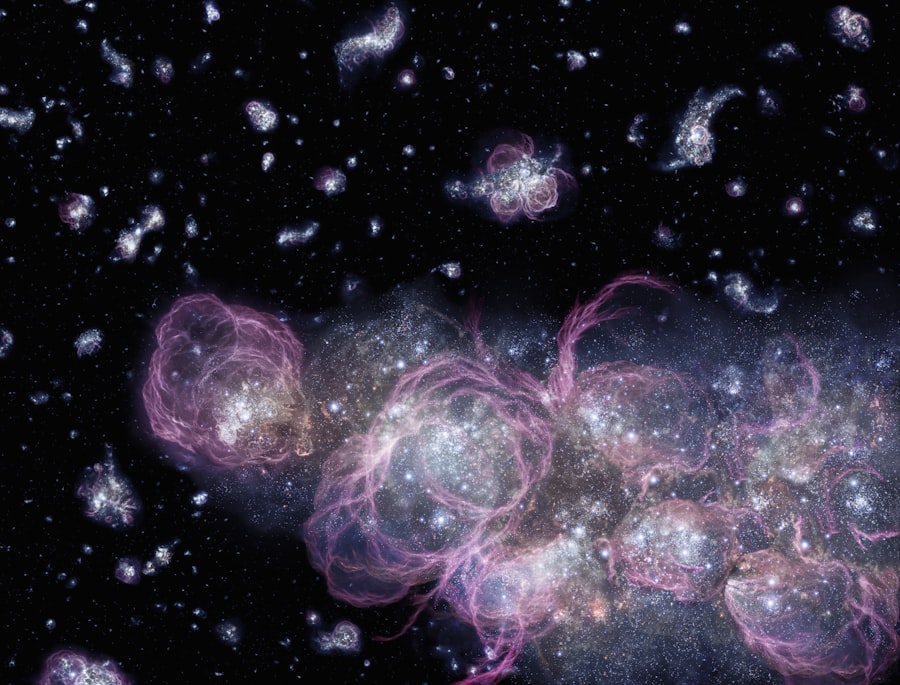
Astronomy serves as the backbone of astrobiology, providing essential data and insights that inform our understanding of potential habitats for life beyond Earth. By studying celestial bodies, astronomers can identify planets within the habitable zone—regions around stars where conditions may be suitable for liquid water to exist. This knowledge is critical, as water is considered a fundamental ingredient for life as we know it.
Furthermore, advancements in observational technology have allowed astronomers to detect exoplanets with increasing precision, opening up new avenues for astrobiological research. The study of stellar environments also plays a significant role in astrobiology. Different types of stars emit varying levels of radiation and heat, which can influence the development of planetary atmospheres and surface conditions.
Understanding these stellar characteristics helps astrobiologists assess whether a given planet could support life. Additionally, astronomical observations can reveal the chemical composition of distant worlds, providing clues about their potential habitability. Thus, astronomy not only enhances our understanding of the universe but also lays the groundwork for exploring life’s possibilities beyond Earth.
The Study of Exoplanets
The discovery of exoplanets—planets orbiting stars outside our solar system—has revolutionized the field of astronomy and astrobiology alike. Since the first confirmed detection in 1992, thousands of exoplanets have been identified, each offering unique insights into planetary formation and potential habitability. The diversity of these worlds challenges traditional notions about what constitutes a “habitable” environment, prompting scientists to broaden their criteria for assessing where life might exist.
Exoplanet studies involve various techniques, including transit photometry and radial velocity measurements, which allow astronomers to infer a planet’s size, mass, and orbital characteristics.
These discoveries are crucial for astrobiologists seeking to understand how common habitable conditions are in the universe.
The Search for Habitable Planets
| Metric | Description | Example Value |
|---|---|---|
| Distance to Nearest Star | Distance from Earth to Proxima Centauri | 4.24 light years |
| Number of Confirmed Exoplanets | Total exoplanets discovered and confirmed | 5,500+ |
| Habitable Zone Range | Distance range from a star where liquid water can exist | 0.95 – 1.37 AU (for Sun-like stars) |
| Age of the Universe | Estimated time since the Big Bang | 13.8 billion years |
| Number of Known Organic Molecules in Space | Count of complex organic molecules detected in interstellar medium | Over 200 |
| Percentage of Water on Earth | Proportion of Earth’s surface covered by water | 71% |
| Estimated Number of Earth-like Planets in Milky Way | Planets in habitable zones around Sun-like stars | ~6 billion |
| Atmospheric Oxygen Level on Earth | Percentage of oxygen in Earth’s atmosphere | 21% |
Identifying habitable planets is a central goal in astrobiology, as it directly relates to the search for extraterrestrial life. Scientists focus on several key factors when determining a planet’s habitability, including its distance from its host star, atmospheric composition, and geological activity. The concept of the “Goldilocks Zone,” where conditions are “just right” for liquid water to exist, serves as a guiding principle in this search.
In addition to traditional criteria based on Earth-like conditions, researchers are increasingly considering alternative forms of life that may thrive in environments vastly different from our own. For instance, some scientists speculate about the potential for life on gas giants or within subsurface oceans on icy moons. This expanded definition of habitability encourages a more inclusive approach to searching for life beyond Earth.
As astronomers continue to discover new exoplanets, they refine their methods for assessing habitability, paving the way for future explorations that may uncover signs of life in unexpected places.
The Origins of Life in the Universe

Understanding the origins of life is one of the most profound questions in both biology and astrobiology. Researchers explore various hypotheses regarding how life may have emerged on Earth and whether similar processes could occur elsewhere in the universe. One prominent theory suggests that life began in hydrothermal vents on the ocean floor, where chemical reactions provided energy and nutrients necessary for early organisms to thrive.
Astrobiologists also investigate panspermia—the idea that life could be distributed throughout the universe via comets or meteorites. This concept raises intriguing possibilities about life’s resilience and adaptability across different environments. By studying extremophiles on Earth and simulating extraterrestrial conditions in laboratories, scientists aim to uncover clues about how life might arise under diverse circumstances.
These investigations not only enhance our understanding of life’s origins but also inform the search for biosignatures on other planets.
The Importance of Water in Astrobiology
Water is often referred to as the “universal solvent,” playing a crucial role in biochemical processes essential for life as we know it. Its unique properties make it an ideal medium for chemical reactions, facilitating the formation of complex organic molecules necessary for biological functions. Consequently, astrobiologists prioritize the search for water when assessing potential habitats beyond Earth.
The presence of liquid water is considered a key indicator of habitability, leading scientists to focus on celestial bodies with evidence of past or present water sources. Mars, with its polar ice caps and signs of ancient riverbeds, remains a prime candidate for exploration. Similarly, moons like Europa and Enceladus are believed to harbor subsurface oceans beneath their icy crusts, raising exciting possibilities for microbial life.
Understanding how water interacts with various environments helps astrobiologists evaluate where life might exist and how it could adapt to different conditions.
The Study of Extreme Environments
The study of extreme environments on Earth has provided valuable insights into the potential for life in harsh conditions elsewhere in the universe. Extremophiles—organisms that thrive in extreme temperatures, pressures, or chemical environments—demonstrate life’s remarkable adaptability and resilience. From deep-sea hydrothermal vents to acidic hot springs and frozen tundras, these organisms challenge traditional notions about where life can exist.
By examining extremophiles, scientists gain insights into how life might survive on other planets or moons with extreme conditions. For example, researchers study organisms that can withstand high radiation levels or extreme salinity to understand how similar adaptations might occur on celestial bodies with harsh environments. This research not only informs astrobiological theories but also enhances our understanding of life’s potential diversity across different worlds.
The Potential for Life on Mars
Mars has long been a focal point in the search for extraterrestrial life due to its similarities to Earth and evidence suggesting it once had liquid water on its surface. The presence of ancient river valleys and polar ice caps indicates that Mars may have had conditions suitable for microbial life billions of years ago. Recent missions have further fueled interest in Mars exploration by discovering organic molecules and seasonal methane emissions—both potential indicators of biological activity.
Current missions like NASA’s Perseverance rover aim to collect samples from Martian soil and rock formations that could provide crucial evidence about past life on the planet. Additionally, future missions are being planned to return these samples to Earth for detailed analysis. The ongoing exploration of Mars not only seeks to uncover its past but also assesses its potential as a future habitat for human colonization.
The Role of Technology in Astrobiology
Technological advancements play a pivotal role in advancing our understanding of astrobiology and enhancing our search for extraterrestrial life. Innovations in telescope design have allowed astronomers to observe distant exoplanets with unprecedented detail, while sophisticated instruments aboard space missions enable scientists to analyze planetary atmospheres and surface compositions. Moreover, advancements in artificial intelligence and machine learning are revolutionizing data analysis in astrobiology research.
These technologies can sift through vast amounts of data collected from telescopes or space missions more efficiently than traditional methods, identifying patterns or anomalies that may indicate signs of life. As technology continues to evolve, it will undoubtedly open new frontiers in our quest to understand life’s potential beyond Earth.
Future Directions in Astronomy and Astrobiology
The future directions in astronomy and astrobiology are filled with promise as researchers continue to push boundaries in their quest for knowledge about the universe and life’s potential within it. Upcoming missions like NASA’s James Webb Space Telescope aim to provide unprecedented insights into exoplanet atmospheres and search for biosignatures indicative of life. Additionally, international collaborations among space agencies are becoming increasingly common as they pool resources and expertise to tackle complex questions about life’s existence beyond Earth.
As technology advances further, scientists anticipate discovering new celestial bodies that may harbor conditions suitable for life or uncovering evidence that challenges existing theories about life’s origins. In conclusion, astronomy and astrobiology together form an exciting frontier at the intersection of science and philosophy—a journey into understanding not only our place in the cosmos but also whether we share it with other forms of life. As humanity continues its exploration into space, each discovery brings us closer to answering one of our most profound questions: Are we alone?
In the fascinating intersection of astronomy and astrobiology, the exploration of exoplanets has become a pivotal area of research. A related article that delves into the potential for life beyond Earth can be found at this link. It discusses the latest discoveries in the search for habitable worlds and the implications for our understanding of life in the universe.
FAQs
What is astronomy?
Astronomy is the scientific study of celestial objects, space, and the universe as a whole. It involves observing and analyzing stars, planets, galaxies, and other phenomena beyond Earth’s atmosphere.
What does astrobiology study?
Astrobiology is the interdisciplinary field that studies the origin, evolution, distribution, and future of life in the universe. It combines biology, chemistry, geology, and astronomy to explore the potential for life beyond Earth.
How are astronomy and astrobiology related?
Astronomy provides the observational data about planets, stars, and other celestial bodies, while astrobiology uses this information to investigate the conditions that might support life. Together, they help scientists understand where and how life could exist in the universe.
What tools do astronomers use to study space?
Astronomers use telescopes (optical, radio, and space-based), spectrometers, satellites, and space probes to observe and collect data about celestial objects and phenomena.
What are exoplanets and why are they important in astrobiology?
Exoplanets are planets that orbit stars outside our solar system. They are important in astrobiology because some may have conditions suitable for life, making them prime targets in the search for extraterrestrial life.
Has astrobiology found evidence of life beyond Earth?
As of now, astrobiology has not confirmed the existence of life beyond Earth. However, ongoing research and missions continue to search for signs of past or present life on planets and moons within our solar system and beyond.
What role does the study of extremophiles play in astrobiology?
Extremophiles are organisms that thrive in extreme environments on Earth. Studying them helps astrobiologists understand the potential for life to exist in harsh conditions elsewhere in the universe.
What missions are currently exploring astrobiology questions?
Missions like NASA’s Mars rovers (Perseverance and Curiosity), the James Webb Space Telescope, and upcoming missions to icy moons like Europa and Enceladus are designed to gather data relevant to astrobiology.
Can astronomy help us understand the origin of life on Earth?
Yes, astronomy helps by studying the formation of stars and planetary systems, the distribution of organic molecules in space, and the conditions that may have contributed to the emergence of life on Earth.
What is the significance of the Drake Equation in astrobiology?
The Drake Equation is a formula used to estimate the number of active, communicative extraterrestrial civilizations in the Milky Way galaxy. It helps frame scientific discussions about the likelihood of life elsewhere in the universe.