Spacetime geometry serves as the foundation for modern physics, intertwining the dimensions of space and time into a single continuum. This concept, first popularized by Albert Einstein in his theory of relativity, revolutionized the way scientists perceive the universe. In this framework, the fabric of spacetime is not merely a passive stage where events unfold; rather, it is dynamic and influenced by the mass and energy contained within it.
The curvature of spacetime, dictated by the distribution of matter, leads to the gravitational effects that govern celestial bodies and their interactions. This understanding has profound implications for both theoretical physics and cosmology, as it provides a mathematical structure to describe the universe’s evolution. The geometry of spacetime is often visualized through the analogy of a rubber sheet, where massive objects like stars and planets create indentations that affect the motion of smaller objects nearby.
This model illustrates how gravity is not a force in the traditional sense but rather a manifestation of curved spacetime. As physicists delve deeper into the intricacies of spacetime geometry, they encounter questions about its fundamental nature, particularly at scales where quantum mechanics reigns supreme. The intersection of these two realms—general relativity and quantum mechanics—poses significant challenges, leading to the exploration of theories that seek to unify them.
Key Takeaways
- Loop Quantum Gravity (LQG) offers a framework to describe spacetime geometry using quantum mechanics principles.
- Spacetime is quantized in LQG, implying it has a discrete structure rather than being continuous.
- Spin networks are fundamental in LQG, representing quantum states of spacetime geometry.
- LQG challenges and extends General Relativity by incorporating quantum effects at the Planck scale.
- Experimental verification of LQG remains difficult, with ongoing research focused on finding observable evidence.
Introducing Loop Quantum Gravity
Loop Quantum Gravity (LQG) emerges as a compelling candidate in the quest to reconcile general relativity with quantum mechanics. Unlike string theory, which posits additional dimensions and fundamental strings as the building blocks of the universe, LQG focuses on quantizing spacetime itself. It proposes that spacetime is not a smooth continuum but rather composed of discrete units or “quanta.” This radical departure from classical notions of spacetime geometry opens up new avenues for understanding the universe at its most fundamental level.
At its core, LQG suggests that the fabric of spacetime is woven from loops of quantum fields, which can be visualized as a network of interconnected strands. These loops form a complex structure that captures the essence of gravitational interactions while adhering to the principles of quantum mechanics. By quantizing spacetime, LQG aims to provide insights into phenomena such as black holes and the Big Bang, where traditional theories struggle to offer coherent explanations.
As researchers continue to develop this framework, they uncover intriguing implications for our understanding of reality itself.
The Role of Quantum Mechanics in Spacetime Geometry
Quantum mechanics plays a pivotal role in shaping our understanding of spacetime geometry, particularly in contexts where gravitational forces are strong and quantum effects become significant. In classical physics, spacetime is treated as a smooth manifold, but quantum mechanics introduces inherent uncertainties and probabilistic behaviors that challenge this view. The principles of superposition and entanglement suggest that particles can exist in multiple states simultaneously, leading to questions about how these behaviors manifest in the fabric of spacetime.
In LQG, quantum mechanics is not merely an add-on to classical theories; it fundamentally alters the way spacetime is conceptualized. The quantization process leads to a granular structure of spacetime, where distances and areas are quantized into discrete units. This perspective aligns with the idea that at extremely small scales—on the order of the Planck length—spacetime may exhibit properties that defy classical intuition.
By integrating quantum mechanics into the framework of spacetime geometry, LQG offers a fresh lens through which to examine the universe’s most profound mysteries.
Quantum States and Spacetime Geometry
| Metric | Description | Typical Values / Range | Relevance to Quantum States and Spacetime Geometry |
|---|---|---|---|
| Entanglement Entropy | Measure of quantum entanglement between subsystems | 0 to ln(dim(Hilbert space)) | Quantifies quantum correlations influencing spacetime connectivity |
| Curvature Scalar (R) | Scalar curvature describing spacetime geometry | Varies; e.g., 0 (flat), positive (sphere), negative (hyperbolic) | Determines geometric background for quantum state evolution |
| Quantum State Fidelity | Overlap measure between two quantum states | 0 (orthogonal) to 1 (identical) | Assesses similarity of quantum states in curved spacetime |
| Hawking Temperature | Temperature associated with black hole radiation | Depends on black hole mass; e.g., 10^-8 K for solar mass BH | Links quantum effects to spacetime horizons |
| Geodesic Deviation | Measure of how nearby geodesics converge or diverge | Depends on curvature tensor components | Reflects influence of quantum fluctuations on spacetime paths |
| Density Matrix Purity | Purity of a quantum state, Tr(ρ²) | 0 (maximally mixed) to 1 (pure state) | Indicates coherence of quantum states in curved backgrounds |
| Planck Length | Fundamental length scale in quantum gravity | Approximately 1.616 x 10^-35 meters | Sets scale where quantum states and spacetime geometry unify |
In Loop Quantum Gravity, quantum states play a crucial role in defining the geometry of spacetime. These states represent different configurations of the gravitational field and are characterized by their unique properties. Each quantum state corresponds to a specific arrangement of loops and nodes within the spin network framework, which serves as a mathematical representation of spacetime at the quantum level.
This approach allows physicists to explore how changes in these states can lead to variations in spacetime geometry. The interplay between quantum states and spacetime geometry raises intriguing questions about the nature of reality itself. If spacetime is fundamentally discrete, as LQG suggests, then it challenges traditional notions of continuity and smoothness that have long been held in physics.
The implications extend beyond theoretical considerations; they invite a reevaluation of concepts such as time and causality. As researchers delve deeper into the relationship between quantum states and spacetime geometry, they uncover new insights that could reshape our understanding of the universe.
Loop Quantum Gravity and the Discreteness of Spacetime
One of the most revolutionary aspects of Loop Quantum Gravity is its assertion that spacetime is fundamentally discrete rather than continuous. This idea contrasts sharply with classical physics, where spacetime is viewed as an uninterrupted expanse. In LQG, spacetime is composed of finite loops that create a network-like structure, suggesting that there are minimum measurable units of space and time.
This discreteness has profound implications for various physical phenomena, including black holes and the early universe. The concept of discrete spacetime challenges long-held beliefs about gravity and its effects on matter. In traditional theories, gravity is described as a smooth force acting over continuous distances; however, LQG posits that at extremely small scales, gravity may behave differently due to its quantized nature.
This shift in perspective opens up new avenues for research, prompting scientists to explore how discrete spacetime could influence cosmic events such as inflation or singularities within black holes. As LQG continues to evolve, its implications for our understanding of gravity and spacetime remain a focal point for theoretical physicists.
The Concept of Spin Networks in Loop Quantum Gravity
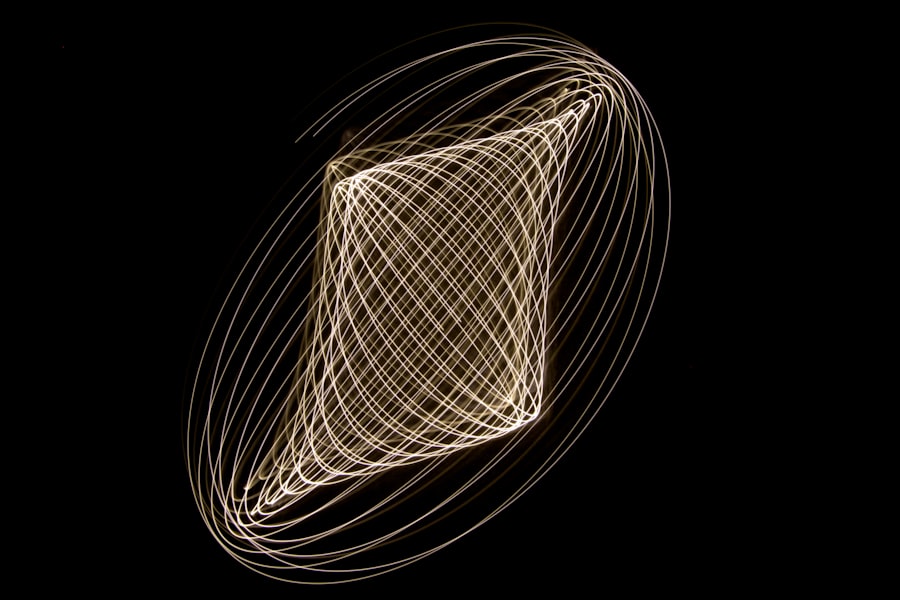
Spin networks are central to Loop Quantum Gravity’s framework, serving as a mathematical representation of quantum states within the theory. These networks consist of nodes and edges that correspond to quantized areas and volumes in spacetime. Each edge carries a “spin” value, which quantifies the amount of area associated with it, while nodes represent points where these edges intersect.
This intricate structure allows physicists to visualize how spacetime is organized at the quantum level. The introduction of spin networks marks a significant departure from traditional geometric representations of spacetime. Instead of viewing spacetime as a smooth continuum, LQG emphasizes its discrete nature through these networks.
The dynamics of spin networks can be studied using mathematical tools from both quantum mechanics and topology, leading to insights about how gravitational interactions manifest at microscopic scales. As researchers continue to explore spin networks, they uncover new relationships between geometry and quantum physics that could reshape our understanding of fundamental forces.
Exploring the Quantum Nature of Spacetime Geometry
The exploration of the quantum nature of spacetime geometry represents one of the most exciting frontiers in theoretical physics. As scientists investigate how quantum mechanics influences gravitational interactions, they confront questions about the very fabric of reality. In Loop Quantum Gravity, this exploration takes on new dimensions as researchers seek to understand how discrete structures like spin networks give rise to familiar geometric properties at larger scales.
This inquiry into quantum spacetime geometry has far-reaching implications for our understanding of cosmological phenomena. For instance, if spacetime exhibits quantum characteristics, it could provide insights into the behavior of black holes or the conditions present during the Big Bang. Additionally, this research may lead to novel predictions about gravitational waves or other observable effects that could be tested through experiments or astronomical observations.
As physicists delve deeper into these questions, they continue to push the boundaries of knowledge regarding the interplay between quantum mechanics and gravity.
The Implications of Loop Quantum Gravity for General Relativity
Loop Quantum Gravity presents profound implications for general relativity, challenging some foundational aspects while seeking to complement others. While general relativity describes gravity as a curvature in smooth spacetime, LQG introduces a quantized perspective that suggests gravity may behave differently at microscopic scales. This divergence raises questions about how well general relativity holds up under extreme conditions—such as those found near black holes or during cosmic inflation.
Moreover, LQG offers potential resolutions to some longstanding puzzles within general relativity itself. For example, it provides insights into singularities—points where gravitational forces become infinite—by suggesting that spacetime may not break down entirely but instead transitions into a different regime governed by quantum effects.
Challenges and Controversies in Loop Quantum Gravity
Despite its promise, Loop Quantum Gravity faces several challenges and controversies within the scientific community. One significant hurdle lies in its mathematical complexity; developing a comprehensive framework that accurately describes all aspects of gravity while remaining consistent with established physics is no small feat. Critics argue that LQG lacks empirical evidence compared to other theories like string theory, which has garnered more attention due to its broader scope and potential connections to particle physics.
Additionally, there are ongoing debates regarding the interpretation of LQG’s results and their implications for our understanding of reality. Some physicists question whether LQG can fully account for phenomena such as dark matter or dark energy—two enigmatic components that dominate our universe yet remain poorly understood within existing frameworks. As researchers continue to grapple with these challenges, they remain committed to refining LQG’s predictions and exploring its potential applications across various domains in physics.
Experimental Evidence for Loop Quantum Gravity
The quest for experimental evidence supporting Loop Quantum Gravity remains an ongoing endeavor within the scientific community. While direct observations are challenging due to the minuscule scales involved in quantum gravity phenomena, researchers have proposed several indirect methods for testing LQG’s predictions. For instance, experiments designed to detect gravitational waves may provide insights into how quantized structures influence wave propagation through spacetime.
Additionally, advancements in observational astronomy offer opportunities to probe cosmic events that could reveal signatures consistent with LQG’s framework. For example, studying black hole mergers or analyzing cosmic microwave background radiation may yield clues about how discrete spacetime affects gravitational interactions on large scales. As technology continues to evolve and experimental techniques improve, physicists remain hopeful that empirical evidence will emerge to validate or challenge Loop Quantum Gravity’s predictions.
The Future of Spacetime Geometry Research in Loop Quantum Gravity
The future of spacetime geometry research within Loop Quantum Gravity holds immense potential for advancing our understanding of fundamental physics. As theoretical frameworks continue to evolve and experimental techniques improve, researchers are poised to explore new avenues that could reshape our comprehension of gravity and its relationship with quantum mechanics. Collaborative efforts across disciplines—ranging from mathematics to astrophysics—will be essential in addressing unresolved questions surrounding LQG.
Moreover, ongoing developments in computational methods may facilitate more sophisticated simulations that capture complex interactions within quantized spacetime structures. These advancements could lead to novel predictions about cosmic phenomena or provide insights into previously unexplored realms of theoretical physics. As scientists embark on this journey into uncharted territory, they remain committed to unraveling the mysteries surrounding spacetime geometry and its implications for our understanding of reality itself.
In exploring the intricate geometry of spacetime within the framework of Loop Quantum Gravity (LQG), one can gain valuable insights from the article available on My Cosmic Ventures. This resource delves into the fundamental aspects of how spacetime is quantized and the implications this has for our understanding of the universe.
mycosmicventures.com/).
WATCH THIS! The Universe Has a Resolution Limit (And We’ve Hit It)
FAQs
What is Loop Quantum Gravity (LQG)?
Loop Quantum Gravity is a theoretical framework that aims to describe the quantum properties of gravity. It attempts to merge quantum mechanics and general relativity by quantizing spacetime itself, rather than treating gravity as a force within a fixed spacetime background.
How does LQG describe the geometry of spacetime?
In LQG, spacetime geometry is quantized and represented by discrete structures called spin networks. These networks consist of nodes and links that encode quantum states of the gravitational field, implying that space is made up of finite, indivisible units at the Planck scale.
What are spin networks in LQG?
Spin networks are graphs with edges labeled by spins (quantum numbers) and nodes representing quantum states of geometry. They provide a mathematical description of the quantum geometry of space, where the edges correspond to quantized areas and the nodes correspond to quantized volumes.
How does LQG differ from other quantum gravity theories?
Unlike string theory, which posits fundamental one-dimensional strings and extra dimensions, LQG focuses on quantizing spacetime itself without requiring additional dimensions or entities. It is a background-independent approach, meaning it does not assume a fixed spacetime geometry.
What is the significance of quantized geometry in LQG?
Quantized geometry implies that space and time have a discrete structure at the smallest scales, preventing the infinities that arise in classical theories. This discreteness could resolve singularities such as those found in black holes and the Big Bang.
Can LQG explain the nature of time?
LQG treats time differently from classical physics. Time emerges from the quantum states of geometry and matter rather than existing as a fixed background parameter. This leads to a relational concept of time, where time is defined through changes in quantum states.
What are the main challenges facing LQG?
Key challenges include deriving classical spacetime and general relativity as low-energy limits of the theory, making testable predictions, and unifying LQG with the Standard Model of particle physics.
Has LQG been experimentally verified?
As of now, LQG remains a theoretical framework without direct experimental confirmation. However, researchers are exploring potential observational signatures, such as effects on cosmic microwave background radiation or black hole physics.
How does LQG handle black holes and singularities?
LQG suggests that the quantization of spacetime geometry can eliminate classical singularities by replacing them with finite quantum states. This could provide a resolution to the infinite densities predicted by classical general relativity inside black holes.
Where can I learn more about the geometry of spacetime in LQG?
To learn more, consider reviewing academic papers, textbooks on quantum gravity, and lectures by experts in the field. Institutions and research groups specializing in quantum gravity often provide accessible resources and updates on recent developments.