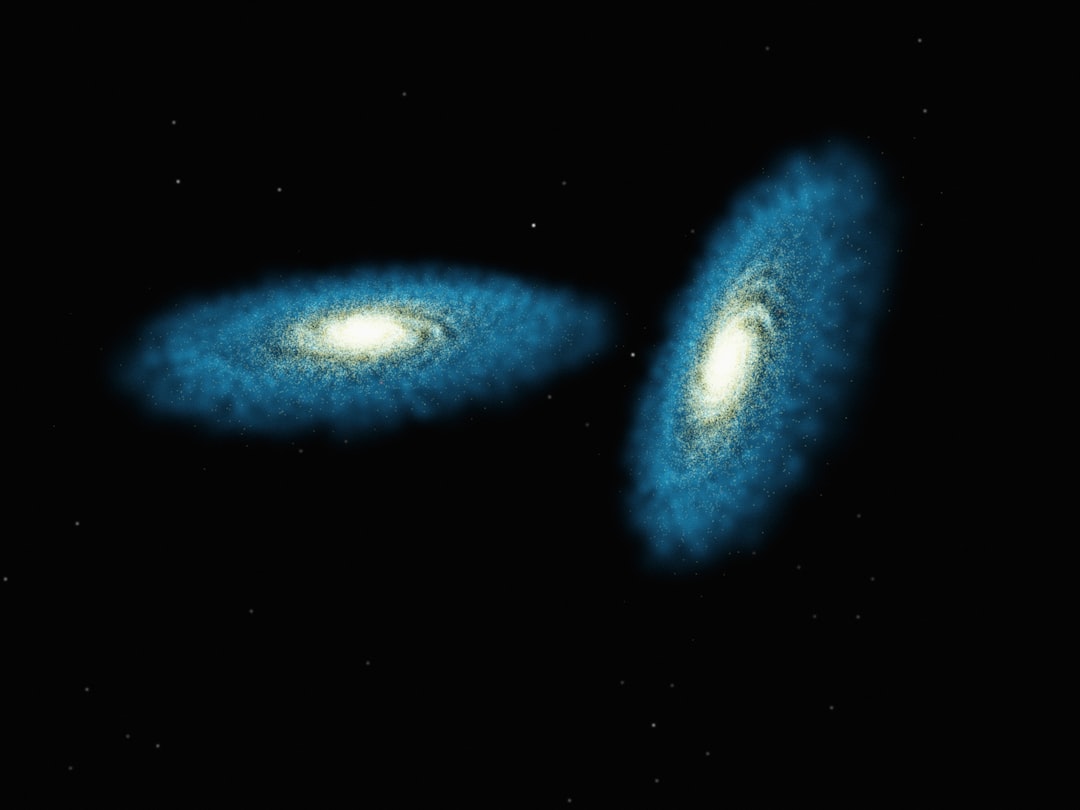
The Big Bang Theory stands as one of the most significant scientific explanations for the origin of the universe. It posits that approximately 13.8 billion years ago, the universe began as an infinitely small, hot, and dense point known as a singularity. This singularity underwent a rapid expansion, leading to the formation of all matter and energy that exists today.
The theory is supported by a wealth of observational evidence, including the abundance of light elements such as hydrogen and helium, as well as the cosmic microwave background radiation that permeates the universe. As scientists delve deeper into the implications of the Big Bang Theory, they uncover a narrative that reshapes humanity’s understanding of existence. The initial moments of the universe were characterized by extreme temperatures and densities, conditions that are difficult to fathom.
However, as the universe expanded and cooled, it allowed for the formation of subatomic particles, which eventually coalesced into atoms. This process laid the groundwork for the stars, galaxies, and ultimately, life itself. The Big Bang Theory not only provides a framework for understanding cosmic history but also raises profound questions about the nature of time and space.
Key Takeaways
- The Big Bang Theory proposes that the universe began as a singularity and has been expanding ever since.
- Cosmic inflation suggests that the universe underwent a rapid expansion in the early stages, leading to its current size.
- Dark energy is a mysterious force that is driving the universe’s expansion at an accelerating rate.
- Hubble’s Law states that the further a galaxy is from us, the faster it is moving away, indicating the universe’s expansion.
- The fate of the universe is still uncertain, with theories suggesting it may continue to expand forever or eventually collapse.
The Expansion of Space: How the Universe Grows
The concept of an expanding universe revolutionized astrophysics and cosmology. Edwin Hubble’s observations in the 1920s revealed that galaxies are moving away from each other, suggesting that space itself is stretching. This expansion is not merely a movement through space; rather, it is space itself that is growing.
As galaxies recede from one another, they leave behind a vast expanse that continues to evolve. This phenomenon can be likened to dots on a balloon being pushed apart as it inflates; as the balloon expands, the distance between the dots increases. The implications of this expansion are profound.
It suggests that the universe has a dynamic nature, constantly changing and evolving over time. The rate of this expansion has been a subject of intense study, leading to discoveries about the universe’s age and its ultimate fate. As astronomers measure the redshift of distant galaxies, they gather crucial data that informs our understanding of cosmic evolution.
The expansion of space challenges traditional notions of a static universe and invites further exploration into the forces driving this remarkable growth.
Cosmic Inflation: The Rapid Expansion of the Early Universe
Cosmic inflation is a theory that addresses some of the puzzles left by the Big Bang Theory. Proposed in the 1980s by physicist Alan Guth, inflation posits that in the first moments after the Big Bang, the universe underwent an exponential expansion. This rapid growth smoothed out any irregularities and led to a uniform distribution of matter and energy across vast distances.
Inflationary theory provides a compelling explanation for why the universe appears so homogeneous on large scales. The implications of cosmic inflation extend beyond mere uniformity; they also offer insights into the formation of structures within the universe. As inflation slowed down, quantum fluctuations in energy density became magnified, leading to variations that would eventually give rise to galaxies and clusters of galaxies.
This process highlights how inflation not only set the stage for cosmic evolution but also influenced the very fabric of reality itself. By studying cosmic inflation, scientists hope to unlock further secrets about the early universe and its subsequent development.
Dark Energy: The Mysterious Force Driving the Universe’s Expansion
| Topic | Data/Metric |
|---|---|
| Discovery | 1998 |
| Percentage of Universe | 68% |
| Composition | Unknown |
| Effect on Universe | Accelerating expansion |
| Research Challenges | Understanding its nature |
Dark energy is one of the most enigmatic components of modern cosmology. Comprising approximately 68% of the universe, this mysterious force is believed to be responsible for the accelerated expansion observed in recent decades. While its exact nature remains elusive, dark energy acts as a repulsive force counteracting gravity on cosmic scales.
This phenomenon was first identified in 1998 when two independent teams of astronomers discovered that distant supernovae were dimmer than expected, indicating that their light had traveled through an expanding universe. The implications of dark energy are profound and far-reaching.
If dark energy continues to dominate cosmic dynamics, it could lead to a scenario known as the “Big Freeze,” where galaxies drift apart indefinitely until stars burn out and galaxies fade into darkness. Understanding dark energy is crucial for unraveling the mysteries of cosmic expansion and determining how it shapes the future trajectory of the universe.
Hubble’s Law: Observing the Relationship Between Distance and Expansion
Hubble’s Law serves as a cornerstone in our understanding of cosmic expansion. Formulated by Edwin Hubble in 1929, this law states that the velocity at which a galaxy recedes from an observer is directly proportional to its distance from that observer. In simpler terms, more distant galaxies move away faster than those closer to us.
This relationship provides astronomers with a powerful tool for measuring distances in an expanding universe. The significance of Hubble’s Law extends beyond mere observation; it offers insights into the rate of expansion known as the Hubble constant. By determining this constant, scientists can estimate the age of the universe and gain a deeper understanding of its evolution over time.
However, recent measurements have revealed discrepancies in determining the Hubble constant, leading to debates within the scientific community about potential new physics or unknown factors influencing cosmic expansion.
The Fate of the Universe: Will it Expand Forever or Collapse?
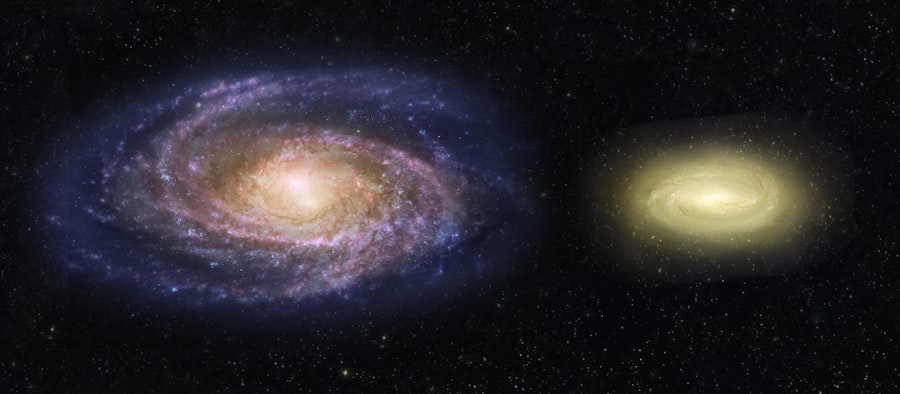
The fate of the universe remains one of cosmology’s most intriguing questions. Current observations suggest two primary scenarios: continued expansion or eventual collapse. If dark energy continues to drive acceleration, it could lead to an infinite expansion where galaxies drift apart indefinitely—a scenario often referred to as “heat death.” In this case, stars would eventually exhaust their nuclear fuel, leaving behind a cold and dark cosmos.
Conversely, if gravitational forces eventually overcome dark energy’s repulsive effects, a “Big Crunch” could occur, where all matter collapses back into a singularity. This scenario raises philosophical questions about cyclical universes and whether our current cosmos is just one iteration in an endless cycle of birth and rebirth. As scientists gather more data and refine their models, they inch closer to answering this profound question about humanity’s place in an ever-expanding or contracting universe.
Cosmic Microwave Background Radiation: Clues to the Universe’s Expansion
The Cosmic Microwave Background Radiation (CMB) serves as a relic from the early universe, providing invaluable insights into its expansion and evolution. Discovered in 1965 by Arno Penzias and Robert Wilson, this faint glow permeates all corners of space and represents thermal radiation from when the universe was just 380,000 years old. At this stage, matter had cooled enough for electrons and protons to combine into hydrogen atoms, allowing photons to travel freely through space.
The CMB carries with it a wealth of information about the universe’s early conditions and subsequent growth patterns. By analyzing its temperature fluctuations and anisotropies, scientists can infer details about cosmic inflation, density variations, and even the composition of matter in the universe. The CMB acts as a snapshot of the infant cosmos, offering clues that help researchers piece together how expansion unfolded over billions of years.
The Role of Gravity in Cosmic Growth
Gravity plays a pivotal role in shaping cosmic structures and influencing expansion dynamics. While dark energy drives accelerated expansion on large scales, gravity acts as an attractive force that pulls matter together. This duality creates a delicate balance between expansion and contraction within galaxies and galaxy clusters.
As matter clumps together under gravity’s influence, it forms stars, planets, and other celestial bodies. Understanding gravity’s role in cosmic growth is essential for comprehending how structures evolve over time. The interplay between gravitational attraction and dark energy’s repulsion leads to complex dynamics within galaxies and clusters.
As scientists study gravitational waves and other phenomena related to gravity, they gain deeper insights into how this fundamental force shapes not only local systems but also influences cosmic evolution on grand scales.
Observing the Expansion: How Astronomers Measure the Universe’s Growth
Astronomers employ various techniques to measure cosmic expansion and gather data about how fast it occurs. One common method involves observing distant supernovae—exploding stars that serve as “standard candles” for measuring distances in space. By analyzing their brightness and redshift, astronomers can determine how far away they are and how quickly they are receding.
Another approach involves studying galaxy clusters and their gravitational lensing effects—where massive objects bend light from more distant sources—allowing researchers to infer mass distributions and expansion rates. Additionally, observations from space telescopes like Hubble have provided critical data on galaxy formations and distributions across different epochs in cosmic history. These diverse methods contribute to a comprehensive understanding of how astronomers measure and interpret cosmic growth.
The Multiverse Theory: Exploring the Possibility of Multiple Universes
The multiverse theory presents an intriguing possibility: that our universe may be just one among many others existing simultaneously in a vast multiverse. This concept arises from various interpretations of quantum mechanics and cosmological models suggesting that different regions could have different physical laws or constants. While still speculative, multiverse theories challenge traditional notions of reality and invite philosophical discussions about existence itself.
If multiple universes exist, they could offer explanations for fine-tuning observed in our own cosmos—where certain physical constants appear perfectly calibrated for life to emerge. The implications extend beyond mere scientific inquiry; they provoke questions about identity, purpose, and humanity’s place within an infinite tapestry of realities. As researchers explore these ideas further through theoretical frameworks and observational evidence, they continue to push boundaries in understanding what lies beyond our observable universe.
The Future of Cosmic Expansion: What We Can Learn from the Universe’s Growth Limits
As scientists continue to investigate cosmic expansion, they confront fundamental questions about its future trajectory and limits. Understanding how far expansion can go—and whether it will eventually slow down or reverse—holds significant implications for humanity’s understanding of existence itself. Current models suggest that if dark energy remains constant or increases over time, galaxies will drift apart indefinitely until stars extinguish themselves.
However, exploring these limits also opens avenues for new discoveries about fundamental physics and cosmology. By studying cosmic growth patterns through advanced telescopes and observational techniques, researchers hope to uncover clues about dark energy’s nature or potential modifications to existing theories governing gravity and expansion dynamics. Ultimately, grappling with these questions not only enriches scientific knowledge but also deepens humanity’s connection to the cosmos—a reminder that we are part of an ever-evolving universe filled with mysteries waiting to be unraveled.
In conclusion, understanding cosmic expansion encompasses a rich tapestry woven from various theories and observations that illuminate humanity’s place within an ever-changing universe. From exploring origins through concepts like the Big Bang Theory to grappling with enigmatic forces like dark energy or contemplating multiverse possibilities—each facet contributes uniquely toward unraveling profound questions about existence itself while inspiring future generations to continue seeking answers among the stars.
In recent discussions about the limits of cosmic growth, a fascinating perspective has been offered by an article on My Cosmic Ventures. This piece delves into the intricate balance between cosmic expansion and the forces that could potentially constrain it. For those interested in exploring this topic further, the article provides a comprehensive analysis of the factors influencing cosmic growth and the theoretical boundaries that scientists are currently investigating. You can read more about these intriguing insights by visiting the article on My Cosmic Ventures.
WATCH THIS! 🌌The Biggest Black Hole Is A LIE
FAQs
What is cosmic growth limits?
Cosmic growth limits refer to the theoretical boundaries that define the maximum size and mass that a cosmic structure, such as a galaxy or a galaxy cluster, can attain within the framework of the laws of physics and the evolution of the universe.
What factors contribute to cosmic growth limits?
The cosmic growth limits are influenced by various factors such as the initial density fluctuations in the early universe, the expansion rate of the universe, the nature of dark matter and dark energy, and the processes of galaxy formation and evolution.
How do cosmic growth limits impact the formation of galaxies and galaxy clusters?
The cosmic growth limits play a crucial role in shaping the formation and evolution of galaxies and galaxy clusters. They determine the maximum size and mass that these cosmic structures can achieve, and thus influence their properties and distribution in the universe.
What are the implications of cosmic growth limits for our understanding of the universe?
Studying cosmic growth limits provides valuable insights into the fundamental processes that govern the evolution of the universe. It helps astronomers and cosmologists to better understand the formation and distribution of cosmic structures, and to test the validity of theoretical models of the universe’s evolution.
How do scientists study cosmic growth limits?
Scientists study cosmic growth limits through theoretical models, computer simulations, and observations of the large-scale structure of the universe. They analyze the distribution and properties of galaxies and galaxy clusters to infer the constraints imposed by cosmic growth limits.