
Quantum entanglement is a quantum mechanical phenomenon where two or more particles become correlated such that the quantum state of each particle cannot be described independently. When particles are entangled, measuring the state of one particle immediately determines the corresponding state of its entangled partner, regardless of the spatial separation between them. This property violates classical locality principles and has been experimentally verified through tests of Bell’s inequalities.
Recent theoretical developments in quantum gravity suggest that spacetime geometry may emerge from quantum entanglement networks rather than existing as a fundamental structure. In this framework, the geometric properties of spacetime arise from the pattern and strength of entanglement between quantum degrees of freedom in the underlying quantum system. The holographic principle and the AdS/CFT correspondence provide mathematical examples where the geometry of higher-dimensional spacetime is encoded in the entanglement structure of a lower-dimensional quantum field theory.
Research in this area includes the study of entanglement entropy, which measures the amount of entanglement between different regions of a quantum system. The Ryu-Takayanagi conjecture establishes a precise relationship between entanglement entropy in the boundary theory and the area of minimal surfaces in the bulk spacetime. These developments suggest that Einstein’s equations of general relativity may emerge from the dynamics of quantum entanglement, potentially providing a path toward reconciling quantum mechanics with gravitational physics.
Key Takeaways
- Quantum entanglement is fundamental to the formation of emergent geometric structures in physics.
- Mathematical frameworks link entangled quantum states to the geometry of space-time and other complex structures.
- Entangled emergent geometry has promising applications in quantum computing and advanced information theory.
- Experimental and theoretical research is ongoing to better understand and harness these geometric phenomena.
- Studying entangled emergent geometry could revolutionize our understanding of the universe and drive future scientific breakthroughs.
Understanding Quantum Entanglement and Its Role in Emergent Geometry
To grasp the significance of quantum entanglement in the context of emergent geometry, it is essential to first understand the nature of entanglement itself. When particles become entangled, their quantum states cannot be described independently; instead, they exist in a shared state that reflects their interdependence. This phenomenon has been experimentally verified through numerous studies, demonstrating that measurements performed on one particle can instantaneously affect the state of another, even when separated by vast distances.
Such behavior defies classical intuitions and raises questions about the nature of reality, locality, and causality. In the framework of emergent geometry, quantum entanglement plays a pivotal role in shaping the geometric properties of spacetime. The idea is that the entangled states of particles can give rise to geometric structures that emerge from their interactions.
For instance, in certain theoretical models, spacetime itself can be viewed as a manifestation of entangled quantum states, where the geometry is not a pre-existing entity but rather a result of the underlying quantum relationships. This perspective invites a reevaluation of how geometry is understood in relation to physical phenomena, suggesting that it may be more fluid and dynamic than previously thought.
The Relationship Between Quantum Entanglement and Geometric Structures

The relationship between quantum entanglement and geometric structures is both intricate and profound. At its core, this relationship suggests that the fabric of spacetime may be woven from the threads of entangled particles. In various theoretical frameworks, such as loop quantum gravity and string theory, researchers have proposed that spacetime itself is quantized and that its geometric properties emerge from the entangled states of fundamental particles.
This challenges traditional views that treat spacetime as a continuous entity, instead positing that it may be composed of discrete units influenced by quantum interactions. Moreover, the geometric structures that emerge from entangled states can exhibit fascinating properties, such as non-locality and curvature. These properties can lead to novel insights into gravitational phenomena and the behavior of matter at extreme scales.
For example, in certain models, the entangled states can give rise to geometric configurations that mimic black holes or other exotic structures in spacetime. This interplay between entanglement and geometry not only enriches theoretical physics but also provides a fertile ground for exploring new physical laws that govern the universe.
Exploring the Mathematical Framework of Entangled Emergent Geometry
The mathematical framework underpinning entangled emergent geometry is complex and multifaceted, drawing from various branches of mathematics and theoretical physics. One prominent approach involves using tensor networks to represent entangled states and their corresponding geometric structures. Tensor networks provide a powerful tool for visualizing and manipulating complex quantum systems, allowing researchers to explore how entanglement can give rise to emergent geometries.
By mapping quantum states onto geometric configurations, scientists can gain insights into how these structures evolve and interact. Another significant aspect of this mathematical framework is the use of topological concepts to describe emergent geometries. Topology focuses on properties that remain invariant under continuous transformations, making it particularly suited for studying the dynamic nature of spacetime as influenced by quantum entanglement.
Researchers have begun to explore how topological features can emerge from entangled states, leading to new understandings of phase transitions and critical phenomena in quantum systems. This mathematical exploration not only enhances theoretical models but also provides a rigorous foundation for experimental investigations into entangled emergent geometries.
Applications of Entangled Emergent Geometry in Physics and Engineering
| Metric | Description | Typical Values / Range | Relevance to Emergent Geometry and Entanglement |
|---|---|---|---|
| Entanglement Entropy (S) | Measure of quantum entanglement between subsystems | 0 (no entanglement) to log(dim(H)) (maximal entanglement) | Quantifies the amount of entanglement; related to area of minimal surfaces in holography |
| Mutual Information (I(A:B)) | Amount of shared information between two subsystems A and B | 0 (independent) to 2 * min(S_A, S_B) | Used to probe correlations and connectivity in emergent geometry |
| Ryu-Takayanagi Surface Area | Area of minimal surface in bulk geometry corresponding to entanglement entropy | Varies with subsystem size and geometry | Geometric dual of entanglement entropy in AdS/CFT correspondence |
| Entanglement Spectrum | Eigenvalues of reduced density matrix of a subsystem | Set of probabilities summing to 1 | Encodes detailed entanglement structure; related to emergent geometry features |
| Quantum Fisher Information | Measure of sensitivity of a quantum state to parameter changes | Non-negative real number, often normalized | Links entanglement to geometry via information-theoretic approaches |
| Correlation Length (ξ) | Characteristic length scale over which correlations decay | Finite or infinite (critical points) | Determines scale of emergent geometric features from entanglement patterns |
| Topological Entanglement Entropy | Subleading constant term in entanglement entropy indicating topological order | Typically negative constant | Signals non-local entanglement contributing to emergent geometry |
The implications of entangled emergent geometry extend beyond theoretical physics into practical applications in various fields, including engineering and technology. One notable area is quantum computing, where understanding the geometric properties of entangled states can lead to more efficient algorithms and error-correcting codes. By leveraging the unique characteristics of entangled systems, engineers can design quantum circuits that outperform classical counterparts in specific tasks, such as optimization problems or cryptographic protocols.
Additionally, entangled emergent geometry has potential applications in materials science. Researchers are investigating how the principles underlying entangled states can inform the design of new materials with tailored properties.
By harnessing the insights gained from studying entangled emergent geometries, scientists can pave the way for innovative materials with unprecedented functionalities.
Quantum Entanglement and Its Implications for Understanding the Universe
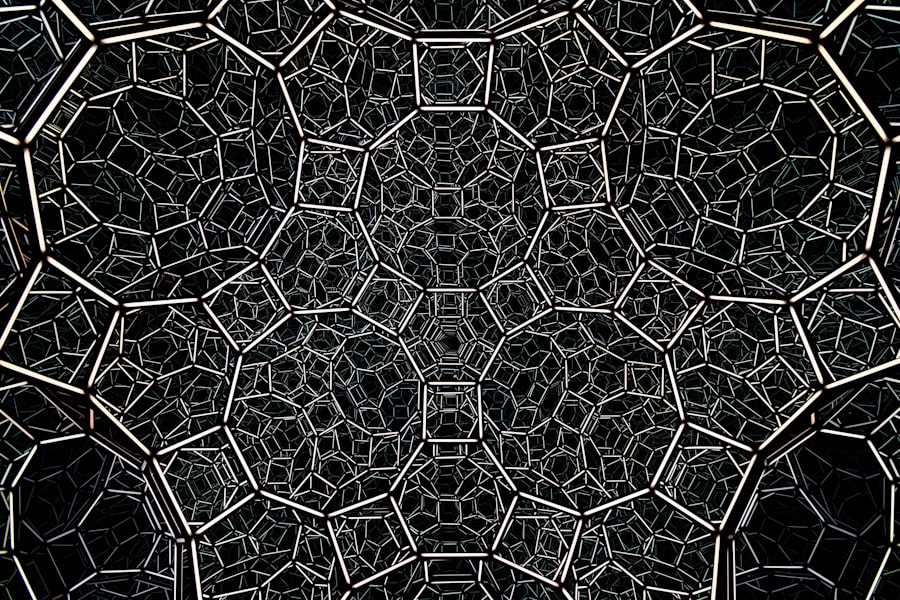
Quantum entanglement holds profound implications for humanity’s understanding of the universe at its most fundamental level. The interconnectedness exhibited by entangled particles challenges classical notions of separateness and locality, suggesting that the universe may be more intricately woven together than previously imagined. This realization prompts questions about the nature of reality itself: Is it possible that all particles are fundamentally connected through an unseen web of entanglement?
Furthermore, exploring the implications of quantum entanglement may shed light on unresolved mysteries in cosmology, such as dark matter and dark energy. Some theorists propose that these enigmatic components of the universe could be manifestations of underlying quantum processes linked through entangled states. By investigating how entanglement influences cosmic structures and dynamics, researchers may uncover new insights into the evolution and fate of the universe itself.
The Role of Emergent Geometric Structures in Quantum Computing
Emergent geometric structures play a crucial role in advancing quantum computing technologies. As researchers strive to build more robust and scalable quantum systems, understanding how geometry influences quantum information processing becomes paramount. The geometric properties associated with entangled states can provide valuable insights into error correction and fault tolerance—two critical challenges facing quantum computing.
For instance, certain geometric configurations can enhance coherence times or facilitate efficient information transfer between qubits. By leveraging these emergent structures, engineers can design quantum algorithms that exploit geometric features for improved performance. Additionally, exploring how different geometric arrangements affect computational outcomes may lead to novel approaches for optimizing quantum circuits and algorithms.
Entangled Emergent Geometry and Its Potential Impact on Information Theory
The intersection of entangled emergent geometry and information theory presents exciting possibilities for advancing our understanding of information processing at a fundamental level. Traditional information theory relies on classical concepts; however, incorporating insights from quantum mechanics allows for a richer framework that accounts for phenomena like superposition and entanglement. Researchers are beginning to explore how emergent geometric structures can inform new paradigms in information theory.
For example, concepts such as entropy and mutual information may take on new meanings when viewed through the lens of emergent geometry. By examining how information is encoded within geometric configurations arising from entangled states, scientists can develop novel approaches to data transmission, storage, and encryption—potentially revolutionizing fields such as telecommunications and cybersecurity.
Theoretical and Experimental Approaches to Studying Entangled Emergent Geometry
Studying entangled emergent geometry requires a combination of theoretical insights and experimental validation. Theoretical physicists employ advanced mathematical models to predict how entangled states give rise to specific geometric structures under various conditions. These models often draw from established frameworks like quantum field theory or string theory while incorporating novel elements related to emergent phenomena.
On the experimental front, researchers are actively conducting experiments designed to probe the relationships between quantum entanglement and emergent geometries. Techniques such as cold atom experiments or photonic systems allow scientists to create controlled environments where they can manipulate entangled states and observe their effects on geometric properties. By comparing experimental results with theoretical predictions, researchers aim to refine their understanding of how these concepts interrelate.
Challenges and Future Directions in Researching Entangled Emergent Geometry
Despite significant progress in understanding entangled emergent geometry, numerous challenges remain for researchers in this field. One major hurdle is developing comprehensive theoretical frameworks that accurately capture the complexities inherent in both quantum mechanics and general relativity. Bridging these two domains requires innovative approaches capable of reconciling their differing principles while accounting for emergent phenomena.
Additionally, experimental validation poses its own set of challenges due to the delicate nature of quantum systems. Creating conditions conducive to observing emergent geometries requires precise control over environmental factors such as temperature and noise levels. As technology advances, researchers are optimistic about overcoming these obstacles through improved experimental techniques and novel materials designed specifically for probing these intricate relationships.
The Promise of Entangled Emergent Geometry for Advancing Scientific Understanding
In conclusion, the exploration of entangled emergent geometry represents a promising frontier in scientific research with far-reaching implications across multiple disciplines. By unraveling the intricate connections between quantum entanglement and geometric structures, researchers are poised to deepen their understanding not only of fundamental physics but also of practical applications in technology and engineering. As scientists continue to investigate this fascinating interplay between quantum mechanics and geometry, they may uncover new insights into the nature of reality itself—potentially reshaping our understanding of space, time, and information at their most fundamental levels.
The journey into this uncharted territory promises not only to advance scientific knowledge but also to inspire future generations to explore the mysteries that lie at the intersection of mathematics, physics, and philosophy.
Emergent geometry and entanglement are fascinating topics that explore the fundamental nature of space and quantum mechanics. A related article that delves deeper into these concepts can be found at mycosmicventures.
com/sample-page/’>this link. This article discusses how emergent geometry can arise from quantum entanglement, providing insights into the interplay between geometry and quantum states.
FAQs
What is emergent geometry?
Emergent geometry refers to the concept that geometric structures, such as spacetime, arise from more fundamental, non-geometric degrees of freedom. Instead of being a fixed background, geometry is seen as a collective phenomenon emerging from underlying quantum or informational processes.
How is entanglement related to emergent geometry?
Entanglement, a quantum correlation between particles, is believed to play a key role in the emergence of geometric properties. In many theoretical frameworks, the pattern and strength of entanglement between quantum states can give rise to the connectivity and shape of emergent spacetime.
What theories explore the connection between entanglement and geometry?
Several approaches investigate this connection, including the AdS/CFT correspondence in string theory, tensor network models, and quantum error-correcting codes. These frameworks suggest that entanglement structures encode geometric information, linking quantum information theory with gravitational physics.
Why is emergent geometry important in physics?
Emergent geometry offers a potential explanation for how classical spacetime and gravity arise from quantum mechanics. Understanding this emergence could provide insights into quantum gravity, black hole physics, and the unification of fundamental forces.
Can emergent geometry be observed experimentally?
Currently, emergent geometry is a theoretical concept primarily explored through mathematical models and simulations. Direct experimental observation is challenging due to the scales involved, but ongoing research in quantum information and condensed matter systems may provide indirect evidence.
What role do tensor networks play in emergent geometry?
Tensor networks are computational tools that represent quantum states with complex entanglement patterns. They have been used to model how entanglement structures can give rise to geometric spaces, providing a concrete way to visualize and study emergent geometry.
Is emergent geometry a widely accepted idea?
Emergent geometry is a promising and active area of research but remains a hypothesis within theoretical physics. While it has gained significant interest, especially in quantum gravity and quantum information communities, it is not yet a universally established framework.