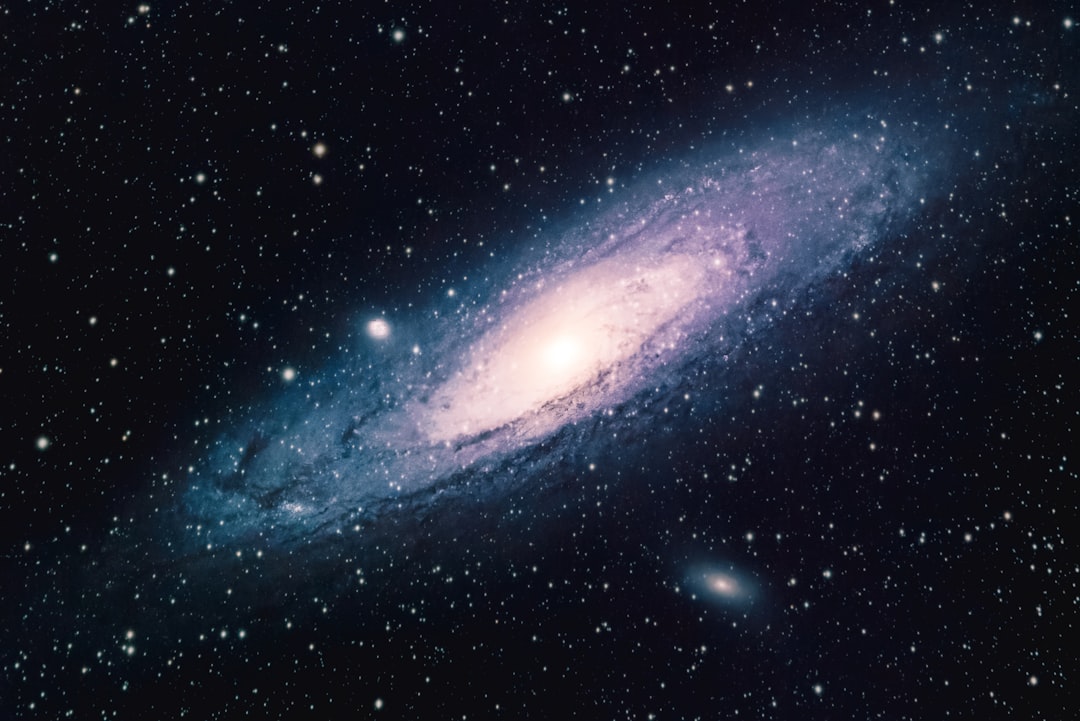
The de Sitter space, characterized by a positive cosmological constant, has emerged as a focal point in modern theoretical physics, particularly in the context of cosmology. The DSCFT (de Sitter Conformal Field Theory) correspondence represents a significant advancement in understanding the intricate relationship between quantum field theories and gravitational theories in de Sitter space. This correspondence draws parallels with the well-established AdS/CFT (Anti-de Sitter/Conformal Field Theory) correspondence, which has been instrumental in bridging the gap between quantum mechanics and general relativity.
By exploring the DSCFT correspondence, researchers aim to unravel the complexities of de Sitter space and its implications for our understanding of the universe. The significance of DSCFT lies not only in its theoretical underpinnings but also in its potential applications across various domains of physics. As the universe continues to expand, driven by dark energy, the study of de Sitter space becomes increasingly relevant.
The DSCFT correspondence offers a framework for analyzing quantum field theories in a cosmological context, providing insights into phenomena such as cosmic inflation and the nature of dark energy. This article delves into the foundational aspects of DSCFT correspondence, its theoretical framework, applications, challenges, and future directions, ultimately highlighting its impact on de Sitter cosmology.
Key Takeaways
- DSCFT correspondence extends holographic principles to de Sitter cosmology, linking quantum gravity in de Sitter space with conformal field theories.
- It builds on the foundation of AdS/CFT correspondence but adapts the framework to the positive cosmological constant of de Sitter space.
- Theoretical models using DSCFT provide new insights into the quantum structure and evolution of the early universe.
- Despite promising applications, DSCFT faces significant challenges, including mathematical complexity and limited experimental verification.
- Ongoing research aims to refine DSCFT, explore observational signatures, and compare it with other holographic approaches in cosmology.
Basics of de Sitter Cosmology
De Sitter cosmology is rooted in the solutions to Einstein’s field equations that describe a universe dominated by a positive cosmological constant. This model presents a universe that is not only expanding but also accelerating in its expansion due to the influence of dark energy. The implications of this model are profound, as they challenge traditional notions of cosmic evolution and structure formation.
In a de Sitter universe, the geometry is hyperbolic, leading to unique properties that distinguish it from other cosmological models. One of the key features of de Sitter space is its horizon, akin to a black hole’s event horizon, which introduces intriguing questions about causality and information transfer. As observers move away from one another due to the accelerated expansion, they may find themselves beyond each other’s horizons, leading to a breakdown in communication.
This phenomenon raises fundamental questions about the nature of reality and observation in an expanding universe. Understanding these dynamics is crucial for developing a comprehensive framework for cosmology that incorporates both quantum mechanics and general relativity.
AdS/CFT Correspondence and its Application in Cosmology
The AdS/CFT correspondence has revolutionized theoretical physics by establishing a duality between gravitational theories in Anti-de Sitter space and conformal field theories defined on its boundary. This duality has provided profound insights into quantum gravity, black hole thermodynamics, and condensed matter physics. The success of AdS/CFT has inspired researchers to explore similar correspondences in other geometries, particularly in de Sitter space.
In cosmology, the application of AdS/CFT principles has opened new avenues for understanding the early universe and cosmic inflation. By leveraging the duality, physicists can analyze quantum field theories in a controlled setting while drawing parallels with gravitational phenomena. This approach has led to significant advancements in understanding how quantum fluctuations during inflation can give rise to the large-scale structure observed in the universe today.
The insights gained from AdS/CFT have laid the groundwork for exploring the DSCFT correspondence, which seeks to extend these ideas into the realm of de Sitter space.
Theoretical Framework of DSCFT Correspondence
| Aspect | Description | Key Metrics | Applications |
|---|---|---|---|
| DSCFT Correspondence | Duality between Double-Scaled Complex Field Theories and String Theories | Scaling limits, coupling constants, correlation functions | Quantum gravity, holography, matrix models |
| Scaling Limit | Limit where number of degrees of freedom and coupling constants scale simultaneously | Double scaling parameter, critical exponents | Non-perturbative string effects, continuum limit of matrix models |
| Correlation Functions | Expectation values of field operators in DSCFT | Two-point, three-point functions, conformal dimensions | Operator product expansions, conformal bootstrap |
| Matrix Model Dual | Matrix integral representation corresponding to DSCFT | Eigenvalue distributions, spectral density | Non-perturbative string theory, random geometry |
| Holographic Duality | Correspondence between DSCFT and higher-dimensional gravity theories | Central charge, entanglement entropy | AdS/CFT correspondence, black hole physics |
The theoretical framework of DSCFT correspondence builds upon the principles established by AdS/CFT but adapts them to accommodate the unique characteristics of de Sitter space.
This duality allows for a deeper understanding of how quantum effects manifest in a cosmological context.
One of the central challenges in formulating DSCFT is addressing the inherent differences between de Sitter and Anti-de Sitter spaces. While AdS space possesses a well-defined boundary that facilitates calculations, de Sitter space presents complications due to its dynamic nature and the presence of horizons. Researchers have developed various approaches to tackle these challenges, including utilizing asymptotic expansions and exploring specific models that exhibit conformal symmetry.
By establishing a robust theoretical framework for DSCFT, physicists aim to unlock new insights into the interplay between quantum mechanics and gravity in an expanding universe.
Applications of DSCFT Correspondence in de Sitter Cosmology
The applications of DSCFT correspondence in de Sitter cosmology are vast and varied, offering potential solutions to some of the most pressing questions in modern physics. One significant area of exploration involves understanding cosmic inflation—a rapid expansion phase that occurred shortly after the Big Bang. By employing DSCFT principles, researchers can analyze how quantum fluctuations during inflation can lead to observable consequences in the cosmic microwave background radiation and large-scale structure formation.
Moreover, DSCFT provides a framework for investigating the nature of dark energy and its role in driving the accelerated expansion of the universe. By examining how quantum field theories behave in de Sitter space, physicists can gain insights into the properties of dark energy and its implications for cosmic evolution. This understanding could pave the way for new models that reconcile observations with theoretical predictions, ultimately enhancing our comprehension of the universe’s fate.
Challenges and Limitations of DSCFT Correspondence in de Sitter Cosmology
Despite its promise, DSCFT correspondence faces several challenges and limitations that must be addressed for it to reach its full potential. One primary obstacle lies in the mathematical complexities associated with de Sitter space. Unlike Anti-de Sitter space, which has a well-defined boundary conducive to calculations, de Sitter space’s dynamic nature complicates the establishment of a clear duality.
Researchers must navigate these complexities while ensuring that their models remain physically relevant. Additionally, there are conceptual challenges related to causality and information transfer within de Sitter space. The presence of horizons can lead to situations where information becomes inaccessible to distant observers, raising questions about how this affects our understanding of quantum field theories in such environments.
Addressing these challenges requires innovative approaches and collaboration across various fields within theoretical physics.
Recent Developments in DSCFT Correspondence
Recent developments in DSCFT correspondence have sparked renewed interest among physicists seeking to deepen their understanding of de Sitter cosmology. Researchers have made strides in formulating concrete models that exhibit DSCFT-like behavior, providing valuable insights into how quantum field theories operate within de Sitter space. These models often involve exploring specific symmetries and utilizing advanced mathematical techniques to bridge gaps between theory and observation.
Moreover, advancements in computational techniques have enabled physicists to simulate scenarios within de Sitter space more effectively. These simulations allow for testing various hypotheses related to cosmic inflation, dark energy dynamics, and other phenomena influenced by quantum effects. As researchers continue to refine their models and computational methods, they are poised to uncover new insights that could reshape our understanding of both DSCFT correspondence and de Sitter cosmology.
Experimental Evidence and Observational Implications of DSCFT Correspondence
While DSCFT correspondence remains primarily theoretical at this stage, its implications extend into observational realms that could be tested through future experiments and astronomical observations.
Additionally, advancements in observational technology may allow scientists to probe the effects of dark energy more directly.
By studying distant supernovae or gravitational waves from merging black holes, researchers can gather data that may align with predictions derived from DSCFT correspondence. As observational techniques continue to evolve, they hold promise for validating or challenging theoretical frameworks associated with de Sitter cosmology.
Future Directions and Potential Impact of DSCFT Correspondence in de Sitter Cosmology
The future directions for DSCFT correspondence are rich with potential for groundbreaking discoveries that could reshape our understanding of cosmology. As researchers continue to refine their theoretical frameworks and explore new models, they may uncover novel connections between quantum mechanics and gravitational phenomena that have yet to be fully realized. Moreover, interdisciplinary collaboration will play a crucial role in advancing DSCFT research.
By integrating insights from fields such as string theory, particle physics, and observational cosmology, physicists can develop more comprehensive models that address existing challenges while paving the way for new avenues of exploration. The potential impact of these developments extends beyond theoretical physics; they could influence our understanding of fundamental questions about the nature of reality itself.
Comparison with Other Correspondence Theories in Cosmology
In comparing DSCFT correspondence with other correspondence theories in cosmology, it becomes evident that each framework offers unique insights while grappling with distinct challenges. For instance, while AdS/CFT has provided profound insights into black hole thermodynamics and condensed matter systems, its applicability to de Sitter space remains less straightforward due to fundamental differences between the two geometries. Other correspondence theories, such as those exploring holographic principles or emergent gravity concepts, also contribute valuable perspectives on the interplay between quantum mechanics and gravity.
However, each theory faces its own set of limitations when applied to cosmological contexts. By examining these various frameworks side by side, researchers can identify common themes and divergences that may inform future developments within DSCFT correspondence.
Conclusion and Summary of DSCFT Correspondence in de Sitter Cosmology
In conclusion, DSCFT correspondence represents a promising avenue for exploring the intricate relationship between quantum field theories and gravitational dynamics within de Sitter cosmology. By building upon established principles from AdS/CFT correspondence while addressing unique challenges posed by de Sitter space, researchers are poised to unlock new insights into fundamental questions about cosmic evolution and dark energy. As advancements continue in both theoretical frameworks and observational techniques, the potential impact of DSCFT correspondence on our understanding of the universe cannot be overstated.
By bridging gaps between theory and observation, this correspondence may ultimately lead to breakthroughs that reshape our comprehension of reality itself—illuminating not only the nature of our universe but also our place within it.
In exploring the fascinating realm of de Sitter cosmology, one can gain further insights by examining related discussions on cosmic expansion and the implications of dark energy. A particularly relevant article can be found at this link, which delves into the intricacies of the universe’s accelerated expansion and its connection to de Sitter space. This resource provides a comprehensive overview that complements the study of dscft correspondence in the context of modern cosmological theories.
WATCH THIS 🛑 The Impossible Proof: Our Universe Is a Black Hole’s Interior
FAQs
What is the dS/CFT correspondence?
The dS/CFT correspondence is a theoretical framework in physics that proposes a relationship between quantum gravity in de Sitter (dS) space and a conformal field theory (CFT) defined on the boundary of that space. It is an extension of the AdS/CFT correspondence to spacetimes with positive cosmological constant.
What is de Sitter cosmology?
De Sitter cosmology refers to models of the universe dominated by a positive cosmological constant, leading to an exponentially expanding spacetime known as de Sitter space. It is relevant for describing the accelerated expansion of the universe, especially during inflation and in the current dark energy-dominated era.
How does the dS/CFT correspondence relate to cosmology?
The dS/CFT correspondence provides a potential holographic description of quantum gravity in an expanding universe with a positive cosmological constant. It aims to describe cosmological observables and the early universe’s quantum fluctuations through a dual conformal field theory on the boundary of de Sitter space.
What is the significance of the dS/CFT correspondence in theoretical physics?
The dS/CFT correspondence offers insights into quantum gravity in spacetimes with positive cosmological constant, which is more realistic for our universe than the anti-de Sitter space used in AdS/CFT. It may help understand the quantum nature of cosmological horizons, entropy, and the origin of cosmic structure.
Is the dS/CFT correspondence fully established like AdS/CFT?
No, the dS/CFT correspondence is less well-understood and more speculative compared to the AdS/CFT correspondence. There are conceptual and technical challenges in defining the dual CFT and interpreting the correspondence in de Sitter space, and it remains an active area of research.
What role does the cosmological constant play in dS/CFT correspondence?
The positive cosmological constant defines the curvature and geometry of de Sitter space, which is the setting for the dS/CFT correspondence. It contrasts with the negative cosmological constant in anti-de Sitter space and influences the nature of the dual conformal field theory.
Can dS/CFT correspondence help explain dark energy?
While the dS/CFT correspondence is primarily a theoretical tool, it may provide a framework to better understand the quantum aspects of dark energy and the accelerated expansion of the universe by describing de Sitter space holographically.
What are the main challenges in applying dS/CFT correspondence to cosmology?
Challenges include defining a precise dual conformal field theory for de Sitter space, dealing with the lack of a global timelike Killing vector, interpreting the holographic dictionary, and connecting theoretical predictions with observable cosmological data.