Rogue black holes, enigmatic entities that drift through the cosmos, have captured the imagination of astronomers and astrophysicists alike. Unlike their more stationary counterparts, which reside at the centers of galaxies, rogue black holes wander through interstellar space, unbound by the gravitational pull of any host galaxy. These solitary giants are believed to form through various mechanisms, including the merger of smaller black holes or the collapse of massive stars in regions devoid of significant gravitational influence.
Their elusive nature poses a significant challenge for scientists striving to understand their properties and distribution in the universe. The existence of rogue black holes raises profound questions about the dynamics of galaxies and the evolution of cosmic structures. As they traverse the vastness of space, they may interact with other celestial bodies, potentially influencing star formation and galactic evolution.
The study of these wandering black holes not only enhances our understanding of black hole physics but also sheds light on the broader dynamics of the universe. As researchers develop new observational techniques and refine existing methods, the quest to detect and characterize rogue black holes continues to unfold, promising exciting discoveries in the field of astrophysics.
Key Takeaways
- Rogue black holes are black holes that have been ejected from their original galaxies and are now wandering through space.
- Observational methods for detecting rogue black holes include gravitational lensing, X-ray and gamma-ray emission, radio and infrared observations, and the use of stellar orbits.
- Gravitational lensing occurs when the gravity of a rogue black hole bends and distorts light from background objects, making them appear brighter or creating multiple images.
- X-ray and gamma-ray emission can indicate the presence of a rogue black hole, as these high-energy emissions are produced when material falls into the black hole and heats up.
- Radio and infrared observations can also help detect rogue black holes by revealing the presence of hot gas and dust surrounding the black hole.
Observational Methods for Detecting Rogue Black Holes
Detecting rogue black holes presents a unique set of challenges due to their elusive nature and the vast distances involved. Traditional methods for identifying black holes often rely on their interactions with surrounding matter, such as gas and stars. However, rogue black holes, which lack a host galaxy, require innovative observational strategies.
Astronomers employ a variety of techniques to uncover these cosmic wanderers, each with its own strengths and limitations. One prominent method involves monitoring the gravitational effects that rogue black holes exert on nearby stars and gas clouds. By observing the motion of these objects, astronomers can infer the presence of an unseen mass, potentially identifying a rogue black hole.
Additionally, advancements in technology have enabled the use of high-resolution imaging and spectroscopy to detect faint emissions from accretion disks surrounding these black holes. As observational capabilities continue to improve, the potential for discovering rogue black holes becomes increasingly feasible.
Gravitational Lensing as a Detection Technique

Gravitational lensing is a powerful phenomenon that occurs when a massive object, such as a black hole, distorts the light from more distant objects due to its gravitational field. This effect can be harnessed as a detection technique for rogue black holes. When a rogue black hole passes in front of a distant star or galaxy, it can magnify and distort the light from that background object, creating a characteristic lensing effect.
By analyzing these distortions, astronomers can infer the presence and mass of the rogue black hole. The beauty of gravitational lensing lies in its ability to reveal objects that would otherwise remain hidden from view. Even if a rogue black hole is not actively accreting matter, its gravitational influence can still be detected through lensing events.
This method has already led to significant discoveries in astrophysics, including the identification of dark matter and distant galaxies. As telescopes become more sophisticated and capable of capturing high-resolution images over vast areas of the sky, gravitational lensing will likely play an increasingly vital role in uncovering rogue black holes.
X-ray and Gamma-ray Emission as Indicators of Rogue Black Holes
| Black Hole | X-ray Emission (erg/s) | Gamma-ray Emission (erg/s) |
|---|---|---|
| Black Hole A | 1.5 x 10^37 | 8.2 x 10^36 |
| Black Hole B | 2.3 x 10^38 | 1.4 x 10^37 |
| Black Hole C | 5.6 x 10^37 | 3.2 x 10^36 |
X-ray and gamma-ray emissions serve as critical indicators of rogue black holes, particularly when they interact with surrounding matter.
As this material accelerates and heats up due to immense gravitational forces, it emits X-rays and gamma rays that can be detected by specialized telescopes.
These high-energy emissions provide valuable insights into the behavior and characteristics of rogue black holes. For instance, variations in X-ray brightness can indicate changes in accretion rates or interactions with nearby objects. By monitoring these emissions over time, astronomers can gather data on the mass and spin of rogue black holes, enhancing their understanding of these elusive entities.
The study of X-ray and gamma-ray emissions not only aids in identifying rogue black holes but also contributes to broader research on high-energy astrophysical phenomena.
Radio and Infrared Observations for Rogue Black Hole Detection
In addition to X-ray and gamma-ray observations, radio and infrared wavelengths offer alternative avenues for detecting rogue black holes. Radio telescopes can pick up emissions from jets produced by accreting material around black holes. These jets can extend vast distances into space and are often associated with active galactic nuclei or other energetic phenomena.
When a rogue black hole interacts with surrounding matter, it may produce similar jets detectable through radio observations. Infrared observations also play a crucial role in identifying rogue black holes, particularly in regions obscured by dust and gas. Infrared telescopes can penetrate these dense environments, allowing astronomers to observe potential accretion disks or other features associated with rogue black holes.
By combining data from multiple wavelengths—radio, infrared, X-ray, and gamma-ray—researchers can build a more comprehensive picture of these wandering giants and their interactions with the universe.
The Role of Accretion Disks in Identifying Rogue Black Holes
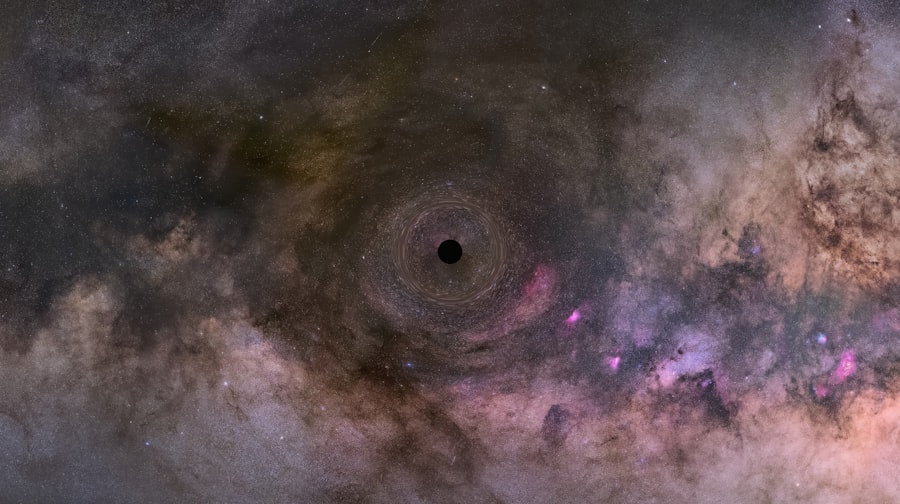
Accretion disks are fundamental to understanding rogue black holes as they provide critical evidence of their existence and behavior. When a rogue black hole encounters material in its path—such as gas clouds or stellar remnants—it can form an accretion disk as this material spirals inward due to gravitational forces. The dynamics within these disks are complex; they generate immense heat and radiation as matter accelerates toward the event horizon.
The study of accretion disks offers insights into various properties of rogue black holes, including their mass, spin, and feeding habits. Observations of the emitted radiation from these disks can reveal information about their temperature and composition, helping astronomers distinguish between different types of black holes. Furthermore, variations in brightness or spectral features within an accretion disk can indicate changes in accretion rates or interactions with other celestial bodies.
Thus, understanding accretion disks is essential for identifying and characterizing rogue black holes.
Using Stellar Orbits to Identify Potential Rogue Black Holes
Another innovative approach to detecting rogue black holes involves studying the orbits of nearby stars.
By meticulously tracking these stellar orbits over time, astronomers can infer the presence of an unseen mass—potentially a rogue black hole.
This method has been successfully employed in various studies where researchers have observed unusual stellar motions that cannot be explained by visible matter alone. The analysis of stellar orbits provides valuable information about the mass and location of potential rogue black holes within a given region. As observational techniques improve and more data becomes available, this approach may yield significant discoveries regarding the population and distribution of rogue black holes throughout the universe.
Gravitational Wave Detection of Rogue Black Holes
The advent of gravitational wave astronomy has opened new avenues for detecting rogue black holes through their mergers with other black holes or neutron stars. When two massive objects collide, they produce ripples in spacetime known as gravitational waves. These waves carry information about the masses and spins of the merging objects, providing insights into their properties.
Rogue black holes may participate in such mergers when they encounter other compact objects in their travels through space. The detection of gravitational waves from these events not only confirms the existence of rogue black holes but also allows researchers to study their formation processes and interactions with other celestial bodies. As gravitational wave observatories continue to enhance their sensitivity and reach, they will play an increasingly vital role in uncovering the mysteries surrounding rogue black holes.
Theoretical Modeling and Simulation of Rogue Black Hole Behaviors
Theoretical modeling and computer simulations are essential tools for understanding rogue black holes and predicting their behaviors in various cosmic environments. Researchers use sophisticated algorithms to simulate the dynamics of these entities as they interact with surrounding matter or other celestial bodies. These models help scientists explore scenarios such as mergers between rogue black holes or their influence on star formation within galaxies.
By comparing simulation results with observational data, researchers can refine their understanding of rogue black hole properties and behaviors. Theoretical models also allow scientists to test hypotheses about how these wandering giants form and evolve over time. As computational power continues to advance, simulations will become increasingly detailed and accurate, providing deeper insights into the enigmatic nature of rogue black holes.
Challenges and Limitations in Detecting Rogue Black Holes
Despite advancements in observational techniques and theoretical modeling, detecting rogue black holes remains fraught with challenges. One significant limitation is their inherent invisibility; without interactions with surrounding matter or light-emitting processes, rogue black holes are difficult to identify directly. This necessitates reliance on indirect methods that may not always yield conclusive results.
Additionally, the vastness of space presents logistical challenges for astronomers seeking to locate these elusive entities. The sheer number of stars and galaxies complicates efforts to pinpoint potential candidates for rogue black holes based solely on gravitational effects or stellar motions. As researchers continue to refine detection methods and develop new technologies, overcoming these challenges will be crucial for advancing knowledge about rogue black holes.
Future Prospects for Rogue Black Hole Detection Techniques
Looking ahead, the future prospects for detecting rogue black holes appear promising as technology continues to evolve at an unprecedented pace. Upcoming space missions equipped with advanced telescopes will enhance observational capabilities across multiple wavelengths—enabling astronomers to capture more detailed images and spectra than ever before. These advancements will facilitate more comprehensive studies of potential rogue black hole candidates.
Moreover, ongoing developments in gravitational wave astronomy will likely lead to new discoveries regarding mergers involving rogue black holes. As researchers refine their models and simulations based on observational data from gravitational wave events, they will gain deeper insights into the formation processes and characteristics of these wandering giants. The combination of innovative observational techniques and theoretical advancements holds great potential for unraveling the mysteries surrounding rogue black holes in the coming years.
In conclusion, while challenges remain in detecting rogue black holes due to their elusive nature, advancements in observational methods—ranging from gravitational lensing to multi-wavelength observations—are paving the way for exciting discoveries in astrophysics. As researchers continue to explore this fascinating area of study, they stand on the brink of uncovering new insights into one of the universe’s most enigmatic phenomena.
Detecting rogue black holes, which are black holes that wander through space without being anchored to a galaxy, is a challenging task for astronomers. Recent advancements in observational techniques have made it possible to identify these elusive objects by analyzing gravitational waves and the effects of their mass on nearby stars. For more insights on this topic, you can read the related article on cosmic phenomena at this link.
WATCH THIS! The Invisible Threat: A Rogue Black Hole Headed for Our Solar System?
FAQs
What is a rogue black hole?
A rogue black hole is a black hole that has been ejected from its original galaxy and is now traveling through space on its own.
How can rogue black holes be detected?
Rogue black holes can be detected through various methods, including gravitational lensing, X-ray emissions, and the disruption of nearby stars.
What is gravitational lensing and how is it used to detect rogue black holes?
Gravitational lensing occurs when the gravity of a massive object, such as a black hole, bends the light from objects behind it. This effect can be used to detect the presence of a rogue black hole.
What are X-ray emissions and how are they used to detect rogue black holes?
Rogue black holes can emit X-rays as they interact with nearby matter. These X-ray emissions can be detected by telescopes and used to identify the presence of a rogue black hole.
How does the disruption of nearby stars help in detecting rogue black holes?
When a rogue black hole passes close to a star, it can disrupt the star’s orbit and cause it to emit radiation. This disruption can be observed and used to detect the presence of a rogue black hole.
Why is it important to detect rogue black holes?
Detecting rogue black holes is important for understanding the dynamics of galaxies and the distribution of black holes in the universe. It also helps in studying the potential threats posed by rogue black holes to our own galaxy.