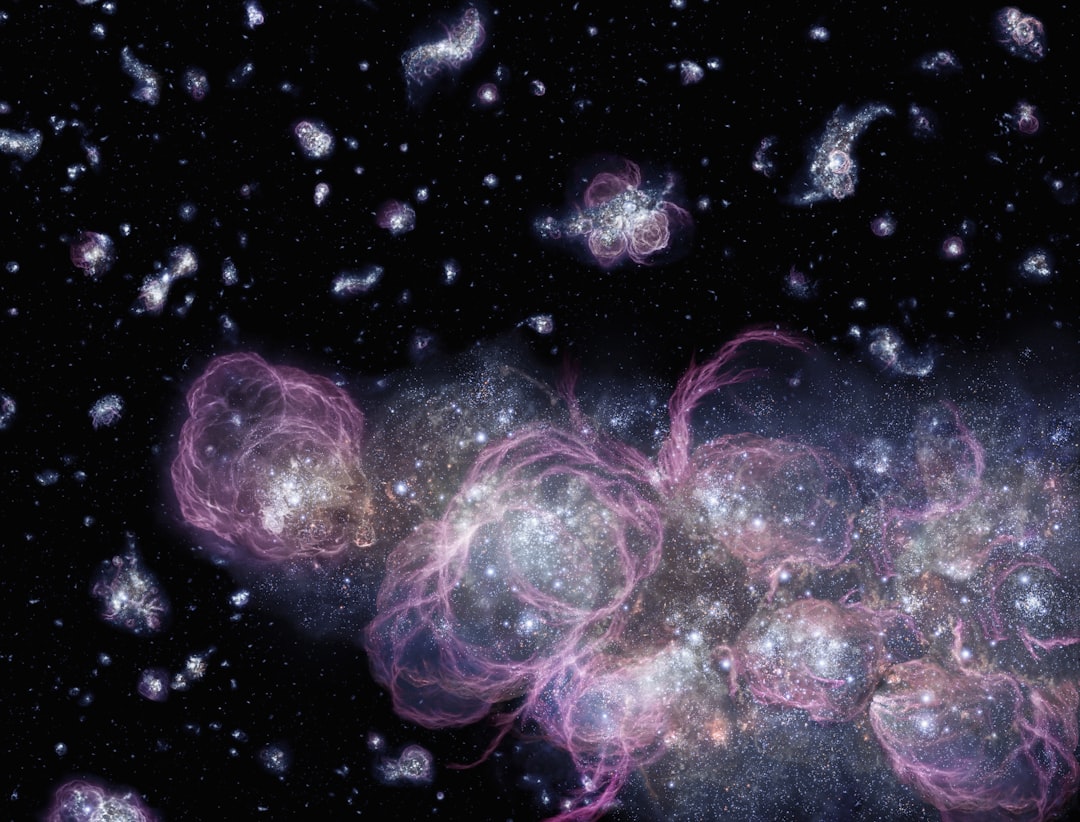
The concept of time has long captivated human thought, an intangible yet ever-present dimension that underpins existence. In cosmology, the study of the universe’s origin, evolution, and large-scale structure, time takes on an even more profound and complex character. Cosmologists grapple with questions that challenge our intuitive understanding of time, from its very inception to its potential ultimate demise. This article endeavors to unravel the multifaceted nature of time within the cosmological framework, exploring various theories and observations that shape our current understanding.
The universe, as we perceive it, is inextricably linked to time. Our perception of cause and effect, sequence, and change all depend on the progression of time. However, within cosmology, time is not merely a backdrop against which events unfold; it is an active participant, its properties intricately interwoven with the fabric of spacetime itself.
The Big Bang and the Genesis of Time
The prevailing cosmological model, the Big Bang theory, posits that the universe originated from an extremely hot, dense state approximately 13.8 billion years ago. A fundamental question arises: did time exist before the Big Bang? Or did time itself emerge with the universe?
- Singularity and the Breakdown of Physics: At the precise moment of the Big Bang, all known laws of physics, including those governing time, break down. This “singularity” represents a theoretical boundary beyond which current mathematical models cannot extrapolate. Some interpretations suggest that time, as we understand it, began at this instant, effectively rendering the question of “before” meaningless within our causal framework.
- The Arrow of Time: The Big Bang also provides a compelling explanation for the observed “arrow of time” – the unidirectional progression from past to future. The universe began in a state of extremely low entropy (high order). As the universe expands and evolves, its entropy increases, moving towards a state of greater disorder. This fundamental thermodynamic principle dictates the direction of time’s flow.
- Alternative Cosmologies and Pre-Big Bang Scenarios: While the Big Bang is widely accepted, some speculative theories explore the possibility of a “pre-Big Bang” era. Cyclic universe models, for instance, propose an eternal series of expansions and contractions, implying an infinite past and future. However, these models face significant theoretical challenges and observational constraints.
The Expansion of Space and the Dilution of Time
The continuous expansion of the universe has profound implications for our understanding of time. As space itself stretches, the distances between galaxies increase, and the light from distant objects becomes redshifted, indicating that the universe is indeed expanding.
- Cosmological Redshift and Lookback Time: The redshifting of light allows astronomers to determine the “lookback time” – how far back in the universe’s history we are observing. Light from more distant galaxies has traveled for a longer duration, presenting us with images of the universe as it was billions of years ago. This inherent property of an expanding universe allows us to essentially “see” the past.
- The Universe’s Age and Hubble’s Constant: The rate of expansion is quantified by Hubble’s constant. By measuring this constant and extrapolating backward, cosmologists can estimate the age of the universe. This age, currently estimated at 13.8 billion years, represents the elapsed time since the Big Bang.
- Future Scenarios: Heat Death, Big Crunch, and Big Rip: The ultimate fate of the universe is tied to its expansion and, consequently, to the long-term behavior of time. Various scenarios are proposed:
- Heat Death (Big Freeze): If the expansion continues indefinitely, the universe will become increasingly dilute, cold, and dark, eventually reaching a state of maximum entropy where no further thermodynamic processes can occur. Time would, in essence, lose its meaning as all activity ceases.
- Big Crunch: If the universe’s density is sufficiently high, gravity could eventually overcome the expansion, leading to a contraction back into a singular state, a “Big Crunch.” In this scenario, time might reverse its arrow or cease to exist at the singularity.
- Big Rip: Driven by a mysterious force known as dark energy, the universe’s expansion could accelerate to such a degree that all structures, from galaxies to atoms, are eventually torn apart. Time would effectively lose its coherence as the fundamental fabric of reality disintegrates.
In exploring the intricate nature of time within the realm of cosmology, one can gain valuable insights from the article found at My Cosmic Ventures. This resource delves into the relationship between time and the expanding universe, examining how our understanding of time has evolved alongside advancements in astronomical research. By investigating concepts such as time dilation and the fabric of spacetime, the article provides a comprehensive overview of how time is perceived in the context of cosmic phenomena.
Relativistic Time: A Dynamic and Relative Quantity
Albert Einstein’s theories of special and general relativity fundamentally altered our perception of time, transforming it from an absolute, universal constant into a dynamic and relative quantity, deeply intertwined with space and gravity.
Special Relativity and Time Dilation
Special relativity, which deals with the relationship between space and time for objects moving at constant velocities, introduced the concept of time dilation.
- The Relativity of Simultaneity: Special relativity posits that simultaneity is not absolute. Events that appear simultaneous to one observer may not appear simultaneous to another observer in relative motion. This challenges the intuitive notion of a universal “now.”
- Time Dilation Explained: For an observer in motion relative to another, time appears to pass more slowly for the moving observer. This effect, though minuscule at everyday speeds, becomes significant at velocities approaching the speed of light. Imagine two clocks, one stationary and one on a spaceship traveling at a significant fraction of the speed of light. Upon its return, the clock on the spaceship would show less elapsed time than the stationary clock. This is not an illusion; it’s a real physical phenomenon confirmed by experiments involving atomic clocks on airplanes.
- Impact on Particle Physics: Time dilation is routinely observed in particle accelerators, where unstable particles traveling at relativistic speeds have extended lifetimes compared to their stationary counterparts. This provides compelling empirical evidence for the relativistic nature of time.
General Relativity and Gravitational Time Dilation
General relativity extends these ideas to include gravity, demonstrating that massive objects warp spacetime, and this warping affects the passage of time.
- Gravity’s Influence on Time: Strong gravitational fields cause time to slow down. An observer near a massive object, such as a black hole, would experience time passing more slowly than an observer in a weaker gravitational field further away. This is known as gravitational time dilation.
- Experimental Verification: GPS Satellites: This effect is not merely theoretical; it has practical implications. Global Positioning System (GPS) satellites orbit the Earth at high altitudes, experiencing weaker gravity than objects on Earth’s surface. Consequently, clocks on these satellites run slightly faster. To maintain accuracy, GPS systems must constantly adjust for both special and general relativistic time dilation. Without these adjustments, GPS would accumulate significant errors daily.
- Black Holes and the Event Horizon: The most extreme manifestation of gravitational time dilation occurs near black holes. At the event horizon, the boundary beyond which nothing, not even light, can escape, time appears to stop from the perspective of a distant observer. An object falling into a black hole would appear to freeze at the event horizon, never quite crossing it, from an external viewpoint. However, for the falling object, time continues to progress normally until it reaches the singularity.
Quantum Time: The Role of Observation and Discreteness
At the quantum level, the very nature of time becomes even more enigmatic. Quantum mechanics, which governs the behavior of matter and energy at the atomic and subatomic scales, introduces concepts that challenge our classical understanding of continuous, flowing time.
The Measurement Problem and the Indeterminacy of Time
In quantum mechanics, the act of measurement plays a crucial role in shaping reality. Before measurement, particles exist in a superposition of states, and their properties are indeterminate.
- Quantum Jumps and Discrete Events: While classical time is continuous, some interpretations of quantum mechanics suggest that fundamental processes might occur in discrete “jumps” or quanta of time. This concept, though highly speculative, aligns with the idea of quantized energy and momentum.
- Observer Effect and the Illusion of Flow: The “measurement problem” in quantum mechanics raises questions about the subjective nature of time. Does time truly flow independently of an observer, or does observation itself play a role in its manifestation? This remains a subject of intense debate among physicists and philosophers.
The Wheeler-DeWitt Equation and the Timeless Universe
One of the most radical departures from classical time comes from the Wheeler-DeWitt equation, a foundational equation in quantum gravity that attempts to unify quantum mechanics with general relativity.
- The Absence of a Time Variable: Strikingly, the Wheeler-DeWitt equation does not contain a “time” variable. This has led some to propose that at the fundamental quantum level, the universe is “timeless.” Time, in this view, could be an emergent phenomenon, arising from the macroscopic averaging of microscopic, timeless interactions.
- Implications for Cosmology: If the universe is fundamentally timeless, then our experience of time’s passage could be an illusion, a consequence of our limited perspective within a vast, unchanging quantum state. This is a profound and counterintuitive idea that continues to be explored in theoretical physics.
The Direction of Time: Why Past, Present, and Future?
Beyond its relativistic and quantum properties, the question of time’s directionality – why time invariably flows from past to present to future – remains a central topic in cosmological inquiry.
The Second Law of Thermodynamics and the Arrow of Time
As mentioned earlier, the Second Law of Thermodynamics provides the most compelling explanation for the macroscopic arrow of time. This law states that the total entropy (disorder or randomness) of an isolated system can only increase over time or remain constant; it can never decrease.
- Entropy and Irreversibility: The universe began in a state of remarkably low entropy, a highly ordered configuration. As the universe evolves, it inevitably moves towards states of higher entropy. This unidirectional increase in disorder drives the perceived flow of time. Processes that increase entropy are generally irreversible – you can’t unscramble an egg.
- Cosmological Initial Conditions: The extremely low initial entropy of the universe at the Big Bang is a crucial ingredient for explaining the observed arrow of time. Without this specific initial condition, the universe would not exhibit a discernible temporal direction.
Psychological and Cosmological Arrows
While the thermodynamic arrow provides a physical basis, other “arrows of time” also contribute to our experience.
- Psychological Arrow of Time: This refers to our subjective experience of time, our memory of the past, and our anticipation of the future. We remember past events but not future ones. This psychological arrow is deeply intertwined with the thermodynamic arrow, as our brains, like all physical systems, operate within an increasing entropy environment.
- Cosmological Arrow of Time (Expansion): The expansion of the universe itself provides a cosmological arrow. The universe is getting bigger, not smaller. This expansion is consistent with the increase in entropy and the overall evolution of the universe from a hot, dense state to a cooler, more diffuse one.
The nature of time in cosmology is a fascinating topic that has intrigued scientists and philosophers alike. Recent discussions have explored how time may not be a linear progression but rather a complex dimension intertwined with the fabric of space. For those interested in delving deeper into this subject, a related article can be found at My Cosmic Ventures, which examines the implications of time’s nature on our understanding of the universe. This exploration raises profound questions about the beginning of time and its ultimate fate, inviting readers to ponder the mysteries that lie beyond our current comprehension.
The Future of Time Research: Unifying the Perspectives
| Aspect | Description | Relevant Metric/Concept | Typical Value/Range |
|---|---|---|---|
| Cosmic Time | Time measured by a clock moving with the cosmic flow, used as a universal time coordinate in cosmology. | Age of the Universe | Approximately 13.8 billion years |
| Proper Time | Time measured by an observer moving along a worldline, dependent on the observer’s motion and gravitational field. | Elapsed time on observer’s clock | Varies with velocity and gravitational potential |
| Expansion of the Universe | Time evolution of the scale factor describing the size of the universe. | Scale Factor (a(t)) | Normalized to 1 at present time; varies from 0 at Big Bang to >1 in future |
| Hubble Parameter (H) | Rate of expansion of the universe at a given cosmic time. | Hubble Constant (H0) | Approximately 67-74 km/s/Mpc (depending on measurement method) |
| Arrow of Time | Directionality of time associated with entropy increase and cosmological evolution. | Entropy Increase | Entropy grows from low at Big Bang to high at present |
| Time Dilation in Cosmology | Effect of gravitational fields and relative motion on the passage of time. | Redshift (z) | Ranges from 0 (present) to >10 for distant objects |
| Quantum Cosmology Time | Concept of time in quantum gravity and early universe models. | Planck Time (tP) | Approximately 5.39 × 10^-44 seconds |
The various perspectives on time in cosmology, from the Big Bang’s genesis to its relativistic distortions and quantum uncertainties, present a rich tapestry of unanswered questions. Unifying these disparate views into a coherent framework remains one of the grand challenges of modern physics.
Quantum Gravity and the Nature of Spacetime
The quest for a theory of quantum gravity, which aims to reconcile general relativity with quantum mechanics, holds the key to a more complete understanding of time. This hypothetical theory would likely offer profound insights into the fundamental structure of spacetime, including the nature of time at its most primordial level.
- Loop Quantum Gravity and Causal Set Theory: Various approaches to quantum gravity, such as loop quantum gravity and causal set theory, propose a discretized structure for spacetime, suggesting that space and time might not be continuous at the Planck scale. These theories could redefine our understanding of how temporal events are ordered and connected.
- Emergent Time: A recurring theme in quantum gravity research is the idea of “emergent time,” where time is not a fundamental entity but rather a macroscopic illusion arising from more fundamental, timeless processes. If time is indeed emergent, it would necessitate a radical rethinking of causality and the nature of reality itself.
Time Travel and Its Cosmological Implications
The fascination with time travel, though often relegated to the realm of science fiction, has prompted serious theoretical investigations into the cosmological implications of manipulating time.
- Closed Timelike Curves (CTCs): General relativity allows for the theoretical possibility of “closed timelike curves” (CTCs), paths through spacetime that return to their starting point, effectively enabling travel into one’s own past. However, the existence of CTCs often requires exotic matter or extreme gravitational conditions that are not observed in the universe.
- Paradoxes and Consistency Conditions: The prospect of time travel immediately raises paradoxes, such as the grandfather paradox, where altering the past could negate one’s own existence. Solutions to these paradoxes often invoke consistency conditions, suggesting that any actions taken by a time traveler would already be consistent with the known past, or that parallel universes might arise to accommodate alternative timelines. From a cosmological perspective, the very possibility of time travel would impose severe constraints on the structure and evolution of the universe.
In conclusion, time in cosmology is far from a simple, linear progression. It is a dynamic entity, born with the universe, shaped by gravity and motion, possibly discreet at its deepest levels, and fundamentally tied to the inexorable march of entropy. While we have made significant strides, the ultimate unraveling of time’s nature remains an ongoing endeavor, pushing the boundaries of our understanding of the cosmos and our place within it. The journey to comprehend time is, in essence, a journey to comprehend the universe itself.
FAQs
What is the nature of time in cosmology?
In cosmology, time is considered a fundamental dimension that, along with space, forms the fabric of the universe known as spacetime. It is used to describe the sequence and duration of events from the Big Bang to the present and beyond.
How does time differ in cosmology compared to everyday experience?
In cosmology, time is affected by factors such as gravity and the expansion of the universe. Unlike the uniform flow of time we experience daily, cosmological time can vary depending on the observer’s frame of reference, especially near massive objects or at high velocities, as described by Einstein’s theory of relativity.
What role does the Big Bang play in the concept of time?
The Big Bang marks the origin of both space and time in the universe. Cosmologists consider it the starting point of cosmic time, meaning that time itself began with this event approximately 13.8 billion years ago.
Can time have a beginning or an end in cosmology?
According to current cosmological models, time has a beginning at the Big Bang. Whether time will have an end depends on the ultimate fate of the universe, which could involve continued expansion, a big crunch, or other scenarios, but this remains an open question in cosmology.
How do cosmologists measure time on a universal scale?
Cosmologists use cosmic time, which is a measure of time elapsed since the Big Bang, based on observations such as the cosmic microwave background radiation and the redshift of distant galaxies. This provides a standardized timeline for events in the universe’s history.