
Dark matter, an enigmatic and elusive component of the universe, has captivated the minds of scientists and astronomers for decades. It is believed to constitute approximately 27% of the universe’s total mass-energy content, yet it remains invisible and undetectable through conventional means. Unlike ordinary matter, which interacts with electromagnetic forces and can be observed through light, dark matter does not emit, absorb, or reflect any electromagnetic radiation.
This characteristic makes it incredibly challenging to study, leading to a reliance on indirect evidence to infer its existence and properties. The quest to understand dark matter is not merely an academic pursuit; it holds the key to unlocking fundamental questions about the nature of the universe itself. The significance of dark matter extends beyond its mere presence in the cosmos.
It plays a crucial role in the formation and evolution of galaxies, influencing their structure and dynamics. The gravitational effects attributed to dark matter are essential for explaining the observed rotation curves of galaxies, which would otherwise defy the laws of physics if only visible matter were considered. As researchers delve deeper into the mysteries surrounding dark matter, they are not only seeking to identify its constituents but also striving to comprehend its implications for cosmology and fundamental physics.
Key Takeaways
- Dark matter is a mysterious substance that makes up about 27% of the universe, but its nature remains unknown.
- Research on dark matter dates back to the 1930s, when astronomer Fritz Zwicky first proposed its existence to explain the movement of galaxies.
- Scientists are actively searching for dark matter particles using a variety of methods, including underground detectors and particle accelerators.
- Dark matter plays a crucial role in the formation and structure of the universe, influencing the distribution of galaxies and the evolution of cosmic structures.
- Studying dark matter presents numerous challenges, such as its elusive nature and the difficulty of detecting its interactions with ordinary matter.
The History of Dark Matter Research
The journey into the realm of dark matter began in the early 20th century when astronomers first noticed discrepancies between the expected and observed motions of celestial bodies. In 1933, Swiss astronomer Fritz Zwicky made a groundbreaking observation while studying the Coma Cluster of galaxies. He found that the visible mass of the cluster was insufficient to account for its gravitational binding, leading him to propose the existence of “dark matter” as a means to explain this anomaly.
Zwicky’s work laid the foundation for future investigations into this mysterious substance, although it would take several decades for his ideas to gain traction within the scientific community. The 1970s marked a pivotal moment in dark matter research, as astronomers such as Vera Rubin and Kent Ford conducted detailed studies of spiral galaxies. Their observations revealed that stars at the outer edges of galaxies were orbiting at unexpectedly high speeds, suggesting that there was more mass present than could be accounted for by visible matter alone.
This phenomenon became known as the “galactic rotation problem,” further solidifying the case for dark matter. As technology advanced and observational techniques improved, the evidence for dark matter continued to mount, leading to a consensus among astrophysicists that it was a fundamental component of the universe.
The Search for Dark Matter Particles

The quest to identify dark matter particles has become one of the most pressing challenges in modern physics. Various theoretical candidates have emerged over the years, with Weakly Interacting Massive Particles (WIMPs) being among the most widely studied.
Numerous experiments have been designed to capture evidence of WIMPs, including underground detectors and particle accelerators, yet conclusive results remain elusive. In addition to WIMPs, other candidates such as axions and sterile neutrinos have gained attention in recent years. Axions are theorized to be extremely light particles that could help explain certain phenomena in quantum chromodynamics, while sterile neutrinos are hypothesized to be a heavier cousin of ordinary neutrinos that do not interact via standard forces.
The search for these particles is not limited to terrestrial experiments; astrophysical observations and cosmic ray studies also play a vital role in constraining their properties. As researchers continue to explore these avenues, they remain hopeful that a breakthrough will eventually lead to the identification of dark matter’s true nature.
The Role of Dark Matter in the Universe
| Data/Metric | Description |
|---|---|
| Dark Matter Density | The average density of dark matter in the universe is estimated to be about 0.2 to 0.3 times the critical density. |
| Dark Matter Composition | Dark matter is thought to be composed of non-baryonic matter, meaning it is not made up of protons, neutrons, or electrons. |
| Dark Matter Distribution | Dark matter is believed to be distributed in a web-like structure throughout the universe, forming the framework for the large-scale structure of the cosmos. |
| Dark Matter Interaction | Dark matter interacts with ordinary matter and itself primarily through gravity, and its effects can be observed through gravitational lensing and the rotation curves of galaxies. |
| Dark Matter Detection | Efforts to directly detect dark matter particles have so far been unsuccessful, leading to ongoing research and experiments to better understand this elusive component of the universe. |
Dark matter’s influence on the universe is profound and multifaceted. It serves as a scaffolding upon which galaxies and galaxy clusters form and evolve. The gravitational pull exerted by dark matter helps to bind galaxies together, preventing them from flying apart due to their rotational speeds.
This gravitational framework is essential for understanding the large-scale structure of the universe, including the distribution of galaxies and cosmic filaments that make up the cosmic web. Moreover, dark matter plays a critical role in cosmic evolution. During the early stages of the universe, shortly after the Big Bang, dark matter began to clump together under its own gravity, creating potential wells that attracted ordinary matter.
This process facilitated the formation of stars and galaxies, shaping the cosmos as we know it today. Without dark matter, the universe would look vastly different; galaxies may not have formed at all, or they would be significantly less massive than what is observed. Thus, understanding dark matter is essential for comprehending not only the structure of galaxies but also the very history of cosmic evolution.
The Challenges of Studying Dark Matter
Studying dark matter presents a unique set of challenges that have stymied researchers for decades. One of the primary difficulties lies in its invisibility; since dark matter does not interact with electromagnetic radiation, it cannot be observed directly using telescopes or other conventional instruments. Instead, scientists must rely on indirect methods, such as gravitational lensing and cosmic microwave background measurements, to infer its presence and properties.
These techniques require sophisticated models and simulations to interpret the data accurately. Another significant challenge is the sheer scale at which dark matter operates. Its effects are most pronounced on cosmic scales, making laboratory experiments difficult to design and execute.
While numerous experiments have been conducted in underground laboratories and particle accelerators, detecting dark matter particles remains an elusive goal. The sensitivity required to observe potential interactions is extraordinarily high, necessitating advancements in technology and methodology. As researchers continue to grapple with these challenges, they remain committed to unraveling the mysteries surrounding dark matter.
Theories and Hypotheses about Dark Matter
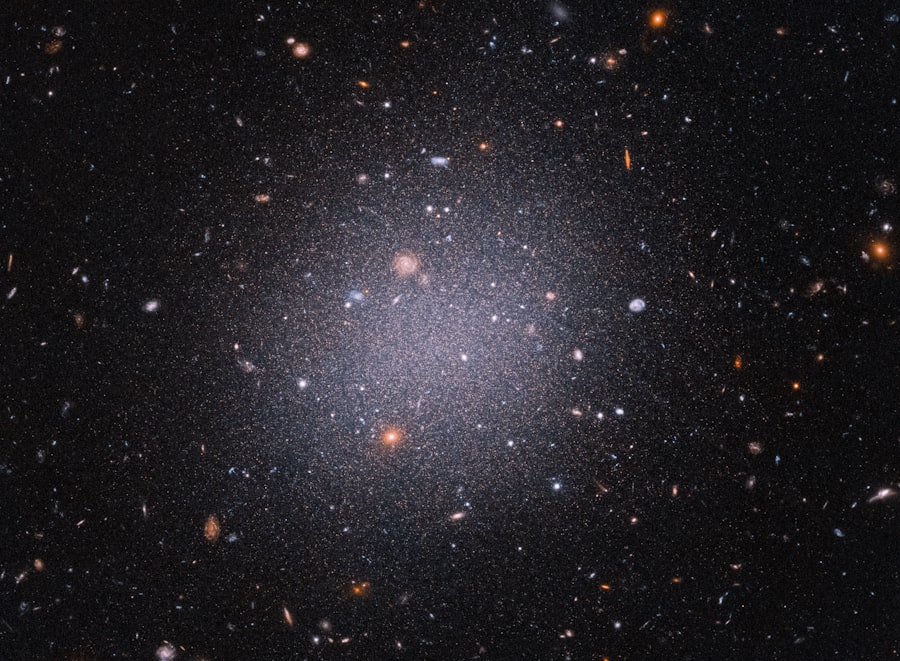
Over the years, various theories and hypotheses have emerged regarding the nature of dark matter. The most prominent among these is the WIMP hypothesis, which posits that dark matter consists of heavy particles that interact weakly with ordinary matter. This theory has inspired numerous experimental efforts aimed at detecting WIMPs directly or indirectly through their decay products.
However, despite extensive searches, no definitive evidence has yet been found. In addition to WIMPs, alternative theories have gained traction within the scientific community. Some researchers propose modifications to existing theories of gravity, such as Modified Newtonian Dynamics (MOND), which seeks to explain galactic rotation curves without invoking dark matter.
Others explore concepts like self-interacting dark matter or even exotic forms of matter that challenge conventional understanding. Each hypothesis brings its own set of predictions and implications for cosmology, leading to a rich tapestry of ideas that continue to evolve as new data emerges.
The Connection Between Dark Matter and Dark Energy
The relationship between dark matter and dark energy is a topic of intense investigation within cosmology. While dark matter acts as a gravitational glue that binds galaxies together, dark energy is thought to drive the accelerated expansion of the universe. Together, they comprise approximately 95% of the universe’s total energy content, yet their exact nature remains one of science’s greatest mysteries.
Some theories suggest that dark matter and dark energy may be interconnected in ways that are not yet fully understood. For instance, certain models propose that modifications to gravity could simultaneously account for both phenomena. Others speculate that interactions between dark matter particles could give rise to effects resembling those attributed to dark energy.
As researchers continue to explore these connections, they hope to uncover insights that could illuminate both dark matter and dark energy’s roles in shaping the cosmos.
The Impact of Dark Matter on Astrophysics
The study of dark matter has profoundly influenced astrophysics and our understanding of the universe’s structure and evolution. It has reshaped theories regarding galaxy formation and dynamics while providing critical insights into cosmic evolution over billions of years. The existence of dark matter has led scientists to reconsider fundamental aspects of physics, prompting new research directions and methodologies.
Moreover, dark matter research has spurred technological advancements in observational techniques and instrumentation. The need for sensitive detectors capable of measuring faint signals has driven innovation in fields ranging from particle physics to astronomy. As scientists continue their quest to understand dark matter, they are likely to uncover new phenomena that could further revolutionize astrophysics and our comprehension of fundamental forces.
The Future of Dark Matter Research
The future of dark matter research holds great promise as scientists develop new technologies and methodologies aimed at unraveling its mysteries. Upcoming experiments such as those conducted at large particle colliders like CERN’s Large Hadron Collider (LHC) or next-generation underground detectors are expected to push the boundaries of sensitivity in detecting potential dark matter candidates. Additionally, advancements in astronomical surveys will provide more precise measurements of cosmic structures influenced by dark matter.
As interdisciplinary collaboration becomes increasingly common in scientific research, physicists and astronomers are likely to work together more closely than ever before. This collaboration will facilitate a more comprehensive understanding of dark matter’s role in cosmology while fostering innovative approaches to tackle longstanding questions about its nature.
The Importance of Understanding Dark Matter
Understanding dark matter is crucial not only for advancing scientific knowledge but also for addressing fundamental questions about existence itself. It challenges our perceptions of reality by revealing that much of what constitutes our universe remains hidden from direct observation. By studying dark matter, scientists aim to uncover insights into how galaxies form and evolve while gaining a deeper appreciation for the intricate workings of cosmic forces.
Moreover, unraveling the mysteries surrounding dark matter could have far-reaching implications beyond astrophysics. It may lead to breakthroughs in fundamental physics or even inspire new technologies with applications across various fields.
The Ethical and Societal Implications of Dark Matter Discovery
The discovery of dark matter particles or a deeper understanding of its nature could have profound ethical and societal implications. Such breakthroughs may challenge existing paradigms within science and philosophy while prompting discussions about humanity’s place in the cosmos. As scientists grapple with these discoveries’ implications, they must also consider how this knowledge might influence public perception and policy regarding scientific research.
Furthermore, advancements in technology driven by dark matter research could lead to new applications with significant societal impacts—ranging from improved energy solutions to enhanced communication systems. As researchers navigate these complex ethical landscapes, they must remain vigilant about ensuring that scientific progress benefits society as a whole while fostering an inclusive dialogue about its implications for humanity’s future. In conclusion, dark matter remains one of science’s most intriguing mysteries—a puzzle that continues to captivate researchers across disciplines.
As investigations into its nature progress, they hold promise not only for advancing our understanding of the universe but also for shaping humanity’s future in profound ways.
In recent years, the enigmatic nature of dark matter has captivated scientists and enthusiasts alike, driving a surge of research and exploration into this mysterious component of our universe. A fascinating article on this topic can be found on My Cosmic Ventures, where the complexities and theories surrounding dark matter are explored in depth. For those interested in delving deeper into the subject, I recommend checking out this related article that provides insightful perspectives and the latest findings in the field.
WATCH THIS! How a Quantum Loophole Sparked Everything: The Universe Born From Nothing, Explained
FAQs
What is dark matter?
Dark matter is a hypothetical form of matter that is thought to make up about 27% of the universe’s total mass and energy. It does not emit, absorb, or reflect light, making it invisible and undetectable by current scientific instruments.
How do we know dark matter exists?
Scientists have inferred the existence of dark matter through its gravitational effects on visible matter, such as stars and galaxies. Observations of the rotation of galaxies, gravitational lensing, and the large-scale structure of the universe all point to the presence of dark matter.
What is the difference between dark matter and dark energy?
Dark matter and dark energy are two different concepts. Dark matter is a form of matter that exerts gravitational forces and affects the motion of galaxies and galaxy clusters. Dark energy, on the other hand, is a mysterious force that is thought to be driving the accelerated expansion of the universe.
What are the leading theories about the nature of dark matter?
There are several theories about the nature of dark matter, including the existence of weakly interacting massive particles (WIMPs), axions, and primordial black holes. However, none of these theories have been conclusively proven, and the true nature of dark matter remains a mystery.
What are the implications of dark matter for our understanding of the universe?
The existence of dark matter has significant implications for our understanding of the universe’s structure, formation, and evolution. It plays a crucial role in the formation of galaxies and galaxy clusters, and its presence has shaped the large-scale structure of the cosmos. Understanding dark matter is essential for developing a complete picture of the universe.