
The universe, in its intricate dance of celestial bodies and fundamental forces, continues to captivate and challenge human understanding. Central to this cosmic ballet are the interwoven concepts of spacetime curvature and gravity, phenomena that dictate the very structure and evolution of the cosmos. This article delves into these profound ideas, tracing their historical development, elucidating their theoretical underpinnings, and exploring their far-reaching implications.
Early Conceptions of Gravity
For millennia, humanity grappled with the invisible force that held objects to the Earth and governed the motions of the planets. Ancient civilizations observed the predictable patterns of celestial bodies, often attributing them to divine intervention or inherent qualities of matter. These early observations, while lacking a unified theoretical framework, laid the groundwork for future inquiry. You can learn more about the block universe theory in this insightful video.
Newton’s Universal Law of Gravitation
The 17th century witnessed a paradigm shift with Isaac Newton’s groundbreaking work. Newton’s “Philosophiae Naturalis Principia Mathematica” introduced the concept of universal gravitation, positing that every particle of matter in the universe attracts every other particle with a force proportional to the product of their masses and inversely proportional to the square of the distance between their centers. This elegant mathematical formulation successfully explained a vast array of phenomena, from the fall of an apple to the orbits of planets, establishing gravity as a fundamental force of nature.
Action at a Distance
Newton’s law, while remarkably successful, also presented a conceptual challenge: “action at a distance.” How could two objects interact without any apparent physical connection between them? Newton himself acknowledged this mystery, stating, “I have not yet been able to discover the cause of these properties of gravity.” This unresolved question would persist for centuries, ultimately finding a profound answer in the realm of spacetime.
Spacetime curvature is a fundamental concept in understanding gravity, as it describes how massive objects influence the fabric of space and time around them. For those interested in delving deeper into this topic, a related article can be found at My Cosmic Ventures, which explores the implications of spacetime curvature on our understanding of the universe and its dynamics. This resource provides valuable insights into how gravity shapes the cosmos and the ongoing research in this fascinating field.
Einstein’s Revolution: Spacetime as a Dynamic Fabric
The Special Theory of Relativity
In the early 20th century, Albert Einstein initiated a scientific revolution with his theory of relativity. The special theory of relativity, published in 1905, fundamentally altered our understanding of space and time. It posited that the laws of physics are the same for all non-accelerating observers and that the speed of light in a vacuum is constant for all such observers, regardless of the motion of the light source.
The Interconnectedness of Space and Time
A pivotal insight of special relativity was the realization that space and time are not independent entities but are intricately woven into a single four-dimensional continuum known as spacetime. This concept challenged the classical Newtonian view of absolute space and time, demonstrating their relativity to the observer’s motion. Imagine, if you will, the separate dimensions of length, width, and height as threads that, when viewed through the lens of relativity, are revealed to be part of a single, interwoven tapestry, with time acting as the fourth dimension.
The General Theory of Relativity
Building upon the foundations of special relativity, Einstein unveiled his general theory of relativity in 1915. This theory provided a new and radical understanding of gravity, moving beyond Newton’s description of gravity as a force to its interpretation as a manifestation of the curvature of spacetime.
Gravity as Spacetime Curvature
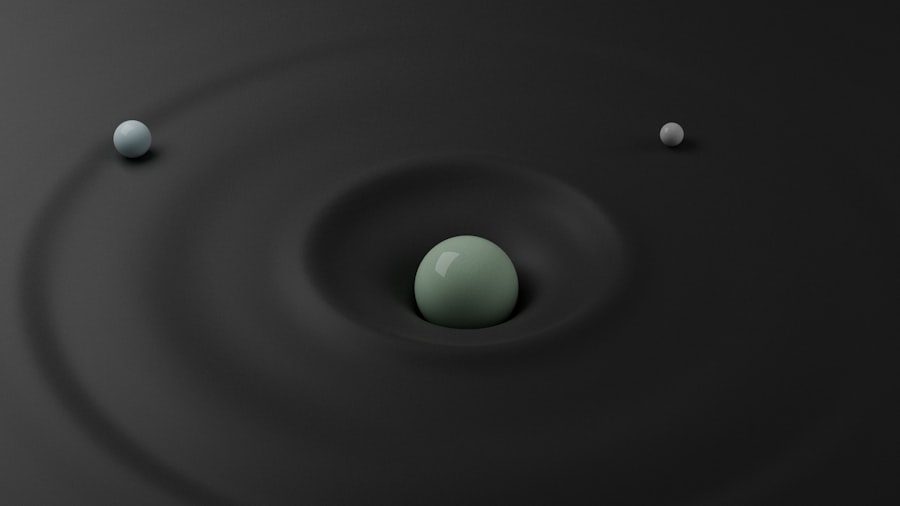
According to general relativity, massive objects, such as planets and stars, warp the fabric of spacetime around them. This curvature, much like a bowling ball placed on a stretched rubber sheet, dictates the paths of other objects, including light. Instead of a direct attractive force, gravity is now understood as the tendency of objects to follow the shortest possible path, or “geodesics,” within this curved spacetime. The Earth, for instance, does not orbit the Sun due to a mysterious pulling force, but because it is following the curved path in spacetime created by the Sun’s immense mass.
The Equivalence Principle
A cornerstone of general relativity is the equivalence principle, which states that gravitational and inertial forces are locally indistinguishable. This means that an observer in a uniformly accelerating reference frame cannot distinguish between the effects of acceleration and the effects of a uniform gravitational field. This principle provided a crucial link between inertia and gravity, paving the way for the geometric interpretation of gravity.
Empirical Evidence and Theoretical Confirmations

The Bending of Light
One of the earliest and most celebrated predictions of general relativity was the bending of light by massive objects. In 1919, Arthur Eddington’s expedition to observe a solar eclipse famously confirmed this prediction, showing that starlight passing near the Sun was deflected, precisely as Einstein’s theory had calculated. This observation provided compelling evidence for the curvature of spacetime.
Gravitational Redshift
General relativity also predicted that light emitted from a strong gravitational field would appear shifted towards longer, or redder, wavelengths – a phenomenon known as gravitational redshift. This effect has been verified through various experiments, including observations of light from distant galaxies and precise measurements using atomic clocks on Earth and in space.
Gravitational Lensing
The bending of light by massive objects can lead to a phenomenon called gravitational lensing, where the spacetime curvature around a galaxy or cluster of galaxies acts like a cosmic magnifying glass, distorting and amplifying the light from more distant objects. This effect has become an invaluable tool for astronomers, allowing them to study distant galaxies, probe the distribution of dark matter, and even detect exoplanets.
Perihelion Precession of Mercury
Newton’s law of gravity successfully explained most of the observed planetary orbits. However, a slight discrepancy in the perihelion precession of Mercury – the slow rotation of its elliptical orbit – remained unexplained. General relativity, with its more precise description of spacetime curvature near massive objects, accurately accounted for this anomaly, providing another triumph for Einstein’s theory.
Gravitational Waves
A profound prediction of general relativity was the existence of gravitational waves – ripples in the fabric of spacetime, generated by accelerating massive objects. Although initially difficult to detect due to their extreme faintness, direct detection of gravitational waves was achieved in 2015 by the LIGO (Laser Interferometer Gravitational-Wave Observatory) collaboration. This monumental discovery opened a new window into the universe, allowing astronomers to observe phenomena like colliding black holes and neutron stars that are otherwise invisible to electromagnetic telescopes.
The Cosmic Implications of Spacetime Curvature
Black Holes
One of the most exotic and fascinating implications of general relativity is the existence of black holes. These cosmic entities are regions of spacetime where gravity is so intense that nothing, not even light, can escape. Black holes form when massive stars collapse under their own gravity, creating a singularity – a point of infinite density – surrounded by an event horizon, the boundary beyond which escape is impossible.
Event Horizons and Singularities
The event horizon represents the “point of no return.” While matter and energy can cross the event horizon into a black hole, no information or matter can ever emerge from it. The singularity at the heart of a black hole represents a breakdown of classical physics, suggesting that a more fundamental theory of quantum gravity is needed to fully understand these extreme environments.
The Expansion of the Universe
General relativity also provides the theoretical framework for understanding the large-scale structure and evolution of the universe. The theory predicts that the universe is not static but is either expanding or contracting. Observational evidence, particularly the redshift of light from distant galaxies, confirms that the universe is indeed expanding.
The Big Bang and Cosmic Evolution
The expansion of the universe, when traced backward in time, leads to the concept of the Big Bang – the widely accepted cosmological model describing the universe’s origin from an extremely hot and dense state approximately 13.8 billion years ago. Spacetime curvature plays a critical role in describing the dynamics of this expansion, influencing the distribution of matter and energy throughout the cosmos.
Dark Matter and Dark Energy
While general relativity has been remarkably successful, it also highlights the existence of profound mysteries. Observations suggest that the visible matter we observe constitutes only a small fraction of the total mass and energy in the universe. The vast majority appears to be composed of “dark matter” and “dark energy.”
The Unseen Components of the Cosmos
Dark matter, whose presence is inferred from its gravitational effects on visible matter, does not interact with light or other electromagnetic radiation, making it invisible to telescopes. Dark energy, even more mysterious, is thought to be responsible for the accelerating expansion of the universe. While these entities do not directly curve spacetime in the same way as ordinary matter, their gravitational influence is undeniable, significantly impacting the large-scale structure of the cosmos. Understanding their nature is one of the most pressing challenges in contemporary physics and cosmology.
Spacetime curvature is a fundamental concept in understanding gravity, as it describes how massive objects influence the fabric of space and time around them. This phenomenon is beautifully illustrated in the theory of general relativity, which reveals how gravity is not merely a force but a result of this curvature. For those interested in exploring this topic further, a related article can provide deeper insights into the implications of spacetime on our universe. You can read more about it in this detailed exploration of spacetime and gravity.
The Future of Spacetime and Gravity Research
| Metric | Description | Typical Value / Unit |
|---|---|---|
| Ricci Curvature Tensor (Rμν) | Measures the degree to which matter influences the volume distortion of spacetime | Varies with mass-energy distribution (unit: 1/m²) |
| Riemann Curvature Tensor (Rμνρσ) | Describes the intrinsic curvature of spacetime, including tidal forces | Varies with gravitational field strength (unit: 1/m²) |
| Scalar Curvature (R) | Trace of the Ricci tensor, representing overall curvature of spacetime | Varies, often near zero in flat spacetime (unit: 1/m²) |
| Einstein Tensor (Gμν) | Combines Ricci tensor and scalar curvature; relates curvature to energy-momentum | Depends on energy-momentum tensor (unit: 1/m²) |
| Gravitational Constant (G) | Fundamental constant relating mass-energy to spacetime curvature | 6.67430 × 10⁻¹¹ m³·kg-1·s-2 |
| Schwarzschild Radius (rs) | Radius defining the event horizon of a non-rotating black hole | rs = 2GM/c² (meters) |
| Curvature Scalar near Earth | Approximate scalar curvature caused by Earth’s mass | ~10-26 1/m² |
| Spacetime Interval (ds²) | Invariant measure combining space and time intervals in curved spacetime | Depends on metric tensor (unit: m²) |
The journey to understand spacetime curvature and gravity is far from complete. Scientists continue to explore the limits of general relativity and seek a more comprehensive theory that can unify it with quantum mechanics.
Quantum Gravity
The quest for a theory of quantum gravity aims to reconcile general relativity, which describes gravity on macroscopic scales, with quantum mechanics, which governs the microscopic world of particles. Such a theory would provide a complete description of gravity, especially in extreme environments like the early universe and within black holes, where both quantum effects and strong gravitational fields are significant. Theories such as string theory and loop quantum gravity represent ongoing efforts in this ambitious endeavor.
Multiverse Theories
Some theoretical frameworks, extending beyond current paradigms, propose the existence of multiple universes or a “multiverse.” While highly speculative, these ideas often emerge from attempts to resolve fundamental questions about the universe’s fine-tuning and the origin of its physical laws. The concept of spacetime in such scenarios would be vastly more intricate, potentially involving higher dimensions or interacting universes.
Ongoing Observational Experiments
New generations of telescopes, gravitational wave detectors, and particle accelerators continue to push the boundaries of observation and experimentation. Missions like the James Webb Space Telescope provide unprecedented views of the early universe, allowing scientists to study the evolution of galaxies and the distribution of matter on cosmic scales. Further advancements in gravitational wave astronomy promise to reveal new insights into the most violent and energetic events in the cosmos, further testing the predictions of general relativity and potentially unveiling new physics.
In conclusion, the concepts of spacetime curvature and gravity, initially framed by Newton and profoundly reimagined by Einstein, offer a profound lens through which to comprehend the universe. From the elegant dance of planetary orbits to the enigmatic allure of black holes and the grand expansion of the cosmos, these ideas form the bedrock of modern astrophysics and cosmology. While much has been unveiled, the universe continues to hold mysteries, inviting future generations to continue the quest for a deeper understanding of its fundamental fabric.
FAQs
What is spacetime curvature in the context of gravity?
Spacetime curvature refers to the bending or warping of the four-dimensional fabric of space and time caused by the presence of mass and energy. According to Einstein’s theory of General Relativity, gravity is not a force acting at a distance but a result of this curvature affecting the motion of objects.
How does spacetime curvature explain gravity?
Gravity is explained as the effect of curved spacetime on the paths that objects follow. Massive objects like stars and planets cause spacetime to curve around them, and other objects move along these curved paths, which appear to us as gravitational attraction.
Who developed the concept of spacetime curvature?
The concept was developed by Albert Einstein as part of his General Theory of Relativity, published in 1915. This theory revolutionized the understanding of gravity by describing it as a geometric property of spacetime.
What is the difference between Newtonian gravity and gravity as spacetime curvature?
Newtonian gravity describes gravity as a force acting instantaneously at a distance between masses. In contrast, General Relativity describes gravity as the effect of curved spacetime geometry, where mass and energy tell spacetime how to curve, and curved spacetime tells objects how to move.
How is spacetime curvature measured or observed?
Spacetime curvature can be observed through phenomena such as the bending of light around massive objects (gravitational lensing), the precession of planetary orbits, time dilation near massive bodies, and gravitational waves detected by observatories like LIGO.
Does spacetime curvature affect time as well as space?
Yes, spacetime curvature affects both space and time. Near massive objects, time runs slower relative to regions farther away, a phenomenon known as gravitational time dilation.
Can spacetime curvature be visualized?
While spacetime is four-dimensional and cannot be fully visualized, it is often represented using two-dimensional analogies like a stretched rubber sheet that bends under the weight of a mass to help illustrate how mass curves space.
What role does spacetime curvature play in black holes?
Black holes are regions where spacetime curvature becomes extremely intense due to a very large concentration of mass in a small area. This extreme curvature creates an event horizon beyond which nothing, not even light, can escape.
Is spacetime curvature relevant only on large scales?
Spacetime curvature is most noticeable around massive objects like stars, planets, and galaxies. However, it exists everywhere, though its effects are negligible at everyday scales and become significant only in strong gravitational fields or at cosmological distances.
How does spacetime curvature relate to gravitational waves?
Gravitational waves are ripples in the curvature of spacetime caused by accelerating masses, such as merging black holes or neutron stars. These waves propagate through spacetime at the speed of light and were first directly detected in 2015.