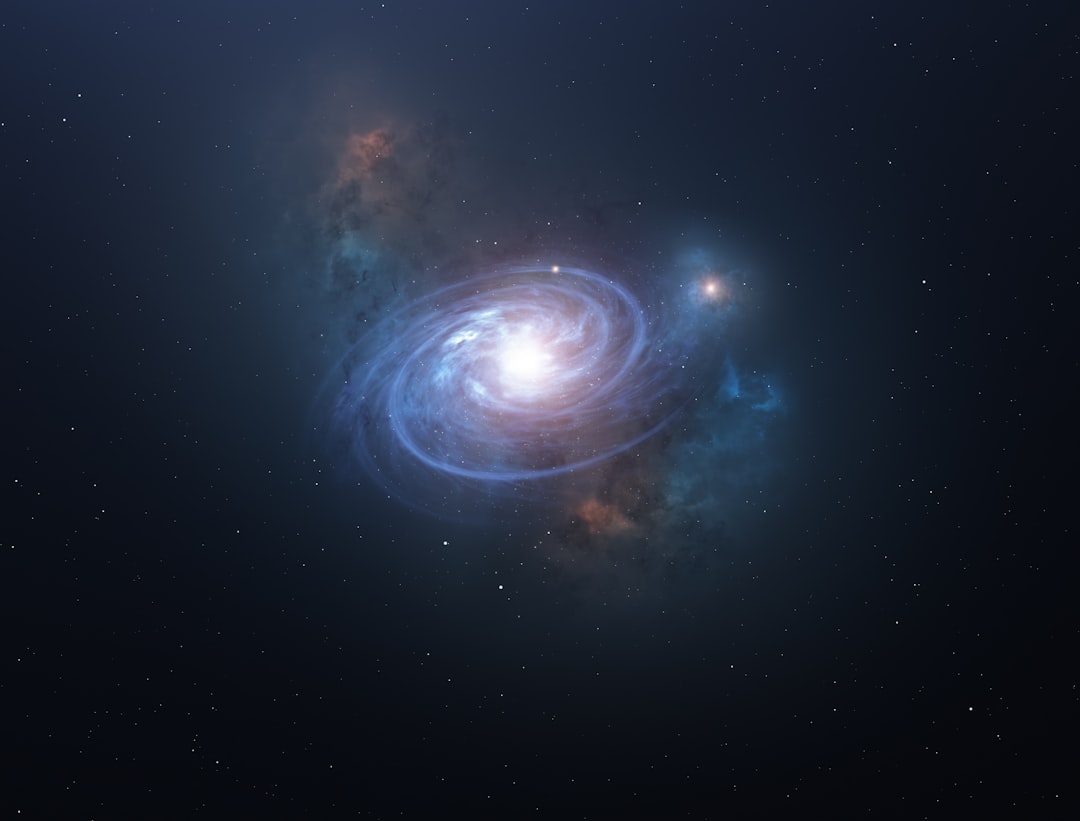
Gravitational lensing occurs when a massive object, such as a galaxy or cluster of galaxies, bends light from a more distant object. This phenomenon is explained by Einstein’s theory of general relativity, which describes how massive objects curve spacetime. When light from a distant quasar passes near an intervening galaxy, the curved spacetime deflects the light’s path, creating multiple images or arc-like distortions of the quasar.
Gravitational lensing provides astronomers with important tools for studying dark matter distribution and cosmic structure. By measuring how light bends around massive objects, researchers can determine their mass and composition. This technique enhances understanding of individual galaxies and reveals information about the large-scale structure of the universe.
Gravitational lensing connects theoretical physics with observational astronomy, enabling direct observation of the relationship between light and gravity.
Key Takeaways
- Gravitational lensing bends light from distant quasars, creating multiple images with time delays.
- Quasars are extremely bright, distant objects powered by supermassive black holes.
- Measuring time delays between lensed quasar images helps determine cosmic distances and the universe’s expansion rate.
- Challenges include accurately modeling lensing galaxies and accounting for microlensing effects.
- Studying these time delays provides valuable insights into cosmology, dark matter, and dark energy.
What are Quasars?
Quasars, or quasi-stellar objects, are among the most luminous and energetic entities in the universe. They are powered by supermassive black holes at the centers of distant galaxies, where matter spirals in and releases enormous amounts of energy in the form of radiation. When you look at a quasar, you are essentially observing a beacon of light that has traveled billions of years to reach you, providing a glimpse into the early universe.
The brightness of quasars can outshine entire galaxies, making them some of the most significant objects for studying cosmic evolution. As you learn more about quasars, you will discover that they are not just fascinating due to their luminosity; they also serve as important markers for understanding the universe’s expansion.
The study of quasars opens up a window into epochs long past, allowing you to piece together the history of cosmic structures and the forces that shaped them. The holographic principle is a fascinating concept in theoretical physics that suggests our universe can be described as a two-dimensional information structure.
The Concept of Time Delays in Quasars
Time delays in quasars arise from the phenomenon of gravitational lensing, where light from a quasar takes different paths to reach an observer due to the presence of a massive foreground object. When you observe multiple images of a quasar created by gravitational lensing, you may notice that these images do not arrive simultaneously. Instead, there is a time delay between them, which can range from days to years depending on the configuration of the lensing mass and the distance to the quasar.
This concept is not just an intriguing aspect of astrophysics; it also provides valuable information about both the quasar and the lensing galaxy. Understanding time delays allows you to explore fundamental questions about the nature of light and gravity. For instance, by measuring these delays, you can estimate the mass of the lensing galaxy with remarkable precision.
This relationship between time delays and mass is crucial for testing theories of gravity and understanding how mass influences light propagation. As you delve deeper into this topic, you’ll find that time delays serve as a unique tool for probing both cosmological parameters and the dynamics of distant celestial objects.
The Role of Gravitational Lensing in Time Delays
Gravitational lensing plays a pivotal role in creating time delays among multiple images of quasars. When light from a distant quasar passes near a massive foreground object, such as a galaxy, it is bent along different paths due to the gravitational field of that object. As you consider this scenario, it becomes clear that each path has a different length and curvature, leading to variations in travel time for each light ray.
This difference in travel time results in observable time delays between the images that reach your telescope. The significance of these time delays extends beyond mere curiosity; they provide critical insights into both the lensing mass and the geometry of spacetime. By analyzing how these delays correlate with other properties of the lensing galaxy, such as its mass distribution and shape, you can gain a deeper understanding of how gravity operates on cosmic scales.
Furthermore, these measurements can help refine models of dark matter distribution within galaxies, offering clues about one of the universe’s most elusive components.
How Time Delays are Measured
| Quasar Name | Lens Galaxy Redshift (z_l) | Source Quasar Redshift (z_s) | Time Delay (days) | Measurement Uncertainty (days) | Reference |
|---|---|---|---|---|---|
| Q0957+561 | 0.36 | 1.41 | 417 | 3 | Refsdal et al. (1964) |
| HE 0435-1223 | 0.45 | 1.69 | 14.4 | 0.8 | Wong et al. (2017) |
| RX J1131-1231 | 0.29 | 0.66 | 91 | 1.5 | Tewes et al. (2013) |
| SDSS J1206+4332 | 0.75 | 1.79 | 111 | 3 | Bonvin et al. (2016) |
| PG 1115+080 | 0.31 | 1.72 | 25 | 3 | Schechter et al. (1997) |
Measuring time delays in gravitationally lensed quasars involves sophisticated observational techniques and data analysis methods. You typically start by monitoring multiple images of a quasar over time using powerful telescopes equipped with sensitive detectors. By capturing light curves—graphs that plot brightness against time—you can identify variations in brightness among different images.
These variations often occur due to intrinsic changes in the quasar’s luminosity or due to microlensing effects caused by stars within the lensing galaxy. Once you have gathered sufficient data, you can analyze these light curves to determine time delays with high precision. This process often involves cross-correlating the light curves from different images to identify peaks and troughs that correspond to changes in brightness.
The resulting time delay measurements can then be used to infer properties about both the quasar and its lensing galaxy. As you engage with this methodology, you’ll appreciate how advancements in technology and data analysis techniques have revolutionized our ability to study these cosmic phenomena.
Challenges in Studying Gravitationally Lensed Quasar Time Delays
Despite the exciting prospects offered by gravitationally lensed quasars, studying their time delays presents several challenges. One significant hurdle is the need for long-term monitoring campaigns to capture sufficient data on quasar variability. Since quasars can exhibit changes in brightness over timescales ranging from days to years, maintaining consistent observations over extended periods is crucial yet logistically demanding.
You may find that coordinating observations across multiple observatories and ensuring data quality can be quite complex. Another challenge lies in disentangling intrinsic variability from effects caused by gravitational lensing. Quasars are inherently variable objects; thus, distinguishing between changes due to their own activity and those induced by lensing requires careful analysis.
Additionally, factors such as microlensing—where individual stars within the lensing galaxy affect light paths—can complicate interpretations further. As you navigate these challenges, you’ll gain insight into how researchers develop innovative strategies to overcome obstacles and enhance our understanding of these remarkable cosmic phenomena.
Applications of Gravitationally Lensed Quasar Time Delays
The study of gravitationally lensed quasar time delays has far-reaching applications across various fields in astrophysics and cosmology. One primary application is in measuring Hubble’s constant—the rate at which the universe is expanding. By utilizing time delays as a cosmic distance indicator, researchers can derive precise measurements of this fundamental parameter.
This information is crucial for understanding the dynamics of cosmic expansion and addressing questions related to dark energy. Moreover, time delays provide valuable insights into dark matter distribution within galaxies. By analyzing how mass influences light paths and time delays, you can infer details about dark matter halos surrounding galaxies.
This knowledge contributes to our understanding of galaxy formation and evolution while also shedding light on one of cosmology’s most pressing mysteries: the nature of dark matter itself. As you explore these applications further, you’ll see how gravitationally lensed quasar time delays serve as a powerful tool for unraveling some of the universe’s most profound questions.
Current Research and Discoveries
Current research on gravitationally lensed quasars is vibrant and continually evolving, with astronomers employing cutting-edge technology and innovative methodologies to deepen our understanding. Recent studies have focused on refining measurements of time delays using advanced imaging techniques and machine learning algorithms to analyze vast datasets more efficiently. These advancements have led to more accurate determinations of Hubble’s constant and improved models for dark matter distribution.
Additionally, researchers are exploring new avenues for studying gravitational lensing effects beyond traditional methods. For instance, multi-wavelength observations—combining data from radio, optical, and X-ray telescopes—are being utilized to gain a more comprehensive view of lensed quasars’ behavior across different energy spectra. This holistic approach allows for richer insights into both quasar physics and lensing dynamics.
As you engage with current research trends, you’ll find that collaboration across disciplines is key to unlocking new discoveries in this exciting field.
Future Prospects in the Study of Gravitationally Lensed Quasar Time Delays
Looking ahead, the future prospects for studying gravitationally lensed quasar time delays are promising and filled with potential breakthroughs. Upcoming astronomical surveys and next-generation telescopes are set to revolutionize our ability to detect and monitor lensed quasars on an unprecedented scale. Projects like the Vera Rubin Observatory’s Legacy Survey of Space and Time (LSST) aim to provide vast amounts of data that will enhance our understanding of quasar variability and gravitational lensing effects.
Moreover, advancements in computational techniques will likely play a crucial role in analyzing complex datasets more efficiently than ever before. Machine learning algorithms are expected to become increasingly integral in identifying lensed quasars and extracting meaningful information from their light curves. As these technologies continue to evolve, they will enable researchers like yourself to tackle longstanding questions about cosmic expansion, dark matter distribution, and fundamental physics with greater precision.
Implications for Cosmology
The implications of studying gravitationally lensed quasar time delays extend far beyond individual measurements; they resonate deeply within cosmology as a whole. By providing precise estimates for Hubble’s constant and insights into dark matter distribution, these studies contribute significantly to our understanding of cosmic evolution and structure formation. As you consider these implications, it becomes evident that unraveling the mysteries surrounding gravitational lensing not only enhances your knowledge but also shapes our broader comprehension of the universe’s history.
Furthermore, findings related to gravitationally lensed quasars may challenge existing cosmological models or lead to new theories altogether. As researchers continue to refine their measurements and explore novel approaches, they may uncover unexpected phenomena that prompt reevaluation of fundamental principles governing our universe. Engaging with these implications allows you to appreciate how each discovery contributes to an ever-evolving narrative about our place within the cosmos.
Unveiling the Mysteries of Gravitationally Lensed Quasar Time Delays
In conclusion, your journey through the realm of gravitationally lensed quasar time delays reveals a captivating intersection between light, gravity, and cosmic evolution.
As researchers continue to push boundaries through innovative techniques and collaborative efforts, they unveil new layers of complexity surrounding these enigmatic phenomena.
As you reflect on this exploration, consider how gravitationally lensed quasars serve as both beacons illuminating distant epochs and tools for probing fundamental questions about reality itself. The ongoing study of their time delays not only enhances your understanding but also invites you to participate in an ever-expanding quest for knowledge—a quest that promises to unveil even more mysteries hidden within the vastness of space-time.
Gravitationally lensed quasars provide a fascinating opportunity to study the effects of gravity on light and the expansion of the universe. A related article that delves deeper into the implications of time delays in these cosmic phenomena can be found at