Quasars, or quasi-stellar objects, are among the most luminous and distant entities in the universe. They are powered by supermassive black holes at the centers of galaxies, which consume surrounding gas and dust, emitting tremendous amounts of energy in the process. Because of their extreme brightness, astronomers can observe quasars from vast distances, making them invaluable tools for studying the formation and evolution of galaxies and providing insights into the early universe.
Absorption spectra are essential for understanding quasars. When light from a quasar travels to Earth, it passes through intervening gas clouds that absorb certain wavelengths of that light. The elements in these clouds create distinct absorption lines in the quasar’s spectrum.
By analyzing these lines, astronomers can determine the composition, temperature, density, and motion of the absorbing material. This analysis reveals information about the physical conditions of the universe at different periods in cosmic history, particularly during the era when quasars were most active.
Key Takeaways
- Quasar absorption spectra provide critical insights into the chemical composition and physical conditions of intergalactic and circumgalactic gas.
- Analyzing absorption lines helps identify the origins and kinematics of gas clouds along the line of sight to quasars.
- These spectra are essential for studying the evolution of galaxies and the large-scale structure of the universe.
- Advanced techniques in spectroscopy enable detailed investigation of the absorbing material’s properties and dynamics.
- Research on quasar absorption spectra faces challenges but holds promising applications for cosmology and astrophysics.
The Significance of Quasar Absorption Spectra in Astronomy
The significance of quasar absorption spectra extends far beyond mere curiosity; they are essential for understanding the universe’s structure and evolution. By analyzing these spectra, astronomers can trace the distribution of matter in the universe, including dark matter and baryonic matter. This information is vital for constructing models of cosmic evolution and understanding how galaxies form and interact over time.
As you explore this field, you will appreciate how quasar absorption spectra serve as a cosmic map, revealing the intricate web of matter that connects galaxies across vast distances. Moreover, quasar absorption spectra provide a unique window into the early universe. The light from quasars has traveled billions of years to reach us, allowing you to observe conditions that existed when the universe was still young.
By studying these ancient light signatures, you can glean insights into the processes that shaped the cosmos shortly after the Big Bang. This connection to the early universe makes quasar absorption spectra a cornerstone of modern cosmology, helping to answer fundamental questions about the origins and evolution of everything we see today. The holographic principle is a fascinating concept in theoretical physics that suggests our universe can be described as a two-dimensional information structure.
Techniques for Analyzing Quasar Absorption Spectra

Analyzing quasar absorption spectra involves a variety of sophisticated techniques that allow astronomers to extract meaningful data from complex light patterns. One of the primary methods is spectroscopy, which involves dispersing light into its constituent wavelengths using instruments like spectrographs. By capturing and analyzing these spectra, you can identify specific absorption lines corresponding to different elements and ions present in the intervening gas clouds.
This process requires careful calibration and correction for various factors, such as instrumental effects and atmospheric interference. In addition to traditional spectroscopy, advanced techniques such as high-resolution spectroscopy and multi-wavelength observations have revolutionized the analysis of quasar absorption spectra. High-resolution spectroscopy enables you to discern subtle features in the absorption lines, providing more precise measurements of physical conditions in the absorbing gas.
Multi-wavelength observations allow for a more comprehensive understanding by comparing data collected across different parts of the electromagnetic spectrum, from radio waves to X-rays. These combined approaches enhance your ability to interpret complex spectra and draw meaningful conclusions about the universe’s composition and dynamics.
Identifying Absorption Lines and Their Origins
Identifying absorption lines within quasar spectra is a critical step in unraveling the mysteries of cosmic matter.
As you study these lines, you will encounter familiar elements such as hydrogen, helium, carbon, and iron, each contributing to the overall picture of cosmic chemistry.
The presence and strength of these lines provide clues about the abundance of elements in the absorbing gas and its physical state. The origins of these absorption lines can be traced back to various astrophysical processes. For instance, some lines may arise from gas clouds located in intergalactic space, while others may originate from material within galaxies themselves.
Understanding where these lines come from is essential for interpreting their significance accurately. As you delve deeper into this topic, you will learn how factors such as temperature, density, and ionization state influence the formation of absorption lines, allowing you to piece together a more comprehensive narrative about the universe’s chemical evolution.
Unveiling the Chemical Composition of Absorbing Material
| Parameter | Description | Typical Value/Range | Unit | Significance in Quasar Absorption Spectra Analysis |
|---|---|---|---|---|
| Redshift (z) | Measure of the wavelength shift due to cosmic expansion | 0.1 – 7.5 | Dimensionless | Determines distance and age of absorbing gas clouds |
| Equivalent Width (EW) | Width of absorption line representing strength | 0.01 – 5 | Angstroms (Å) | Indicates column density and abundance of elements |
| Column Density (N) | Number of atoms per unit area along line of sight | 1012 – 1022 | cm-2 | Quantifies amount of absorbing material |
| Doppler Parameter (b) | Broadening of absorption lines due to thermal and turbulent motions | 5 – 100 | km/s | Helps infer temperature and velocity dispersion of gas |
| Optical Depth (τ) | Measure of opacity of absorbing gas | 0 – 10 | Dimensionless | Determines absorption strength and saturation level |
| Signal-to-Noise Ratio (SNR) | Quality of spectral data | 10 – 1000 | Dimensionless | Higher SNR allows more precise line measurements |
| Velocity Offset (Δv) | Difference in velocity between absorption components | 0 – 1000 | km/s | Used to study kinematics and structure of absorbing gas |
One of the most exciting aspects of studying quasar absorption spectra is uncovering the chemical composition of absorbing material. By analyzing absorption lines corresponding to various elements and ions, you can determine not only what elements are present but also their relative abundances. This information is crucial for understanding the processes that govern star formation and galactic evolution.
For example, a high abundance of heavy elements may indicate that a region has undergone significant star formation and supernova activity. As you explore this chemical landscape, you will also encounter intriguing phenomena such as metallicity—the abundance of elements heavier than hydrogen and helium in a given region. Metallicity plays a vital role in shaping galaxies and influencing their evolution over time.
By studying quasar absorption spectra, you can trace how metallicity varies across different epochs in cosmic history, providing insights into how galaxies evolve and interact with their environments.
Studying the Physical Conditions of Absorbing Gas
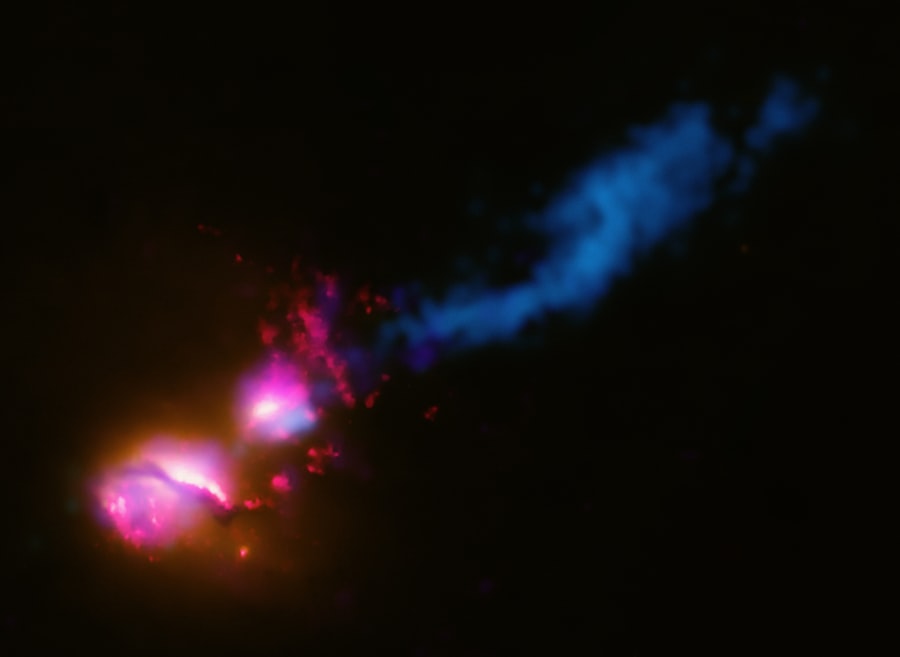
In addition to revealing chemical composition, quasar absorption spectra offer valuable information about the physical conditions of absorbing gas clouds. Parameters such as temperature, density, and pressure can be inferred from the characteristics of absorption lines. For instance, broadening of these lines can indicate high temperatures or turbulent motions within the gas.
As you analyze these features, you will gain insights into the dynamic processes occurring within these clouds. Understanding the physical conditions of absorbing gas is essential for constructing models of galaxy formation and evolution. The interplay between gas dynamics and star formation is a complex dance that shapes galaxies over billions of years.
By studying quasar absorption spectra, you can contribute to this ongoing dialogue about how galaxies evolve in response to their environments and how they interact with one another through processes like mergers and accretion.
Investigating the Kinematics of Absorbing Gas
The kinematics of absorbing gas is another fascinating aspect revealed through quasar absorption spectra. By examining how absorption lines shift due to the Doppler effect—caused by the motion of gas clouds relative to Earth—you can infer information about their velocities and dynamics. This analysis allows you to explore how gas moves within galaxies and across intergalactic space.
As you investigate these kinematic properties, you may uncover evidence for outflows driven by supernova explosions or active galactic nuclei (AGN). These outflows play a crucial role in regulating star formation within galaxies by expelling gas that could otherwise form new stars. Understanding these processes is vital for piecing together a comprehensive picture of galaxy evolution and how energy flows through cosmic structures.
Exploring the Evolution of Quasar Absorption Spectra
The evolution of quasar absorption spectra over cosmic time provides a unique lens through which to view changes in the universe’s structure and composition. As you study quasars at different redshifts—essentially different points in time—you will observe variations in their absorption features that reflect changes in the intergalactic medium and galactic environments. This temporal perspective allows you to trace how matter has evolved since the early universe.
By comparing absorption spectra from quasars at various epochs, you can identify trends related to cosmic reionization—the period when hydrogen gas became ionized due to intense radiation from stars and quasars. This phase transition had profound implications for galaxy formation and evolution. Your exploration into these spectral changes will deepen your understanding of how quasars have influenced their surroundings throughout cosmic history.
Implications for Cosmology and Galactic Evolution
The implications of studying quasar absorption spectra extend far beyond individual galaxies; they touch upon fundamental questions in cosmology and our understanding of galactic evolution. By analyzing these spectra, you contribute to our knowledge about dark matter distribution, cosmic expansion rates, and even the nature of dark energy. The insights gained from quasar absorption lines help refine cosmological models that describe how our universe has evolved since its inception.
Furthermore, your research into quasar absorption spectra sheds light on how galaxies interact with their environments over time. The processes governing galaxy formation are complex and multifaceted; by examining how quasars influence surrounding gas clouds through feedback mechanisms like outflows or accretion events, you can contribute valuable data to ongoing discussions about galactic evolution.
Challenges and Future Directions in Quasar Absorption Spectra Research
Despite significant advancements in our understanding of quasar absorption spectra, numerous challenges remain in this field of research. One major hurdle is obtaining high-quality data from distant quasars due to their faintness and the interference caused by intervening material along our line of sight. As technology continues to improve with more advanced telescopes and instruments being developed, your ability to gather clearer data will enhance your research capabilities.
Developing sophisticated models that accurately account for these complexities is essential for drawing reliable conclusions about cosmic conditions. As you navigate these challenges, collaboration with other researchers across disciplines will be crucial for advancing our understanding of quasar absorption spectra.
Applications of Quasar Absorption Spectra in Astrophysics and Cosmology
The applications of quasar absorption spectra extend into various realms within astrophysics and cosmology. For instance, they are instrumental in probing large-scale structures like filaments and voids within the universe’s cosmic web. By mapping out these structures using absorption features from multiple quasars along different lines of sight, you can gain insights into how matter is distributed on grand scales.
Additionally, quasar absorption spectra have implications for understanding fundamental physics beyond standard cosmological models. They provide opportunities to test theories related to dark matter interactions or modifications to gravity on cosmological scales. As you engage with this research area, you’ll find that quasar absorption spectra serve as a bridge between observational astronomy and theoretical physics—offering pathways toward answering some of humanity’s most profound questions about our place in the universe.
In conclusion, your journey through the world of quasars and their absorption spectra reveals a rich tapestry woven from threads of chemistry, physics, and cosmology. Each spectrum tells a story about our universe’s past while offering glimpses into its future—a narrative that continues to unfold as new discoveries are made through ongoing research efforts.
Quasar absorption spectra analysis is a crucial aspect of understanding the chemical composition and physical conditions of the universe. For a deeper dive into this topic, you can explore the related article on cosmic phenomena at this link. This article provides valuable insights into the methods used to analyze quasar absorption lines and their implications for cosmology.
⚡WATCH NOW: Discover why physicists think the laws of physics might be changing!
FAQs
What is a quasar absorption spectrum?
A quasar absorption spectrum is the pattern of dark lines or bands seen in the light from a quasar, caused by intervening gas clouds absorbing specific wavelengths of light as it travels to Earth.
Why are quasar absorption spectra important in astronomy?
They provide valuable information about the composition, temperature, density, and motion of intergalactic and interstellar gas clouds between the quasar and Earth, helping scientists study the large-scale structure of the universe and the evolution of matter.
How are quasar absorption spectra obtained?
They are obtained by using spectrographs attached to telescopes to disperse the light from distant quasars into its component wavelengths, revealing absorption lines caused by intervening material.
What types of absorption lines are commonly found in quasar spectra?
Common absorption lines include those from hydrogen (Lyman-alpha), metals such as carbon, magnesium, and iron, and molecular species, each indicating different physical conditions and chemical compositions of the absorbing gas.
What can quasar absorption spectra tell us about the early universe?
They can reveal the distribution and properties of gas in the early universe, including the presence of primordial elements, the formation of galaxies, and the reionization epoch.
What challenges are involved in analyzing quasar absorption spectra?
Challenges include distinguishing overlapping absorption lines, correcting for instrumental effects, accounting for redshift, and modeling the physical conditions of the absorbing gas accurately.
How does redshift affect quasar absorption spectra?
Redshift stretches the wavelengths of absorption lines to longer wavelengths, allowing astronomers to determine the distance and velocity of the absorbing gas relative to Earth.
Can quasar absorption spectra be used to measure the expansion of the universe?
Yes, by analyzing the redshifts of absorption lines from multiple gas clouds at different distances, astronomers can study the rate of cosmic expansion and test cosmological models.
What instruments are typically used for quasar absorption spectra analysis?
High-resolution spectrographs on large ground-based telescopes and space telescopes are commonly used to obtain detailed quasar absorption spectra.
How does the analysis of quasar absorption spectra contribute to our understanding of dark matter?
While quasar absorption spectra do not detect dark matter directly, they help map the distribution of normal matter in the universe, which in turn provides indirect clues about the presence and influence of dark matter on cosmic structures.