
Proxima Centauri is the nearest star to our solar system, located approximately 4.24 light-years away within the Alpha Centauri star system. This red dwarf star has become a significant focus of astronomical research and interest. In 2016, astronomers discovered Proxima b, an Earth-sized exoplanet orbiting within Proxima Centauri’s habitable zone—the region where conditions could potentially support liquid water and life as we understand it.
This discovery has substantially increased scientific interest in the star system as a potential target for future space exploration missions. The proximity of Proxima Centauri to Earth makes it the most accessible star system for potential interstellar travel, despite the vast distances involved. Current spacecraft would require thousands of years to reach Proxima Centauri using existing propulsion technology.
The existence of Proxima b has prompted serious scientific consideration of advanced propulsion systems and long-term space exploration strategies. Studying this star system contributes to broader research into exoplanet characteristics, stellar behavior, and the prevalence of potentially habitable worlds beyond our solar system. Future missions to Proxima Centauri, whether robotic probes or eventual human expeditions, would represent a major milestone in space exploration and could provide valuable data about planetary formation, atmospheric composition, and the possibility of life elsewhere in the universe.
Explore the future of space travel with laser sails technology.
Key Takeaways
- Proxima Centauri is the closest star to Earth, making it a prime target for interstellar exploration.
- Interstellar travel presents significant challenges, including vast distances and technological limitations.
- The Proxima Mission involves advanced spacecraft technology and rigorous crew selection and training.
- Life aboard the spacecraft requires careful planning to support the crew during the long journey.
- The mission aims to achieve groundbreaking scientific discoveries and leave a lasting legacy for humanity.
The Challenges of Interstellar Travel
Embarking on a journey to Proxima Centauri is fraught with challenges that extend far beyond the technical aspects of spacecraft design. One of the most significant hurdles you would face is the vast distance involved. Traveling 4.24 light-years means that even at the speed of light, it would take over four years to reach your destination.
Current spacecraft technology, however, operates at a fraction of that speed, making the journey potentially last thousands of years. This reality raises questions about the feasibility of human travel and the need for innovative propulsion systems that could significantly reduce travel time. In addition to the distance, you must also consider the physical and psychological toll that such a long journey would take on astronauts.
The isolation of deep space travel can lead to mental health challenges, as you would be cut off from Earth and loved ones for extended periods. The spacecraft would need to be equipped with life-support systems capable of sustaining human life for years, including food production, waste recycling, and psychological support mechanisms. These factors highlight the complexity of interstellar missions and the necessity for comprehensive planning and preparation.
The Development of the Proxima Mission
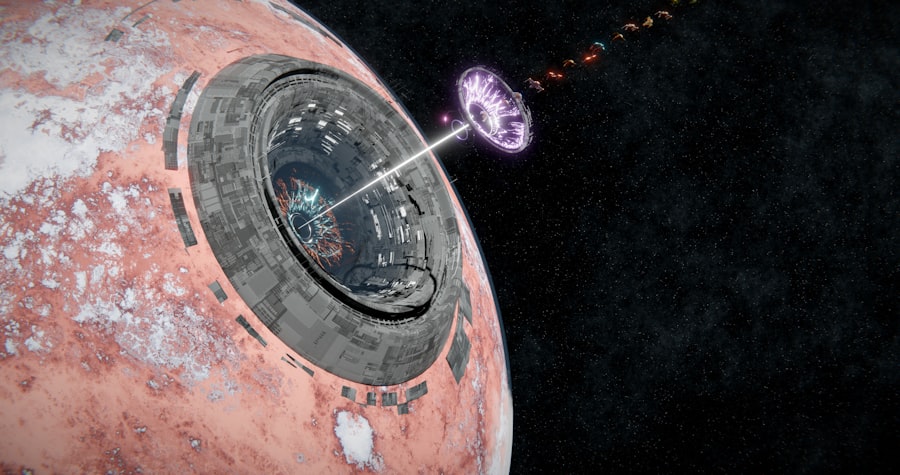
The Proxima Mission represents a monumental step forward in humanity’s quest to explore the cosmos. As you learn about its development, you will discover that it is not merely a single mission but rather a culmination of decades of research and technological advancements. Scientists and engineers have collaborated across disciplines to design a spacecraft capable of enduring the harsh conditions of interstellar space while carrying a crew safely to Proxima Centauri and back.
This mission embodies humanity’s relentless pursuit of knowledge and exploration. The planning phase for the Proxima Mission has involved extensive simulations and modeling to predict potential challenges and outcomes. You might be intrigued by how teams have utilized advanced computer algorithms to optimize flight paths and minimize fuel consumption.
The mission’s timeline has been meticulously crafted, taking into account various factors such as propulsion technology development, crew training schedules, and launch windows. Each decision made during this phase reflects a commitment to ensuring the mission’s success while pushing the boundaries of what is possible in space exploration.
The Technology Behind the Interstellar Spacecraft
At the heart of the Proxima Mission lies cutting-edge technology designed to propel humanity into the stars. As you explore this aspect, you will encounter concepts such as nuclear propulsion, solar sails, and even theoretical warp drives that could revolutionize space travel. Each technology presents unique advantages and challenges, requiring careful consideration during the design process.
For instance, nuclear propulsion could provide sustained thrust over long periods, while solar sails harness sunlight for propulsion, offering an eco-friendly alternative. Moreover, you will discover that life-support systems are equally crucial for sustaining human life during the journey. Advanced recycling systems will be necessary to manage water and air supplies efficiently, while hydroponic gardens could provide fresh food for astronauts.
The integration of artificial intelligence into spacecraft systems will also play a vital role in monitoring conditions and assisting crew members in decision-making processes. This blend of innovative technologies not only enhances safety but also ensures that astronauts can thrive in an environment far removed from Earth.
The Crew Selection and Training Process
| Metric | Value | Unit | Notes |
|---|---|---|---|
| Target Star | Proxima Centauri | – | Nearest star to the Sun |
| Distance | 4.24 | light years | Approximately 40 trillion kilometers |
| Mission Duration (Current Technology) | 20,000 | years | Using chemical rockets |
| Mission Duration (Proposed Breakthrough Starshot) | 20 | years | Using light sail propelled by lasers |
| Spacecraft Speed (Breakthrough Starshot) | 0.2 | c (speed of light) | Approximately 60,000 km/s |
| Communication Delay | 4.24 | years | One-way signal travel time |
| Power Source | Radioisotope Thermoelectric Generator (RTG) | – | Common for deep space missions |
| Payload Mass (Breakthrough Starshot) | ~0.001 | kg | Gram-scale nanocraft |
| Launch Window Frequency | Continuous | – | No specific launch window due to interstellar space |
Selecting the right crew for the Proxima Mission is a critical component that requires careful consideration. You might imagine what it would be like to undergo rigorous selection processes designed to identify individuals with not only exceptional skills but also strong psychological resilience. Candidates would need to demonstrate expertise in various fields such as engineering, biology, and medicine while also exhibiting teamwork and adaptability—qualities essential for surviving in an isolated environment.
Once selected, crew members would undergo extensive training that simulates conditions they will face during their journey. This training would encompass everything from technical skills related to spacecraft operation to psychological preparation for long-term isolation. You can envision astronauts participating in simulated missions that replicate life aboard the spacecraft, allowing them to build camaraderie and develop strategies for coping with stressors unique to interstellar travel.
This comprehensive approach ensures that each crew member is well-prepared for the challenges ahead.
The Journey to Proxima: Planning and Preparation

As you consider the logistics involved in planning a journey to Proxima Centauri, you will appreciate the meticulous attention to detail required at every stage. From launch windows to trajectory calculations, every aspect must be carefully orchestrated to ensure success. You might find it fascinating how mission planners utilize advanced software tools to simulate various scenarios, allowing them to anticipate potential obstacles and devise contingency plans.
Moreover, preparing for unforeseen circumstances is paramount in interstellar travel.
The spacecraft would need to be equipped with redundant systems to ensure that critical functions remain operational even if one component fails.
This level of preparedness reflects humanity’s commitment to exploring new frontiers while prioritizing crew safety above all else.
Life on board the Interstellar Spacecraft
Life aboard the interstellar spacecraft will be a unique experience that challenges your understanding of daily routines. As you envision this environment, you might picture a compact living space where astronauts must adapt to confined quarters for an extended period. The design of living quarters will prioritize comfort while maximizing functionality, incorporating areas for work, relaxation, and exercise.
You may also consider how social dynamics will play out among crew members during their journey. With limited space and resources, interpersonal relationships will be tested as individuals navigate conflicts and stressors inherent in long-term isolation. To foster a positive atmosphere, mission planners may implement structured schedules that include recreational activities and opportunities for personal reflection.
This holistic approach aims to maintain mental well-being while ensuring that each crew member remains focused on their mission objectives.
The Scientific Objectives of the Proxima Mission
The Proxima Mission is not solely about reaching another star; it is also driven by ambitious scientific objectives that could reshape our understanding of the universe. As you delve into these goals, you will discover that researchers aim to study Proxima b’s atmosphere, geology, and potential habitability. By analyzing data collected during their journey, astronauts could provide invaluable insights into whether life exists beyond Earth.
Additionally, you might find it intriguing how scientists plan to investigate cosmic phenomena encountered along the way. The mission could serve as an opportunity to study interstellar dust clouds or magnetic fields that influence space weather—knowledge that could enhance our understanding of astrophysics and planetary formation processes. Each scientific objective reflects humanity’s insatiable curiosity about the cosmos and our desire to uncover its secrets.
The Potential Discoveries at Proxima Centauri
Upon arrival at Proxima Centauri, you can imagine the excitement that would envelop the crew as they prepare to explore this alien world. The potential discoveries awaiting them are vast and varied; from geological formations that tell stories of planetary evolution to atmospheric conditions that may harbor signs of life, every moment spent on Proxima b could yield groundbreaking revelations. You might envision scientists conducting experiments designed to analyze soil samples or deploying drones equipped with sensors to gather data from hard-to-reach areas.
Moreover, you may ponder how these discoveries could impact humanity’s understanding of its place in the universe. If evidence of microbial life were found on Proxima b or if its atmosphere contained elements indicative of habitability, it would challenge existing paradigms about life’s existence beyond Earth. Such findings could inspire future generations to continue exploring distant worlds while fostering a sense of unity among people on Earth as they collectively ponder their cosmic significance.
The Return Journey and Reintegration into Earth Society
After an extended stay at Proxima Centauri, you can envision how astronauts would prepare for their return journey home—a bittersweet moment filled with reflection on their experiences and discoveries. The transition back to Earth would require careful planning as well; astronauts must readjust not only physically but also psychologically after spending years in isolation among stars. You might imagine how they would undergo debriefing sessions designed to help them process their experiences while sharing insights gained during their time away.
Reintegration into Earth society poses its own set of challenges as well; returning astronauts may find themselves grappling with feelings of disconnection from friends and family who have lived their lives without them during their absence. To facilitate this transition, support systems would need to be established—offering counseling services tailored specifically for returning space travelers who have experienced profound changes during their journey.
The Legacy of the Proxima Mission
The legacy left by the Proxima Mission will extend far beyond its immediate scientific achievements; it represents humanity’s enduring spirit of exploration and discovery. As you reflect on this mission’s impact, you may recognize how it serves as a catalyst for future endeavors aimed at reaching even more distant stars or exploring other celestial bodies within our solar system. The knowledge gained from this mission could inform subsequent missions while inspiring new generations of scientists and engineers eager to push boundaries further than ever before.
Moreover, you might consider how this mission fosters international collaboration among nations united by a common goal—exploring the cosmos together rather than competing against one another. By working collaboratively on ambitious projects like the Proxima Mission, humanity can harness its collective ingenuity while promoting peace through shared aspirations for knowledge and understanding. In conclusion, as you contemplate all aspects surrounding Proxima Centauri—from its allure as our nearest stellar neighbor to the challenges posed by interstellar travel—you will appreciate how this mission encapsulates humanity’s quest for knowledge and exploration beyond our home planet.
The Proxima Mission stands as a testament not only to what we can achieve through innovation but also serves as an invitation for future generations to dream big about what lies beyond our world.
As humanity looks toward the stars, the prospect of interstellar missions to our nearest stellar neighbor, Proxima Centauri, becomes increasingly tantalizing. A related article that delves into the challenges and possibilities of such missions can be found at My Cosmic Ventures. This piece explores the technological advancements needed for interstellar travel and the potential for discovering habitable exoplanets in our galactic neighborhood.
WATCH THIS! 🚀✨ Can Laser Sails Take Us to Alpha Centauri in 20 Years?
FAQs
What is an interstellar mission to the nearest star?
An interstellar mission to the nearest star involves sending a spacecraft beyond our solar system to explore or study the closest star outside the Sun, typically Proxima Centauri, which is about 4.24 light-years away.
Why is Proxima Centauri considered the nearest star for such missions?
Proxima Centauri is the closest known star to the Sun, located approximately 4.24 light-years away in the Alpha Centauri star system, making it the most feasible target for interstellar exploration.
What are the main challenges of an interstellar mission to the nearest star?
Key challenges include the vast distances involved, requiring travel times of decades or centuries with current technology, the need for advanced propulsion systems, communication delays, and ensuring spacecraft durability over long durations.
What propulsion methods are considered for interstellar missions?
Proposed propulsion methods include nuclear propulsion, laser-driven light sails, ion drives, and theoretical concepts like antimatter engines or fusion drives, aiming to achieve a significant fraction of the speed of light.
How long would it take to reach the nearest star with current or near-future technology?
With current technology, it would take tens of thousands of years to reach Proxima Centauri. Advanced concepts like laser-driven light sails could reduce travel time to a few decades.
What scientific objectives would an interstellar mission aim to achieve?
Objectives include studying the star and its planetary system, searching for signs of life, understanding stellar and planetary formation, and gathering data on interstellar space.
Are there any ongoing projects or proposals for interstellar missions?
Yes, projects like Breakthrough Starshot propose sending small, laser-propelled probes to the Alpha Centauri system within a few decades.
How would communication be handled over interstellar distances?
Communication would rely on powerful transmitters and sensitive receivers, with signals taking years to travel between the spacecraft and Earth, requiring autonomous operation and data storage onboard.
What kind of spacecraft design is suitable for interstellar travel?
Spacecraft must be lightweight, durable, and capable of autonomous operation, often envisioned as small probes with minimal mass to maximize acceleration and reduce travel time.
What is the significance of an interstellar mission to humanity?
Such missions could revolutionize our understanding of the universe, potentially discover extraterrestrial life, and inspire technological advancements and international collaboration.