
The concept of total energy in the universe is a profound and intricate topic that has captivated scientists, philosophers, and curious minds alike for centuries. It encompasses not only the energy that is visible and tangible but also the mysterious forces that govern the cosmos. Total energy serves as a fundamental principle in understanding the dynamics of the universe, influencing everything from the formation of galaxies to the expansion of space itself.
As researchers delve deeper into the fabric of reality, they uncover layers of complexity that challenge existing paradigms and invite new questions about the nature of existence. In recent years, advancements in technology and observational techniques have allowed astronomers and physicists to gather unprecedented data about the universe. This has led to a more nuanced understanding of total energy, which includes various components such as kinetic energy, potential energy, and the enigmatic dark energy and dark matter.
Each of these elements plays a crucial role in shaping the universe’s structure and behavior. As humanity stands on the brink of new discoveries, the quest to comprehend total energy remains a central theme in cosmology, promising to unlock secrets that could redefine our understanding of reality.
Key Takeaways
- Total energy in the universe encompasses all forms of energy, including visible and invisible components.
- Understanding the concept of total energy is crucial for comprehending the dynamics and evolution of the universe.
- Different forms of energy in the universe include visible matter, dark energy, and dark matter, each playing a significant role in the total energy balance.
- Dark energy contributes to the total energy of the universe and is believed to be responsible for the accelerated expansion of the universe.
- Dark matter also contributes to the total energy of the universe and its presence has profound implications for the structure and evolution of the cosmos.
The Concept of Total Energy and its Significance
Total energy can be defined as the sum of all forms of energy present in a system, encompassing both observable and unobservable components. In the context of the universe, this concept extends beyond mere calculations; it embodies the very essence of cosmic interactions. The significance of total energy lies in its ability to provide insights into the fundamental laws governing physical phenomena.
By analyzing total energy, scientists can make predictions about the behavior of celestial bodies, the evolution of galaxies, and even the fate of the universe itself. Understanding total energy is crucial for several reasons. Firstly, it allows researchers to establish a framework for interpreting astronomical observations.
For instance, when studying the motion of galaxies or the behavior of cosmic microwave background radiation, total energy calculations help scientists discern patterns and anomalies that might otherwise go unnoticed. Secondly, total energy serves as a cornerstone for theoretical models in physics, guiding researchers in their quest for a unified theory that can explain all fundamental forces and particles in nature. As such, it is not merely an abstract concept but a vital tool for unlocking the mysteries of the cosmos.
Understanding the Different Forms of Energy in the Universe

The universe is a vast tapestry woven from various forms of energy, each contributing to its overall dynamics. Kinetic energy, for instance, is associated with the motion of celestial bodies, such as planets orbiting stars or galaxies colliding with one another. This form of energy is easily observable and measurable, providing a tangible connection to the forces at play in the cosmos.
It plays a critical role in understanding phenomena such as gravitational binding energy, which holds galaxies and clusters together. Beyond these familiar forms of energy lie more elusive components like dark energy and dark matter.
Dark energy is believed to be responsible for the accelerated expansion of the universe, acting as a repulsive force that counteracts gravitational attraction on cosmic scales. Dark matter, while invisible, exerts gravitational influence on visible matter, shaping the structure of galaxies and clusters. Together, these forms of energy create a complex interplay that defines the universe’s evolution.
By studying these different types of energy, scientists can gain deeper insights into how they interact and contribute to the total energy landscape.
The Role of Dark Energy in the Total Energy of the Universe
| Aspect | Data/Metric |
|---|---|
| Dark Energy Density | ~ 70% of the total energy density of the universe |
| Effect on Universe Expansion | Causes the universe’s expansion to accelerate |
| Unknown Nature | Properties and origin are not fully understood |
| Challenges in Understanding | One of the greatest mysteries in cosmology |
Dark energy is one of the most intriguing components contributing to the total energy of the universe. Discovered through observations of distant supernovae and cosmic microwave background radiation, dark energy accounts for approximately 68% of the universe’s total energy density. Its existence challenges conventional understanding and raises profound questions about the nature of space and time.
Unlike ordinary matter or radiation, dark energy appears to have a uniform distribution throughout space, exerting a constant pressure that drives cosmic expansion. The implications of dark energy are far-reaching. As it continues to dominate the universe’s total energy budget, it influences not only the rate at which galaxies move apart but also shapes theories about the ultimate fate of the cosmos.
Some models suggest that if dark energy remains constant or increases over time, it could lead to scenarios such as the “Big Freeze,” where galaxies drift further apart until stars burn out and galaxies become dark and cold. Understanding dark energy is thus essential for predicting how the universe will evolve over billions of years.
Exploring the Contribution of Dark Matter to the Total Energy
Dark matter represents another critical component in calculating total energy within the universe. Although it cannot be observed directly through electromagnetic radiation, its presence is inferred from gravitational effects on visible matter. Dark matter constitutes about 27% of the universe’s total mass-energy content and plays a pivotal role in shaping cosmic structures.
It acts as a scaffolding upon which galaxies form and evolve, influencing their rotation curves and clustering behavior.
For example, without dark matter, galaxies would not have enough mass to hold themselves together based on their observed rotation speeds.
This discrepancy has led scientists to postulate its existence as a means to account for missing mass in the universe. By studying dark matter’s properties and interactions, researchers can refine their models of total energy and gain insights into how this elusive substance affects cosmic evolution.
The Impact of Visible Matter on the Total Energy of the Universe
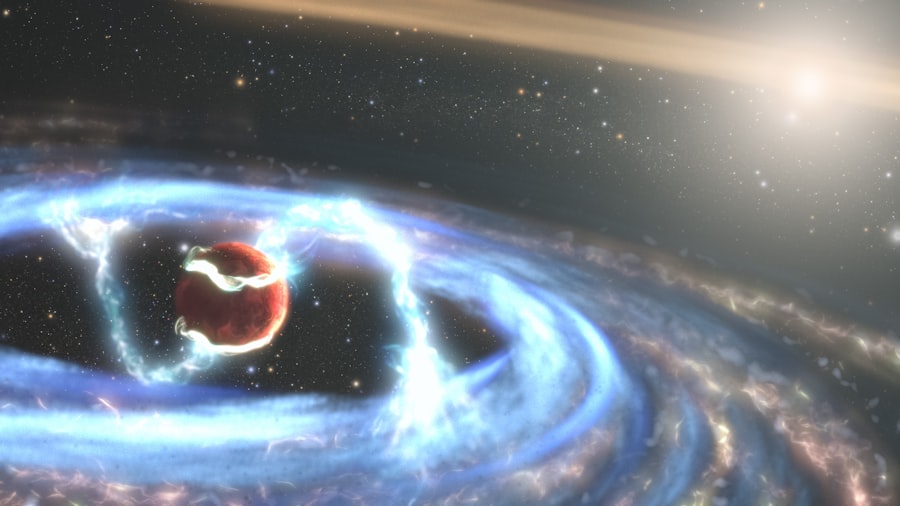
Visible matter, comprising stars, planets, gas, and dust, constitutes only about 5% of the universe’s total energy content. Despite its relatively small contribution compared to dark matter and dark energy, visible matter plays an essential role in shaping our understanding of cosmic dynamics. It is through visible matter that humanity has been able to observe and study celestial phenomena directly.
The light emitted or reflected by stars allows astronomers to gather data about their composition, temperature, distance, and motion. The impact of visible matter on total energy extends beyond mere observation; it also influences gravitational interactions within galaxies and clusters. The distribution and density of visible matter affect how galaxies form and evolve over time.
For instance, regions with higher concentrations of visible matter tend to attract more mass due to gravitational pull, leading to denser structures like galaxy clusters. Understanding how visible matter interacts with dark matter and dark energy is crucial for developing comprehensive models that accurately depict total energy dynamics across cosmic scales.
The Search for a Unified Theory of Total Energy in the Universe
The quest for a unified theory that encompasses all forms of total energy in the universe has been a driving force behind much of modern physics. Scientists have long sought a framework that can seamlessly integrate general relativity with quantum mechanics—a challenge that has eluded researchers for decades. Such a theory would not only provide insights into how different forms of energy interact but also offer explanations for phenomena like black holes and cosmic inflation.
Efforts toward achieving this goal have led to various theoretical models, including string theory and loop quantum gravity. These approaches aim to reconcile discrepancies between classical physics and quantum mechanics while accounting for all known forms of energy. A successful unified theory would revolutionize our understanding of total energy by providing a comprehensive framework that explains both large-scale cosmic structures and subatomic particles’ behavior.
Challenges in Measuring and Calculating the Total Energy of the Universe
Measuring and calculating total energy within the universe presents numerous challenges due to its vastness and complexity. One significant hurdle lies in accurately determining the contributions from dark matter and dark energy—both remain largely mysterious despite their substantial influence on cosmic dynamics. Current observational techniques rely on indirect measurements, such as gravitational lensing or cosmic microwave background analysis, which can introduce uncertainties into calculations.
Additionally, variations in local conditions can complicate efforts to establish a universal framework for total energy measurement. For instance, regions with high concentrations of visible matter may exhibit different gravitational behaviors than those dominated by dark matter or dark energy. As researchers continue to refine their methodologies and develop new observational tools, they face an ongoing challenge: how to reconcile disparate data sets into a coherent picture that accurately reflects total energy across diverse cosmic environments.
Theoretical Models and Hypotheses about the Total Energy of the Universe
Numerous theoretical models have emerged over time to explain total energy within the universe’s context. One prominent hypothesis is based on Einstein’s theory of general relativity, which posits that mass-energy influences spacetime curvature—a concept integral to understanding gravitational interactions at large scales. This framework has led to predictions about how different forms of energy contribute to cosmic expansion and structure formation.
Another intriguing model involves exploring alternative theories such as modified gravity or quintessence—an evolving form of dark energy that changes over time rather than remaining constant. These hypotheses aim to address discrepancies observed in cosmological data while providing new avenues for understanding total energy dynamics. As researchers continue to explore these theoretical frameworks, they contribute valuable insights into how various components interact within an ever-evolving cosmos.
Implications of Total Energy for the Fate and Evolution of the Universe
The implications of total energy extend far beyond mere calculations; they shape our understanding of the universe’s fate and evolution over time. Current models suggest several possible scenarios based on different configurations of total energy components—each leading to distinct outcomes for cosmic evolution. For instance, if dark energy continues to dominate as it does today, scenarios like “heat death” or “Big Freeze” become plausible outcomes where galaxies drift apart until stars extinguish.
Conversely, if dark energy were to decrease or reverse its effects over time—an idea explored in some theoretical models—the universe could experience a “Big Crunch,” where gravitational forces ultimately lead to a collapse back into a singularity. These scenarios highlight how variations in total energy can dramatically alter predictions about cosmic evolution while underscoring humanity’s quest for understanding our place within this vast expanse.
Future Research and Discoveries in Unraveling the Universe’s Total Energy
As humanity continues its exploration into understanding total energy within the universe’s context, future research promises exciting discoveries that could reshape existing paradigms. Advancements in observational technology—such as next-generation telescopes capable of probing deeper into space—will enable scientists to gather more precise data about distant galaxies and cosmic phenomena. Moreover, interdisciplinary collaboration between physicists, astronomers, and cosmologists will be crucial for unraveling complex questions surrounding total energy dynamics.
By integrating insights from various fields—ranging from particle physics to astrophysics—researchers can develop comprehensive models that account for all known forms while addressing lingering mysteries like dark matter’s true nature or dark energy’s role in cosmic expansion. In conclusion, understanding total energy within our universe remains an ongoing journey filled with challenges yet ripe with potential discoveries waiting just beyond reach—a testament not only to humanity’s insatiable curiosity but also its enduring quest for knowledge amidst an ever-expanding cosmos.
In exploring the profound question of the universe’s total energy, one might find it intriguing to delve into related discussions that expand on cosmic phenomena and the fundamental principles governing our universe. A fascinating article that complements this topic can be found on My Cosmic Ventures, which offers insights into various cosmic mysteries and scientific explorations. For those interested in a broader understanding of the universe’s intricacies, I recommend checking out this