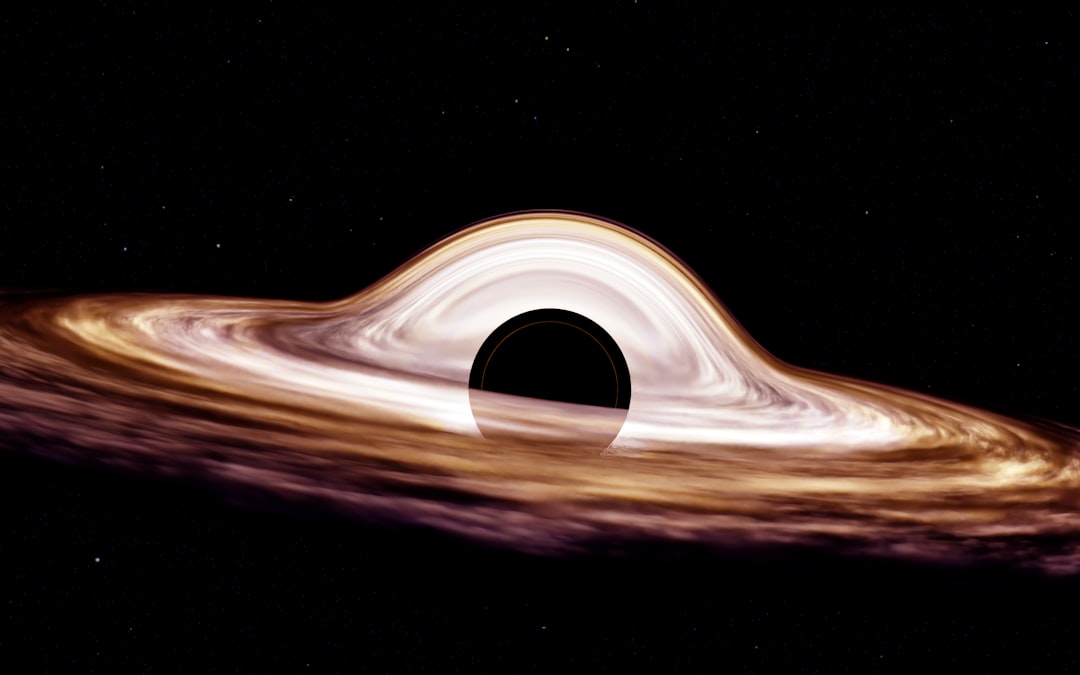
Black holes are objects of significant scientific interest that challenge fundamental principles of physics. They form when massive stars collapse under their own gravity. Black holes have gravitational fields so strong that nothing, including light, can escape from within their event horizon.
This property makes them invisible to direct observation, but scientists can detect their presence by observing their effects on surrounding matter and radiation. Since their theoretical prediction, advances in observational technology and theoretical physics have greatly improved our understanding of black holes. Black holes are important for investigating fundamental questions about space, time, and gravity.
One concept that emerges from studying black holes is scrambling time, which describes how information becomes distributed and transformed in the extreme conditions near black holes. Scrambling time helps explain how matter and energy behave in these regions and contributes to theoretical physics research, particularly in quantum mechanics and efforts to develop a unified theory of gravity.
Key Takeaways
- Scrambling time refers to how quickly information is mixed and lost within a black hole’s event horizon.
- Understanding scrambling time is crucial for addressing the black hole information paradox in quantum mechanics.
- Hawking radiation and black hole entropy play key roles in the theoretical models of information scrambling.
- Recent research advances are shedding light on the connections between scrambling time, quantum gravity, and string theory.
- Experimental and theoretical studies continue to explore scrambling time, aiming to unlock deeper insights into black hole physics.
The Concept of Scrambling Time
Scrambling time refers to the duration it takes for information to become irretrievably mixed or scrambled in a chaotic system, such that it becomes impossible to retrieve the original state from which it derived. In the context of black holes, this concept is particularly relevant due to the extreme gravitational forces at play and the unique conditions that arise in their vicinity. When matter falls into a black hole, it is subjected to intense tidal forces that can stretch and compress it, leading to a rapid transformation of its information content.
This process raises fundamental questions about how information is preserved or lost in such extreme environments. The implications of scrambling time extend beyond mere theoretical curiosity; they touch upon the very fabric of reality as understood through quantum mechanics. In a sense, scrambling time serves as a bridge between classical physics and quantum theory, illustrating how information behaves differently under varying conditions.
The study of scrambling time in black holes not only enhances our understanding of these cosmic giants but also provides insights into the nature of information itself, challenging long-held assumptions about its permanence and accessibility.
Theoretical Framework for Scrambling Time in Black Holes
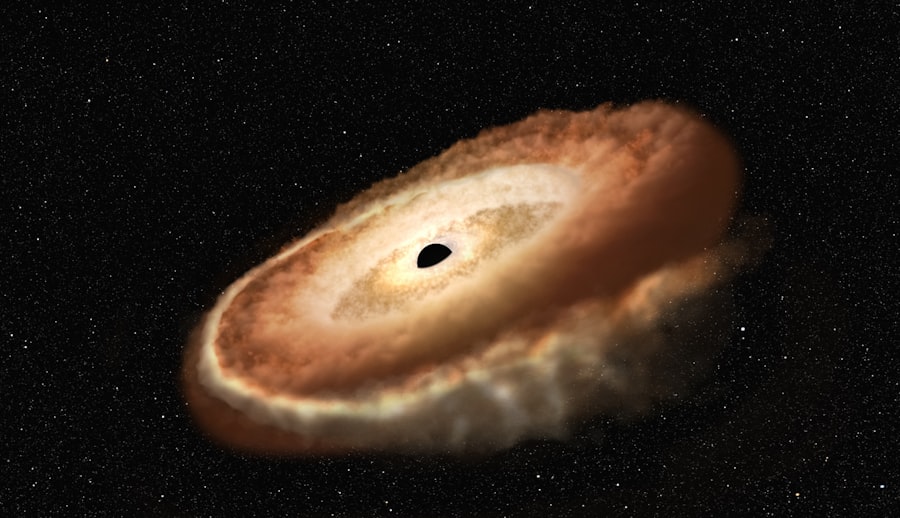
The theoretical framework surrounding scrambling time in black holes is rooted in both general relativity and quantum mechanics. General relativity describes how massive objects warp spacetime, leading to the formation of black holes, while quantum mechanics governs the behavior of particles at the smallest scales. Researchers have sought to reconcile these two pillars of modern physics, leading to a deeper understanding of how information behaves in extreme gravitational fields.
One prominent model used to explore scrambling time is based on the concept of quantum entanglement. When particles become entangled, the state of one particle becomes dependent on the state of another, regardless of the distance separating them. In a black hole’s environment, this entanglement can lead to rapid scrambling of information as particles interact with one another under extreme conditions.
Theoretical physicists have developed mathematical models that describe this process, allowing them to quantify scrambling time and its implications for information preservation in black holes.
Quantum Mechanics and Information Paradox
The intersection of quantum mechanics and black hole physics gives rise to one of the most perplexing dilemmas in modern science: the information paradox. According to quantum mechanics, information cannot be destroyed; however, when matter crosses the event horizon of a black hole, it appears to vanish from the observable universe. This contradiction has led to intense debates among physicists regarding the fate of information that falls into a black hole.
Some theorists propose that information is not lost but rather encoded in subtle correlations within Hawking radiation—the theoretical radiation emitted by black holes due to quantum effects near the event horizon. This idea suggests that while information may be scrambled and difficult to retrieve, it is not obliterated entirely. The implications of this perspective are profound, as they challenge traditional notions of causality and determinism in physics.
Understanding how information behaves in black holes could ultimately lead to breakthroughs in reconciling quantum mechanics with general relativity.
Hawking Radiation and Black Hole Entropy
| Metric | Description | Typical Value | Units |
|---|---|---|---|
| Scrambling Time | Time taken for information to become distributed and effectively lost in a black hole | log(S) × (R / c) | seconds |
| Black Hole Radius (R) | Schwarzschild radius of the black hole | 3 × 10^3 (for a solar mass black hole) | meters |
| Entropy (S) | Black hole entropy proportional to horizon area | 10^77 (solar mass black hole) | dimensionless |
| Speed of Light (c) | Fundamental constant | 3 × 10^8 | meters/second |
| Scrambling Time (Solar Mass BH) | Estimated scrambling time for a solar mass black hole | ~10^-3 | seconds |
| Scrambling Time (Supermassive BH) | Estimated scrambling time for a supermassive black hole (10^6 solar masses) | ~10 seconds | seconds |
Hawking radiation plays a crucial role in discussions surrounding black holes and scrambling time. Proposed by physicist Stephen Hawking in 1974, this phenomenon arises from quantum fluctuations near the event horizon, where particle-antiparticle pairs can spontaneously form. If one particle falls into the black hole while the other escapes, it results in a net loss of mass for the black hole, leading to its gradual evaporation over astronomical timescales.
The relationship between Hawking radiation and black hole entropy is equally significant. Black hole entropy is a measure of the amount of information that can be contained within a black hole, often described using the Bekenstein-Hawking formula. This formula suggests that the entropy of a black hole is proportional to its surface area rather than its volume, a counterintuitive result that has profound implications for our understanding of thermodynamics and information theory.
As researchers explore the connections between Hawking radiation, entropy, and scrambling time, they uncover new insights into how information is processed and transformed in these extreme environments.
Recent Discoveries in Scrambling Time Research

Recent advancements in research on scrambling time have yielded exciting discoveries that deepen our understanding of black holes and their associated phenomena. One notable development involves experimental simulations conducted using quantum computers and other advanced technologies. These simulations allow researchers to model scrambling processes in controlled environments, providing valuable insights into how information behaves under various conditions.
Additionally, studies have revealed that scrambling time may be influenced by factors such as temperature and dimensionality. For instance, researchers have found that higher temperatures can lead to faster scrambling times, suggesting that thermal effects play a significant role in how information is processed near black holes. These findings not only enhance theoretical models but also pave the way for future experimental investigations aimed at unraveling the complexities of scrambling time.
Challenges in Studying Scrambling Time in Black Holes
Despite significant progress in understanding scrambling time, researchers face numerous challenges when studying this phenomenon within black holes. One primary obstacle is the inherent difficulty in observing black holes directly due to their nature as invisible entities. Most studies rely on indirect observations or theoretical models, which can introduce uncertainties and limitations.
Moreover, the extreme conditions surrounding black holes complicate experimental efforts to replicate or simulate scrambling processes accurately. The interplay between gravity and quantum mechanics creates a complex landscape that defies straightforward analysis. As researchers strive to develop more sophisticated models and experimental techniques, they must navigate these challenges while remaining open to new ideas and approaches.
Implications for Quantum Gravity and String Theory
The exploration of scrambling time in black holes holds significant implications for broader theories such as quantum gravity and string theory. As physicists seek to unify general relativity with quantum mechanics, understanding how information behaves in extreme gravitational fields becomes paramount. Scrambling time offers insights into how spacetime itself may be structured at fundamental levels.
In string theory, for instance, researchers propose that fundamental particles are not point-like entities but rather one-dimensional strings vibrating at different frequencies. This framework allows for a richer understanding of how information might be encoded within spacetime itself. By studying scrambling time within this context, physicists hope to uncover new connections between gravity and quantum mechanics that could lead to a more comprehensive theory of everything.
Experimental Approaches to Studying Scrambling Time
To advance knowledge about scrambling time, researchers are increasingly turning to experimental approaches that leverage cutting-edge technology. Quantum computers have emerged as powerful tools for simulating complex systems and exploring phenomena like scrambling time in controlled environments. By manipulating qubits—quantum bits—scientists can create scenarios that mimic the conditions near black holes, allowing them to study how information scrambles over time.
Additionally, advancements in observational astronomy have enabled scientists to gather more data about black holes and their interactions with surrounding matter. Techniques such as gravitational wave detection provide new avenues for understanding how information is processed during events like black hole mergers. These experimental approaches not only enhance theoretical models but also contribute to a more comprehensive understanding of scrambling time and its implications for fundamental physics.
Future Directions in Scrambling Time Research
As research on scrambling time continues to evolve, several promising directions are emerging for future exploration. One area of focus involves refining theoretical models to better account for various factors influencing scrambling processes, such as temperature fluctuations or interactions with other particles. By developing more accurate models, researchers can gain deeper insights into how information behaves under extreme conditions.
Another promising avenue lies in interdisciplinary collaboration between physicists, mathematicians, and computer scientists. By combining expertise from diverse fields, researchers can develop innovative approaches to studying scrambling time and its implications for quantum gravity and string theory. Furthermore, continued advancements in experimental techniques will likely yield new data that could reshape existing theories and lead to groundbreaking discoveries.
Unraveling the Mysteries of Scrambling Time in Black Holes
In conclusion, the study of scrambling time within black holes represents a fascinating intersection of theoretical physics and observational research. As scientists continue to unravel the complexities surrounding this phenomenon, they are not only deepening their understanding of black holes but also challenging fundamental assumptions about information and reality itself. The implications extend far beyond astrophysics; they touch upon core questions about the nature of space, time, and gravity.
As researchers forge ahead into uncharted territory, they remain committed to exploring the mysteries of scrambling time with an open mind and innovative spirit. The journey promises to yield profound insights into the workings of our universe while potentially paving the way for breakthroughs that could reshape our understanding of fundamental physics for generations to come.
Recent research into scrambling time in black holes has opened up fascinating discussions about the nature of information and its preservation in the universe. For a deeper understanding of this concept and its implications, you can explore a related article on the topic at My Cosmic Ventures. This resource delves into the intricate relationship between black holes and quantum mechanics, shedding light on how information is theorized to be scrambled and potentially recovered.
FAQs
What is scrambling time in the context of black holes?
Scrambling time refers to the time it takes for information that falls into a black hole to become thoroughly mixed or “scrambled” with the black hole’s internal degrees of freedom, making the original information effectively irretrievable.
Why is scrambling time important in black hole physics?
Scrambling time is important because it relates to how quickly a black hole can hide information, which has implications for the black hole information paradox and the understanding of quantum information processing in gravitational systems.
How is scrambling time estimated for black holes?
Scrambling time is typically estimated using theoretical models from quantum information theory and black hole thermodynamics. For a black hole of mass M, the scrambling time is often proportional to the logarithm of the black hole’s entropy, roughly t_scramble ~ (1/2πkT) log S, where T is the Hawking temperature and S is the entropy.
What is the relationship between scrambling time and the black hole information paradox?
The scrambling time is central to discussions of the black hole information paradox because it sets a timescale for when information that falls into a black hole becomes inaccessible or “hidden” in the black hole’s quantum state, challenging the notion of information loss in black hole evaporation.
Do all black holes have the same scrambling time?
No, scrambling time depends on the size and properties of the black hole. Larger black holes with greater entropy generally have longer scrambling times, but the dependence is logarithmic, so the increase is relatively slow compared to the black hole’s size.
Can scrambling time be observed experimentally?
Currently, scrambling time cannot be directly observed experimentally due to the extreme conditions near black holes and the limitations of current technology. It remains a theoretical concept studied through models in quantum gravity and holography.
How does scrambling time relate to quantum chaos?
Scrambling time is closely related to quantum chaos because it characterizes how quickly quantum information spreads and becomes entangled within a system, similar to how chaotic systems rapidly mix classical information.
What role does the holographic principle play in understanding scrambling time?
The holographic principle, particularly through the AdS/CFT correspondence, provides a framework to study scrambling time by relating black hole dynamics to quantum field theories, allowing researchers to analyze information scrambling in a dual, more tractable system.