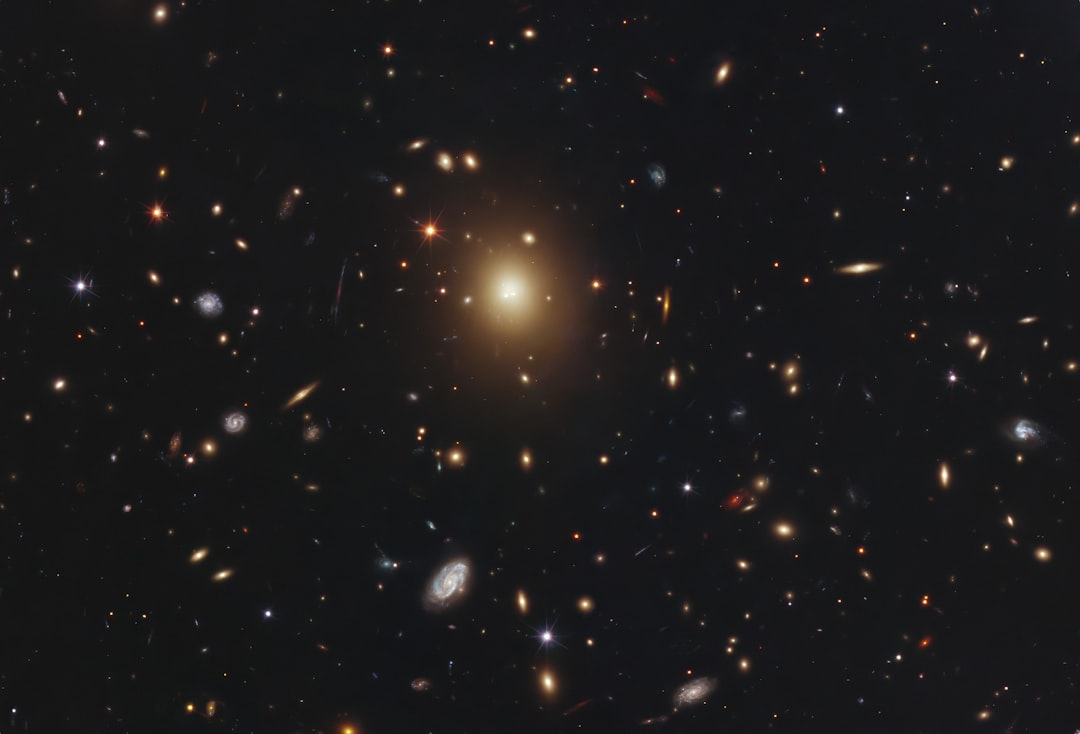
The cosmological constant, denoted by the symbol Λ (Lambda), is a fundamental concept in cosmology that represents a form of energy density filling space homogeneously. It was originally introduced by Albert Einstein in 1917 as a modification to his equations of general relativity, allowing for a static universe. The cosmological constant is often associated with the accelerated expansion of the universe, which has profound implications for our understanding of cosmic evolution.
In essence, it acts as a repulsive force that counteracts the attractive force of gravity on cosmic scales, influencing the dynamics of the universe’s expansion. In contemporary cosmology, the cosmological constant is often linked to dark energy, a mysterious form of energy that constitutes about 68% of the universe. This connection has led to significant advancements in understanding the universe’s fate and its large-scale structure.
The cosmological constant is not merely a theoretical construct; it has real implications for how galaxies form and evolve over time. As scientists delve deeper into the nature of this constant, they uncover layers of complexity that challenge existing paradigms and inspire new lines of inquiry.
Key Takeaways
- The cosmological constant is a term in Einstein’s theory of general relativity that represents the energy density of space.
- The history of the cosmological constant dates back to the early 20th century when Einstein first introduced it as a way to achieve a static universe.
- The cosmological constant plays a crucial role in Einstein’s theory of general relativity by balancing the effects of gravity to maintain a stable universe.
- The mystery surrounding the cosmological constant stems from its unexpected value and its implications for the fate of the universe.
- Observational evidence for the existence of the cosmological constant comes from studies of distant supernovae and the cosmic microwave background radiation.
The History of the Cosmological Constant
The origins of the cosmological constant can be traced back to the early 20th century when Einstein sought to reconcile his theory of general relativity with the prevailing belief in a static universe. At that time, the idea of an expanding universe was not yet widely accepted. To maintain a static model, Einstein introduced the cosmological constant into his field equations, effectively adding a term that would allow for a balance between gravitational attraction and repulsion.
However, this modification was soon rendered unnecessary with the discovery of the expanding universe by Edwin Hubble in 1929. Despite its initial dismissal, the cosmological constant regained prominence in the late 20th century when observations revealed that the expansion of the universe is not only ongoing but accelerating. This unexpected finding led to a resurgence of interest in Einstein’s original idea.
The cosmological constant was re-evaluated as a potential explanation for this acceleration, leading to a renewed focus on its implications for cosmology and theoretical physics. The historical journey of the cosmological constant reflects the evolving nature of scientific understanding and the interplay between theory and observation.
The Role of the Cosmological Constant in Einstein’s Theory of General Relativity
In Einstein’s theory of general relativity, gravity is not merely a force but a curvature of spacetime caused by mass and energy. The introduction of the cosmological constant into this framework allowed Einstein to account for a static universe by providing an additional source of pressure that could counteract gravitational attraction. This term effectively modified the geometry of spacetime, enabling a balance that would prevent collapse under its own gravity.
However, once the expansion of the universe was established, Einstein famously referred to his introduction of the cosmological constant as his “greatest blunder.” He abandoned it in favor of a dynamic model that aligned with observational evidence. Yet, as modern astrophysics has shown, this “blunder” may have been prescient. The cosmological constant now plays a crucial role in understanding how gravity interacts with dark energy and influences cosmic expansion.
It serves as a reminder that scientific theories are often subject to revision as new data emerges, highlighting the importance of adaptability in scientific inquiry.
The Mystery Surrounding the Cosmological Constant
| Researcher | Discovery | Year |
|---|---|---|
| Albert Einstein | Cosmological Constant | 1917 |
| Edwin Hubble | Expansion of the Universe | 1929 |
| Dark Energy | Acceleration of Universe’s Expansion | 1998 |
Despite its significance, the cosmological constant remains shrouded in mystery. One of the most perplexing aspects is its value; theoretical predictions based on quantum field theory suggest that it should be vastly larger than what is observed in the universe. This discrepancy between theoretical expectations and empirical measurements is known as the “cosmological constant problem.” It raises fundamental questions about our understanding of quantum mechanics and gravity, suggesting that there may be unknown physics at play.
Moreover, the nature of dark energy itself is still largely enigmatic. While the cosmological constant provides a straightforward explanation for cosmic acceleration, it does not address why its value is so small compared to theoretical predictions. This conundrum has led physicists to explore alternative models and theories, including modifications to general relativity and various forms of dynamic dark energy.
The ongoing quest to unravel these mysteries underscores the complexity of the cosmos and challenges researchers to rethink established concepts.
Observational Evidence for the Existence of the Cosmological Constant
The existence of the cosmological constant is supported by several key observational findings. One of the most compelling pieces of evidence comes from Type Ia supernovae observations, which indicate that distant galaxies are receding from us at an accelerating rate. These observations suggest that an unknown force—attributed to dark energy—dominates the energy content of the universe, leading to accelerated expansion.
Additionally, measurements from cosmic microwave background radiation (CMB) provide further support for the cosmological constant. The CMB represents relic radiation from the early universe and carries information about its composition and evolution. Analyses from missions like NASA’s Wilkinson Microwave Anisotropy Probe (WMAP) and ESA’s Planck satellite have shown that the universe’s geometry is flat, consistent with a significant contribution from dark energy in the form of a cosmological constant.
These observations collectively reinforce the notion that Λ plays a critical role in shaping our understanding of cosmic dynamics.
Theoretical Explanations for the Cosmological Constant
Theoretical explanations for the cosmological constant vary widely, reflecting different approaches to understanding its nature and implications. One prominent explanation involves quantum field theory, which posits that vacuum fluctuations contribute to an energy density that could manifest as a cosmological constant. However, as previously mentioned, calculations yield values many orders of magnitude larger than what is observed, leading to significant challenges in reconciling theory with reality.
Another avenue explored by physicists involves modifications to general relativity itself or alternative theories such as scalar-tensor theories or f(R) gravity models. These approaches aim to provide dynamic explanations for cosmic acceleration without relying solely on a constant value for dark energy. While these theories offer intriguing possibilities, they also introduce new complexities and require rigorous testing against observational data.
The search for a satisfactory theoretical framework continues to be an active area of research in modern physics.
The Connection Between the Cosmological Constant and Dark Energy
The cosmological constant is often equated with dark energy due to their shared role in driving cosmic acceleration. Dark energy is characterized by its negative pressure, which leads to repulsive gravitational effects on large scales. The cosmological constant serves as a simple model for dark energy, providing a uniform energy density throughout space that remains constant over time.
However, it is essential to recognize that dark energy may not be limited to just a cosmological constant.
Understanding this connection between dark energy and the cosmological constant is crucial for unraveling the mysteries surrounding cosmic expansion and ultimately determining the fate of the universe.
The Cosmological Constant and the Fate of the Universe
The implications of the cosmological constant extend beyond mere theoretical considerations; they have profound consequences for predicting the ultimate fate of the universe. If Λ remains positive and constant over time, it suggests an ever-accelerating expansion leading to a scenario known as “Big Freeze,” where galaxies drift apart and stars eventually burn out, leaving behind a cold and dark cosmos. Conversely, if future observations reveal variations in Λ or if alternative models gain traction, different outcomes may emerge.
Scenarios such as “Big Crunch” or “Big Rip” could become plausible if gravitational forces or other factors come into play. Thus, understanding the nature and behavior of the cosmological constant is pivotal for cosmologists attempting to forecast how our universe will evolve over billions of years.
The Impact of the Cosmological Constant on Modern Cosmology
The resurgence of interest in the cosmological constant has significantly shaped modern cosmology and influenced various fields within physics. It has prompted researchers to reevaluate fundamental assumptions about gravity, spacetime, and cosmic evolution. The exploration of Λ has led to advancements in observational techniques and theoretical frameworks, fostering interdisciplinary collaboration among astrophysicists, particle physicists, and mathematicians.
Moreover, discussions surrounding the cosmological constant have sparked public interest in cosmology and science as a whole. As researchers strive to communicate complex ideas about dark energy and cosmic expansion to broader audiences, they contribute to a greater appreciation for scientific inquiry and its implications for understanding our place in the universe.
Unsolved Questions and Future Research Directions
Despite significant progress in understanding the cosmological constant, numerous questions remain unanswered. Researchers continue to grapple with issues such as why Λ has its observed value and whether it might change over time or vary across different regions of space. Investigating these questions requires innovative approaches and advanced observational techniques capable of probing deeper into cosmic phenomena.
Future research directions may involve exploring alternative theories beyond general relativity or investigating potential connections between quantum mechanics and gravity. Additionally, upcoming observational missions aimed at mapping dark energy’s effects on large scales will provide invaluable data for refining models and enhancing our understanding of cosmic dynamics.
The Cosmological Constant in the Context of the Multiverse Theory
The concept of a multiverse introduces intriguing possibilities regarding the cosmological constant and its implications for our understanding of reality. In multiverse scenarios, different regions may exhibit varying values for Λ due to quantum fluctuations or other mechanisms at play during cosmic inflation. This raises questions about why our universe possesses such a specific value compared to others.
If multiple universes exist with diverse physical constants, it could provide insights into why our universe appears fine-tuned for life while also addressing some aspects of the cosmological constant problem. Exploring these connections between multiverse theory and Λ opens new avenues for theoretical exploration and challenges researchers to rethink fundamental assumptions about existence itself. In conclusion, while much has been learned about the cosmological constant since its inception over a century ago, it remains one of modern physics’ most profound mysteries.
As scientists continue their quest for answers through observation and theoretical innovation, they inch closer to unraveling this enigma that lies at the heart of our understanding of cosmic evolution and existence itself.
The cosmological constant, often denoted by the Greek letter Lambda (Λ), plays a crucial role in our understanding of the universe’s accelerated expansion. It was first introduced by Albert Einstein in his field equations of General Relativity as a means to achieve a static universe, which was the prevailing belief at the time. However, after the discovery of the universe’s expansion, Einstein reportedly referred to it as his “biggest blunder.” Today, the cosmological constant is associated with dark energy, a mysterious force driving the acceleration of the universe’s expansion. For a deeper dive into the implications of the cosmological constant and its role in modern cosmology, you can explore a related article on My Cosmic Ventures.
WATCH THIS! How a Quantum Loophole Sparked Everything: The Universe Born From Nothing, Explained
FAQs
What is the cosmological constant?
The cosmological constant is a term in the equations of general relativity proposed by Albert Einstein. It represents a constant energy density filling space homogeneously.
What is the significance of the cosmological constant?
The cosmological constant is significant in cosmology as it is thought to be responsible for the observed accelerated expansion of the universe.
How does the cosmological constant affect the universe?
The cosmological constant is believed to exert a repulsive force that counteracts the attractive force of gravity, leading to the observed accelerated expansion of the universe.
What are the implications of the cosmological constant for our understanding of the universe?
The existence of the cosmological constant challenges our understanding of the fundamental forces and energy content of the universe. It also has implications for the ultimate fate of the universe.
Is the cosmological constant a confirmed aspect of our understanding of the universe?
The existence and nature of the cosmological constant are still areas of active research and debate in cosmology. Its precise value and implications are not yet fully understood.