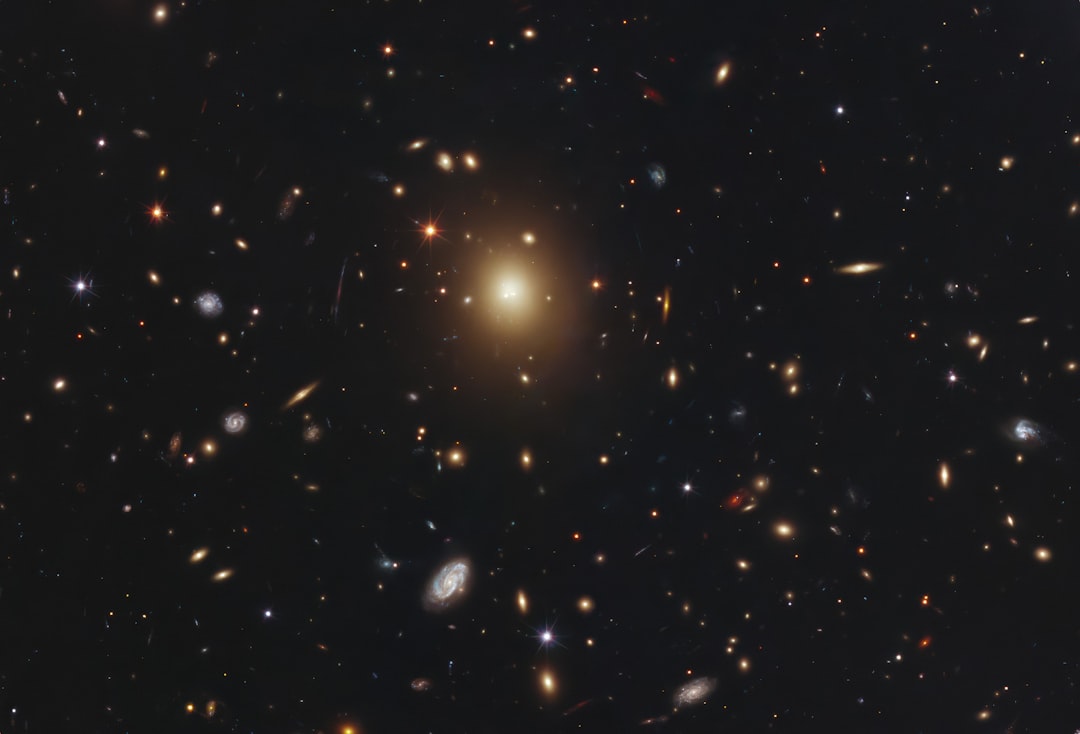
De Sitter space is a cosmological model named after Dutch astronomer Willem de Sitter that describes a universe dominated by a positive cosmological constant. The cosmological constant is a term that Albert Einstein incorporated into his general relativity equations to represent a form of energy density that fills space uniformly and affects cosmic expansion dynamics. This concept serves as a fundamental component in modern cosmological theory and helps explain the observed acceleration of universal expansion.
The study of de Sitter space and the cosmological constant has significant implications for understanding the universe’s ultimate fate. These concepts reveal the complex interactions between gravity, energy, and spacetime structure. The cosmological constant represents the theoretical foundation for dark energy, the mysterious force believed to drive the universe’s accelerated expansion.
This framework addresses fundamental questions about the nature of physical reality and the forces that govern cosmic evolution.
Key Takeaways
- De Sitter space and the cosmological constant are fundamental concepts in understanding the universe’s accelerated expansion.
- The cosmological constant has evolved historically from Einstein’s introduction to its modern interpretation as dark energy.
- Observational data, such as supernovae and cosmic microwave background measurements, support the existence of a positive cosmological constant.
- There remain significant theoretical challenges and controversies regarding the nature and value of the cosmological constant.
- Future research aims to clarify the relationship between dark energy, de Sitter space, and the cosmological constant to deepen our understanding of cosmology.
Historical Background and Development of the Cosmological Constant
The journey to comprehend the cosmological constant began in the early 20th century when Einstein introduced it as a means to achieve a static universe. At that time, the prevailing belief was that the universe was unchanging and eternal. However, with the advent of observational evidence suggesting that galaxies were moving away from each other, Einstein’s static model became untenable.
In 1929, Edwin Hubble’s observations confirmed that the universe was indeed expanding, leading Einstein to abandon his cosmological constant, famously calling it his “greatest blunder.” Despite its initial dismissal, the cosmological constant resurfaced in the late 20th century as astronomers discovered that the expansion of the universe was not just ongoing but accelerating. This revelation prompted a reevaluation of Einstein’s earlier work and reignited interest in the cosmological constant. You may find it intriguing that this once-rejected idea has become central to contemporary cosmology, reshaping our understanding of cosmic evolution and leading to new theories about dark energy. Explore the fascinating connection between a near death experience quantum physics in this insightful video.
Theoretical Implications of de Sitter Space and the Cosmological Constant
The implications of de Sitter space and the cosmological constant extend far beyond mere theoretical musings; they challenge your understanding of fundamental physics. In a universe characterized by de Sitter space, you encounter a scenario where gravity is counteracted by a repulsive force associated with dark energy. This interplay leads to a unique cosmic landscape where galaxies are not only receding from one another but doing so at an accelerating rate.
The mathematics behind this phenomenon reveals a rich tapestry of interactions between matter, energy, and spacetime. Moreover, as you explore these theoretical implications, you may find yourself grappling with questions about the nature of dark energy itself. What is this enigmatic force that drives cosmic acceleration?
Is it truly a constant, or does it vary over time? These inquiries push the boundaries of your understanding and invite you to consider new frameworks for interpreting cosmic phenomena. The exploration of de Sitter space opens doors to innovative theories that could reshape your perception of reality.
Observational Evidence for the Cosmological Constant
As you navigate through the landscape of observational evidence supporting the cosmological constant, you encounter a wealth of data that reinforces its significance in modern cosmology. One of the most compelling pieces of evidence comes from Type Ia supernovae observations, which revealed that these stellar explosions are fainter than expected in a decelerating universe. This discrepancy led scientists to conclude that an unknown form of energy—later identified as dark energy—was driving the accelerated expansion.
Additionally, measurements from cosmic microwave background radiation provide further support for the existence of a cosmological constant. The fluctuations in this ancient light reveal insights into the universe’s composition and structure, indicating that dark energy constitutes approximately 68% of the total energy density.
Challenges and Controversies in Understanding the Cosmological Constant
| Parameter | Symbol | Typical Value | Units | Description |
|---|---|---|---|---|
| Cosmological Constant | Λ | 1.1 × 10⁻⁵² | m⁻² | Energy density of vacuum driving accelerated expansion |
| de Sitter Radius | R | 1.7 × 10²⁶ | m | Characteristic radius of de Sitter space |
| Hubble Parameter (de Sitter) | H | 2.2 × 10⁻¹⁸ | s⁻¹ | Expansion rate in de Sitter universe |
| Vacuum Energy Density | ρ_Λ | 6.8 × 10⁻¹⁰ | J/m³ | Energy density associated with cosmological constant |
| de Sitter Temperature | T_ds | 2.3 × 10⁻³ | K | Temperature associated with de Sitter horizon |
Despite its central role in contemporary cosmology, understanding the cosmological constant is fraught with challenges and controversies. One significant issue is known as the “cosmological constant problem,” which arises from the stark discrepancy between theoretical predictions and observed values. Quantum field theory suggests that vacuum energy should contribute significantly to the cosmological constant; however, calculations yield values many orders of magnitude larger than what is observed in our universe.
This mismatch raises profound questions about our understanding of fundamental physics and challenges your intuition about energy scales in cosmology. As researchers grapple with these discrepancies, debates continue regarding whether modifications to general relativity or entirely new physics are necessary to reconcile these differences. Engaging with these controversies invites you to consider alternative perspectives and encourages critical thinking about established theories.
Alternative Theories and Explanations for de Sitter Space and the Cosmological Constant
In your quest for understanding de Sitter space and the cosmological constant, you may encounter various alternative theories that seek to explain cosmic acceleration without relying solely on dark energy. One such approach is modified gravity theories, which propose alterations to Einstein’s general relativity to account for observed phenomena. These theories suggest that gravity may behave differently on cosmic scales than previously thought, potentially eliminating the need for a cosmological constant altogether.
Another intriguing avenue involves exploring quintessence—a dynamic form of dark energy that evolves over time rather than remaining constant. This concept introduces a scalar field that can change its properties as the universe expands, offering a more flexible framework for understanding cosmic acceleration. As you delve into these alternative explanations, you are encouraged to think critically about their implications and how they might reshape your understanding of cosmic dynamics.
The Role of de Sitter Space in Modern Cosmology
In modern cosmology, de Sitter space serves as a cornerstone for understanding not only cosmic expansion but also fundamental aspects of theoretical physics. Its significance extends beyond mere mathematical elegance; it provides insights into how our universe behaves on large scales. As you explore this role further, you’ll discover that de Sitter space offers a framework for studying inflationary models—periods of rapid expansion in the early universe that set the stage for cosmic structure formation.
Moreover, de Sitter space has implications for our understanding of black holes and their thermodynamic properties. The connection between black hole entropy and de Sitter space leads to intriguing discussions about information loss and quantum gravity. Engaging with these concepts allows you to appreciate how de Sitter space intertwines with various facets of modern physics, enriching your understanding of both cosmology and fundamental theories.
The Connection between Dark Energy and the Cosmological Constant
As you delve deeper into the relationship between dark energy and the cosmological constant, you begin to unravel a complex tapestry woven from observational data and theoretical frameworks.
While the cosmological constant represents a specific form of dark energy characterized by its constancy over time, dark energy itself encompasses a broader range of possibilities.
This distinction invites you to consider various models of dark energy beyond the cosmological constant framework. For instance, some theories propose that dark energy could evolve over time or exhibit interactions with other forms of matter and energy in ways not yet fully understood. As you explore these connections, you gain insight into how researchers are working to unravel the mysteries surrounding dark energy and its implications for our understanding of cosmic evolution.
Future Directions in Research on de Sitter Space and the Cosmological Constant
Looking ahead, research on de Sitter space and the cosmological constant promises to be an exciting frontier in cosmology. As observational techniques advance and new data becomes available from telescopes and satellites, scientists are poised to refine their understanding of these concepts further. Upcoming missions like the Euclid satellite aim to map dark energy’s influence on cosmic structures with unprecedented precision, potentially shedding light on its nature and behavior.
Moreover, theoretical advancements may lead to novel insights into how de Sitter space interacts with other fundamental forces in nature. As researchers explore quantum gravity and its implications for spacetime geometry, you may witness breakthroughs that challenge existing paradigms and reshape your understanding of reality itself. Engaging with these future directions invites you to remain curious about how our comprehension of de Sitter space will evolve in tandem with technological advancements.
Practical Applications and Implications of Understanding de Sitter Space and the Cosmological Constant
While discussions surrounding de Sitter space and the cosmological constant often seem abstract or esoteric, their implications extend into practical realms as well. Understanding these concepts can influence various fields beyond pure cosmology, including astrophysics, particle physics, and even philosophy. For instance, insights gained from studying dark energy may inform our understanding of fundamental forces at play in high-energy particle collisions or contribute to advancements in quantum technologies.
Furthermore, as humanity grapples with existential questions about our place in the cosmos, contemplating concepts like de Sitter space can inspire philosophical reflections on existence itself. Engaging with these ideas encourages you to think critically about humanity’s role within an ever-expanding universe—a perspective that can shape not only scientific inquiry but also cultural narratives about our relationship with reality.
Conclusion and the Quest for Unraveling the Mystery of de Sitter Space Cosmological Constant
In conclusion, your exploration of de Sitter space and the cosmological constant reveals a rich tapestry woven from historical developments, theoretical implications, observational evidence, challenges, and future directions in research. As you reflect on this journey through modern cosmology, you recognize that understanding these concepts is not merely an academic pursuit; it represents humanity’s quest to unravel some of the deepest mysteries of existence itself. The interplay between dark energy and cosmic expansion continues to captivate scientists and philosophers alike as they seek answers to fundamental questions about our universe’s fate.
As research progresses and new discoveries emerge, your engagement with these ideas will undoubtedly deepen your appreciation for both the beauty and complexity inherent in our cosmos—a journey that invites curiosity and wonder at every turn.
In exploring the implications of the de Sitter space and its relationship with the cosmological constant, one can gain further insights by examining related discussions on cosmic expansion. A particularly relevant article can be found at this link, which delves into the effects of dark energy on the universe’s geometry and evolution. This resource provides a comprehensive overview of how the cosmological constant influences our understanding of cosmic dynamics.
FAQs
What is de Sitter space?
De Sitter space is a solution to Einstein’s field equations of General Relativity that describes a universe with a positive cosmological constant and no matter. It is a maximally symmetric, curved spacetime with constant positive curvature, often used as a model for an expanding universe dominated by dark energy.
What is the cosmological constant?
The cosmological constant, denoted by the Greek letter Lambda (Λ), is a term introduced by Einstein in his field equations. It represents a constant energy density filling space homogeneously, which can cause the expansion of the universe to accelerate. It is closely associated with dark energy in modern cosmology.
How are de Sitter space and the cosmological constant related?
De Sitter space is the geometric representation of a universe with a positive cosmological constant and no matter or radiation. The cosmological constant determines the curvature and expansion rate of de Sitter space, making it a fundamental parameter in describing this spacetime.
Why is de Sitter space important in cosmology?
De Sitter space serves as a simplified model for the late-time accelerated expansion of the universe driven by dark energy. It also plays a crucial role in inflationary cosmology, where the early universe undergoes a rapid exponential expansion similar to de Sitter space.
What are the key properties of de Sitter space?
De Sitter space has constant positive curvature, is maximally symmetric, and exhibits exponential expansion. It has a cosmological horizon analogous to a black hole horizon, beyond which events cannot affect an observer.
Can the cosmological constant be zero or negative?
Yes. A zero cosmological constant corresponds to a flat universe without accelerated expansion, while a negative cosmological constant leads to anti-de Sitter space, which has constant negative curvature and different physical properties.
How does the cosmological constant affect the fate of the universe?
A positive cosmological constant causes the universe to expand at an accelerating rate, potentially leading to a cold, empty, and ever-expanding cosmos. A zero or negative cosmological constant would result in different expansion dynamics, possibly leading to a recollapsing universe.
Is the cosmological constant related to dark energy?
Yes. The cosmological constant is the simplest form of dark energy, representing a constant energy density that permeates space and drives the accelerated expansion of the universe.
How is the value of the cosmological constant determined?
The value of the cosmological constant is inferred from astronomical observations, such as supernovae luminosity distances, cosmic microwave background measurements, and large-scale structure surveys, which collectively indicate an accelerating universe.
What challenges exist in understanding the cosmological constant?
One major challenge is the cosmological constant problem, which arises from the discrepancy between the observed small value of Λ and the much larger theoretical predictions from quantum field theory. Understanding this gap remains a significant open question in physics.