The notion of “nothing” has long intrigued philosophers, scientists, and thinkers alike. In the context of the universe, “nothing” is not merely the absence of matter or energy; it represents a profound philosophical and scientific conundrum. Traditionally, nothingness has been perceived as a void, a state devoid of existence.
However, modern physics challenges this simplistic view, suggesting that even in what appears to be nothing, there may be underlying structures and potentialities waiting to emerge. This paradox invites deeper contemplation about the nature of existence itself and the very fabric of reality. In cosmology, the concept of nothing becomes even more complex.
The universe is often described as having originated from a singularity—a point of infinite density and temperature—where the laws of physics as we know them cease to apply. This singularity raises questions about what existed before the Big Bang and whether “nothing” can truly exist in a meaningful sense. Some theorists propose that the universe could have arisen from a quantum vacuum state, where fluctuations give rise to particles and energy.
Thus, the exploration of “nothing” is not merely an abstract philosophical exercise but a gateway to understanding the fundamental principles that govern the cosmos.
Key Takeaways
- “Nothing” in the universe is not truly empty, but rather a complex interplay of quantum fluctuations and dark matter and energy.
- The Big Bang Theory suggests that the universe began as a singularity and has been expanding ever since.
- Quantum fluctuations are believed to have played a key role in the creation of matter in the early universe.
- Dark matter and dark energy are thought to make up the majority of the universe, yet their nature remains a mystery.
- The cosmic microwave background provides crucial evidence for the Big Bang and the subsequent expansion of the universe.
The Big Bang Theory and the Origin of the Universe
The Big Bang Theory stands as one of the most widely accepted explanations for the origin of the universe. According to this theory, approximately 13.
This expansion marked the birth of space and time, leading to the formation of all matter and energy that would eventually coalesce into stars, galaxies, and planets.
The evidence supporting this theory is compelling, including the observed redshift of distant galaxies and the cosmic microwave background radiation that permeates the universe. As the universe expanded, it underwent a series of transformations. Initially, it was a hot, dense soup of particles that gradually cooled as it expanded.
Within minutes, protons and neutrons formed, leading to the synthesis of light elements such as hydrogen and helium during a period known as Big Bang nucleosynthesis. This primordial mixture laid the groundwork for the formation of stars and galaxies millions of years later. The Big Bang Theory not only provides a framework for understanding the universe’s origins but also raises profound questions about its ultimate fate and the nature of time itself.
Quantum Fluctuations and the Creation of Matter
At the heart of modern cosmology lies the concept of quantum fluctuations, which play a crucial role in understanding how matter emerged from what was once thought to be nothing. Quantum mechanics posits that particles can spontaneously appear and disappear in a vacuum due to fluctuations in energy levels. These transient events are not merely theoretical; they have been observed in laboratory settings and are integral to our understanding of particle physics.
In the early universe, these fluctuations could have been amplified during cosmic inflation—a rapid expansion that occurred shortly after the Big Bang—leading to variations in density that eventually gave rise to galaxies and large-scale structures. The implications of quantum fluctuations extend beyond mere particle creation; they challenge our understanding of causality and determinism in physics. If particles can emerge from a vacuum without a clear cause, it raises questions about the nature of reality itself.
Are these fluctuations random, or do they follow underlying principles yet to be discovered? Furthermore, they suggest that the universe may be inherently unpredictable at its most fundamental level, inviting scientists to explore new theories that bridge quantum mechanics with cosmology.
The Role of Dark Matter and Dark Energy in the Universe
| Concept | Dark Matter | Dark Energy |
|---|---|---|
| Definition | Unseen matter that does not emit or interact with electromagnetic radiation | Mysterious force driving the accelerated expansion of the universe |
| Composition | Believed to be made up of unknown particles | Not well understood, possibly a property of space itself |
| Effects | Contributes to the gravitational pull that holds galaxies together | Causes the universe’s expansion to accelerate |
| Discovery | First proposed by Fritz Zwicky in the 1930s | Discovered through observations of distant supernovae in the late 1990s |
As astronomers delve deeper into the cosmos, they encounter two enigmatic components that dominate its structure: dark matter and dark energy. Dark matter is an invisible substance that does not emit or absorb light, making it undetectable by conventional means. However, its presence is inferred from gravitational effects on visible matter, such as stars and galaxies.
It is estimated that dark matter constitutes about 27% of the universe’s total mass-energy content, playing a critical role in shaping cosmic structures and influencing their formation. In contrast, dark energy is an even more mysterious force believed to drive the accelerated expansion of the universe. Comprising approximately 68% of the universe’s total energy density, dark energy acts counter to gravity, pushing galaxies apart at an increasing rate.
The discovery of dark energy has profound implications for our understanding of cosmic evolution and raises questions about the ultimate fate of the universe. Together, dark matter and dark energy represent some of the most significant challenges in contemporary astrophysics, prompting researchers to seek new insights into their nature and properties.
The Expansion of the Universe and the Cosmic Microwave Background
The expansion of the universe is one of its most striking features, fundamentally altering our perception of space and time. Observations reveal that galaxies are moving away from each other, with more distant galaxies receding at faster rates—a phenomenon known as Hubble’s Law. This expansion suggests that the universe is not static but dynamic, continuously evolving since its inception in the Big Bang.
The implications of this expansion extend beyond mere distance; they challenge our understanding of gravity and spacetime itself. A key piece of evidence supporting this expansion is the cosmic microwave background (CMB) radiation—an afterglow from the early universe that fills all space. Discovered in 1965 by Arno Penzias and Robert Wilson, the CMB provides a snapshot of the universe when it was just 380,000 years old, revealing a nearly uniform temperature with slight fluctuations that correspond to density variations.
These fluctuations are crucial for understanding how matter clumped together to form galaxies and clusters over billions of years. The CMB serves as a cornerstone for cosmological models, offering insights into the universe’s age, composition, and evolution.
The Formation of Stars, Galaxies, and Black Holes
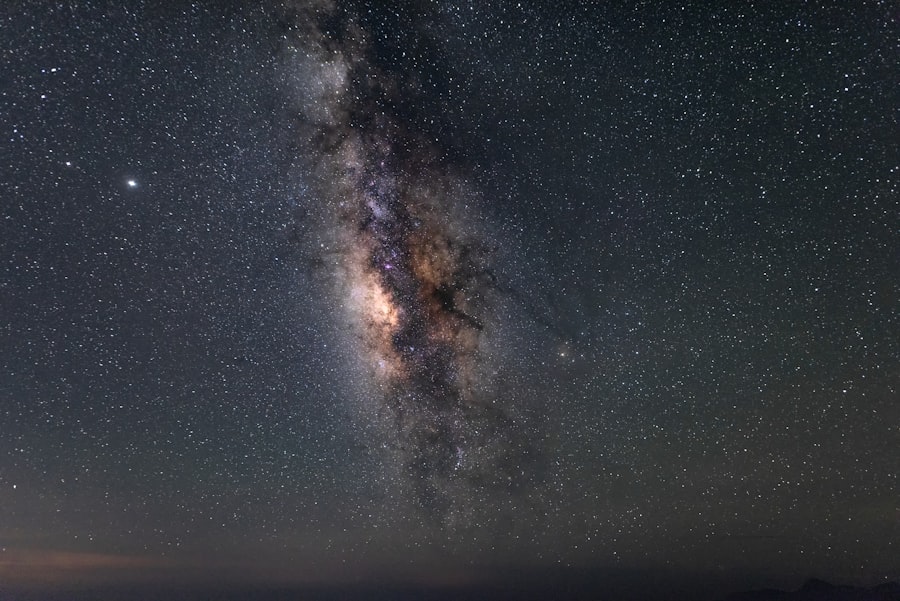
The processes that led to the formation of stars and galaxies are among the most fascinating aspects of cosmic evolution. After millions of years following the Big Bang, regions within gas clouds began to collapse under their own gravity, forming protostars. As these protostars accumulated mass, nuclear fusion ignited in their cores, marking their transition into fully-fledged stars.
This stellar birth process is not uniform; it varies based on factors such as mass, temperature, and chemical composition. Galaxies emerged as vast collections of stars bound together by gravity. Over time, these galaxies interacted through mergers and collisions, leading to diverse structures ranging from spiral galaxies like our Milky Way to elliptical galaxies and irregular forms.
Within these galaxies lie black holes—regions where gravity is so intense that nothing can escape their grasp. Stellar black holes form from collapsing massive stars at their life’s end, while supermassive black holes reside at the centers of most galaxies, including our own. The study of these cosmic entities reveals not only their formation but also their influence on galactic dynamics and evolution.
The Evolution of Life in the Universe
The evolution of life within the universe remains one of humanity’s most profound questions. On Earth, life emerged approximately 3.5 billion years ago from simple organic compounds through processes still not fully understood. The conditions on our planet—such as liquid water, a stable climate, and protective atmospheres—have fostered an incredible diversity of life forms over geological time scales.
However, scientists ponder whether similar conditions exist elsewhere in the cosmos. Astrobiology seeks to answer these questions by exploring extreme environments on Earth where life thrives—such as deep-sea hydrothermal vents or acidic lakes—suggesting that life could potentially exist in diverse forms across different planetary environments. The discovery of exoplanets within habitable zones around distant stars has fueled speculation about extraterrestrial life.
While no definitive evidence has yet been found, ongoing missions aim to identify biosignatures—chemical indicators of life—in planetary atmospheres beyond our solar system.
The Fate of the Universe: Expansion, Contraction, or Something Else?
As scientists contemplate the future trajectory of the universe, several scenarios emerge regarding its ultimate fate. Current observations suggest that dark energy will continue to drive accelerated expansion indefinitely—a scenario known as “heat death,” where galaxies drift apart until stars burn out and matter becomes increasingly sparse.
Alternatively, some theories propose a “Big Crunch,” where gravitational forces eventually overcome dark energy’s repulsive effects, leading to a reversal in expansion and a collapse back into a singularity. Other hypotheses include oscillating models where cycles of expansion and contraction occur or even scenarios involving multiverse theories where our universe could be just one among many with varying fates. Each possibility raises profound questions about time, existence, and what lies beyond our observable universe.
The Search for Exoplanets and the Possibility of Extraterrestrial Life
The quest for exoplanets—planets orbiting stars outside our solar system—has revolutionized our understanding of potential habitats for life beyond Earth. Advances in technology have enabled astronomers to detect thousands of exoplanets using methods such as transit photometry and radial velocity measurements. Many exoplanets reside within their star’s habitable zone—the region where conditions might allow liquid water to exist—making them prime candidates for further study.
The search for extraterrestrial life extends beyond mere detection; it involves analyzing planetary atmospheres for biosignatures such as oxygen or methane that could indicate biological processes. Missions like NASA’s James Webb Space Telescope aim to characterize exoplanet atmospheres in unprecedented detail. As researchers continue to explore these distant worlds, they remain hopeful that one day they may uncover evidence confirming humanity’s long-held dream: that we are not alone in this vast universe.
Theoretical Physics and the Multiverse Hypothesis
Theoretical physics has ventured into realms that challenge conventional notions of reality through concepts like string theory and quantum mechanics. Among these ideas is the multiverse hypothesis—the proposition that our universe may be just one among an infinite number of universes with varying physical laws and constants. This notion arises from interpretations of quantum mechanics suggesting that every possible outcome occurs across different branches of reality.
While still speculative, multiverse theories offer intriguing explanations for fine-tuning problems in cosmology—why certain physical constants appear perfectly calibrated for life as we know it. If countless universes exist with different parameters, it becomes statistically probable that at least one would support life. However, this hypothesis raises philosophical questions about observation and reality: if other universes exist beyond our observable horizon, how can we ever confirm their existence?
Such inquiries push scientists to rethink fundamental assumptions about existence itself.
The Philosophical Implications of the Universe from Nothing
The exploration of how something can arise from nothing invites profound philosophical reflections on existence itself. If modern physics suggests that particles can emerge spontaneously from a vacuum state or quantum fluctuations can give rise to entire universes, what does this imply about causality? Traditional philosophical frameworks often rely on notions of cause-and-effect relationships; however, quantum mechanics challenges these assumptions by introducing randomness at fundamental levels.
Moreover, contemplating a universe born from nothing raises existential questions about purpose and meaning within an indifferent cosmos. If everything we observe emerged from an initial state devoid of structure or intention, what significance does human existence hold? Philosophers grapple with these dilemmas while considering concepts like existentialism or nihilism—each offering different perspectives on humanity’s place within an expansive universe.
In conclusion, humanity’s quest to understand the cosmos encompasses scientific inquiry intertwined with philosophical contemplation. From grappling with concepts like “nothing” to exploring theories about dark matter and dark energy or pondering life’s existence beyond Earth—the journey through space-time reveals both wonders and mysteries yet to be unraveled. As knowledge expands through research and exploration, so too does humanity’s understanding of its role within this vast tapestry we call the universe.
In the fascinating exploration of cosmology, the concept of a “Universe from Nothing” challenges our understanding of the origins of everything we know. This idea, popularized by physicist Lawrence Krauss, suggests that the universe could have emerged from a state of nothingness, governed by the laws of quantum mechanics. For those intrigued by this profound topic, a related article on the subject can be found on My Cosmic Ventures. This article delves deeper into the scientific theories and philosophical implications surrounding the universe’s inception. To read more about this captivating subject, visit the article on My Cosmic Ventures.
WATCH THIS! How a Quantum Loophole Sparked Everything: The Universe Born From Nothing, Explained
FAQs
What is the concept of “Universe from Nothing”?
The concept of “Universe from Nothing” refers to the idea that the universe could have originated from a state of nothingness, without the need for a creator or external cause.
What are the scientific theories about the origin of the universe from nothing?
Several scientific theories propose that the universe could have originated from a quantum vacuum fluctuation, a quantum tunneling event, or as a result of the laws of physics.
What is the quantum vacuum fluctuation theory?
The quantum vacuum fluctuation theory suggests that the universe could have emerged from a quantum vacuum state, where particles and antiparticles spontaneously appear and disappear due to quantum uncertainty.
How does the quantum tunneling theory explain the origin of the universe from nothing?
The quantum tunneling theory proposes that the universe could have originated from a quantum tunneling event, where a tiny region of space-time “tunneled” from a state of nothingness to a state of existence.
What role do the laws of physics play in the concept of “Universe from Nothing”?
The laws of physics, particularly quantum mechanics and the principles of quantum field theory, are invoked to explain how the universe could have emerged from a state of nothingness through natural processes.
Is the concept of “Universe from Nothing” widely accepted in the scientific community?
The concept of “Universe from Nothing” is a topic of ongoing debate and research in the scientific community, with some physicists and cosmologists supporting the idea while others remain skeptical.