The Big Bang Theory stands as one of the most significant scientific explanations for the origin of the universe. It posits that approximately 13.8 billion years ago, the universe began as an infinitely small, hot, and dense point, which then expanded rapidly in a colossal explosion. This event marked the inception of time and space as we know them.
The theory is supported by a wealth of observational evidence, including the redshift of distant galaxies and the abundance of light elements such as hydrogen and helium, which align with predictions made by the theory. The Big Bang Theory not only provides a framework for understanding the universe’s beginnings but also sets the stage for exploring its subsequent evolution.
The initial moments after the Big Bang were characterized by extreme temperatures and densities, leading to the formation of fundamental particles. As the universe expanded and cooled, these particles began to coalesce into protons and neutrons, eventually forming the first atoms. This process laid the groundwork for the formation of stars and galaxies, marking a pivotal transition in cosmic history.
The Big Bang Theory thus serves as a cornerstone for modern cosmology, guiding researchers in their quest to understand not only how the universe began but also how it continues to evolve.
Key Takeaways
- The Big Bang Theory explains the beginning of the universe as a rapid expansion from a hot, dense state.
- Stars and galaxies formed as the universe evolved, with gravity playing a key role in their formation.
- Dark matter and dark energy make up the majority of the universe, yet their nature remains a mystery.
- Black holes are mysterious phenomena with gravitational pull so strong that nothing, not even light, can escape.
- The expansion of the universe is driven by dark energy, causing galaxies to move away from each other at an accelerating rate.
The Formation of Stars and Galaxies: How the Universe Evolved
Following the Big Bang, the universe entered a phase known as the “cosmic dark ages,” during which matter was primarily in the form of hydrogen and helium gas. Over time, gravitational forces began to pull these gases together, leading to the formation of the first stars. These early stars were massive and short-lived, burning brightly before exploding in supernovae, which scattered heavier elements throughout the cosmos.
This process not only enriched the interstellar medium with essential building blocks for future generations of stars but also played a crucial role in shaping galaxies. Galaxies themselves began to form as clumps of stars and gas coalesced under gravity’s influence.
The interactions between galaxies, including mergers and collisions, further contributed to their development. As stars continued to form and die within these galaxies, they created a dynamic environment where new stars could emerge from the remnants of their predecessors. This intricate dance of creation and destruction illustrates how galaxies serve as laboratories for stellar evolution, providing insights into the processes that govern the universe’s growth.
Dark Matter and Dark Energy: Unraveling the Secrets of the Universe
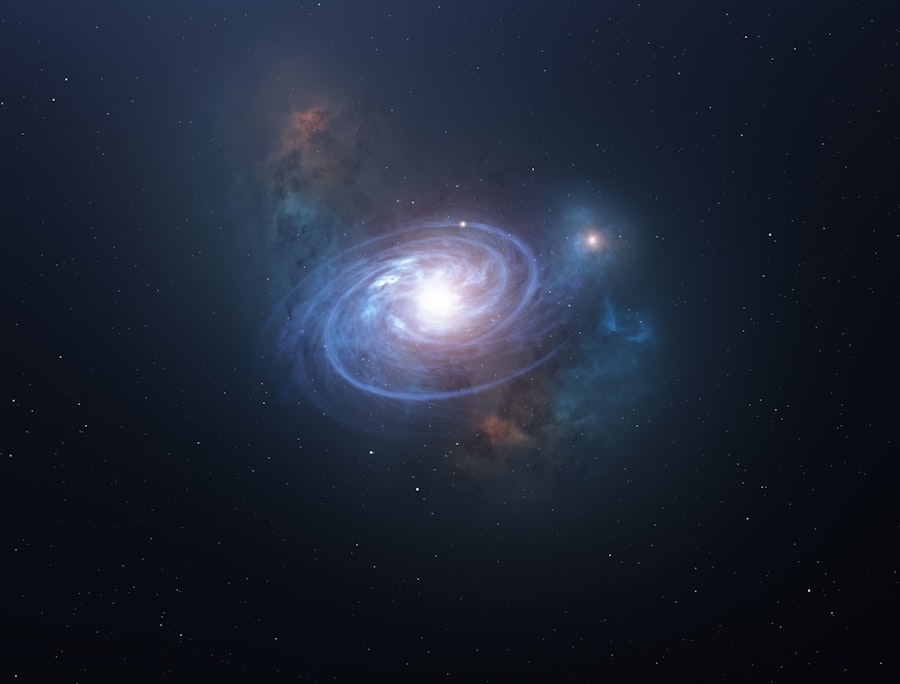
In the quest to understand the universe’s composition, scientists have identified two enigmatic components: dark matter and dark energy. Dark matter is believed to make up about 27% of the universe’s total mass-energy content, yet it remains invisible and undetectable through conventional means. Its presence is inferred from gravitational effects on visible matter, such as stars and galaxies.
Observations of galaxy rotation curves and gravitational lensing provide compelling evidence for dark matter’s existence, suggesting that it plays a crucial role in holding galaxies together. On the other hand, dark energy constitutes approximately 68% of the universe and is thought to be responsible for its accelerated expansion. This mysterious force counteracts gravity on cosmic scales, pushing galaxies apart at an increasing rate.
The discovery of dark energy has profound implications for cosmology, challenging existing theories about the fate of the universe. As researchers continue to investigate these elusive components, they are not only unraveling fundamental questions about the universe’s structure but also confronting some of the most profound mysteries in modern physics.
Black Holes: The Mysterious Phenomenon of Cosmic Destruction
| Black Holes | Details |
|---|---|
| Definition | An area in space where the gravitational pull is so strong that nothing, not even light, can escape from it. |
| Formation | Occurs when a massive star collapses under its own gravity, or when two smaller black holes merge. |
| Size | Can range from a few times the mass of the sun to millions of times the mass of the sun. |
| Effects | Can distort spacetime, consume nearby matter, and emit powerful radiation. |
| Discovery | First predicted by Albert Einstein’s theory of general relativity and later confirmed through astronomical observations. |
Black holes represent one of the most fascinating yet perplexing phenomena in astrophysics. Formed from the remnants of massive stars that have undergone gravitational collapse, black holes possess gravitational fields so strong that nothing—not even light—can escape their grasp. This characteristic gives them their name and renders them invisible against the backdrop of space.
Despite their elusive nature, black holes can be detected through their interactions with surrounding matter, such as when they pull in gas from nearby stars or emit powerful jets of radiation. The study of black holes has revealed much about fundamental physics, particularly in relation to general relativity and quantum mechanics. The event horizon—the boundary surrounding a black hole—marks a point of no return for any object that crosses it.
Inside this boundary lies a singularity, where gravitational forces compress matter to an infinitely small point. This raises profound questions about the nature of space and time, as well as what happens to information that falls into a black hole. As researchers continue to explore these cosmic enigmas, they are not only expanding our understanding of black holes but also probing deeper into the fabric of reality itself.
The Expansion of the Universe: Investigating the Forces at Play
The expansion of the universe is a fundamental aspect of cosmology that has captivated scientists since Edwin Hubble first observed it in the 1920s. Hubble’s discovery that distant galaxies are moving away from Earth at speeds proportional to their distance provided compelling evidence for an expanding universe. This phenomenon is often described using Hubble’s Law, which has become a cornerstone in understanding cosmic dynamics.
The expansion suggests that the universe was once concentrated in a singular state before undergoing rapid growth. Investigating what drives this expansion has led to significant advancements in cosmological theories. Initially thought to be slowing down due to gravitational forces, observations in the late 1990s revealed that the expansion is actually accelerating—an unexpected finding attributed to dark energy.
This realization has prompted scientists to explore various models that explain this acceleration while reconciling it with existing theories about gravity and cosmic evolution. As researchers continue to probe this enigmatic force, they are piecing together a more comprehensive picture of how the universe behaves on both large and small scales.
Cosmic Microwave Background Radiation: Clues to the Early Universe
The Cosmic Microwave Background Radiation (CMB) serves as a relic from the early universe, providing invaluable insights into its infancy. This faint glow permeates all of space and is considered one of the strongest pieces of evidence supporting the Big Bang Theory. Formed approximately 380,000 years after the Big Bang when protons and electrons combined to create neutral hydrogen atoms, this radiation marks a pivotal moment when photons could travel freely through space for the first time.
The CMB carries with it information about the conditions present in the early universe, including temperature fluctuations that correspond to density variations in matter. By studying these fluctuations through sophisticated instruments like NASA’s Wilkinson Microwave Anisotropy Probe (WMAP) and the European Space Agency’s Planck satellite, scientists have been able to map out the universe’s structure and composition with remarkable precision. These observations have not only confirmed predictions made by cosmological models but have also provided clues about its eventual fate.
The Search for Exoplanets: Exploring the Possibility of Other Habitable Worlds
The search for exoplanets—planets orbiting stars outside our solar system—has emerged as one of astronomy’s most exciting frontiers. With thousands of confirmed exoplanets discovered since the first detection in 1992, researchers are increasingly focused on identifying potentially habitable worlds that could support life as we know it. The methods employed in this search range from transit photometry, which detects dips in starlight caused by orbiting planets, to radial velocity measurements that observe wobbles in stars due to gravitational pulls from their planets.
As technology advances, so too does humanity’s ability to explore distant worlds. Space telescopes like Kepler and TESS (Transiting Exoplanet Survey Satellite) have revolutionized exoplanet discovery by surveying vast swathes of sky for signs of planetary systems. The ultimate goal is not merely to catalog these planets but to assess their habitability by examining factors such as their distance from their host star, atmospheric composition, and potential for liquid water.
This quest raises profound questions about life’s existence beyond Earth and challenges our understanding of biology in diverse environments.
The Role of Gravity in Shaping the Universe: From Planetary Orbits to Cosmic Structures
Gravity is often described as one of nature’s fundamental forces, governing everything from planetary orbits to galaxy formation. Its influence is pervasive throughout the cosmos; it dictates how celestial bodies interact with one another and shapes large-scale structures like galaxy clusters and superclusters. Isaac Newton’s law of universal gravitation laid the groundwork for understanding gravity’s role in celestial mechanics, while Albert Einstein’s theory of general relativity expanded this understanding by describing gravity as a curvature of spacetime caused by mass.
In addition to holding planets in orbit around stars and moons around planets, gravity plays a crucial role in cosmic evolution. It drives processes such as star formation within molecular clouds and governs galaxy mergers that can lead to new structures emerging over billions of years. As researchers continue to study gravitational interactions on various scales—from individual star systems to vast cosmic webs—they gain deeper insights into how gravity shapes not only individual celestial objects but also entire galaxies and clusters.
The Influence of Supernovae: How Exploding Stars Shape the Cosmos
Supernovae are among the most spectacular events in the universe, marking the explosive death throes of massive stars. These cataclysmic explosions release an immense amount of energy and can outshine entire galaxies for brief periods. Supernovae play a vital role in enriching interstellar space with heavy elements forged during stellar nucleosynthesis processes.
Elements such as carbon, oxygen, and iron are dispersed into surrounding regions when a star explodes, contributing to the material from which new stars and planets can form. Moreover, supernovae serve as critical tools for astronomers studying cosmic distances and expansion rates. Type Ia supernovae, which occur in binary systems when a white dwarf accumulates enough mass to ignite nuclear fusion explosively, have been used as standard candles for measuring astronomical distances due to their consistent brightness at peak luminosity.
By analyzing these explosions across vast distances, scientists have gained insights into both local galactic dynamics and broader cosmological phenomena such as dark energy.
The Connection Between Quantum Physics and the Universe: Exploring the Subatomic World
The intersection between quantum physics and cosmology presents one of science’s most intriguing challenges: reconciling two seemingly disparate realms—the subatomic world governed by quantum mechanics and the vast cosmos described by general relativity. Quantum physics delves into phenomena at incredibly small scales where particles exhibit wave-particle duality and uncertainty principles dictate behavior. In contrast, general relativity describes gravity’s effects on large-scale structures like planets and galaxies.
Efforts to bridge this gap have led to groundbreaking theories such as quantum gravity and string theory, which seek to unify these frameworks into a cohesive understanding of reality. Concepts like quantum entanglement challenge traditional notions of locality while suggesting interconnectedness across vast distances—a notion that resonates with cosmological observations regarding entangled particles potentially influencing each other instantaneously regardless of separation distance. As researchers continue exploring these connections between quantum mechanics and cosmology, they inch closer toward unraveling some fundamental mysteries about existence itself.
The Future of Cosmic Exploration: Advancements in Technology and the Quest for Answers
The future of cosmic exploration promises exciting advancements driven by cutting-edge technology and innovative methodologies aimed at answering some of humanity’s most profound questions about existence beyond Earth. Space agencies worldwide are investing heavily in next-generation telescopes capable of peering deeper into space than ever before—such as NASA’s James Webb Space Telescope (JWST), which aims to study exoplanets’ atmospheres while observing distant galaxies’ formation processes. Moreover, private companies are entering this arena with ambitious plans for interplanetary exploration—such as SpaceX’s initiatives aimed at establishing human presence on Mars within this decade—while robotic missions continue probing our solar system’s outer reaches through spacecraft like Voyager 1 & 2 or New Horizons exploring Pluto’s domain beyond Neptune’s orbit.
As technology evolves alongside our understanding of fundamental physics principles governing cosmic phenomena—from dark matter investigations through particle colliders like CERN’s Large Hadron Collider (LHC) down to gravitational wave detections via observatories like LIGO—humanity stands poised at an unprecedented juncture where answers may soon emerge regarding not only our place within this vast cosmos but also potential life beyond Earth itself. In conclusion, humanity’s journey through cosmic exploration reflects an insatiable curiosity about existence itself—a quest fueled by scientific inquiry spanning centuries yet still unfolding today amidst new discoveries awaiting revelation across time’s tapestry woven throughout space’s expanse!
In exploring the vast expanse of the universe, the article “Cosmic Origins” delves into the mysteries of how the cosmos came to be. For those interested in further expanding their understanding of the universe’s beginnings, a related article can be found on My Cosmic Ventures. This piece provides additional insights and complements the themes discussed in “Cosmic Origins.” To read more about these fascinating topics, visit the article on My Cosmic Ventures.
WATCH THIS! How a Quantum Loophole Sparked Everything: The Universe Born From Nothing, Explained
FAQs
What is the cosmic origins?
The cosmic origins refer to the study of the origins and evolution of the universe, including the formation of galaxies, stars, planets, and other celestial bodies.
What are some of the key theories about cosmic origins?
Some key theories about cosmic origins include the Big Bang theory, which suggests that the universe began as a hot, dense point and has been expanding ever since, and the theory of cosmic inflation, which proposes that the universe underwent a rapid expansion in the early moments of its existence.
How do scientists study cosmic origins?
Scientists study cosmic origins through a variety of methods, including observations with telescopes and other instruments, computer simulations, and theoretical models. They also study the cosmic microwave background radiation, which is the afterglow of the Big Bang, and analyze the chemical composition of celestial bodies to learn more about their origins.
What are some of the major discoveries in the field of cosmic origins?
Some major discoveries in the field of cosmic origins include the cosmic microwave background radiation, the discovery of exoplanets orbiting other stars, and the detection of gravitational waves, which are ripples in spacetime caused by cataclysmic events in the universe.
Why is the study of cosmic origins important?
Studying cosmic origins helps us understand our place in the universe and how the universe has evolved over billions of years. It also provides insights into the fundamental laws of physics and the conditions necessary for life to exist. Additionally, it can inspire technological advancements and innovations.