
The Big Bang Theory stands as one of the most significant scientific explanations for the origins and evolution of the universe. It posits that the universe began as an incredibly hot and dense point approximately 13.8 billion years ago, which subsequently expanded and cooled, leading to the cosmos as it is known today. This theory has transformed the field of cosmology, providing a framework for understanding not only the birth of the universe but also its ongoing development.
The Big Bang Theory is not merely a singular event; it encompasses a series of processes that have shaped the universe over billions of years. As scientists delve deeper into the mysteries of the cosmos, the Big Bang Theory continues to be refined and tested against new observations. It has sparked a wealth of research and debate, prompting questions about the nature of time, space, and existence itself.
The theory serves as a cornerstone for modern astrophysics, influencing various disciplines and inspiring countless inquiries into the fundamental workings of the universe. Understanding this theory is crucial for anyone interested in the origins of everything that exists, from galaxies to individual stars and planets.
Key Takeaways
- The Big Bang Theory proposes that the universe began as a hot, dense point and has been expanding ever since.
- Evidence supporting the Big Bang Theory includes the cosmic microwave background radiation and the abundance of light elements in the universe.
- Challenges to the Big Bang Theory include the horizon problem and the flatness problem.
- The expansion of the universe is supported by the redshift of distant galaxies and the Hubble constant.
- Cosmic microwave background radiation is the afterglow of the Big Bang and provides crucial evidence for the theory.
- The formation of elements, such as hydrogen and helium, occurred during the early stages of the universe.
- Dark matter and dark energy play a significant role in the evolution and expansion of the universe.
- The future of the universe includes possibilities such as the Big Freeze, Big Rip, or Big Crunch.
- Alternative theories to the Big Bang include the steady state theory and the oscillating universe theory.
- Understanding the Big Bang Theory has implications for our understanding of the origin and evolution of the universe, as well as the fundamental laws of physics.
The Origins of the Universe
The origins of the universe, as described by the Big Bang Theory, trace back to a singularity—a point of infinite density and temperature. This singularity is thought to have contained all the mass and energy that would eventually give rise to everything in existence. The moment of the Big Bang marks not only the beginning of matter but also the inception of time and space as we understand them.
Prior to this event, conventional physics breaks down, leaving scientists to grapple with concepts that challenge human comprehension. In the moments following the Big Bang, the universe underwent rapid inflation, expanding exponentially in a fraction of a second. This inflationary period smoothed out any irregularities and set the stage for the formation of fundamental particles.
The early universe was a chaotic environment filled with energy and radiation, but it was also a fertile ground for the eventual emergence of galaxies, stars, and planets.
Evidence Supporting the Big Bang Theory
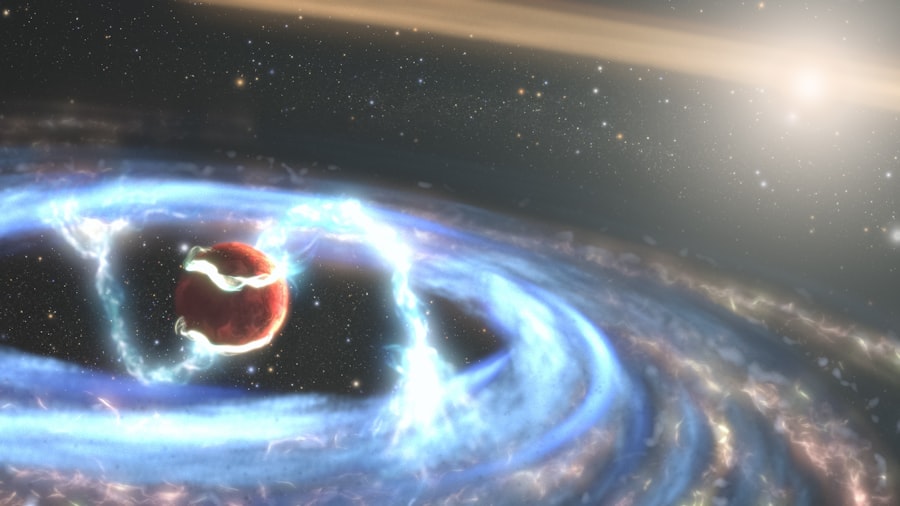
A multitude of evidence supports the Big Bang Theory, making it one of the most robust models in cosmology. One of the most compelling pieces of evidence is the observed redshift of distant galaxies. As light from these galaxies travels through space, it stretches due to the expansion of the universe, causing it to shift toward longer wavelengths.
This phenomenon, known as redshift, indicates that galaxies are moving away from each other, suggesting that they were once much closer together—a key tenet of the Big Bang Theory. Another significant piece of evidence is the Cosmic Microwave Background Radiation (CMB), which serves as a remnant from the early universe. Discovered in 1965 by Arno Penzias and Robert Wilson, this faint glow permeates all of space and is considered a snapshot of the universe when it was just 380,000 years old.
The uniformity and slight fluctuations in temperature across the CMB provide critical insights into the conditions that prevailed shortly after the Big Bang, further corroborating the theory’s predictions.
Challenges to the Big Bang Theory
| Challenge | Description |
|---|---|
| Flatness Problem | The universe appears to be very flat, which is difficult to explain within the Big Bang model. |
| Horizon Problem | The uniformity of the cosmic microwave background radiation is hard to reconcile with the limited time available for light to travel across the universe. |
| Matter-Antimatter Asymmetry | The Big Bang theory struggles to explain why there is an abundance of matter in the universe, but very little antimatter. |
| Dark Matter and Dark Energy | The existence and nature of dark matter and dark energy, which make up the majority of the universe’s mass-energy content, are not well understood within the Big Bang framework. |
Despite its widespread acceptance, the Big Bang Theory faces several challenges that prompt ongoing research and debate within the scientific community. One major challenge lies in explaining certain observations that do not align perfectly with predictions made by the theory. For instance, discrepancies in measurements of cosmic expansion rates have led to questions about whether current models accurately reflect reality.
These inconsistencies have sparked discussions about potential modifications or extensions to the existing framework. Additionally, some scientists argue that aspects such as dark matter and dark energy complicate our understanding of cosmic evolution. While these phenomena are integral to current models, their exact nature remains elusive.
Dark matter, which is thought to make up a significant portion of the universe’s mass, has yet to be directly observed, leading to speculation about its properties and implications for cosmology. Similarly, dark energy’s role in accelerating cosmic expansion raises questions about its origin and influence on future cosmic evolution.
The Expansion of the Universe
The expansion of the universe is a central concept within the Big Bang Theory, fundamentally altering humanity’s understanding of cosmic dynamics. Initially proposed by Edwin Hubble in the 1920s, this idea posits that galaxies are receding from one another at speeds proportional to their distances—a phenomenon known as Hubble’s Law. This observation not only supports the notion that the universe is expanding but also implies that it was once concentrated in a much smaller volume.
As scientists continue to study this expansion, they have discovered that it is not merely a uniform process; rather, it is influenced by various factors including gravitational forces and dark energy. The rate of expansion appears to be accelerating, leading researchers to explore potential explanations for this phenomenon. Understanding how and why the universe expands is crucial for predicting its ultimate fate and unraveling deeper cosmic mysteries.
Cosmic Microwave Background Radiation

The Cosmic Microwave Background Radiation (CMB) serves as a critical piece of evidence for the Big Bang Theory, providing a glimpse into the early universe’s conditions. This faint radiation fills all of space and is a remnant from when protons and electrons combined to form neutral hydrogen atoms approximately 380,000 years after the Big Bang. At this point, photons could travel freely through space, resulting in a uniform glow that can still be detected today.
The CMB is not just a relic; it carries vital information about the universe’s early state. Detailed measurements of its temperature fluctuations reveal insights into density variations that eventually led to galaxy formation. By studying these fluctuations with precision instruments like NASA’s Wilkinson Microwave Anisotropy Probe (WMAP) and the European Space Agency’s Planck satellite, scientists have been able to map out the universe’s structure and composition with remarkable accuracy.
The Formation of Elements
The formation of elements in the early universe is another crucial aspect explained by the Big Bang Theory. During the first few minutes after the Big Bang, conditions were ripe for nuclear fusion—a process where lighter atomic nuclei combine to form heavier ones. This era, known as Big Bang nucleosynthesis, resulted in the creation of essential elements such as hydrogen, helium, and trace amounts of lithium and beryllium.
The abundance ratios of these primordial elements provide strong support for the Big Bang Theory. Observations show that about 75% of ordinary matter in the universe is hydrogen and roughly 25% is helium—exactly what theoretical models predict based on conditions during nucleosynthesis. This consistency between observation and theory reinforces confidence in our understanding of how elements formed in those early moments.
The Role of Dark Matter and Dark Energy
Dark matter and dark energy play pivotal roles in shaping our understanding of cosmic evolution within the framework of the Big Bang Theory. Dark matter is an invisible substance that does not emit or absorb light but exerts gravitational influence on visible matter. Its presence is inferred from gravitational effects on galaxies and galaxy clusters; without it, many observed structures would not hold together as they do.
On the other hand, dark energy is thought to be responsible for driving the accelerated expansion of the universe. While its exact nature remains unknown, it constitutes approximately 68% of total energy density in the cosmos. The interplay between dark matter and dark energy complicates our understanding of cosmic dynamics but also highlights areas where further research could yield groundbreaking insights into fundamental physics.
The Future of the Universe
The future trajectory of the universe remains a topic of intense speculation among cosmologists. Current models suggest several possible scenarios based on various factors such as dark energy’s properties and cosmic expansion rates. One possibility is that the universe will continue expanding indefinitely—a scenario known as “heat death,” where galaxies drift apart and stars eventually burn out.
Alternatively, some theories propose that gravitational forces could eventually dominate over dark energy, leading to a “Big Crunch,” where all matter collapses back into a singularity. Other hypotheses include oscillating models where cycles of expansion and contraction occur over vast timescales. Each scenario presents profound implications for understanding not only cosmic evolution but also humanity’s place within this grand narrative.
Alternative Theories to the Big Bang
While the Big Bang Theory remains dominant in cosmological discourse, alternative theories have emerged that challenge or complement its tenets. One such theory is Steady State Cosmology, which posits that new matter is continuously created as galaxies move apart, maintaining a constant density throughout an infinite time frame. Although this model fell out of favor due to observational evidence supporting an evolving universe, it sparked valuable discussions about cosmic origins.
Another alternative involves cyclic models where universes undergo endless cycles of expansion and contraction—each “Big Bang” followed by a “Big Crunch.” These theories offer intriguing perspectives on time and existence but face challenges in reconciling with current observational data. Exploring these alternatives enriches scientific discourse and encourages critical examination of established paradigms.
Implications of Understanding the Big Bang Theory
Understanding the Big Bang Theory carries profound implications beyond mere scientific inquiry; it shapes philosophical perspectives on existence itself. By grasping how everything came into being from an initial singularity, humanity gains insight into its own origins and place within an ever-expanding cosmos. This knowledge fosters a sense of connection with the universe at large—a realization that all matter is interwoven through time and space.
Moreover, advancements in cosmology driven by research into the Big Bang Theory have far-reaching consequences for technology and society. Innovations stemming from astronomical research often find applications in fields such as medicine, engineering, and information technology. As scientists continue to unravel cosmic mysteries through rigorous investigation into our universe’s beginnings, they pave pathways toward understanding not only where we come from but also where we might be headed in an ever-evolving cosmos.
The Big Bang Theory, a cornerstone of modern cosmology, explains the origin of our universe as a massive expansion from a singular point. For those interested in delving deeper into the intricacies of this theory, an insightful article can be found on My Cosmic Ventures. This article explores the implications of the Big Bang Theory on our understanding of the cosmos and how it has shaped contemporary scientific thought. To read more about this fascinating topic, visit the article at My Cosmic Ventures.
WATCH THIS! How a Quantum Loophole Sparked Everything: The Universe Born From Nothing, Explained
FAQs
What is the Big Bang Theory?
The Big Bang Theory is the prevailing cosmological model for the observable universe from the earliest known periods through its subsequent large-scale evolution.
When was the Big Bang Theory proposed?
The Big Bang Theory was first proposed in the 1920s by the Belgian physicist Georges Lemaître and was later developed and refined by other scientists.
What does the Big Bang Theory state?
The Big Bang Theory states that the universe began as a hot, dense point and has been expanding and cooling ever since.
What evidence supports the Big Bang Theory?
Evidence supporting the Big Bang Theory includes the cosmic microwave background radiation, the abundance of light elements, and the large-scale structure of the universe.
What is the cosmic microwave background radiation?
The cosmic microwave background radiation is the afterglow of the Big Bang, which is a faint glow of light that fills the universe in all directions.
How does the Big Bang Theory explain the formation of galaxies and stars?
The Big Bang Theory explains that the early universe was very hot and dense, and as it expanded and cooled, matter began to clump together, eventually forming galaxies and stars.
Is the Big Bang Theory widely accepted in the scientific community?
Yes, the Big Bang Theory is widely accepted in the scientific community and is supported by a large body of evidence from various fields of study, including astronomy, physics, and cosmology.