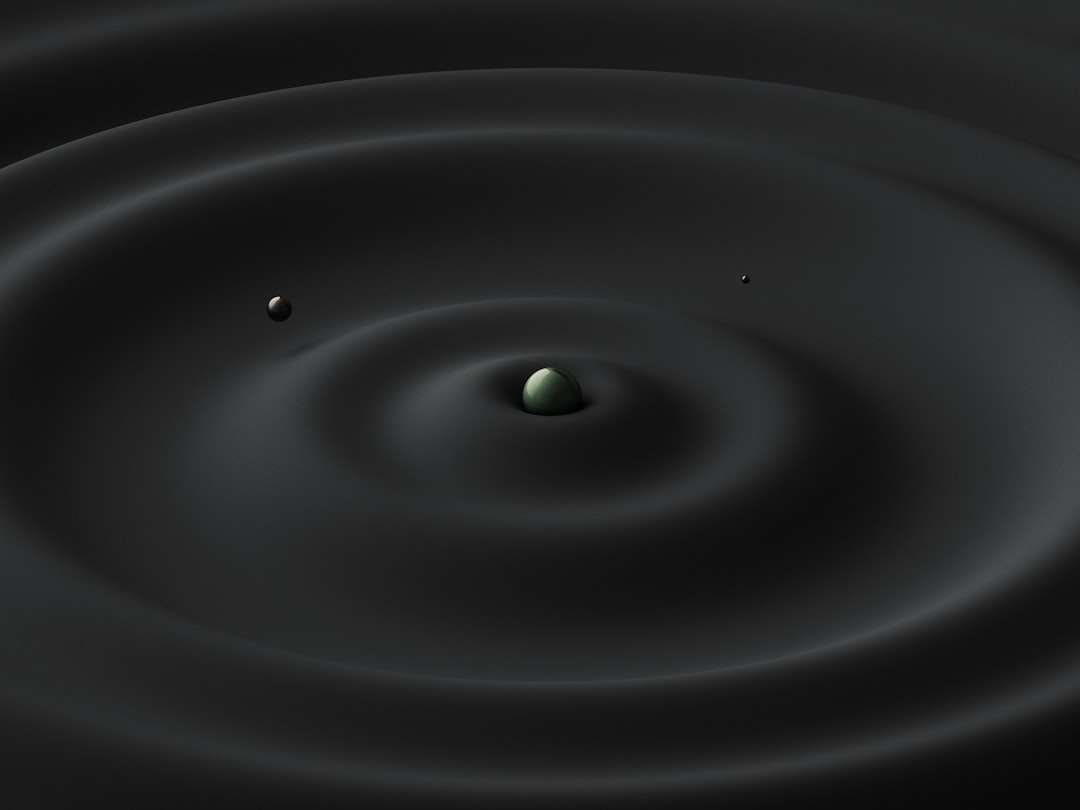
The Ekpyrotic Scenario is a cosmological model that proposes an alternative to the standard Big Bang theory. According to this model, the universe began through the collision of two three-dimensional membranes (branes) existing within a higher-dimensional space. This theoretical framework attempts to address fundamental questions about cosmic origins, large-scale structure formation, and the observed homogeneity in the cosmic microwave background radiation.
The Ekpyrotic Scenario is based on string theory and M-theory, which describe the universe as containing multiple dimensions beyond the familiar three spatial dimensions and one time dimension.
The model suggests that when two such branes collide, the resulting energy release creates the hot, dense conditions traditionally attributed to the Big Bang.
This theoretical approach offers potential solutions to several cosmological problems, including the horizon problem and the flatness problem, without requiring an inflationary period. The model proposes that the collision between branes can naturally produce the nearly scale-invariant spectrum of density fluctuations observed in the cosmic microwave background. Additionally, the Ekpyrotic Scenario may provide insights into the nature of dark energy and the possibility of cyclic cosmological models where brane collisions occur repeatedly over vast timescales.
Key Takeaways
- The Ekpyrotic Scenario proposes a cosmological model where our universe originated from the collision of higher-dimensional branes.
- It offers an alternative to the traditional Big Bang theory by explaining the universe’s beginning without a singularity.
- String theory plays a crucial role in formulating and supporting the Ekpyrotic model.
- While there is some supporting evidence, the scenario faces significant challenges and criticisms from the scientific community.
- Research into the Ekpyrotic Scenario continues to explore its implications for the universe’s fate and its connection to multiverse theories.
The Origins of the Ekpyrotic Scenario
The Ekpyrotic Scenario emerged from the confluence of ideas in cosmology and string theory during the late 20th century. It was primarily developed by physicists Justin Khoury, Burt Ovrut, Paul Steinhardt, and Neil Turok in the early 2000s. Their work sought to address some of the shortcomings of the Big Bang model, particularly issues related to cosmic inflation and the uniformity of the universe.
The term “ekpyrotic” itself is derived from the Greek word for “conflagration,” reflecting the idea that the universe’s birth was not a singular explosion but rather a complex interaction between branes. The theoretical framework of the Ekpyrotic Scenario draws heavily on string theory, which posits that fundamental particles are not point-like objects but rather one-dimensional strings vibrating at different frequencies. This perspective allows for a higher-dimensional universe where multiple branes can exist simultaneously.
The collision of these branes serves as a catalyst for cosmic creation, leading to a new understanding of how matter and energy came into being. By integrating concepts from both cosmology and string theory, the Ekpyrotic Scenario provides a rich tapestry of ideas that challenge conventional wisdom.
The Collision of Universes in Ekpyrotic Cosmology
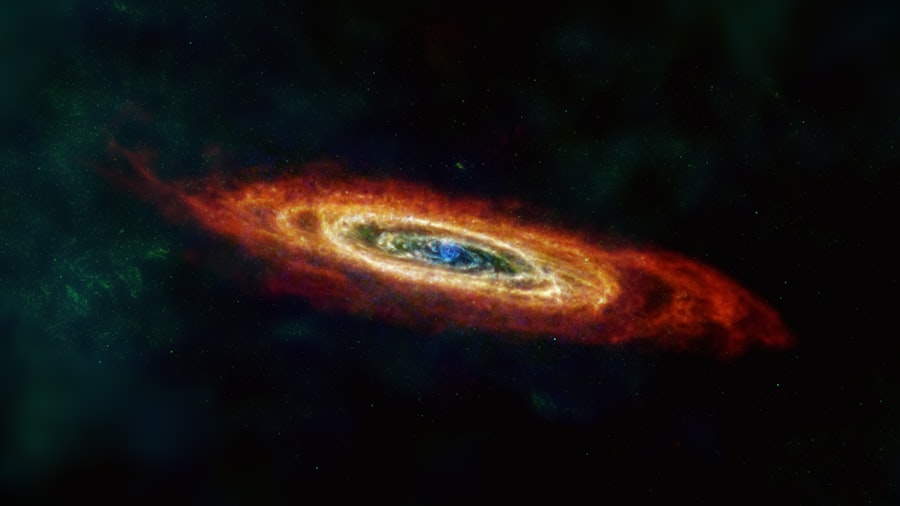
Central to the Ekpyrotic Scenario is the concept of brane collisions, which serve as the mechanism for cosmic creation. In this model, our universe is situated on one brane, while another brane approaches it from a higher-dimensional space. When these two branes collide, they create an enormous release of energy, resulting in the formation of matter and radiation.
This collision is not merely a one-time event; rather, it can be viewed as part of an ongoing cycle of collisions and separations between branes. The implications of this collision are profound. Unlike the Big Bang, which suggests a singular beginning to time and space, the Ekpyrotic Scenario allows for a cyclical model where universes can be born and reborn through successive collisions.
This cyclical nature introduces a dynamic aspect to cosmology, suggesting that the universe may have existed in various forms long before what is traditionally considered its beginning. Such a perspective invites further inquiry into the nature of time itself and whether it is linear or cyclical.
Evidence Supporting the Ekpyrotic Scenario
While the Ekpyrotic Scenario is still largely theoretical, several lines of evidence lend support to its claims. One significant aspect is its ability to address certain cosmological puzzles that have long perplexed scientists. For instance, it offers explanations for the uniformity of cosmic microwave background radiation and the large-scale structure of the universe without relying on inflationary theory.
The Ekpyrotic model suggests that these features arise naturally from the dynamics of brane collisions rather than requiring an additional inflationary phase. Moreover, recent advancements in observational cosmology have provided data that could be interpreted in favor of the Ekpyrotic Scenario. For example, studies examining gravitational waves and their potential signatures in cosmic background radiation may reveal patterns consistent with brane interactions.
As technology advances and observational techniques improve, researchers are increasingly able to test predictions made by this model against empirical data, potentially validating its claims.
Challenges and Criticisms of the Ekpyrotic Scenario
| Metric | Description | Value / Range | Units |
|---|---|---|---|
| Scalar Spectral Index (n_s) | Measure of the scale dependence of primordial density fluctuations | Approximately 0.97 – 0.99 | Dimensionless |
| Tensor-to-Scalar Ratio (r) | Ratio of gravitational wave amplitude to density perturbations | Typically very small, r < 0.01 | Dimensionless |
| Equation of State Parameter (w) | Ratio of pressure to energy density during ekpyrotic phase | > 1 (often w ≈ 100) | Dimensionless |
| Duration of Ekpyrotic Phase | Time span of the slow contraction phase before the bounce | ~10^-30 to 10^-35 | Seconds (approximate) |
| Energy Scale of Bounce | Energy scale at which the universe transitions from contraction to expansion | ~10^16 | GeV |
| Non-Gaussianity Parameter (f_NL) | Measure of deviation from Gaussian primordial fluctuations | Order of 1 to 10 | Dimensionless |
Despite its intriguing propositions, the Ekpyrotic Scenario faces several challenges and criticisms from within the scientific community. One major concern revolves around its reliance on string theory, which remains unproven and highly speculative. Critics argue that without empirical evidence supporting string theory itself, any conclusions drawn from it—including those related to the Ekpyrotic Scenario—are tenuous at best.
Additionally, some physicists question whether the model can adequately explain all observed phenomena in cosmology. For instance, while it addresses certain aspects of cosmic uniformity, it may struggle to account for other features such as galaxy formation and dark matter distribution. These criticisms highlight the need for further research and refinement within the framework of Ekpyrotic Cosmology to ensure it can provide a comprehensive understanding of the universe’s origins.
The Role of String Theory in Ekpyrotic Cosmology
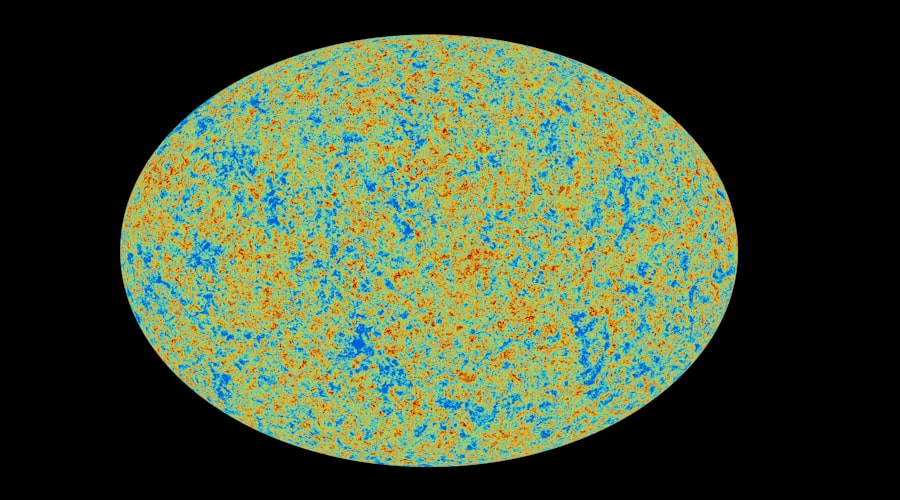
String theory plays a pivotal role in shaping the foundations of the Ekpyrotic Scenario. As a theoretical framework that seeks to unify all fundamental forces and particles in nature, string theory provides a higher-dimensional context in which branes can exist and interact. This perspective allows for a more nuanced understanding of cosmic events, as it situates our universe within a broader multiverse landscape.
In this context, branes are not merely isolated entities but part of an intricate web of interactions within higher dimensions. The dynamics governing these interactions are crucial for understanding how collisions lead to cosmic creation. String theory’s mathematical elegance offers tools for modeling these processes, enabling physicists to explore scenarios that extend beyond conventional three-dimensional thinking.
As research continues to evolve in both string theory and cosmology, their interplay may yield new insights into fundamental questions about existence.
The Ekpyrotic Scenario and the Big Bang Theory
The relationship between the Ekpyrotic Scenario and the Big Bang Theory is complex and multifaceted. While both models aim to explain the origins of our universe, they diverge significantly in their fundamental assumptions and implications. The Big Bang Theory posits a singular beginning marked by an explosive expansion from an infinitely dense point, whereas the Ekpyrotic Scenario envisions a more gradual process involving multiple brane collisions.
This divergence raises important questions about how these models can coexist or complement one another. Some researchers propose that elements from both theories could be integrated to form a more comprehensive understanding of cosmic origins. For instance, aspects of inflationary theory could potentially be reconciled with brane dynamics to explain certain observed phenomena while retaining the cyclical nature proposed by the Ekpyrotic Scenario.
The Implications of the Ekpyrotic Scenario for the Fate of the Universe
The implications of adopting an Ekpyrotic perspective extend beyond understanding cosmic origins; they also influence theories regarding the ultimate fate of the universe. If brane collisions are indeed cyclical events, then it follows that our universe may not be destined for a singular end but rather could undergo repeated cycles of birth and rebirth. This cyclical model challenges conventional notions about entropy and thermodynamics on cosmic scales.
Such a view invites speculation about what lies beyond our current understanding of time and existence. If universes can be born anew through brane interactions, then questions arise about what happens during these cycles—do remnants persist from one cycle to another? How does consciousness fit into this framework?
These inquiries push researchers to explore not only physical laws but also philosophical implications regarding existence itself.
The Ekpyrotic Scenario and Multiverse Theory
The Ekpyrotic Scenario naturally aligns with concepts found within multiverse theory, which posits that our universe is just one among many possible universes existing simultaneously. In this context, each collision between branes could give rise to distinct universes with varying physical laws and properties. This perspective expands upon traditional notions of reality by suggesting an infinite tapestry of universes coexisting within higher dimensions.
The implications for multiverse theory are profound; if each collision results in a new universe, then it raises questions about how these universes interact or influence one another. Are there pathways between them? Do they share common histories or diverge entirely?
Such inquiries challenge researchers to rethink fundamental assumptions about causality and interconnectedness across different realms of existence.
The Future of Ekpyrotic Cosmology Research
As research into Ekpyrotic Cosmology continues to evolve, several avenues for exploration emerge on the horizon. Advances in observational technology may provide new data that could validate or challenge predictions made by this model. For instance, upcoming missions aimed at studying gravitational waves or cosmic background radiation could yield insights into brane dynamics and their implications for cosmic structure.
Moreover, interdisciplinary collaboration between physicists, mathematicians, and cosmologists will be crucial for refining theoretical frameworks surrounding Ekpyrotic Cosmology. By integrating diverse perspectives and methodologies, researchers can develop more robust models capable of addressing both empirical observations and theoretical challenges.
The Significance of Exploring the Ekpyrotic Scenario
In conclusion, exploring the Ekpyrotic Scenario offers profound insights into fundamental questions about existence, time, and cosmic origins. By challenging conventional models like the Big Bang Theory, this framework invites researchers to rethink established paradigms while opening new avenues for inquiry into multiverse dynamics and cyclical cosmology. As scientific understanding continues to evolve through rigorous research and collaboration across disciplines, humanity’s quest for knowledge about its place in the cosmos remains an ever-unfolding journey filled with wonder and discovery.
The ekpyrotic scenario in cosmology presents a fascinating alternative to the traditional Big Bang model, suggesting that our universe originated from the collision of two three-dimensional worlds in a higher-dimensional space. For a deeper understanding of this concept and its implications for the nature of the universe, you can explore a related article on this topic at My Cosmic Ventures. This resource provides insights into the theoretical framework and the potential observational consequences of the ekpyrotic model.
FAQs
What is the ekpyrotic scenario in cosmology?
The ekpyrotic scenario is a cosmological model that proposes the universe originated from a collision between two three-dimensional branes in a higher-dimensional space. It serves as an alternative to the traditional Big Bang theory and aims to explain the early conditions of the universe without requiring a singularity.
How does the ekpyrotic scenario differ from the Big Bang theory?
Unlike the Big Bang theory, which starts with a singularity and rapid expansion (inflation), the ekpyrotic scenario suggests the universe’s hot, dense state resulted from the collision of branes. This model avoids the initial singularity and provides a different mechanism for generating the observed large-scale structure of the universe.
What role do branes play in the ekpyrotic scenario?
In the ekpyrotic scenario, branes are multidimensional objects within higher-dimensional space. The collision of two such branes releases energy that creates the conditions for the universe as we observe it. This interaction replaces the traditional concept of a singular Big Bang event.
Does the ekpyrotic scenario address the horizon and flatness problems?
Yes, the ekpyrotic scenario offers solutions to the horizon and flatness problems by proposing a slow contraction phase before the brane collision. This phase smooths and flattens the universe, similar to how inflationary models address these issues but through a different mechanism.
Is the ekpyrotic scenario widely accepted in the scientific community?
The ekpyrotic scenario is considered a viable alternative to inflationary cosmology but remains less widely accepted. It is an active area of research, with ongoing studies evaluating its predictions and consistency with observational data.
What predictions does the ekpyrotic scenario make?
The ekpyrotic scenario predicts a nearly scale-invariant spectrum of primordial density fluctuations, similar to inflationary models, but with distinct signatures in the cosmic microwave background and gravitational waves. These differences provide potential observational tests to distinguish between models.
Who developed the ekpyrotic scenario?
The ekpyrotic scenario was developed in the early 2000s by physicists including Paul Steinhardt and Neil Turok, building on ideas from string theory and brane cosmology.
How does the ekpyrotic scenario relate to string theory?
The ekpyrotic scenario is grounded in string theory concepts, particularly the existence of branes and extra dimensions. It uses these ideas to explain the origin and evolution of the universe through brane interactions in higher-dimensional space.