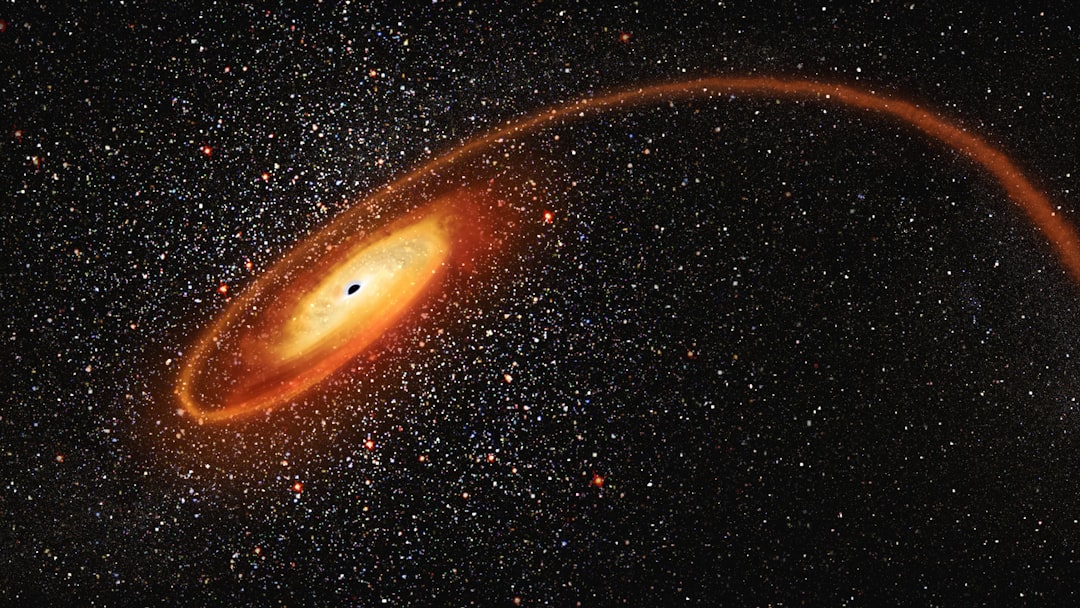
Primordial black holes (PBHs) are theoretical black holes that differ fundamentally from stellar-mass black holes in their formation mechanism and timing. While conventional black holes form from the gravitational collapse of massive stars at the end of their lifecycle, primordial black holes are hypothesized to have formed during the first fraction of a second after the Big Bang, when the universe was extremely dense and hot. The formation of PBHs is attributed to density fluctuations in the early universe.
In regions where matter density exceeded a critical threshold, gravitational collapse could occur directly, bypassing the stellar evolution process entirely. These density perturbations would need to be significantly larger than the average fluctuations that eventually led to galaxy formation. The mass range of primordial black holes could vary dramatically, from microscopic scales to several solar masses, depending on the specific conditions present during their formation epoch.
Research into primordial black holes addresses several key areas in modern cosmology and astrophysics. PBHs are considered potential candidates for dark matter, particularly those with masses between 10^-16 and 10^-10 solar masses, which would have evaded direct detection. They also serve as probes of the early universe’s conditions, potentially providing evidence for cosmic inflation models and the nature of density perturbations in the primordial cosmos.
Additionally, the study of PBHs contributes to our understanding of gravitational wave sources, as their mergers could produce detectable signals, and Hawking radiation, as smaller primordial black holes would evaporate over cosmological timescales.
Key Takeaways
- Primordial black holes (PBHs) are hypothesized to have formed in the early universe with unique characteristics distinct from stellar black holes.
- Hawking radiation predicts that PBHs can evaporate over time, potentially leaving observable signatures.
- Observational evidence for PBH evaporation remains inconclusive but is crucial for validating theoretical models.
- Studying PBH evaporation offers insights into early universe conditions and fundamental physics.
- Future research aims to resolve controversies and explore applications of PBH evaporation in cosmology and astrophysics.
Formation and Characteristics of Primordial Black Holes
The formation of primordial black holes is theorized to occur during the high-energy conditions present in the early universe. In the moments following the Big Bang, quantum fluctuations in density could have led to regions where matter was densely packed. If these regions reached a critical threshold, they would collapse under their own gravitational pull, resulting in the formation of black holes.
This process is distinct from stellar black hole formation, as it does not rely on the lifecycle of massive stars but rather on the dynamics of the early universe. Primordial black holes can vary significantly in mass, ranging from tiny black holes with masses less than that of an asteroid to supermassive ones that could rival stellar masses. Their diverse mass spectrum is one of the intriguing aspects of PBHs, as it suggests that they could contribute to various cosmic phenomena.
For instance, smaller PBHs might evaporate quickly due to Hawking radiation, while larger ones could persist for billions of years. This variability in mass and lifespan makes them a compelling subject for research, as they may hold clues to both dark matter and the evolution of cosmic structures.
Theoretical Predictions of Primordial Black Hole Evaporation
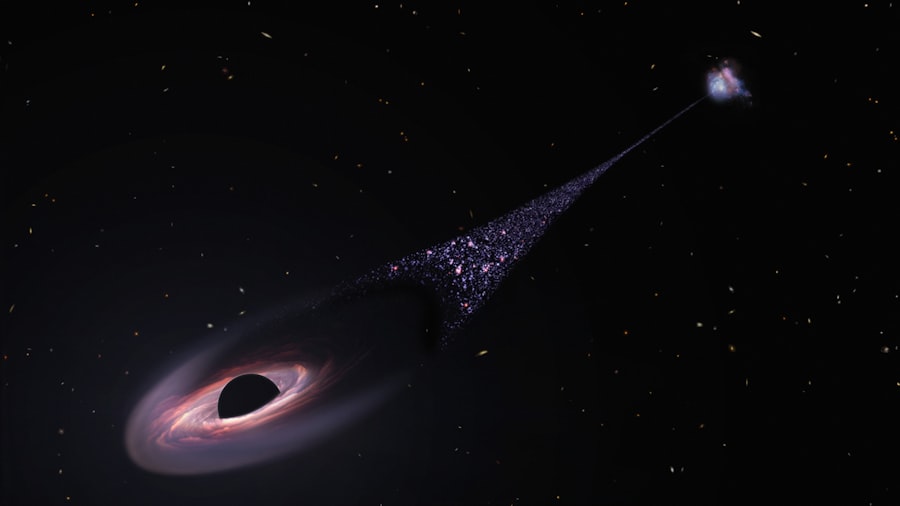
The theoretical framework surrounding primordial black hole evaporation is primarily based on Stephen Hawking’s groundbreaking work on black hole thermodynamics. According to Hawking’s theory, black holes are not entirely black; they emit radiation due to quantum effects near their event horizons. This radiation leads to a gradual loss of mass and energy over time, ultimately resulting in the evaporation of the black hole.
For primordial black holes, which can have a wide range of masses, the rate of evaporation varies significantly. Smaller primordial black holes are predicted to evaporate much more quickly than their larger counterparts. For instance, a PBH with a mass similar to that of a mountain might evaporate in a fraction of a second, while a supermassive PBH could take billions of years to completely dissipate.
This disparity in evaporation timescales presents an intriguing challenge for researchers attempting to understand the implications of PBH evaporation on cosmic evolution and structure formation.
Hawking Radiation and Primordial Black Hole Evaporation
Hawking radiation is a pivotal concept in understanding how primordial black holes can evaporate over time. This phenomenon arises from quantum mechanics and general relativity, suggesting that particle-antiparticle pairs can spontaneously form near the event horizon of a black hole. When one particle falls into the black hole while the other escapes, it results in a net loss of mass for the black hole, leading to its gradual evaporation.
The implications of Hawking radiation for primordial black holes are profound. As these black holes emit radiation, they lose mass and energy, which can influence their surroundings. The emitted radiation could potentially be detected by current or future observational instruments, providing indirect evidence for the existence of primordial black holes.
Moreover, understanding Hawking radiation is crucial for exploring fundamental questions about entropy, information loss, and the nature of spacetime itself.
Observational Evidence for Primordial Black Hole Evaporation
| Parameter | Description | Typical Value / Range | Units |
|---|---|---|---|
| Mass of Primordial Black Hole (PBH) | Initial mass of the PBH at formation | 10^15 to 10^20 | grams |
| Evaporation Time | Time taken for PBH to completely evaporate via Hawking radiation | ~10^10 to 10^20 | years |
| Hawking Temperature | Temperature of the black hole due to Hawking radiation | ~10^-8 to 10^12 | Kelvin |
| Evaporation Rate | Mass loss rate due to Hawking radiation | Varies inversely with mass | grams per second |
| Lifetime Formula | Approximate formula for PBH lifetime | t ≈ 5120 π G² M³ / (ħ c⁴) | seconds |
| Critical Mass for Evaporation Today | Mass of PBH that would be evaporating now | ~5 × 10^14 | grams |
| Energy Emission Spectrum | Range of particles emitted during evaporation | Photons, neutrinos, electrons, positrons, etc. | Various |
Despite their theoretical underpinnings, observational evidence for primordial black hole evaporation remains elusive. Researchers have proposed various methods to detect the signatures of evaporating PBHs, including monitoring high-energy gamma-ray bursts or gravitational waves that could result from their collapse. The challenge lies in distinguishing these signals from other astrophysical phenomena, making it a complex endeavor.
Recent advancements in observational technology have opened new avenues for detecting potential signs of primordial black hole evaporation. For instance, space-based observatories equipped with sensitive detectors may be able to capture gamma-ray emissions associated with PBH evaporation events. Additionally, gravitational wave observatories like LIGO and Virgo could provide insights into mergers involving primordial black holes, further enhancing our understanding of their role in cosmic evolution.
Implications of Primordial Black Hole Evaporation for Cosmology
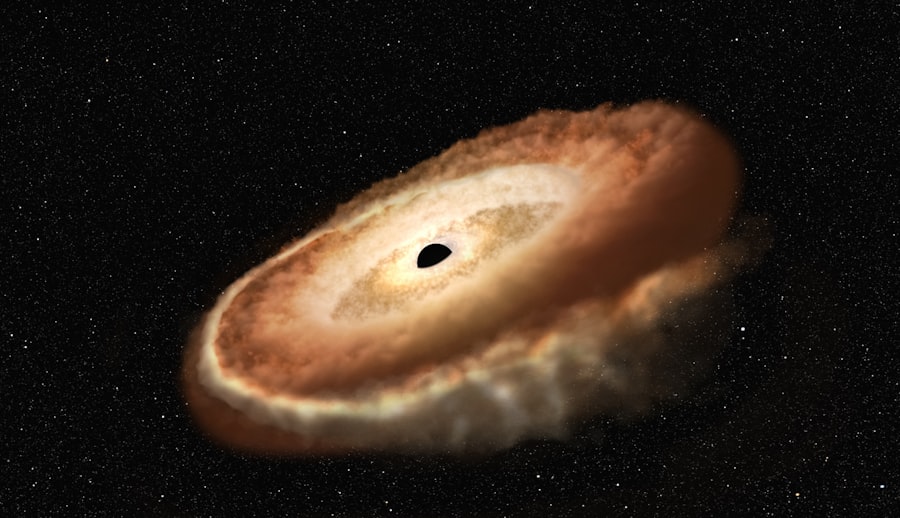
The evaporation of primordial black holes carries significant implications for cosmology and our understanding of dark matter. If PBHs exist and contribute to dark matter, their evaporation could alter the distribution and behavior of dark matter in the universe.
Furthermore, studying primordial black hole evaporation can shed light on fundamental questions regarding the early universe’s conditions and dynamics. The presence or absence of PBHs could provide insights into inflationary models and the mechanisms that governed cosmic expansion. Understanding how PBHs interact with other forms of matter and energy can help refine cosmological models and enhance our comprehension of the universe’s structure.
Challenges and Controversies in Studying Primordial Black Hole Evaporation
The study of primordial black hole evaporation is fraught with challenges and controversies that complicate researchers’ efforts to draw definitive conclusions. One significant challenge lies in the lack of direct observational evidence for PBHs themselves. While theoretical models suggest their existence, confirming their presence through empirical data remains an ongoing struggle.
Moreover, there are debates within the scientific community regarding the mass range and abundance of primordial black holes. Some researchers argue that PBHs could account for a substantial portion of dark matter, while others contend that their contribution is negligible. These differing perspectives highlight the complexities involved in understanding PBHs and their role in cosmic evolution.
Potential Applications of Primordial Black Hole Evaporation
The study of primordial black hole evaporation extends beyond theoretical exploration; it also holds potential applications across various fields within physics and cosmology. For instance, insights gained from PBH evaporation could inform models related to quantum gravity and help bridge gaps between general relativity and quantum mechanics. Understanding how these two fundamental theories interact is crucial for advancing our knowledge of the universe.
Additionally, if primordial black holes are confirmed as viable candidates for dark matter, their evaporation could have practical implications for future astrophysical research. Detecting signatures associated with evaporating PBHs may lead to breakthroughs in our understanding of dark matter’s nature and distribution throughout the cosmos.
Future Research Directions in Studying Primordial Black Hole Evaporation
As researchers continue to explore primordial black hole evaporation, several promising avenues for future research emerge. One key direction involves refining observational techniques to detect potential signatures associated with PBH evaporation more effectively. Advancements in gamma-ray astronomy and gravitational wave detection may provide new opportunities for uncovering evidence supporting or refuting the existence of primordial black holes.
Moreover, theoretical investigations into the interplay between PBHs and other cosmic phenomena will be essential for developing comprehensive models that account for their potential impact on cosmic evolution. Collaborative efforts between observational astronomers and theoretical physicists will be crucial in advancing our understanding of primordial black holes and their role in shaping the universe.
The Role of Primordial Black Hole Evaporation in Understanding the Early Universe
Primordial black hole evaporation serves as a critical tool for unraveling mysteries surrounding the early universe’s conditions and dynamics. By studying how these black holes form, evolve, and ultimately evaporate, researchers can gain insights into fundamental processes that occurred shortly after the Big Bang. This knowledge can inform theories related to cosmic inflation, structure formation, and even the nature of spacetime itself.
Furthermore, understanding PBH evaporation may provide clues about the distribution and behavior of dark matter during the universe’s formative years. As researchers piece together this intricate puzzle, they contribute to a more comprehensive narrative about how our universe came into being and how it continues to evolve.
The Significance of Primordial Black Hole Evaporation in Astrophysics and Cosmology
In conclusion, primordial black hole evaporation represents a captivating intersection between theoretical physics and observational astronomy. As scientists continue to explore this phenomenon, they unlock new insights into fundamental questions about dark matter, cosmic evolution, and the early universe’s conditions. The challenges associated with studying PBHs only serve to highlight their complexity and significance within astrophysics.
As research progresses and new technologies emerge, it is likely that primordial black holes will remain a focal point in astrophysical inquiry for years to come, offering profound implications for our understanding of both the universe’s past and its future trajectory.
Primordial black holes (PBHs) are fascinating cosmic entities that may have formed in the early universe and are theorized to evaporate over time due to Hawking radiation. This intriguing process has significant implications for our understanding of dark matter and the evolution of the universe. For a deeper exploration of these concepts, you can read more in the related article on cosmic phenomena at My Cosmic Ventures.
FAQs
What are primordial black holes?
Primordial black holes are hypothetical black holes that are thought to have formed in the early universe, shortly after the Big Bang, due to high-density fluctuations. Unlike black holes formed from collapsing stars, primordial black holes could have a wide range of masses, including very small ones.
How do primordial black holes evaporate?
Primordial black holes evaporate through a process called Hawking radiation, where quantum effects near the event horizon cause the black hole to emit particles and lose mass over time. This evaporation process causes the black hole to shrink and eventually disappear.
What is Hawking radiation?
Hawking radiation is theoretical radiation predicted by physicist Stephen Hawking. It arises from quantum effects near the event horizon of a black hole, allowing the black hole to emit particles and lose energy, leading to gradual evaporation.
How long does it take for a primordial black hole to evaporate?
The evaporation time depends on the mass of the primordial black hole. Smaller black holes evaporate faster, potentially within the age of the universe, while larger ones can take much longer. For example, a black hole with the mass of a mountain could evaporate in about a billion years.
Can primordial black holes still exist today?
Yes, if primordial black holes were formed with sufficiently large masses, they could still exist today because their evaporation times exceed the current age of the universe. Smaller primordial black holes may have already evaporated.
Why is the study of primordial black hole evaporation important?
Studying primordial black hole evaporation helps scientists understand early universe conditions, test theories of quantum gravity, and explore potential contributions of primordial black holes to dark matter.
Have primordial black holes been observed directly?
No direct observation of primordial black holes has been confirmed. However, researchers look for indirect evidence through gravitational lensing, gravitational waves, and cosmic radiation signatures that could indicate their presence.
What happens when a primordial black hole finishes evaporating?
When a primordial black hole completes its evaporation, it is theorized to disappear completely, releasing a final burst of high-energy particles. The exact details of this final stage remain an area of active research.
Could primordial black hole evaporation be detected?
In principle, the final stages of evaporation could produce detectable bursts of radiation or particles. Scientists use telescopes and detectors to search for such signals, but none have been conclusively observed so far.
Do primordial black holes contribute to dark matter?
Primordial black holes are considered a candidate for dark matter, especially if they have masses that allow them to survive until today. However, current observations place constraints on their abundance, and their role in dark matter remains uncertain.