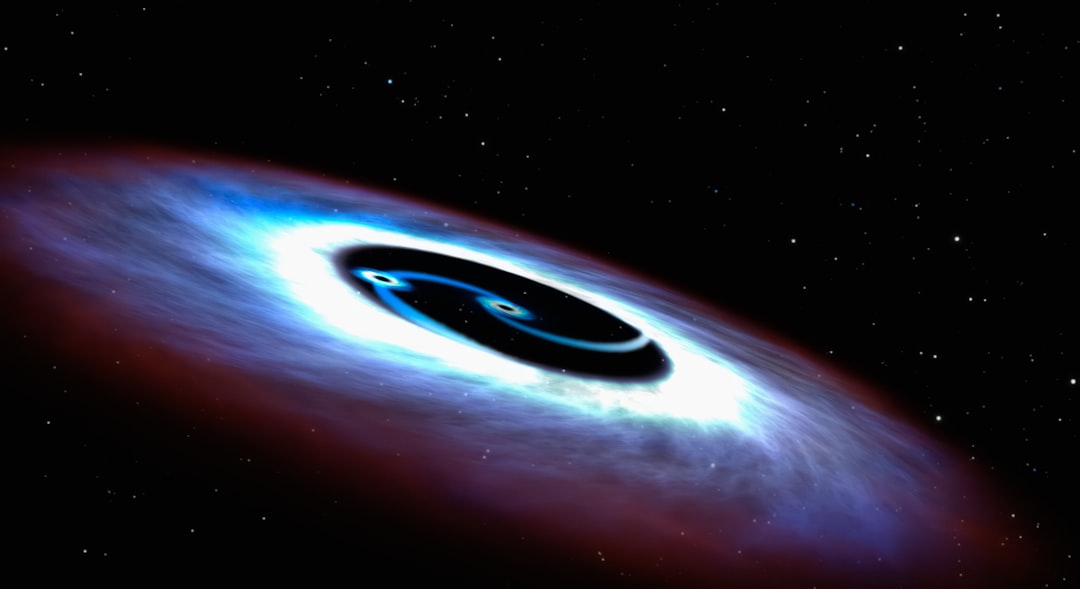
Primordial black holes (PBHs) are theoretical black holes that differ from stellar-mass black holes in their formation mechanism and timing. While conventional black holes form from the gravitational collapse of massive stars at the end of their lifecycles, primordial black holes are hypothesized to have formed during the first fraction of a second after the Big Bang, when the universe was extremely dense and hot. The formation of primordial black holes requires specific conditions in the early universe.
During this period, quantum fluctuations in the density of matter could have created regions where the density exceeded a critical threshold. When these overdense regions collapsed under their own gravitational pull, they would have formed black holes with masses potentially ranging from subatomic scales to thousands of solar masses, depending on the size of the initial density perturbation. Current research on primordial black holes addresses several significant cosmological questions.
Scientists investigate their potential role as dark matter candidates, particularly for black holes in specific mass ranges that could account for a portion of the universe’s missing matter. Additionally, PBHs serve as probes for understanding the conditions and physics of the very early universe, including inflation theory and the nature of primordial density fluctuations. Observational efforts to detect primordial black holes employ multiple approaches, including gravitational wave detection, microlensing surveys, and studies of their potential evaporation through Hawking radiation.
These investigations contribute to our understanding of cosmic structure formation, the nature of dark matter, and the fundamental physics governing the universe’s evolution from its earliest moments.
Key Takeaways
- Primordial black holes (PBHs) are theoretical black holes formed in the early universe with a wide possible mass range.
- Gravitational lensing and cosmic microwave background data provide key observational constraints on PBH masses.
- PBHs are considered a potential candidate for dark matter, influencing cosmological models.
- Future space missions aim to improve detection capabilities and refine PBH mass range estimates.
- Understanding PBH formation and mass distribution offers insights into early universe conditions and fundamental physics.
Theoretical Predictions for Primordial Black Holes
The theoretical predictions surrounding primordial black holes are rooted in several key concepts from cosmology and particle physics. One prominent theory suggests that during the rapid expansion known as cosmic inflation, tiny fluctuations in density could have occurred. These fluctuations might have been significant enough to cause certain regions of space to collapse into black holes.
The mass of these primordial black holes could vary widely, depending on the specific conditions present during their formation, leading to a diverse population ranging from very small to supermassive sizes. Another important aspect of these predictions involves the role of quantum effects in the early universe. Some models propose that quantum fluctuations could have contributed to the formation of PBHs, particularly in scenarios where the energy density was extremely high.
This interplay between quantum mechanics and general relativity presents a unique challenge for physicists, as it requires a synthesis of two fundamental theories that are typically considered separately. As researchers continue to refine their models, they aim to better understand how these primordial black holes could fit into the broader framework of cosmic evolution.
Observational Evidence for Primordial Black Holes
Despite their theoretical underpinnings, observational evidence for primordial black holes remains elusive. However, several indirect methods have been proposed to search for signs of their existence. One promising avenue involves studying gravitational waves produced by merging black holes.
If primordial black holes exist in significant numbers, they could contribute to the population of black holes detected by observatories like LIGO and Virgo. Analyzing the mass distribution and merger rates of these detected black holes may provide clues about the presence of primordial counterparts. Additionally, researchers are investigating the potential effects of primordial black holes on cosmic structures.
For instance, if PBHs constitute a portion of dark matter, their gravitational influence could affect the formation and dynamics of galaxies and galaxy clusters. By examining the distribution of galaxies and their motions, scientists hope to glean insights into whether primordial black holes play a role in shaping the large-scale structure of the universe. While direct detection remains challenging, these indirect methods offer a pathway toward understanding the significance of primordial black holes in cosmic history.
Exploring the Mass Range of Primordial Black Holes through Gravitational Lensing
Gravitational lensing is a powerful tool in astrophysics that can provide valuable information about distant objects, including potential primordial black holes. When light from a distant star or galaxy passes near a massive object, such as a black hole, its path is bent due to the object’s gravitational field. This effect can create multiple images or distortions of the background object, allowing astronomers to infer properties about the lensing mass.
By studying gravitational lensing events, researchers can explore the mass range of primordial black holes. If PBHs exist within certain mass ranges, they could act as lenses for light from more distant sources. Observations from telescopes equipped with advanced imaging capabilities can help identify these lensing events and determine the mass of the lensing objects.
This approach not only aids in constraining the mass spectrum of primordial black holes but also enhances our understanding of their distribution throughout the universe.
The Impact of Primordial Black Holes on Cosmology
| Mass Range | Approximate Mass (kg) | Description | Possible Formation Epoch |
|---|---|---|---|
| Subatomic scale | 10^−8 to 10^5 | Extremely small primordial black holes, possibly evaporated by now | 10^−43 to 10^−23 seconds after Big Bang |
| Asteroid mass range | 10^10 to 10^15 | Mass comparable to asteroids, potential dark matter candidates | 10^−23 to 10^−20 seconds after Big Bang |
| Stellar mass range | 1 to 100 times mass of the Sun (~10^30 to 10^32) | Comparable to black holes formed by stellar collapse | 10^−5 to 1 second after Big Bang |
| Intermediate mass range | 10^2 to 10^5 times mass of the Sun | Possible seeds for supermassive black holes | 1 to 10^3 seconds after Big Bang |
The existence of primordial black holes could have profound implications for cosmology as a whole. If they constitute a significant fraction of dark matter, they would alter our understanding of how galaxies form and evolve over time. Traditional models of structure formation rely on cold dark matter (CDM) particles, but if PBHs are present in substantial numbers, they could introduce new dynamics into these processes.
Moreover, primordial black holes may influence cosmic microwave background (CMB) radiation through their gravitational effects. The presence of PBHs could lead to variations in temperature fluctuations observed in the CMB, providing a potential observational signature that could be detected by future missions. Understanding how PBHs interact with other components of the universe will be crucial for refining cosmological models and addressing fundamental questions about its origin and fate.
Constraints on the Mass Range of Primordial Black Holes from Cosmic Microwave Background Radiation
The cosmic microwave background radiation serves as a relic from the early universe, providing a snapshot of its conditions shortly after the Big Bang. Researchers have utilized this radiation to place constraints on various cosmological phenomena, including primordial black holes. By analyzing temperature fluctuations in the CMB, scientists can infer information about density perturbations that occurred during inflation.
If primordial black holes were abundant in certain mass ranges, they would leave distinct signatures in the CMB data. For instance, their gravitational influence could create additional anisotropies or alter existing patterns in temperature fluctuations.
This interplay between observational cosmology and theoretical predictions is essential for refining our understanding of both primordial black holes and the early universe.
The Potential for Detecting Primordial Black Holes with Future Space Missions
As technology advances, future space missions hold great promise for detecting primordial black holes more directly than ever before. Missions designed to study gravitational waves or observe high-energy cosmic phenomena may provide new avenues for uncovering evidence for these elusive entities.
Additionally, missions focused on mapping dark matter distribution may shed light on the role of primordial black holes within this mysterious component of the universe. By combining data from multiple observatories and missions, researchers can build a more comprehensive picture of how PBHs fit into the larger cosmic landscape. The potential for groundbreaking discoveries in this field underscores the importance of continued investment in space exploration and astrophysical research.
The Role of Primordial Black Holes in Dark Matter
One of the most intriguing aspects of primordial black holes is their potential role as candidates for dark matter. Dark matter remains one of the most significant unsolved mysteries in modern astrophysics, constituting approximately 27% of the universe’s total mass-energy content. While various particle candidates have been proposed, primordial black holes offer an alternative explanation that aligns with certain cosmological observations.
If PBHs make up a portion of dark matter, they would influence galaxy formation and evolution through their gravitational effects. Their presence could help explain certain anomalies observed in galaxy rotation curves and large-scale structure formation that cannot be accounted for by conventional dark matter models alone. As researchers continue to explore this connection between primordial black holes and dark matter, they may uncover new insights into both phenomena that reshape our understanding of cosmic evolution.
Theoretical Models for the Formation of Primordial Black Holes
Theoretical models for the formation of primordial black holes are diverse and complex, reflecting the intricate interplay between various physical processes in the early universe. One prominent model involves scenarios where rapid inflation leads to density perturbations that exceed a critical threshold, causing regions to collapse into black holes. These models often incorporate elements from both general relativity and quantum mechanics to account for conditions present during inflation.
Another approach considers phase transitions in the early universe, such as those associated with symmetry breaking or changes in fundamental forces. These transitions could create regions with varying energy densities that might collapse into primordial black holes under specific conditions. As researchers refine these theoretical frameworks, they aim to develop a more comprehensive understanding of how different mechanisms contribute to PBH formation and how these processes relate to observable phenomena.
Implications of the Mass Range of Primordial Black Holes for the Early Universe
The mass range of primordial black holes carries significant implications for our understanding of the early universe’s dynamics and evolution. If PBHs exist across a broad spectrum of masses, they could influence various processes such as structure formation and reionization. For instance, smaller PBHs might evaporate through Hawking radiation over time, while larger ones could persist and contribute to gravitational interactions within galaxies.
Moreover, understanding the mass distribution of primordial black holes can provide insights into conditions during inflation and subsequent cosmic evolution. By correlating observed structures with theoretical predictions based on different mass ranges, researchers can refine their models and enhance our comprehension of how the universe transitioned from its hot, dense state to its current form.
Future Directions for Research on Primordial Black Holes
As interest in primordial black holes continues to grow within the scientific community, future research directions are likely to focus on several key areas. One priority will be improving observational techniques to detect PBHs directly or indirectly through their effects on cosmic structures or gravitational waves. Advancements in technology will play a crucial role in enabling more sensitive measurements and expanding our search capabilities.
Additionally, interdisciplinary collaboration between cosmologists, particle physicists, and astronomers will be essential for developing comprehensive models that integrate various aspects of primordial black hole research. By combining insights from different fields, researchers can address fundamental questions about PBHs’ nature and their implications for dark matter and cosmic evolution. In conclusion, primordial black holes represent a captivating frontier in astrophysics that challenges existing paradigms while offering new avenues for exploration.
As scientists continue to investigate their theoretical foundations and search for observational evidence, they may unlock profound insights into both the early universe and the fundamental nature of reality itself.
Recent discussions in astrophysics have brought attention to the intriguing mass range of primordial black holes (PBHs) and their potential implications for dark matter. A related article that delves deeper into this topic can be found on My Cosmic Ventures, where it explores the formation and characteristics of these enigmatic objects. For more information, you can read the article here: My Cosmic Ventures.
FAQs
What are primordial black holes?
Primordial black holes (PBHs) are hypothetical black holes that are thought to have formed in the early universe, shortly after the Big Bang, due to high-density fluctuations. Unlike black holes formed from collapsing stars, PBHs could have a wide range of masses.
What is the mass range of primordial black holes?
The mass range of primordial black holes is theoretically broad, spanning from as small as about 10^−5 grams (the Planck mass scale) up to thousands or even millions of solar masses. This wide range depends on the conditions in the early universe when they formed.
How do primordial black holes differ in mass from stellar black holes?
Stellar black holes typically have masses ranging from about 3 to 100 times the mass of the Sun, formed from the collapse of massive stars. Primordial black holes, however, could be much smaller or much larger, as their formation is not tied to stellar processes but to density fluctuations in the early universe.
Why is the mass range of primordial black holes important?
The mass range is crucial because it affects how primordial black holes behave, how they might be detected, and their potential role in cosmology, such as being candidates for dark matter or influencing galaxy formation.
Can primordial black holes evaporate?
Yes, according to Hawking radiation theory, smaller primordial black holes can evaporate over time. Those with masses less than about 10^15 grams would have evaporated by now, while more massive ones could still exist.
How do scientists search for primordial black holes?
Scientists look for primordial black holes through various methods, including gravitational lensing, gravitational wave detection, cosmic microwave background observations, and studying their potential effects on astrophysical phenomena.
Are primordial black holes confirmed to exist?
As of now, primordial black holes remain hypothetical. There is no direct observational evidence confirming their existence, but ongoing research and observations continue to explore their possible presence in the universe.