Quantum gravity represents one of the most profound challenges in modern theoretical physics, seeking to reconcile the principles of quantum mechanics with the fabric of spacetime as described by general relativity. This endeavor is particularly significant when considering black holes, enigmatic regions of spacetime where gravitational forces are so intense that nothing, not even light, can escape their grasp. The intersection of these two realms—quantum mechanics and general relativity—has led to a plethora of questions about the fundamental nature of reality, the structure of spacetime, and the fate of information that falls into black holes.
The study of quantum gravity is not merely an academic pursuit; it has far-reaching implications for our understanding of the universe. As physicists delve deeper into the mysteries surrounding black holes, they are compelled to confront the limitations of current theories. The quest for a unified theory that encompasses both quantum mechanics and general relativity could unlock new insights into the workings of the cosmos, potentially revealing the underlying principles that govern all physical phenomena.
Key Takeaways
- Quantum gravity aims to unify quantum mechanics and general relativity to explain the fundamental nature of space-time.
- Black holes present key challenges, including the information paradox linked to quantum entanglement.
- Understanding quantum gravity could reveal the origins of the universe and unify all fundamental forces.
- Particle physics experiments are crucial in the ongoing search for evidence of quantum gravity.
- Advances in quantum gravity theory have significant implications for black hole physics and future cosmological models.
Theoretical Framework for Understanding Quantum Gravity
To grasp the complexities of quantum gravity, one must first appreciate the theoretical frameworks that have been proposed to bridge the gap between quantum mechanics and general relativity. One prominent approach is string theory, which posits that fundamental particles are not point-like objects but rather one-dimensional strings vibrating at different frequencies. This model suggests that the universe has additional spatial dimensions beyond the familiar three, which could provide a natural setting for unifying gravity with other fundamental forces.
Another significant framework is loop quantum gravity, which attempts to quantize spacetime itself. In this theory, spacetime is composed of discrete units or “loops,” leading to a granular structure at the Planck scale. This perspective challenges traditional notions of smooth spacetime and offers a novel way to understand gravitational interactions at quantum levels.
Both string theory and loop quantum gravity represent ambitious attempts to formulate a coherent theory of quantum gravity, yet neither has been definitively proven or universally accepted within the scientific community.
Quantum Mechanics and General Relativity
Quantum mechanics and general relativity stand as two pillars of modern physics, each successful in its own domain yet fundamentally incompatible with one another. Quantum mechanics excels in describing the behavior of subatomic particles and their interactions, governed by probabilistic laws. In contrast, general relativity provides a comprehensive framework for understanding gravity as the curvature of spacetime caused by mass and energy.
The challenge lies in reconciling these two theories, particularly in extreme environments such as those found near black holes. The incompatibility becomes starkly evident when considering scenarios where both quantum effects and strong gravitational fields are present. For instance, near the event horizon of a black hole, quantum fluctuations may influence particle behavior in ways that general relativity cannot account for.
This intersection raises profound questions about the nature of reality itself: Is spacetime fundamentally smooth, or does it exhibit a discrete structure at microscopic scales? The answers to these questions could reshape humanity’s understanding of the universe.
The Enigma of Black Holes
Black holes have captivated scientists and laypeople alike for decades, serving as a focal point for discussions about the limits of human knowledge in physics. These cosmic entities are formed when massive stars exhaust their nuclear fuel and collapse under their own gravity, creating regions where gravitational pull becomes so strong that escape is impossible. The boundary surrounding a black hole, known as the event horizon, marks the point of no return, beyond which all information is seemingly lost to the outside universe.
The enigma deepens when one considers the implications of black holes on our understanding of time and space. Inside a black hole, conventional notions of time may break down, leading to scenarios where causality is violated. Furthermore, the singularity at the center—a point where density becomes infinite—poses significant challenges for physicists attempting to apply known laws of physics.
As researchers continue to explore these mysteries, black holes remain a rich source of inquiry into the fundamental nature of reality.
Quantum Entanglement and Black Hole Information Paradox
| Metric | Description | Typical Values / Range | Relevance to Quantum Gravity Black Holes |
|---|---|---|---|
| Planck Length (lP) | Fundamental length scale where quantum gravity effects become significant | ~1.616 × 10⁻³⁵ meters | Sets the scale for quantum gravitational corrections near black hole singularities |
| Planck Mass (mP) | Mass scale associated with quantum gravity | ~2.176 × 10⁻⁸ kg | Defines the mass scale at which black holes exhibit quantum gravitational behavior |
| Black Hole Entropy (S) | Measure of the information content of a black hole | S = (kB c3 A) / (4 G ħ) | Links thermodynamics and quantum gravity; area law is a key quantum gravity prediction |
| Hawking Temperature (TH) | Temperature of black hole radiation due to quantum effects | TH = ħ c3 / (8 π G M kB) | Demonstrates quantum field theory effects in curved spacetime, essential for quantum gravity |
| Black Hole Mass (M) | Mass of the black hole | Varies from Planck mass to billions of solar masses | Determines the scale at which classical vs quantum gravity effects dominate |
| Quantum Correction Parameter (α) | Dimensionless parameter quantifying quantum gravity corrections | Model-dependent, typically ≪ 1 | Used in effective models to incorporate quantum gravity effects on black hole metrics |
| Black Hole Lifetime (τ) | Time for black hole evaporation via Hawking radiation | τ ∝ M3 (in classical approximation) | Quantum gravity may modify lifetime predictions, especially near Planck scale |
One of the most perplexing issues arising from the study of black holes is the information paradox, which questions whether information that falls into a black hole is irretrievably lost. According to quantum mechanics, information cannot be destroyed; however, if matter is consumed by a black hole, it seems to vanish from existence. This contradiction has led to intense debates among physicists regarding the fate of information and its implications for our understanding of quantum mechanics.
Quantum entanglement plays a crucial role in this discussion. When particles become entangled, their states become interdependent regardless of the distance separating them. This phenomenon suggests that information may be preserved in some form even after it has crossed the event horizon.
Some theorists propose that entangled particles could provide a mechanism for retrieving information from black holes, potentially resolving the paradox. However, this remains an area of active research, with no consensus yet reached on how to reconcile these conflicting ideas.
Quantum Gravity and the Nature of Space-Time
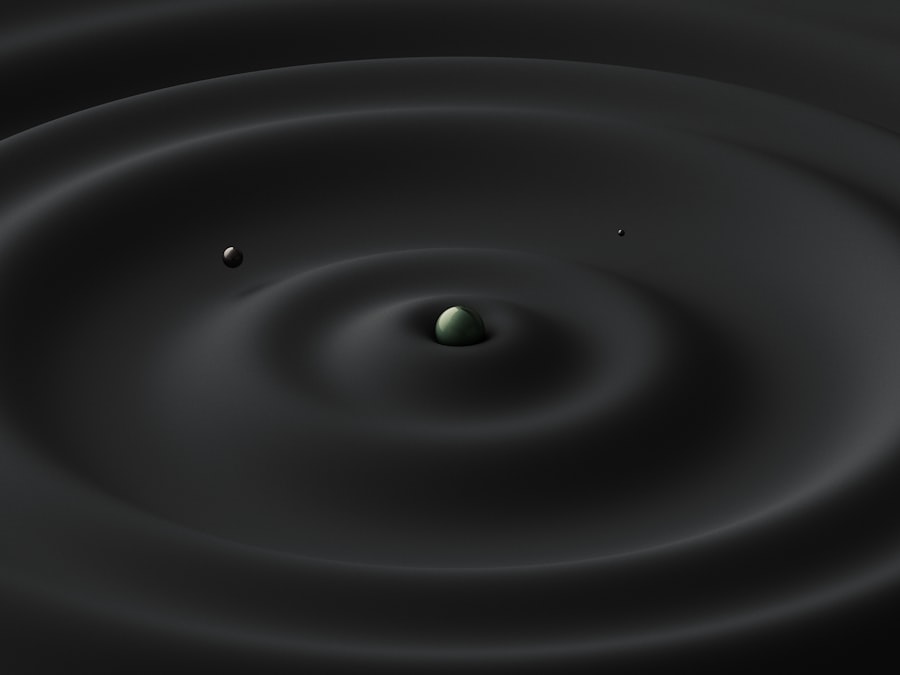
The exploration of quantum gravity invites profound questions about the very nature of space-time itself. Traditional views depict space-time as a continuous fabric that can be warped by mass and energy; however, theories like loop quantum gravity suggest that space-time may be fundamentally discrete at its core. This shift in perspective could lead to a radical rethinking of how we understand gravitational interactions and their relationship with quantum phenomena.
If space-time is indeed quantized, it may have implications for our understanding of black holes and their singularities. Rather than being points of infinite density, singularities might be resolved into finite structures governed by quantum laws. This could provide insights into what happens at the center of black holes and how they interact with surrounding space-time.
As researchers continue to investigate these ideas, they may uncover new principles that redefine our understanding of both gravity and quantum mechanics.
The Search for Quantum Gravity in Particle Physics
The quest for a theory of quantum gravity has significant implications for particle physics, as it seeks to unify all fundamental forces under a single framework. Current models describe three fundamental forces—electromagnetism, weak nuclear force, and strong nuclear force—while gravity remains an outlier due to its incompatibility with quantum mechanics. The search for quantum gravity aims to integrate these forces into a cohesive theory that can explain their interactions at both macroscopic and microscopic scales.
Experimental efforts to detect signs of quantum gravity are ongoing, with researchers exploring high-energy particle collisions and cosmic phenomena as potential avenues for discovery. For instance, experiments at particle accelerators like CERN aim to probe conditions similar to those present during the early universe when all forces were unified. By studying particle interactions at unprecedented energy levels, scientists hope to uncover evidence supporting or refuting various theories of quantum gravity.
Quantum Gravity and the Unification of Fundamental Forces
The unification of fundamental forces stands as one of the holy grails of modern physics. Historically, physicists have successfully unified electromagnetism with weak nuclear force through electroweak theory; however, incorporating gravity into this framework remains elusive. Quantum gravity seeks to achieve this unification by providing a comprehensive description that encompasses all four fundamental forces: electromagnetism, weak nuclear force, strong nuclear force, and gravity.
Achieving such unification would not only deepen humanity’s understanding of physical laws but also offer insights into phenomena such as dark matter and dark energy—mysteries that currently elude explanation within existing frameworks. A successful theory of quantum gravity could illuminate connections between seemingly disparate aspects of physics and provide a more complete picture of how forces interact across different scales.
Quantum Gravity and the Origin of the Universe
The implications of quantum gravity extend beyond black holes and fundamental forces; they also touch upon questions regarding the origin of the universe itself. The Big Bang theory describes the universe’s expansion from an initial singularity; however, this model encounters difficulties when attempting to reconcile it with quantum mechanics. A theory of quantum gravity could offer insights into what preceded the Big Bang or how space-time itself emerged from a primordial state.
Some theorists propose that understanding quantum gravity may reveal mechanisms behind cosmic inflation—a rapid expansion that occurred shortly after the Big Bang—potentially shedding light on why our universe appears so uniform on large scales. By exploring these connections between quantum gravity and cosmology, researchers hope to uncover new insights into the fundamental processes that shaped our universe’s evolution.
Quantum Gravity and the Future of Cosmology
As research into quantum gravity progresses, its implications for cosmology are becoming increasingly apparent. A deeper understanding of how gravity operates at quantum scales could revolutionize cosmological models and enhance predictions about cosmic evolution. For instance, insights gained from studying black holes may inform theories about galaxy formation or structure formation in the early universe.
Moreover, advancements in observational technology—such as gravitational wave detectors—may provide empirical evidence supporting or challenging various theories of quantum gravity. As scientists continue to explore these frontiers, they stand on the brink of potentially transformative discoveries that could reshape humanity’s understanding of both cosmology and fundamental physics.
Implications of Quantum Gravity for Black Hole Physics
The exploration of quantum gravity carries profound implications for black hole physics, particularly concerning our understanding of their formation, evolution, and ultimate fate. As researchers grapple with concepts like Hawking radiation—the theoretical prediction that black holes can emit radiation due to quantum effects—new insights may emerge regarding how black holes interact with their surroundings and what happens when they evaporate over time.
By developing a coherent theory that incorporates both gravitational and quantum principles, physicists may unlock answers to longstanding questions about black holes while simultaneously advancing our comprehension of fundamental physical laws governing the universe. In conclusion, the pursuit of quantum gravity represents one of the most exciting frontiers in contemporary physics. As researchers continue to explore its implications for black holes and beyond, they stand poised to uncover new truths about the nature of reality itself—truths that may redefine humanity’s place within the cosmos.
Recent advancements in the study of quantum gravity have shed light on the enigmatic nature of black holes, particularly in understanding how they might reconcile the principles of quantum mechanics with general relativity. For a deeper exploration of this fascinating topic, you can read more in the article available at this link. This article delves into the implications of quantum gravity theories on black hole behavior and their potential to reshape our understanding of the universe.
FAQs
What is quantum gravity?
Quantum gravity is a field of theoretical physics that seeks to describe gravity according to the principles of quantum mechanics. It aims to unify general relativity, which explains gravity at large scales, with quantum mechanics, which governs the behavior of particles at the smallest scales.
How does quantum gravity relate to black holes?
Quantum gravity is essential for understanding black holes at a fundamental level, especially near their singularities where classical general relativity breaks down. It attempts to explain phenomena such as the behavior of spacetime inside black holes and the nature of black hole entropy and evaporation.
What are black holes?
Black holes are regions in space where gravity is so strong that nothing, not even light, can escape from them. They are formed from the remnants of massive stars after they collapse under their own gravity.
Why can’t classical physics fully describe black holes?
Classical physics, including general relativity, predicts singularities inside black holes where densities become infinite and the laws of physics cease to apply. Quantum gravity aims to provide a more complete description that avoids these infinities by incorporating quantum effects.
What is the significance of Hawking radiation in black hole physics?
Hawking radiation is a theoretical prediction that black holes can emit radiation due to quantum effects near the event horizon. This phenomenon suggests that black holes can lose mass and eventually evaporate, linking quantum mechanics with gravity.
Are there any experimental observations of quantum gravity effects in black holes?
Currently, there are no direct experimental observations of quantum gravity effects in black holes. Most research is theoretical or based on indirect astrophysical observations, as the scales involved are extremely challenging to probe.
What are some approaches to quantum gravity?
Popular approaches include string theory, loop quantum gravity, and causal dynamical triangulations. Each offers different methods to reconcile quantum mechanics with general relativity and to describe the quantum properties of spacetime and black holes.
How might quantum gravity solve the black hole information paradox?
The black hole information paradox arises from the question of whether information that falls into a black hole is lost forever. Quantum gravity theories aim to resolve this paradox by proposing mechanisms through which information is preserved or recovered, consistent with quantum mechanics.
Why is understanding quantum gravity important for physics?
Understanding quantum gravity is crucial for a complete theory of fundamental forces and particles. It could provide insights into the early universe, the nature of spacetime, and unify all fundamental interactions under a single framework.