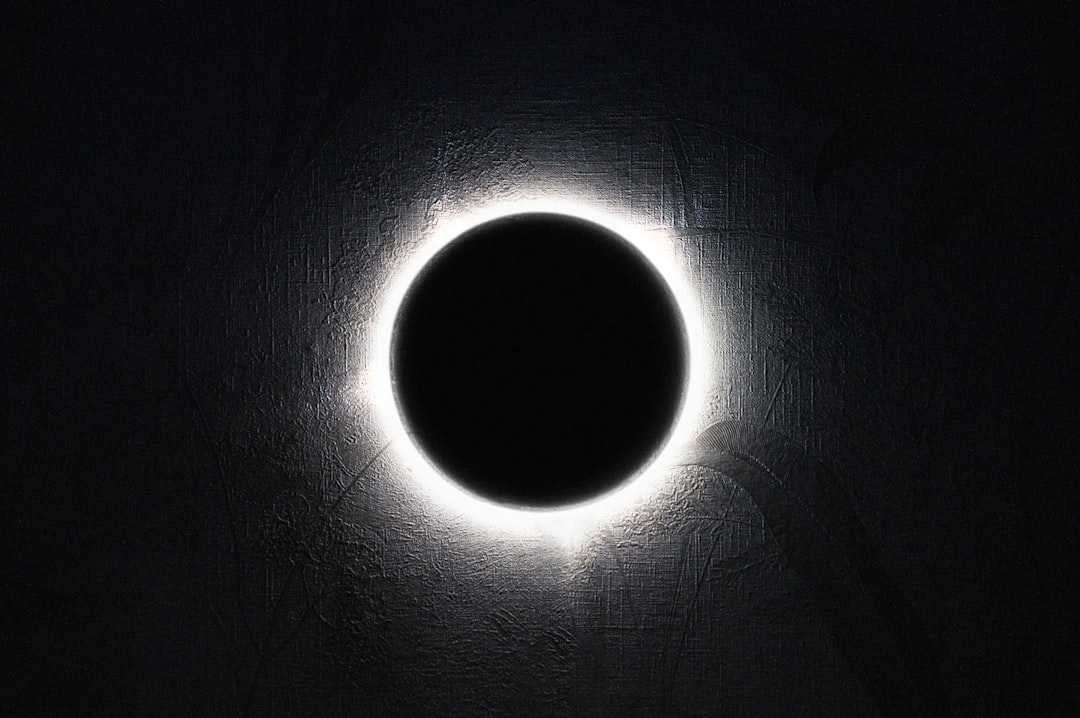
A black hole event horizon is a boundary in spacetime beyond which the gravitational field becomes so strong that no matter or electromagnetic radiation can escape. This boundary represents the critical distance from a black hole’s center where the escape velocity equals the speed of light. Any object that crosses this threshold becomes permanently trapped within the black hole’s gravitational well.
The event horizon is not a physical surface but a mathematical boundary defined by the black hole’s gravitational field strength. Its radius, known as the Schwarzschild radius, is directly proportional to the black hole’s mass. For a non-rotating black hole, this radius is calculated as 2GM/c², where G is the gravitational constant, M is the mass, and c is the speed of light.
Stellar-mass black holes typically have event horizons with radii of several kilometers, while supermassive black holes can have event horizons spanning millions of kilometers. The event horizon serves as the observational limit for studying black holes, as no information can travel from inside this boundary to external observers. This property makes the interior of black holes fundamentally unobservable through conventional means.
The study of event horizons is essential for understanding black hole thermodynamics, Hawking radiation, and the information paradox in theoretical physics.
Key Takeaways
- A black hole event horizon marks the boundary beyond which nothing can escape the black hole’s gravitational pull.
- Near the event horizon, space and time are significantly warped due to intense gravity.
- Hawking radiation suggests black holes can emit particles, slowly losing mass over time.
- Observations and theoretical models help scientists study event horizons and address information paradoxes.
- Understanding event horizons advances knowledge in astrophysics, cosmology, and quantum mechanics.
Understanding the Gravitational Pull of Black Holes
The gravitational pull of black holes is one of the most powerful forces in the universe, capable of influencing nearby stars and gas clouds. This immense gravitational attraction arises from the concentration of mass within a relatively small volume, creating a gravitational field that warps spacetime. As objects approach a black hole, they experience an increase in gravitational force, which accelerates them toward the event horizon.
This phenomenon can lead to spectacular displays, such as accretion disks, where matter spirals into the black hole, emitting intense radiation in the process. The strength of a black hole’s gravitational pull can be understood through Einstein’s theory of general relativity, which describes how mass distorts spacetime. The closer an object gets to a black hole, the more pronounced this distortion becomes.
For instance, stars orbiting near a supermassive black hole at the center of a galaxy can be observed moving at incredible speeds due to this gravitational influence.
The Distortion of Space and Time near Black Hole Event Horizons
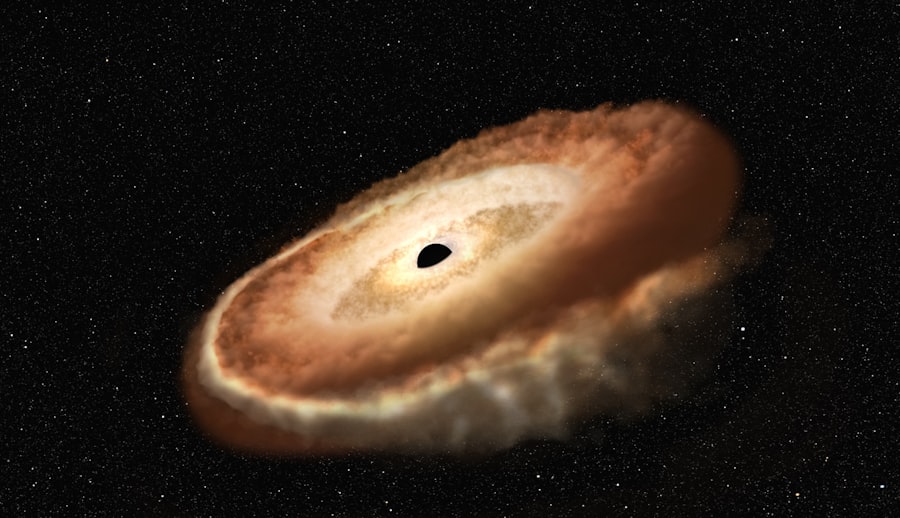
Near a black hole’s event horizon, space and time undergo extreme distortion, leading to phenomena that challenge our understanding of physics. As an object approaches this boundary, time appears to slow down relative to an outside observer. This effect, known as time dilation, suggests that for someone falling into a black hole, time would seem to pass normally; however, to an external observer, their descent would appear to take an eternity.
This intriguing interplay between time and gravity raises profound questions about the nature of reality and perception. Additionally, space itself becomes warped in the vicinity of a black hole. The intense gravitational field causes light to bend and curve, leading to visual distortions known as gravitational lensing.
This effect allows astronomers to observe distant objects that would otherwise be hidden behind a black hole’s immense gravity. The study of these distortions not only enhances our understanding of black holes but also provides insights into the fundamental nature of spacetime itself.
Hawking Radiation and Black Hole Event Horizons
Hawking radiation is a groundbreaking theoretical concept proposed by physicist Stephen Hawking in 1974, which suggests that black holes are not entirely black but can emit radiation due to quantum effects near their event horizons. According to this theory, particle-antiparticle pairs constantly form in empty space. When one particle falls into a black hole while its counterpart escapes, it results in a net loss of mass for the black hole, leading to its gradual evaporation over time.
This process challenges the traditional view that nothing can escape from a black hole. The implications of Hawking radiation are profound, as they suggest that black holes could eventually evaporate completely, leaving behind no remnants. This raises questions about the fate of information that falls into a black hole—a topic that has sparked intense debate among physicists.
If information is lost forever when it crosses the event horizon, it contradicts fundamental principles of quantum mechanics, leading to what is known as the information paradox. The exploration of Hawking radiation continues to be a vibrant area of research, with scientists seeking to reconcile these ideas with our understanding of the universe.
Observing Black Hole Event Horizons from Earth
| Metric | Description | Typical Values | Units |
|---|---|---|---|
| Event Horizon Radius (Schwarzschild Radius) | Radius of the event horizon for a non-rotating black hole | 3 km per solar mass | kilometers (km) |
| Surface Gravity | Gravitational acceleration at the event horizon | 1.5 × 10^12 (for 1 solar mass BH) | m/s² |
| Hawking Temperature | Temperature of black hole radiation at the event horizon | 6.2 × 10^-8 (for 1 solar mass BH) | Kelvin (K) |
| Event Horizon Area | Surface area of the event horizon | 1.13 × 10^8 (for 1 solar mass BH) | square kilometers (km²) |
| Escape Velocity | Velocity needed to escape gravitational pull at the event horizon | Speed of light | meters per second (m/s) |
| Time Dilation Factor | Ratio of time passage at event horizon compared to distant observer | Approaches infinity | Dimensionless |
Observing black hole event horizons directly poses significant challenges due to their nature; however, astronomers have developed innovative techniques to study them indirectly. One notable method involves observing the behavior of stars and gas clouds in close proximity to black holes. By tracking their orbits and movements, scientists can infer the presence and properties of these invisible entities.
For instance, the Event Horizon Telescope (EHT) collaboration made headlines in 2019 when it captured the first-ever image of a black hole’s shadow in the galaxy M87, providing direct evidence of its existence. In addition to stellar dynamics, researchers also analyze electromagnetic radiation emitted by matter as it spirals into a black hole’s accretion disk. This radiation can provide valuable information about the temperature and composition of the material surrounding the event horizon.
By studying these emissions across various wavelengths—from radio waves to X-rays—scientists can gain insights into the behavior and characteristics of black holes, enhancing our understanding of their role in cosmic evolution.
The Role of Quantum Mechanics in Black Hole Event Horizons

Quantum mechanics plays a pivotal role in shaping our understanding of black holes and their event horizons. The interplay between quantum effects and gravitational forces leads to intriguing phenomena that challenge classical physics. For instance, near the event horizon, quantum fluctuations can give rise to Hawking radiation, as previously mentioned.
This intersection between quantum mechanics and general relativity remains one of the most significant unsolved problems in theoretical physics. Moreover, quantum entanglement raises questions about how information behaves when it falls into a black hole. The idea that information cannot be destroyed contradicts classical notions associated with black holes, leading to ongoing debates among physicists regarding the nature of reality itself.
As researchers continue to explore these concepts, they seek to develop a unified theory that reconciles quantum mechanics with general relativity—an endeavor that could revolutionize our understanding of both black holes and the fundamental laws governing the universe.
Exploring the Connection between Black Hole Event Horizons and Information Paradoxes
The connection between black hole event horizons and information paradoxes has become a central topic in modern theoretical physics. The information paradox arises from the apparent conflict between quantum mechanics and general relativity regarding what happens to information when it falls into a black hole. According to quantum theory, information cannot be destroyed; however, if something crosses an event horizon and disappears from view, it raises questions about whether that information is lost forever.
Various theories have emerged to address this paradox, including ideas related to holography and quantum entanglement. Some physicists propose that information may be encoded on the event horizon itself or that it could be released back into the universe through Hawking radiation over time. These discussions have led to new insights into how we understand gravity and quantum mechanics, pushing researchers to rethink fundamental concepts about reality and existence.
Theoretical Models of Black Hole Event Horizons
Theoretical models play a crucial role in advancing our understanding of black hole event horizons and their properties. Various models have been proposed to describe different types of black holes—such as Schwarzschild (non-rotating), Kerr (rotating), and Reissner-Nordström (charged)—each with unique characteristics related to their event horizons. These models help scientists predict how matter behaves near these boundaries and how they interact with surrounding spacetime.
Additionally, researchers are exploring more exotic models that incorporate additional dimensions or modifications to general relativity. These theories aim to address unresolved questions about singularities at the center of black holes and their implications for spacetime structure. By developing comprehensive models that account for various factors influencing event horizons, scientists hope to gain deeper insights into these enigmatic cosmic phenomena.
Black Hole Mergers and Event Horizon Interactions
Black hole mergers represent some of the most dramatic events in the universe, resulting from two black holes spiraling toward each other before ultimately colliding. During this process, their event horizons interact in complex ways, leading to significant changes in their properties and gravitational waves being emitted throughout spacetime. These gravitational waves carry vital information about the merging process and have been detected by observatories like LIGO and Virgo since 2015.
The study of black hole mergers not only enhances our understanding of individual black holes but also sheds light on their formation and evolution within galaxies. By analyzing data from these events, scientists can infer details about their masses, spins, and even potential connections to supermassive black holes at galactic centers. As more merger events are detected over time, researchers anticipate uncovering new insights into how these cosmic giants shape their environments.
The Potential for Discoveries in Black Hole Event Horizon Research
The field of black hole event horizon research holds immense potential for groundbreaking discoveries that could reshape our understanding of physics and cosmology. As technology advances and observational techniques improve, scientists are poised to uncover new phenomena related to black holes that were previously beyond reach.
Moreover, ongoing research into gravitational waves from merging black holes could lead to new revelations about their formation processes and interactions with surrounding matter. Each discovery adds another piece to the puzzle of understanding these enigmatic objects and their role in shaping galaxies and cosmic structures over time.
The Implications of Understanding Black Hole Event Horizons for Astrophysics and Cosmology
Understanding black hole event horizons has far-reaching implications for both astrophysics and cosmology. By unraveling the mysteries surrounding these cosmic entities, scientists can gain insights into fundamental questions about the nature of gravity, spacetime, and even the origins of our universe itself. Black holes serve as natural laboratories for testing theories related to general relativity and quantum mechanics—two pillars of modern physics that have yet to be reconciled.
Furthermore, studying event horizons contributes to our understanding of galaxy formation and evolution since supermassive black holes are often found at galactic centers influencing star formation rates and dynamics within galaxies. As researchers continue exploring these connections between black holes and cosmic structures, they pave the way for new discoveries that could redefine humanity’s place within the universe. In conclusion, black hole event horizons represent one of the most fascinating areas of study in contemporary astrophysics and cosmology.
From their gravitational pull to their implications for quantum mechanics and information theory, these enigmatic boundaries challenge our understanding while offering opportunities for groundbreaking discoveries that could reshape our comprehension of reality itself.
Recent advancements in our understanding of black hole event horizons have sparked significant interest in the field of astrophysics. For a deeper dive into the complexities of black hole physics and the implications of event horizons, you can explore the article available at My Cosmic Ventures. This resource provides valuable insights into the latest research and theories surrounding these enigmatic cosmic phenomena.
FAQs
What is a black hole event horizon?
The event horizon of a black hole is the boundary beyond which nothing, not even light, can escape the gravitational pull of the black hole. It marks the point of no return.
How is the event horizon related to the black hole’s size?
The size of the event horizon is defined by the Schwarzschild radius, which depends on the mass of the black hole. Larger mass black holes have larger event horizons.
Can anything escape from inside the event horizon?
No. According to current physics, once an object crosses the event horizon, it cannot escape the black hole’s gravitational pull.
What happens to time near the event horizon?
Time appears to slow down near the event horizon relative to an outside observer, a phenomenon known as gravitational time dilation.
Is the event horizon a physical surface?
No, the event horizon is not a physical surface but a mathematical boundary in spacetime.
What is Hawking radiation in relation to the event horizon?
Hawking radiation is theoretical radiation predicted to be emitted by black holes due to quantum effects near the event horizon, causing black holes to slowly lose mass over time.
Can we observe the event horizon directly?
We cannot observe the event horizon directly, but we can observe its effects, such as the behavior of matter and light near it. The Event Horizon Telescope has imaged the shadow of a black hole’s event horizon.
Does the event horizon affect the information paradox?
Yes, the event horizon is central to the black hole information paradox, which questions how information about matter falling into a black hole is preserved or lost.
What is the difference between the event horizon and the singularity?
The event horizon is the boundary around a black hole, while the singularity is the point at the center where density and gravity become infinite.
How does the event horizon relate to different types of black holes?
All black holes have event horizons, but their properties can vary depending on the black hole type (e.g., Schwarzschild, Kerr, or Reissner-Nordström black holes), affecting the shape and dynamics of the horizon.