
Dark matter is a theoretical form of matter that comprises approximately 27% of the universe’s total mass-energy content. It does not interact with electromagnetic radiation, meaning it does not emit, absorb, or reflect light, making it undetectable through direct optical observation. Scientists infer its existence through its gravitational effects on visible matter, cosmic microwave background radiation, and the formation of large-scale cosmic structures.
The hypothesis of dark matter originated in the early 20th century when astronomical observations revealed inconsistencies between the calculated mass of galaxies based on visible matter and the gravitational forces required to explain the observed motion of stars within those galaxies.
Current evidence for dark matter includes galaxy rotation curves that remain flat at large radii rather than declining as predicted by visible matter alone, gravitational lensing effects that bend light from distant objects, and computer simulations of cosmic structure formation that require dark matter to match observed patterns.
Dark matter research has become a fundamental area of study in astrophysics and cosmology, driving developments in particle physics, detector technology, and theoretical modeling as scientists work to identify its composition and properties.
Key Takeaways
- Dark matter is a mysterious substance that influences the universe’s structure and evolution but does not emit light.
- Multiple lines of observational evidence support the existence of dark matter, including galaxy rotation curves and cosmic microwave background measurements.
- Identifying the particles that make up dark matter remains a major scientific challenge, with ongoing experiments searching for direct and indirect signals.
- Dark matter plays a crucial role in galaxy formation and the large-scale structure of the cosmos.
- Advancing our understanding of dark matter could have profound implications for cosmology, particle physics, and our comprehension of the universe.
Theoretical Framework of Dark Matter
The theoretical framework surrounding dark matter is built upon a combination of astrophysical observations and particle physics. One of the most widely accepted theories is that dark matter consists of weakly interacting massive particles (WIMPs). These hypothetical particles are predicted to have mass and interact through the weak nuclear force, making them difficult to detect.
The WIMP paradigm is supported by various models in supersymmetry, which propose a partner particle for every known particle in the Standard Model of particle physics. Another prominent theory is the existence of axions, which are ultra-light particles that could account for dark matter’s elusive nature. Axions arise from certain extensions of quantum chromodynamics and are predicted to have very low mass and interact very weakly with ordinary matter.
The exploration of these theoretical frameworks has led to a plethora of models that attempt to explain the properties and behavior of dark matter. Each model presents unique predictions that can be tested through experiments and observations, contributing to a deeper understanding of this mysterious substance.
Observational Evidence for Dark Matter
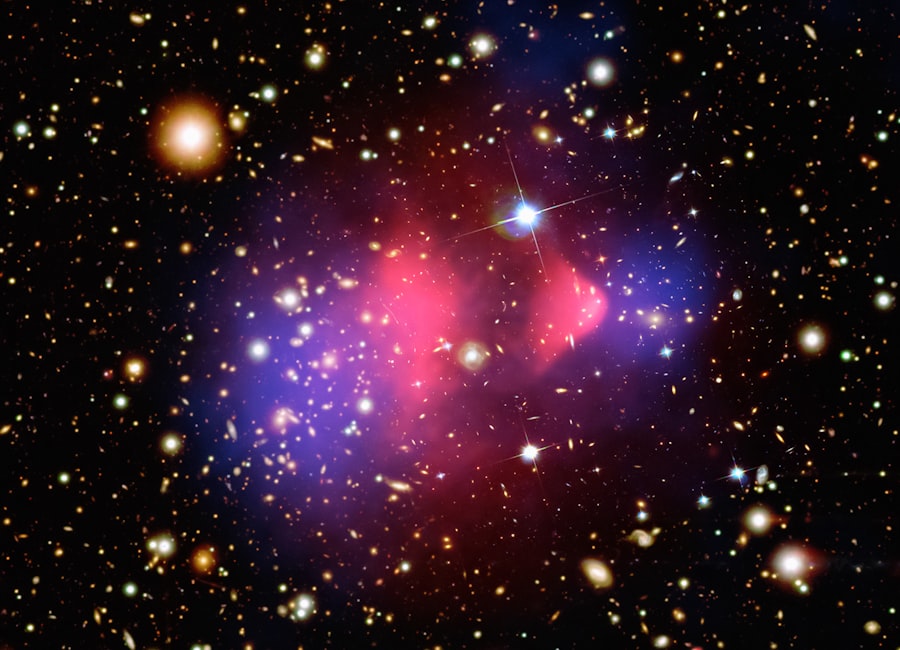
The evidence for dark matter is primarily derived from astronomical observations that reveal its gravitational influence on visible matter. One of the most compelling pieces of evidence comes from the rotation curves of galaxies. When astronomers measure the speed at which stars orbit the center of galaxies, they find that these speeds do not decrease as expected with distance from the galactic center.
Instead, they remain constant or even increase, suggesting that there is significantly more mass present than what can be accounted for by visible stars and gas. Additionally, observations of galaxy clusters provide further support for dark matter’s existence. The gravitational lensing effect, where light from distant objects is bent around massive foreground objects, allows astronomers to map the distribution of mass in galaxy clusters.
Studies have shown that the visible mass in these clusters falls short of what is needed to explain the observed gravitational lensing effects. This discrepancy reinforces the notion that a substantial amount of unseen mass—dark matter—must be present to account for these phenomena.
The Search for Dark Matter Particles
The search for dark matter particles is an ongoing endeavor that spans multiple disciplines within physics. Various experimental approaches are being employed to detect these elusive particles directly or indirectly. Direct detection experiments aim to observe interactions between dark matter particles and ordinary matter in highly sensitive detectors located deep underground or in isolated environments to minimize background noise.
These experiments often utilize materials like xenon or germanium, which are chosen for their ability to register low-energy recoils from potential dark matter interactions. Indirect detection methods focus on identifying byproducts from dark matter annihilation or decay. For instance, if dark matter particles collide and annihilate each other, they could produce gamma rays or other particles that can be detected by space-based observatories or ground-based telescopes.
The Large Hadron Collider (LHC) also plays a crucial role in this search by attempting to produce dark matter particles through high-energy collisions. Each approach contributes valuable data that could eventually lead to a breakthrough in understanding the nature of dark matter.
The Role of Dark Matter in the Universe
| Dark Matter Mystery | Description | Current Understanding | Key Metrics |
|---|---|---|---|
| Nature of Dark Matter | What particles or phenomena constitute dark matter? | Likely non-baryonic particles such as WIMPs or axions | Estimated to make up ~27% of universe’s mass-energy |
| Detection Methods | How can dark matter be observed or detected? | Indirect detection via gravitational effects; direct detection experiments ongoing | Detection sensitivity reaching cross-sections below 10^-46 cm² |
| Distribution in the Universe | How is dark matter distributed across galaxies and clusters? | Forms halos around galaxies, influencing rotation curves | Dark matter halo mass typically 5-10 times visible matter |
| Role in Structure Formation | How does dark matter influence galaxy and large-scale structure formation? | Acts as gravitational scaffold for baryonic matter to form galaxies | Simulations match observed cosmic web structures |
| Alternative Theories | Are there other explanations besides dark matter? | Modified gravity theories like MOND proposed but less favored | MOND explains some galaxy rotation curves but not cluster data |
Dark matter plays a fundamental role in shaping the structure and evolution of the universe. Its gravitational influence is essential for the formation of galaxies and galaxy clusters. Without dark matter, the universe would look vastly different; galaxies would not have formed as they did, and cosmic structures would lack the necessary gravitational scaffolding to hold them together.
The presence of dark matter helps explain why galaxies are able to rotate at such high speeds without flying apart. Moreover, dark matter influences cosmic evolution on larger scales. It acts as a framework around which visible matter congregates, leading to the formation of filaments and voids in the cosmic web structure.
This web-like arrangement is crucial for understanding how galaxies are distributed throughout the universe. The interplay between dark matter and baryonic (ordinary) matter is a key factor in determining the fate of cosmic structures over billions of years.
Dark Matter and Cosmology

In cosmology, dark matter is integral to our understanding of the universe’s history and its ultimate fate. The Lambda Cold Dark Matter (ΛCDM) model is currently the leading cosmological model that incorporates dark matter as a critical component alongside dark energy. This model describes how dark matter influences cosmic expansion and structure formation from the Big Bang to the present day.
The cosmic microwave background (CMB) radiation provides further evidence for dark matter’s role in cosmology. Measurements from satellites like the Wilkinson Microwave Anisotropy Probe (WMAP) and Planck have revealed fluctuations in temperature that correspond to density variations in the early universe. These fluctuations are influenced by both dark matter and baryonic matter, allowing cosmologists to infer the density and distribution of dark matter throughout cosmic history.
Challenges in Understanding Dark Matter
Despite significant advancements in research, understanding dark matter remains fraught with challenges. One major hurdle is its elusive nature; since it does not interact with electromagnetic forces, detecting it directly has proven exceptionally difficult. Many experiments have yet to yield conclusive results, leading some scientists to question whether current theoretical models accurately describe dark matter’s properties.
Additionally, there are competing theories regarding what constitutes dark matter. While WIMPs and axions are popular candidates, alternative models such as modified gravity theories challenge the need for dark matter altogether. These theories propose that our understanding of gravity may need revision rather than invoking unseen mass.
The existence of multiple competing hypotheses complicates efforts to reach a consensus within the scientific community.
Dark Matter and the Standard Model of Particle Physics
The relationship between dark matter and the Standard Model of particle physics is complex and multifaceted. While the Standard Model successfully describes known particles and their interactions, it does not account for dark matter. This gap has led physicists to explore extensions beyond the Standard Model, such as supersymmetry and extra dimensions, which could provide a framework for understanding dark matter’s properties.
Supersymmetry posits that every particle has a superpartner with different spin characteristics, potentially including candidates for dark matter like neutralinos. Other theories suggest that dark matter could arise from interactions involving additional spatial dimensions or new forces beyond those currently known. As researchers continue to probe these extensions, they hope to uncover connections between dark matter and fundamental physics that could revolutionize our understanding of both realms.
Dark Matter and Galaxy Formation
The process of galaxy formation is intricately linked to dark matter’s gravitational influence. In the early universe, small fluctuations in density allowed regions with higher concentrations of dark matter to attract baryonic matter, leading to the formation of stars and galaxies over time. Simulations incorporating dark matter reveal how it acts as a gravitational anchor around which galaxies can form and evolve.
Furthermore, studies have shown that different types of galaxies exhibit varying relationships with dark matter. For instance, spiral galaxies tend to have more pronounced dark matter halos compared to elliptical galaxies. Understanding these relationships helps astronomers piece together how different galactic structures emerged throughout cosmic history and how they continue to evolve under the influence of both visible and invisible forces.
The Future of Dark Matter Research
The future of dark matter research holds great promise as new technologies and methodologies emerge.
The advent of next-generation particle colliders may provide opportunities to produce dark matter candidates directly or uncover new physics beyond current paradigms.
Moreover, advancements in observational astronomy will allow scientists to probe deeper into cosmic structures and refine measurements related to dark matter’s influence on galaxy formation and evolution. As interdisciplinary collaboration between astrophysicists, particle physicists, and cosmologists grows stronger, researchers are optimistic about making significant strides toward unraveling one of science’s most profound mysteries.
Implications of Understanding Dark Matter
Understanding dark matter carries profound implications for both fundamental physics and our comprehension of the universe at large. If researchers can identify its true nature—whether through direct detection or theoretical breakthroughs—it could lead to revolutionary advancements in particle physics, cosmology, and our understanding of gravity itself. Moreover, unraveling the mysteries surrounding dark matter may provide insights into other cosmic phenomena such as dark energy, which drives the accelerated expansion of the universe.
As scientists continue their quest for knowledge about this elusive substance, they stand on the brink of potentially transformative discoveries that could reshape humanity’s understanding of existence itself—illuminating not only what constitutes our universe but also how it came into being and how it will evolve in the future.
The mysteries surrounding dark matter continue to intrigue scientists and enthusiasts alike, as researchers strive to uncover its elusive nature and role in the universe. For those interested in delving deeper into this captivating topic, a related article can be found at this link, which explores various theories and recent discoveries in the field of dark matter research.
FAQs
What is dark matter?
Dark matter is a form of matter that does not emit, absorb, or reflect light, making it invisible to current telescopes. It is believed to make up about 27% of the universe’s total mass and energy.
How do scientists know dark matter exists if it cannot be seen?
Scientists infer the existence of dark matter through its gravitational effects on visible matter, such as the rotation curves of galaxies, gravitational lensing, and the large-scale structure of the universe.
What are the leading theories about the composition of dark matter?
The leading theories suggest dark matter is composed of unknown particles that do not interact with electromagnetic forces. Candidates include Weakly Interacting Massive Particles (WIMPs), axions, and sterile neutrinos.
How does dark matter affect the formation of galaxies?
Dark matter provides the gravitational scaffolding necessary for galaxies to form and hold together. Its presence helps explain why galaxies rotate at the speeds they do without flying apart.
Can dark matter be detected directly?
Direct detection of dark matter is a major goal in physics. Experiments use sensitive detectors deep underground to try to observe rare interactions between dark matter particles and normal matter, but so far, no conclusive detection has been made.
What is the difference between dark matter and dark energy?
Dark matter is a type of matter that exerts gravitational attraction, while dark energy is a mysterious force causing the accelerated expansion of the universe. They are distinct phenomena with different effects on cosmic evolution.
Why is understanding dark matter important?
Understanding dark matter is crucial for a complete picture of the universe’s composition, structure, and evolution. It also has implications for fundamental physics and could lead to new discoveries beyond the Standard Model.
Are there any alternative explanations to dark matter?
Some alternative theories, such as Modified Newtonian Dynamics (MOND), propose changes to the laws of gravity to explain observations without invoking dark matter. However, these alternatives have not gained widespread acceptance due to inconsistencies with various observations.