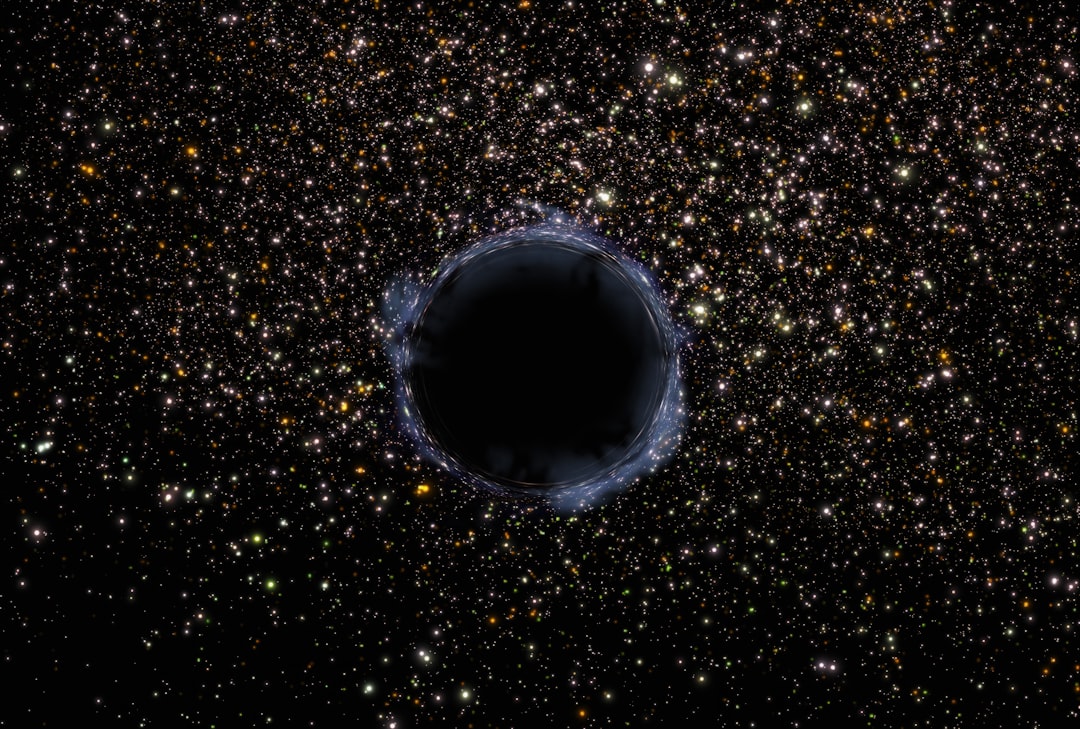
Black holes are astronomical objects that form when massive stars collapse at the end of their lifecycle. Their gravitational fields are so strong that the escape velocity exceeds the speed of light, preventing any matter or electromagnetic radiation from escaping once it crosses the event horizon. While classical general relativity describes black holes using only three parameters—mass, electric charge, and angular momentum—quantum mechanical considerations have introduced additional complexity to their theoretical description.
The study of black hole microstates emerged from attempts to reconcile quantum mechanics with general relativity, particularly in addressing the black hole information paradox and understanding the statistical mechanical origin of black hole entropy. According to the Bekenstein-Hawking entropy formula, a black hole’s entropy is proportional to the area of its event horizon rather than its volume, suggesting an enormous number of possible quantum states. These microstates represent the different quantum configurations that can give rise to the same macroscopic black hole properties.
Current research in theoretical physics, including string theory and loop quantum gravity, investigates how these microstates might be realized and organized within black hole interiors. This work aims to provide a quantum mechanical description of black hole formation, evolution, and potential evaporation through Hawking radiation, while addressing fundamental questions about information conservation and the nature of spacetime at quantum scales.
Key Takeaways
- Black hole interior microstates provide a framework to understand the microscopic structure inside black holes.
- Black hole entropy relates to the number of possible microstates, linking thermodynamics and quantum theory.
- The black hole information paradox challenges the preservation of information in black hole evaporation.
- String theory offers promising tools to describe and count black hole microstates.
- Recent research advances are refining theoretical models and guiding future experimental tests of black hole interiors.
Understanding Black Holes and their Event Horizons
To comprehend black hole interior microstates, one must first grasp the fundamental nature of black holes themselves. A black hole is formed when a massive star exhausts its nuclear fuel and collapses under its own gravity. The core contracts to an infinitely dense point known as a singularity, while the outer region forms an event horizon—the boundary beyond which nothing can escape.
This event horizon serves as a one-way membrane, marking the point of no return for any matter or radiation that ventures too close. The event horizon is not merely a physical boundary; it also plays a crucial role in defining the properties of a black hole. According to the laws of thermodynamics, black holes can be described in terms of temperature and entropy, leading to intriguing parallels between thermodynamic systems and these cosmic phenomena.
The study of black holes has evolved significantly since their theoretical inception, with physicists now recognizing that they are not just voids in space but rather complex entities governed by the principles of quantum mechanics.
The Concept of Black Hole Entropy
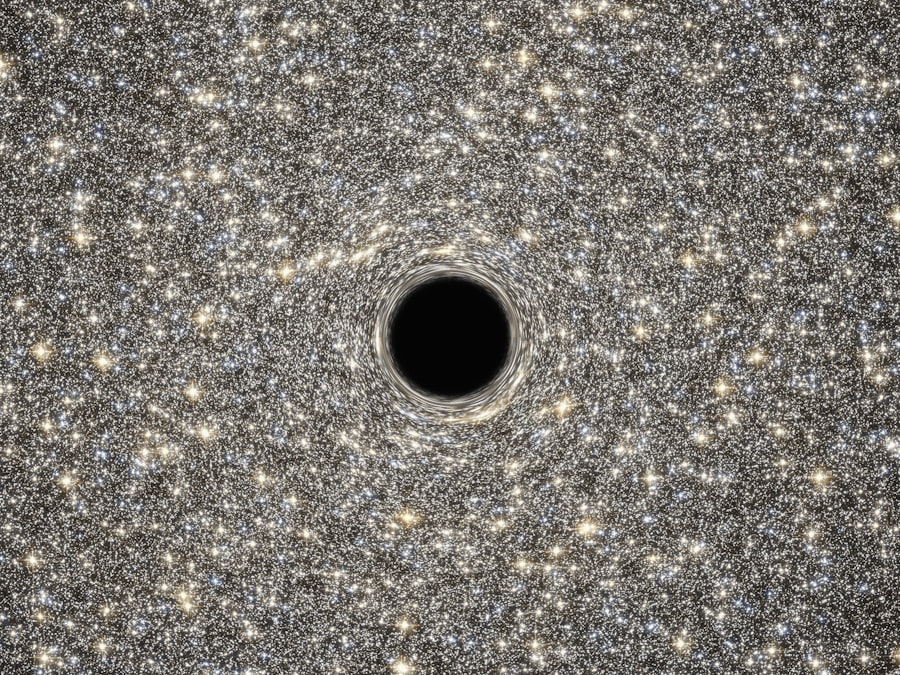
The concept of entropy is central to understanding black holes and their microstates.
When applied to black holes, this idea takes on a unique form.
The entropy of a black hole is proportional to the area of its event horizon rather than its volume, a revelation that emerged from the work of physicist Jacob Bekenstein and later confirmed by Stephen Hawking’s groundbreaking research on black hole radiation. Bekenstein proposed that black holes should possess entropy, which would account for the information content associated with the matter that has fallen into them. This notion was revolutionary, as it suggested that black holes could store information in a manner analogous to thermodynamic systems.
The entropy associated with a black hole is given by the famous Bekenstein-Hawking formula, which states that the entropy (S) is proportional to the area (A) of the event horizon divided by the Planck length squared: S = kA/4l_p^2, where k is Boltzmann’s constant and l_p is the Planck length.
Unraveling the Mystery of Black Hole Information Paradox
The concept of black hole entropy leads to one of the most perplexing dilemmas in modern physics: the black hole information paradox. This paradox arises from the apparent conflict between quantum mechanics and general relativity regarding information preservation. According to quantum mechanics, information cannot be destroyed; however, when matter falls into a black hole, it seems to vanish beyond the event horizon, leading to questions about whether information is truly lost forever.
The implications of this paradox are profound. If information is lost when matter crosses into a black hole, it challenges the very foundations of quantum theory. Conversely, if information is preserved in some form, it raises questions about how it can be retrieved or encoded within the black hole’s structure.
Various theories have emerged to address this paradox, including ideas related to holography and the potential role of black hole microstates in encoding information.
Exploring Quantum Gravity and Black Hole Microstates
| Metric | Description | Typical Value / Range | Unit |
|---|---|---|---|
| Number of Microstates (Ω) | Count of distinct quantum states corresponding to the black hole interior | Exp(S), where S is the Bekenstein-Hawking entropy | Dimensionless |
| Bekenstein-Hawking Entropy (S) | Entropy proportional to the area of the event horizon | Approximately (Area)/(4 × Planck length²) | Dimensionless (in natural units) |
| Event Horizon Area (A) | Surface area of the black hole event horizon | Varies with black hole mass and spin | Square meters (m²) |
| Black Hole Mass (M) | Mass of the black hole influencing microstate count | From a few solar masses to billions of solar masses | Kilograms (kg) |
| Hawking Temperature (T_H) | Temperature associated with black hole radiation | Inverse proportional to mass, e.g., ~10⁻⁸ K for solar mass black hole | Kelvin (K) |
| Quantum State Degeneracy | Number of quantum states with the same energy level inside the black hole | Exponential in entropy | Dimensionless |
| String Theory Microstate Count | Number of microstates predicted by string theory models | Matches Bekenstein-Hawking entropy for certain black holes | Dimensionless |
To fully understand black hole interior microstates, one must delve into the realm of quantum gravity—a field that seeks to unify general relativity with quantum mechanics. Quantum gravity posits that spacetime itself may exhibit quantum properties at extremely small scales, leading to a reevaluation of traditional notions about gravity and singularities. In this context, black hole microstates emerge as potential solutions to some of the challenges posed by both quantum mechanics and general relativity.
Microstates can be thought of as distinct configurations that correspond to a given macroscopic state of a black hole. Each microstate represents a different way in which matter and energy can be arranged within the confines of a black hole’s event horizon. By counting these microstates, physicists can gain insights into the entropy associated with a black hole and explore how information might be preserved or encoded within its structure.
The Role of String Theory in Understanding Black Hole Interior

String theory has emerged as one of the leading candidates for a theory of quantum gravity and offers valuable insights into the nature of black hole interior microstates. In string theory, fundamental particles are not point-like objects but rather one-dimensional strings vibrating at different frequencies. This framework allows for a more comprehensive understanding of spacetime and its interactions at quantum scales.
One significant contribution of string theory to black hole research is its ability to provide explicit constructions of microstates for certain types of black holes. For instance, in certain supersymmetric models, string theory predicts a vast number of microstates that correspond to specific macroscopic properties such as mass and charge. These microstates can help resolve issues related to entropy and information preservation by demonstrating how different configurations can coexist within a single black hole.
Black Hole Thermodynamics and Microstate Counting
The study of black hole thermodynamics has revealed profound connections between thermodynamic principles and the behavior of black holes. The laws governing thermodynamics—such as energy conservation and entropy increase—find parallels in the behavior of black holes as they absorb matter and emit radiation through Hawking radiation. This relationship has led physicists to explore how microstate counting can provide insights into black hole entropy.
Microstate counting involves determining the number of distinct configurations that correspond to a given macroscopic state. In the context of black holes, this means calculating how many different ways matter can be arranged within a black hole while still yielding the same overall properties such as mass and charge. By employing statistical mechanics and advanced mathematical techniques, researchers have made significant strides in counting these microstates, shedding light on how they contribute to the overall entropy and thermodynamic behavior of black holes.
Recent Advances in Black Hole Interior Microstate Research
Recent years have witnessed remarkable progress in understanding black hole interior microstates through both theoretical advancements and computational techniques. Researchers have developed sophisticated models that incorporate various aspects of quantum gravity and string theory to explore how microstates might manifest within black holes. These models have provided new insights into how information could be encoded within a black hole’s structure and how it might be retrieved.
Additionally, advancements in numerical simulations have allowed physicists to investigate complex scenarios involving black holes and their interactions with surrounding matter. These simulations have provided valuable data on how microstates evolve over time and how they might influence observable phenomena such as Hawking radiation or gravitational waves emitted during black hole mergers.
Implications of Black Hole Interior Microstates for Theoretical Physics
The exploration of black hole interior microstates carries significant implications for theoretical physics as a whole. By deepening our understanding of these microstates, physicists may uncover new insights into fundamental questions about spacetime, gravity, and quantum mechanics.
Moreover, unraveling the nature of black hole interior microstates may provide clues about unifying theories that seek to reconcile general relativity with quantum mechanics. As researchers continue to investigate these concepts, they may uncover new principles that govern not only black holes but also other cosmic phenomena, potentially reshaping our understanding of reality itself.
Experimental Evidence and Observational Constraints on Black Hole Microstates
While much of the research surrounding black hole interior microstates has been theoretical, there are ongoing efforts to gather experimental evidence and observational constraints that could validate or challenge these ideas. Observations from gravitational wave detectors like LIGO and Virgo have provided valuable data on merging black holes, offering insights into their properties and behaviors during such events. Additionally, advancements in astrophysical observations using telescopes capable of capturing high-energy emissions from accreting black holes may yield clues about their internal structures.
By studying these emissions and their correlations with theoretical predictions regarding microstates, researchers hope to bridge the gap between theory and observation.
Future Directions in Black Hole Interior Microstate Research
As research into black hole interior microstates continues to evolve, several promising directions lie ahead for physicists seeking to deepen their understanding of these enigmatic entities. One avenue involves further exploration of holographic principles, which suggest that information about three-dimensional objects can be encoded on two-dimensional surfaces—an idea that could revolutionize our understanding of spacetime itself. Another promising direction involves interdisciplinary collaboration between physicists and mathematicians to develop new mathematical frameworks capable of addressing complex questions related to microstate counting and entropy.
By combining insights from various fields, researchers may uncover novel approaches that could lead to breakthroughs in our understanding of both black holes and fundamental physics. In conclusion, the study of black hole interior microstates represents an exciting frontier in theoretical physics. As researchers continue to unravel these mysteries, they may not only shed light on the nature of black holes but also contribute to our broader understanding of the universe’s fundamental laws.
The journey into this uncharted territory promises to challenge existing paradigms and inspire new avenues for exploration in the quest for knowledge about our cosmos.
The study of black hole interiors and their microstates has garnered significant interest in the field of theoretical physics. A related article that delves into the complexities of black hole microstates can be found on My Cosmic Ventures. This article explores the implications of quantum mechanics on the structure of black holes and how these microstates contribute to our understanding of gravity and spacetime. For more insights, you can read the article [here](https://www.mycosmicventures.com/).
FAQs
What is a black hole interior microstate?
A black hole interior microstate refers to a specific quantum configuration that describes the microscopic structure or quantum state inside a black hole. These microstates are thought to account for the black hole’s entropy and provide a detailed description of its internal quantum properties.
Why are black hole interior microstates important?
Black hole interior microstates are important because they help resolve the black hole information paradox by explaining how information is stored and preserved inside a black hole. Understanding these microstates is crucial for developing a consistent theory of quantum gravity.
How do microstates relate to black hole entropy?
Black hole entropy, as described by the Bekenstein-Hawking formula, is proportional to the area of the event horizon. Microstates represent the different quantum configurations that correspond to this entropy, providing a microscopic explanation for the macroscopic thermodynamic properties of black holes.
What theories describe black hole interior microstates?
Theories such as string theory and loop quantum gravity attempt to describe black hole interior microstates. In string theory, microstates are often modeled as configurations of branes and strings, while loop quantum gravity uses quantized spacetime geometry to explain these states.
Can we observe black hole interior microstates directly?
Currently, black hole interior microstates cannot be observed directly due to the event horizon’s nature, which prevents information from escaping. Research relies on theoretical models and indirect evidence from black hole thermodynamics and quantum gravity.
How do black hole microstates affect the information paradox?
Black hole microstates provide a framework in which information about matter falling into a black hole is not lost but encoded in the quantum states inside the black hole. This helps reconcile the principles of quantum mechanics with black hole physics, addressing the information paradox.
Are black hole interior microstates the same for all black holes?
The specific microstates depend on the black hole’s properties, such as mass, charge, and angular momentum. Different types of black holes may have different sets of microstates, reflecting their unique quantum configurations.
What role does holography play in understanding black hole microstates?
The holographic principle suggests that all information contained within a volume of space can be represented on its boundary. This idea is used in the AdS/CFT correspondence to study black hole microstates by relating the interior quantum states to a lower-dimensional boundary theory.