
The concept of black holes has long fascinated scientists and the general public alike, serving as a gateway to understanding the most extreme conditions in the universe. Among the many intriguing aspects of black holes, the Page Curve stands out as a pivotal element in the ongoing quest to unravel the mysteries of information recovery in these enigmatic cosmic entities. The Page Curve, named after physicist Don Page, provides a framework for understanding how information is preserved or lost when matter falls into a black hole.
This topic has garnered significant attention in recent years, as it challenges traditional notions of information conservation in the realm of quantum mechanics and general relativity. As researchers delve deeper into the implications of the Page Curve, they are not only exploring fundamental questions about the nature of black holes but also addressing broader issues related to the fabric of reality itself. The interplay between quantum mechanics and gravitational physics raises profound questions about the fate of information and its potential recovery from black holes.
This article aims to explore the intricacies of the Page Curve, its theoretical underpinnings, experimental evidence, and the broader implications for our understanding of the universe.
Key Takeaways
- The Page Curve is crucial for understanding how information escapes black holes, addressing the black hole information paradox.
- Quantum mechanics plays a key role in explaining the behavior of the Page Curve and the recovery of information from black holes.
- Experimental evidence increasingly supports the theoretical predictions of the Page Curve in black hole physics.
- Research on the Page Curve has broad implications, potentially impacting other areas of physics and our comprehension of the universe.
- Despite progress, significant challenges and ethical considerations remain in studying and applying Page Curve black hole information recovery.
Understanding the Page Curve and its significance in black hole information recovery
The Page Curve represents a theoretical model that describes how information is expected to be recovered from a black hole over time. According to this model, when a black hole forms, it captures all the information about the matter that has fallen into it.
The Page Curve illustrates that initially, as a black hole evaporates, the amount of recoverable information increases until it reaches a peak, after which it begins to decline. This behavior is crucial for understanding how information might escape from a black hole’s grasp. The significance of the Page Curve lies in its implications for the fundamental principles of quantum mechanics.
Traditionally, quantum theory posits that information cannot be destroyed; however, if black holes were to obliterate information, it would challenge this foundational principle. The Page Curve offers a resolution to this dilemma by suggesting that while information may be temporarily inaccessible within a black hole, it is ultimately recoverable. This perspective not only aligns with quantum mechanics but also provides a framework for reconciling it with general relativity, which has historically struggled with issues related to information loss.
Theoretical framework for the Page Curve and its implications for black hole physics
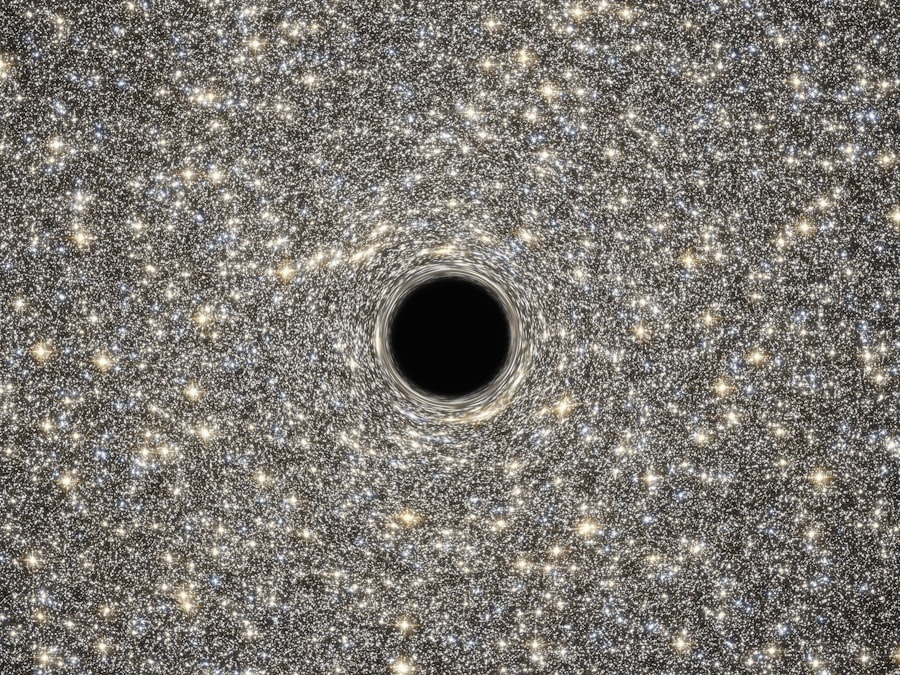
The theoretical framework surrounding the Page Curve is rooted in several key concepts from quantum mechanics and general relativity. At its core, the Page Curve is derived from an understanding of entanglement and thermal dynamics in quantum systems. When matter falls into a black hole, it becomes entangled with the black hole’s quantum state.
As the black hole emits Hawking radiation, this entanglement leads to a gradual release of information about the initial state of the matter that was consumed. One of the most profound implications of the Page Curve is its challenge to classical notions of causality and locality. In classical physics, information is thought to be localized and preserved within a system.
However, the behavior described by the Page Curve suggests that information can be spread across vast distances and may even be recovered from regions previously thought to be inaccessible. This revelation has far-reaching consequences for our understanding of space-time and could lead to new insights into the nature of reality itself.
Experimental evidence supporting the existence of the Page Curve in black holes
While much of the discussion surrounding the Page Curve has been theoretical, there have been efforts to gather experimental evidence that supports its existence. One avenue of research involves studying analog systems that mimic black hole behavior in controlled laboratory settings. For instance, researchers have created “black hole” analogs using ultracold atoms or photonic systems that exhibit similar properties to those predicted by general relativity.
These experimental setups allow scientists to observe phenomena such as Hawking radiation and entanglement dynamics in real-time. Preliminary results from these experiments have shown behaviors consistent with predictions made by the Page Curve, lending credence to its validity. Although these analog systems do not replicate all aspects of true black holes, they provide valuable insights into how information might be recovered from such extreme environments.
Challenges and controversies in the study of Page Curve black hole information recovery
| Metric | Description | Typical Value / Range | Relevance to Page Curve |
|---|---|---|---|
| Page Time | Time at which the entanglement entropy of Hawking radiation reaches its maximum | Approximately half the black hole evaporation time | Marks the turning point in the Page curve indicating information recovery begins |
| Black Hole Entropy (S_BH) | Entropy proportional to the area of the black hole horizon | Varies with black hole mass; S_BH = (Area)/(4 * Planck length²) | Initial maximum entropy before information starts to be recovered |
| Entanglement Entropy of Radiation (S_rad) | Entropy of the emitted Hawking radiation | Increases initially, then decreases after Page time | Tracks information leakage from black hole to radiation |
| Evaporation Time | Total time for black hole to evaporate via Hawking radiation | Proportional to mass³ (in Planck units) | Sets scale for Page time and information recovery timeline |
| Mutual Information | Measure of correlations between black hole interior and radiation | Zero before Page time, increases after | Indicates entanglement structure changes during information recovery |
| Replica Wormhole Contribution | Quantum gravity effect that modifies entropy calculations | Non-zero after Page time | Explains the decrease in entropy consistent with unitarity |
Despite its promise, the study of the Page Curve and black hole information recovery is fraught with challenges and controversies. One major point of contention among physicists revolves around the interpretation of Hawking radiation and its implications for information loss. Some researchers argue that Hawking radiation carries no information about the matter that fell into a black hole, leading to a potential violation of quantum mechanics’ core tenets.
This debate has sparked intense discussions within the scientific community regarding how best to reconcile these conflicting viewpoints. Additionally, there are significant technical challenges associated with studying black holes directly. The extreme conditions surrounding these cosmic phenomena make them difficult to observe and measure accurately.
As a result, much of the research relies on theoretical models and indirect evidence, which can lead to uncertainties in conclusions drawn from such studies. These challenges underscore the need for continued exploration and innovation in both theoretical and experimental approaches to understanding black holes and their associated phenomena.
The role of quantum mechanics in understanding the Page Curve and information recovery

Quantum mechanics plays a central role in shaping our understanding of the Page Curve and its implications for information recovery from black holes. At its core, quantum theory posits that particles exist in superpositions of states until measured, leading to inherent uncertainties in their properties. This principle extends to black holes, where entangled states can exist between particles inside and outside the event horizon.
The concept of entanglement is particularly relevant when considering how information might be recovered from a black hole. As Hawking radiation is emitted, it carries away entangled particles that are linked to those trapped within the black hole. This entanglement suggests that even though information may seem lost within a black hole’s event horizon, it remains encoded in subtle correlations between particles outside the black hole.
Understanding these correlations is crucial for developing a comprehensive theory of information recovery that aligns with both quantum mechanics and general relativity.
Potential applications of Page Curve black hole information recovery in other fields of physics
The insights gained from studying the Page Curve and black hole information recovery extend beyond astrophysics and cosmology; they hold potential applications across various fields of physics. For instance, concepts derived from entanglement and information recovery could inform advancements in quantum computing and cryptography. By harnessing principles related to entangled states and information preservation, researchers may develop more robust quantum algorithms or secure communication protocols.
Moreover, understanding how information behaves in extreme gravitational environments could lead to breakthroughs in condensed matter physics or high-energy particle physics. The principles governing entanglement and thermal dynamics may provide new perspectives on phase transitions or critical phenomena in complex systems. As researchers continue to explore these connections, they may uncover novel applications that bridge disparate areas of physics.
The future of research in Page Curve black hole information recovery
The future of research surrounding the Page Curve and black hole information recovery appears promising yet challenging. As advancements in observational technology continue to evolve, scientists are optimistic about gathering more direct evidence related to black holes and their properties. Upcoming missions aimed at studying gravitational waves or imaging black holes could provide invaluable data that enhances our understanding of these cosmic giants.
Furthermore, interdisciplinary collaboration will likely play a crucial role in advancing research on this topic. By integrating insights from various fields such as mathematics, computer science, and philosophy, researchers can develop more comprehensive models that address unresolved questions surrounding information recovery from black holes. As new theories emerge and experimental techniques improve, there is hope that scientists will unlock further secrets hidden within these enigmatic objects.
Implications of Page Curve black hole information recovery for our understanding of the universe
The implications of successfully recovering information from black holes through mechanisms described by the Page Curve extend far beyond theoretical physics; they touch upon fundamental questions about existence itself. If information can indeed be recovered from black holes, it suggests that reality is more interconnected than previously thought—implying that every particle carries traces of its history even when subjected to extreme conditions. This perspective challenges conventional notions about causality and determinism within our universe.
It raises profound philosophical questions regarding identity, memory, and continuity across time and space. As researchers continue to explore these ideas through rigorous scientific inquiry, they may uncover new frameworks for understanding not only black holes but also the very nature of reality itself.
Ethical considerations in the study and application of Page Curve black hole information recovery
As with any groundbreaking scientific endeavor, ethical considerations must accompany research into Page Curve black hole information recovery. The potential applications arising from this field could have far-reaching consequences for technology development—particularly concerning quantum computing or cryptography—raising questions about security and privacy.
Ensuring responsible communication about discoveries related to black holes will be essential in fostering public trust while promoting informed discourse around complex topics like quantum mechanics.
The promise and potential of unlocking the secrets of black holes through Page Curve information recovery
In conclusion, exploring the Page Curve and its implications for black hole information recovery represents one of modern physics’ most exciting frontiers. As researchers grapple with profound questions about entanglement, causality, and reality itself, they stand on the brink of potentially transformative discoveries that could reshape our understanding of both black holes and fundamental principles governing our universe. The journey toward unlocking these secrets will undoubtedly be fraught with challenges; however, it also holds immense promise for advancing knowledge across multiple disciplines while inspiring future generations to continue probing nature’s deepest mysteries.
Through collaborative efforts spanning theoretical exploration and experimental validation, scientists may one day illuminate aspects of existence previously thought beyond reach—ultimately enriching humanity’s collective understanding of its place within an ever-expanding cosmos.
Recent discussions in theoretical physics have focused on the intriguing concept of black hole information recovery, particularly in relation to the page curve. For a deeper understanding of this topic, you can explore the article available at