
Gravitational lensing is a fascinating phenomenon that occurs when a massive object, such as a galaxy or cluster of galaxies, bends the light from a more distant object. This bending of light is a direct consequence of Einstein’s theory of general relativity, which posits that mass can warp the fabric of space-time. As you delve into the world of gravitational lensing, you will discover how this effect not only enhances our understanding of the universe but also serves as a powerful tool for astronomers to observe celestial bodies that would otherwise remain hidden from view.
The implications of gravitational lensing extend far beyond mere visual distortion. It allows you to probe the distribution of dark matter, study the formation and evolution of galaxies, and even search for exoplanets. By harnessing the power of gravitational lensing, astronomers can unlock secrets about the cosmos that were previously thought to be out of reach.
As you explore this captivating subject, you will gain insight into the history, mechanics, and applications of gravitational lensing, revealing its significance in modern astrophysics.
Key Takeaways
- Gravitational lensing is a phenomenon where the light from a distant object is bent by the gravitational pull of a massive object, creating a magnified or distorted image.
- Gravitational lensing was first predicted by Albert Einstein in 1915 as a consequence of his theory of general relativity, and was later confirmed by observations of the deflection of starlight during a solar eclipse in 1919.
- Gravitational lensing works by the bending of light around massive objects such as galaxies, clusters of galaxies, and dark matter, creating multiple images, arcs, or even complete rings of the background object.
- There are three main types of gravitational lensing: strong lensing, weak lensing, and microlensing, each with different characteristics and applications in astronomy.
- Gravitational lensing has numerous applications in astronomy, including the study of dark matter, the search for exoplanets, the study of distant galaxies, and the measurement of cosmological parameters, providing valuable insights into the universe.
History of Gravitational Lensing
The concept of gravitational lensing can be traced back to the early 20th century when Albert Einstein first published his theory of general relativity in 1915. Although the idea that massive objects could bend light was revolutionary, it wasn’t until 1936 that Einstein himself predicted the phenomenon of gravitational lensing in a paper titled “Lens-Like Action of a Star by the Deformation of Space-Time.” In this work, he illustrated how a star’s light could be bent around a massive object, creating multiple images or distorted views of the star. The first observational evidence for gravitational lensing came in 1979 when astronomers discovered a double quasar, known as Q0957+561.
This quasar appeared as two distinct images due to the gravitational influence of a foreground galaxy. This discovery marked a turning point in the field of astrophysics, as it provided tangible proof of Einstein’s predictions and opened the door for further exploration into the effects of gravitational lensing. As you reflect on this history, you will appreciate how far we have come in understanding this complex phenomenon and its implications for our knowledge of the universe.
How Gravitational Lensing Works
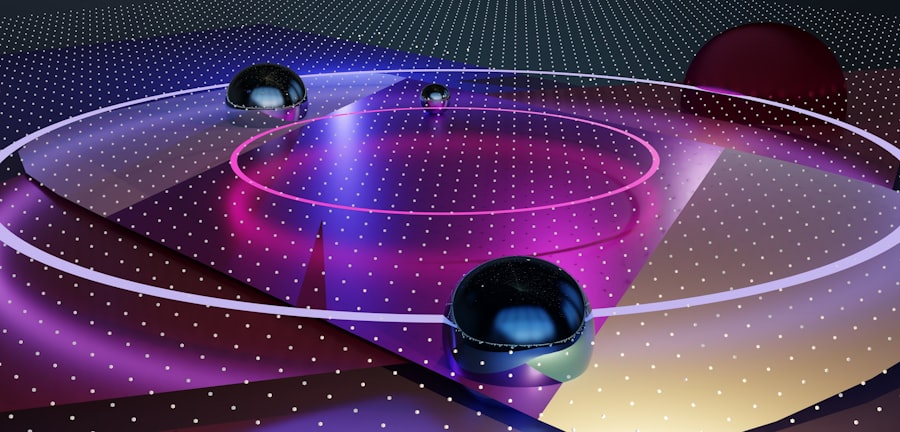
At its core, gravitational lensing operates on the principle that mass can curve space-time. When light from a distant object passes near a massive body, such as a galaxy or cluster, the path of the light is altered due to the gravitational field created by that mass. This bending effect can lead to various observable phenomena, including multiple images, arcs, or even complete rings known as Einstein rings.
As you consider these effects, it becomes clear that gravitational lensing is not merely an optical illusion but rather a profound demonstration of the interplay between mass and light. The degree to which light is bent depends on several factors, including the mass of the lensing object and its alignment with the source and observer. The closer the light passes to the massive object, the more pronounced the bending effect will be.
This relationship allows astronomers to calculate the mass of the lensing object based on how much it distorts the light from background sources. By understanding these mechanics, you can appreciate how gravitational lensing serves as a bridge between theoretical physics and observational astronomy.
Types of Gravitational Lensing
| Types of Gravitational Lensing | Description |
|---|---|
| Strong Lensing | Occurs when the alignment between the source, lens, and observer is nearly perfect, resulting in highly distorted and magnified images of the source. |
| Weak Lensing | Causes small distortions in the shapes of background galaxies, which can be used to map the distribution of dark matter in the universe. |
| Micro Lensing | Occurs when a compact object, such as a star, passes in front of a more distant star, causing a temporary increase in brightness. |
Gravitational lensing can be categorized into three primary types: strong lensing, weak lensing, and microlensing. Strong lensing occurs when there is a significant alignment between a massive foreground object and a distant background source. This alignment results in dramatic distortions, such as multiple images or arcs.
As you explore strong lensing, you will find that it provides valuable insights into the distribution of dark matter and the structure of galaxies. Weak lensing, on the other hand, involves more subtle distortions that are often difficult to detect without sophisticated techniques. In weak lensing scenarios, the gravitational influence of foreground objects causes slight changes in the shapes of background galaxies.
By analyzing these small distortions across large fields of view, astronomers can map out the distribution of dark matter in the universe. This type of lensing is particularly useful for studying large-scale structures and understanding how galaxies interact with one another. Microlensing is yet another fascinating aspect of gravitational lensing.
It occurs when a relatively small object, such as a star or planet, passes in front of a more distant source.
Microlensing events have been instrumental in discovering exoplanets and studying their properties.
As you delve into these different types of gravitational lensing, you will gain a deeper appreciation for their unique characteristics and contributions to our understanding of the cosmos.
Applications of Gravitational Lensing in Astronomy
Gravitational lensing has become an indispensable tool for astronomers seeking to unravel the mysteries of the universe. One significant application is its role in mapping dark matter. Since dark matter does not emit light and cannot be observed directly, gravitational lensing provides a means to infer its presence by observing how it influences the light from distant galaxies.
By analyzing patterns of distortion in large galaxy clusters, you can help create detailed maps that reveal where dark matter is concentrated. Another critical application lies in studying distant galaxies and their formation. Gravitational lensing allows astronomers to observe galaxies that are billions of light-years away, which would otherwise be too faint or obscured by intervening material.
By examining these lensed galaxies, you can gain insights into their structure, composition, and evolution over cosmic time. This information is vital for understanding how galaxies form and grow in the early universe.
Gravitational Lensing and Dark Matter
Dark matter remains one of the most enigmatic components of our universe, constituting approximately 27% of its total mass-energy content. Gravitational lensing plays a pivotal role in our understanding of dark matter by providing indirect evidence for its existence and distribution. When you observe how light from distant galaxies is bent by massive foreground objects, you are witnessing the effects of dark matter’s gravitational influence.
One notable example is the study of galaxy clusters, which are some of the largest structures in the universe. By analyzing how these clusters act as gravitational lenses, astronomers can estimate their total mass, including both visible matter (like stars and gas) and dark matter. This approach has led to significant discoveries about how dark matter is distributed within clusters and has helped refine models that describe its behavior on cosmic scales.
As you explore this relationship between gravitational lensing and dark matter, you will uncover essential insights into one of modern astrophysics’ most pressing questions.
Gravitational Lensing and the Search for Exoplanets
Gravitational lensing has also emerged as a powerful method for discovering exoplanets—planets that orbit stars outside our solar system. Microlensing events provide unique opportunities to detect these distant worlds by observing how their gravitational fields affect light from background stars. When an exoplanet passes in front of a more distant star during a microlensing event, it can create characteristic brightness variations that signal its presence.
This technique has proven particularly effective for detecting planets that are otherwise difficult to observe using traditional methods like transit photometry or radial velocity measurements. By analyzing data from microlensing surveys, astronomers have identified numerous exoplanets across various sizes and distances from their host stars. As you consider this innovative application of gravitational lensing, you will appreciate how it expands our understanding of planetary systems beyond our own.
Gravitational Lensing and the Study of Distant Galaxies
The ability to study distant galaxies through gravitational lensing has revolutionized our understanding of galaxy formation and evolution. When light from these far-off galaxies is bent by intervening mass, it allows you to observe them in greater detail than would otherwise be possible. This phenomenon enables astronomers to investigate galaxies that existed billions of years ago during critical periods in cosmic history.
By examining lensed galaxies, you can gather information about their morphology, star formation rates, and chemical compositions. These observations provide valuable insights into how galaxies evolve over time and how they interact with their environments. Furthermore, studying lensed galaxies helps refine models that describe galaxy formation processes in different cosmic epochs.
As you explore this aspect of gravitational lensing, you will gain a deeper appreciation for its role in shaping our understanding of galactic evolution.
Gravitational Lensing and the Measurement of Cosmological Parameters
Gravitational lensing also plays a crucial role in measuring cosmological parameters—quantities that describe the large-scale structure and evolution of the universe. By analyzing how light is distorted by massive objects at various distances, astronomers can derive important information about the expansion rate of the universe and its overall geometry. One key parameter that can be estimated through gravitational lensing is the Hubble constant, which describes how fast galaxies are receding from us due to cosmic expansion.
Additionally, gravitational lensing helps constrain models related to dark energy—the mysterious force driving this accelerated expansion. As you consider these applications, it becomes evident that gravitational lensing serves as a vital tool for probing fundamental questions about our universe’s fate.
Challenges and Limitations of Gravitational Lensing
Despite its many advantages, gravitational lensing is not without challenges and limitations. One significant hurdle is accurately modeling complex mass distributions within lensing objects. The presence of multiple mass components—such as stars, gas, and dark matter—can complicate interpretations of observed distortions.
As an observer or researcher in this field, you must navigate these complexities to draw meaningful conclusions from your data. Another limitation arises from observational constraints. Detecting subtle distortions caused by weak lensing requires high-quality imaging over large areas of sky.
This necessitates advanced telescopes and imaging techniques that may not always be available or feasible for all research projects. Additionally, distinguishing between genuine lensing effects and other astrophysical phenomena can pose challenges in data analysis. As you engage with these challenges, you will develop a deeper understanding of both the potential and limitations inherent in using gravitational lensing as an observational tool.
Future Prospects and Developments in Gravitational Lensing
Looking ahead, the future prospects for gravitational lensing research are promising and exciting.
These developments will enhance your ability to study gravitational lenses with greater precision than ever before.
Moreover, ongoing surveys aimed at mapping dark matter through weak lensing will continue to refine our understanding of its distribution on cosmic scales. As new discoveries emerge regarding exoplanets through microlensing techniques, your knowledge about planetary systems will expand further still. The interplay between gravitational lensing and other fields—such as cosmology and galaxy formation—will undoubtedly yield new insights into fundamental questions about our universe’s structure and evolution.
In conclusion, as you explore gravitational lensing’s rich history and diverse applications within astronomy, you will come to appreciate its significance as both a theoretical concept and an observational tool. From mapping dark matter to discovering exoplanets and studying distant galaxies, gravitational lensing continues to shape our understanding of the cosmos in profound ways. The future holds exciting possibilities for further exploration and discovery within this captivating field.
Gravitational lensing is a fascinating phenomenon where the gravitational field of a massive object, like a galaxy or a cluster of galaxies, bends the light from objects behind it, acting like a cosmic magnifying glass. This effect not only provides a unique way to study distant galaxies and the distribution of dark matter but also offers insights into the expansion of the universe. For those interested in exploring more about the wonders of our universe and related cosmic phenomena, you might find this article on My Cosmic Ventures intriguing. It delves into various aspects of astrophysics and the mysteries of the cosmos, providing a broader context to the study of gravitational lensing.
FAQs
What is gravitational lensing?
Gravitational lensing is a phenomenon in which the light from a distant object, such as a galaxy or quasar, is bent and distorted by the gravitational pull of a massive object, such as a galaxy cluster or black hole, that lies between the distant object and the observer.
How does gravitational lensing occur?
Gravitational lensing occurs due to the bending of space-time by massive objects. According to Einstein’s theory of general relativity, massive objects warp the fabric of space-time, causing light to follow curved paths as it travels through this warped space-time.
What are the types of gravitational lensing?
There are two main types of gravitational lensing: strong lensing and weak lensing. Strong lensing occurs when the gravitational field is strong enough to produce highly distorted and magnified images of the background object, while weak lensing produces subtle distortions in the shapes of background objects.
What are the applications of gravitational lensing?
Gravitational lensing has several important applications in astrophysics and cosmology. It can be used to study the distribution of dark matter in the universe, to measure the masses of galaxy clusters, and to detect and study distant objects that would otherwise be too faint to observe.
What are some famous examples of gravitational lensing?
One of the most famous examples of gravitational lensing is the “Einstein Cross,” in which a distant quasar is lensed into four separate images by a foreground galaxy. Another well-known example is the “Bullet Cluster,” where the separation of dark matter and ordinary matter was observed through gravitational lensing.