As you delve into the fascinating realm of astrophysics, one of the most intriguing concepts you will encounter is that of dark matter halo models. These models serve as a framework for understanding the distribution and behavior of dark matter in the universe. Dark matter, which constitutes about 27% of the universe’s total mass-energy content, remains elusive and undetectable by conventional means.
However, its gravitational effects are evident in the motion of galaxies and galaxy clusters. Dark matter halo models provide a theoretical basis for interpreting these gravitational influences, allowing you to explore the unseen structures that shape the cosmos. The significance of dark matter halo models extends beyond mere academic curiosity; they are essential for explaining a variety of astronomical phenomena.
From the rotation curves of galaxies to the large-scale structure of the universe, these models help you make sense of observations that would otherwise be inexplicable. As you navigate through this article, you will gain insights into the theoretical frameworks that underpin these models, the observational constraints that validate them, and their implications for our understanding of cosmology and galaxy formation.
Key Takeaways
- Dark matter halo models provide a framework for understanding the distribution of dark matter in galaxies and its role in galaxy formation.
- Theoretical framework for dark matter halo models involves the use of simulations and mathematical models to study the behavior and properties of dark matter halos.
- Observational constraints on dark matter halo models come from studying the dynamics of galaxies, gravitational lensing, and the cosmic microwave background radiation.
- Analyzing the distribution of dark matter in galaxies involves studying the density profiles, mass distribution, and spatial extent of dark matter halos.
- Understanding the role of dark matter in galaxy formation is crucial for unraveling the mysteries of the universe and understanding the evolution of cosmic structures.
Theoretical Framework for Dark Matter Halo Models
To comprehend dark matter halo models, it is crucial to understand their theoretical foundations. At the core of these models lies the concept of gravitational interactions. You will find that dark matter is thought to exist in vast halos surrounding galaxies, exerting a gravitational pull that influences visible matter.
The most widely accepted framework for modeling these halos is based on the cold dark matter (CDM) paradigm, which posits that dark matter particles move slowly compared to the speed of light. This assumption leads to a hierarchical structure formation scenario, where small halos merge to form larger ones over cosmic time. In addition to CDM, alternative theories have emerged to explain dark matter’s properties and behavior.
For instance, warm dark matter (WDM) and self-interacting dark matter (SIDM) propose different particle characteristics that could lead to variations in halo formation and structure. As you explore these theoretical frameworks, you will appreciate how they shape our understanding of dark matter’s role in the universe. Each model offers unique predictions about halo density profiles, mass distributions, and the dynamics of galaxies, providing a rich tapestry of possibilities for researchers to investigate.
Observational Constraints on Dark Matter Halo Models

As you venture further into the study of dark matter halo models, you will encounter a wealth of observational data that serves as a critical test for these theoretical frameworks. Astronomers have employed various techniques to measure the effects of dark matter on visible structures in the universe. One of the most compelling pieces of evidence comes from galaxy rotation curves.
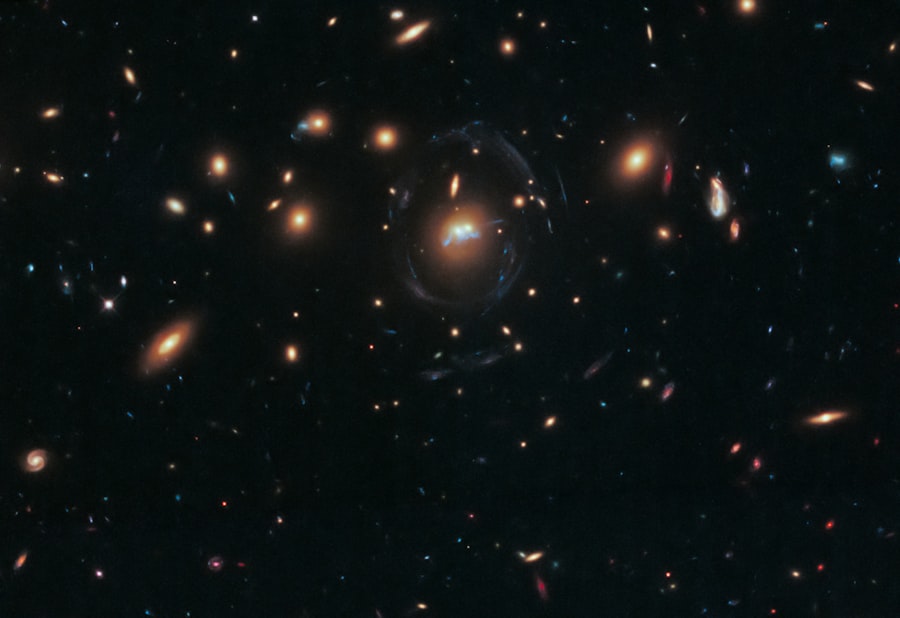
When you analyze the rotation speeds of galaxies, you will notice that they remain constant at large distances from their centers, contrary to what would be expected if only visible matter were present. This discrepancy strongly suggests the presence of an unseen mass—dark matter—extending well beyond the visible components. Another significant observational constraint arises from gravitational lensing, where light from distant objects is bent by the gravitational field of intervening mass.
By studying how light is distorted around galaxy clusters, you can infer the distribution and amount of dark matter present. These observations have led to the development of mass maps that reveal the intricate web of dark matter halos surrounding galaxies. As you consider these observational constraints, it becomes clear that they play a pivotal role in refining dark matter halo models and ensuring their alignment with empirical data.
Analyzing the Distribution of Dark Matter in Galaxies
| Galaxy | Dark Matter Distribution | Observation Method |
|---|---|---|
| Milky Way | Concentrated in the central bulge and halo | Gravitational lensing and rotation curves |
| Andromeda | Evenly distributed throughout the galaxy | Stellar kinematics and satellite galaxy dynamics |
| Triangulum | Concentrated in the central region | Radio observations and gas dynamics |
Understanding how dark matter is distributed within galaxies is a key aspect of your exploration into dark matter halo models. The distribution is not uniform; rather, it follows specific density profiles that have been extensively studied. One of the most prominent profiles is the Navarro-Frenk-White (NFW) profile, which describes how density decreases with distance from a galaxy’s center.
As you analyze this profile, you will find that it predicts a steep increase in density near the center, tapering off at larger radii. However, alternative profiles have also been proposed, such as the Einasto profile and the Burkert profile, each offering different insights into how dark matter behaves in various galactic environments. By examining these profiles through simulations and observational data, you can gain a deeper understanding of how dark matter interacts with baryonic matter—such as stars and gas—within galaxies.
This analysis not only enhances your knowledge of individual galaxies but also contributes to a broader understanding of galaxy formation and evolution across cosmic time.
Understanding the Role of Dark Matter in Galaxy Formation
As you continue your journey through dark matter halo models, it becomes essential to grasp how dark matter influences galaxy formation. The interplay between dark matter and baryonic matter is fundamental to understanding how galaxies evolve over billions of years. In the early universe, fluctuations in dark matter density provided gravitational wells that attracted baryonic matter, leading to the formation of stars and galaxies.
You will discover that without dark matter’s gravitational influence, the structures we observe today would likely not exist. Moreover, as galaxies form and evolve, dark matter halos play a crucial role in regulating their growth. The mass and distribution of dark matter determine how much gas can cool and condense to form stars.
This relationship between dark matter and baryonic processes is complex; while dark matter provides the scaffolding for galaxy formation, it also influences star formation rates and galaxy morphology. By studying this intricate relationship, you can gain valuable insights into not only how galaxies form but also how they interact with their environments over cosmic time.
Comparing Different Dark Matter Halo Models
In your exploration of dark matter halo models, it is important to compare various approaches to understand their strengths and weaknesses. The cold dark matter model has been widely accepted due to its success in explaining large-scale structures and cosmic microwave background observations. However, as you delve deeper into alternative models like warm dark matter or self-interacting dark matter, you will find that they offer different predictions regarding halo formation and structure.
For instance, warm dark matter models predict a suppression of small-scale structures compared to cold dark matter models due to increased thermal velocities of particles. This has implications for galaxy formation in low-mass halos. On the other hand, self-interacting dark matter introduces additional complexity by allowing interactions between dark matter particles themselves, potentially leading to different density profiles and halo shapes.
Implications of Dark Matter Halo Models for Cosmology
The implications of dark matter halo models extend far beyond individual galaxies; they have profound consequences for cosmology as a whole. As you consider these models, you will realize that they provide a framework for understanding the large-scale structure of the universe. The distribution of dark matter halos influences how galaxies cluster together and form cosmic filaments—vast structures that define the architecture of the universe.
Furthermore, these models are integral to our understanding of cosmic evolution. They help explain phenomena such as cosmic inflation and the formation of the cosmic microwave background radiation. By studying how dark matter interacts with baryonic matter over time, you can gain insights into critical events in cosmic history, including reionization and structure formation epochs.
The interplay between dark matter halo models and cosmological theories enriches your understanding of not only what exists in the universe but also how it came to be.
Challenges and Limitations in Dark Matter Halo Modeling
Despite their significance, dark matter halo models are not without challenges and limitations. As you engage with this field, you will encounter various issues that researchers face when attempting to refine these models. One major challenge lies in accurately measuring the properties of dark matter halos across different scales.
While large-scale structures can be mapped relatively well through gravitational lensing and galaxy surveys, smaller halos remain elusive due to their faintness and difficulty in detection. Additionally, discrepancies between observations and model predictions often arise. For example, some simulations predict more subhalos than are observed in certain regions of space, leading to what is known as the “missing satellite problem.” This inconsistency raises questions about our understanding of both dark matter properties and baryonic physics.
As you navigate these challenges, it becomes clear that ongoing research is essential for addressing these limitations and refining our models.
Future Directions in Dark Matter Halo Model Research
Looking ahead, there are numerous exciting directions for future research in dark matter halo modeling. One promising avenue involves leveraging advancements in observational technology and computational simulations to gather more precise data on dark matter distributions. Upcoming surveys like the Vera Rubin Observatory’s Legacy Survey of Space and Time (LSST) are expected to provide unprecedented insights into galaxy formation and evolution by mapping millions of galaxies across vast distances.
Moreover, interdisciplinary approaches that integrate insights from particle physics could lead to new discoveries about dark matter’s nature. As researchers explore potential candidates for dark matter particles—such as axions or weakly interacting massive particles (WIMPs)—the implications for halo modeling could be profound. By combining theoretical frameworks with cutting-edge observational techniques, you can anticipate significant advancements in our understanding of dark matter halos in the coming years.
Applications of Dark Matter Halo Models in Astrophysics
The applications of dark matter halo models extend beyond theoretical exploration; they play a vital role in various areas of astrophysics. For instance, these models are instrumental in interpreting data from galaxy surveys and understanding galaxy cluster dynamics. By applying halo modeling techniques to observational data, researchers can derive important parameters such as halo mass and concentration, which are crucial for studying galaxy evolution.
Additionally, dark matter halo models have implications for gravitational wave astronomy as well. Understanding how dark matter interacts with baryonic structures can inform predictions about gravitational wave sources like merging black holes or neutron stars within galactic environments. As you consider these applications, it becomes evident that dark matter halo models are not just abstract concepts; they are essential tools for unlocking the mysteries of our universe.
The Significance of Exploring Dark Matter Halo Models
In conclusion, your exploration into dark matter halo models reveals their profound significance within astrophysics and cosmology. These models provide a framework for understanding one of the universe’s most enigmatic components—dark matter—and its role in shaping galaxies and large-scale structures. Through theoretical frameworks, observational constraints, and comparative analyses, you have gained insights into how these models contribute to our understanding of cosmic evolution.
As research continues to advance in this field, it is clear that unraveling the mysteries surrounding dark matter will have far-reaching implications for our comprehension of the universe itself. By engaging with these concepts and remaining curious about ongoing developments, you position yourself at the forefront of one of science’s most exciting frontiers—one that holds the potential to reshape our understanding of reality itself.
In the fascinating realm of astrophysics, Dark Matter halo models play a crucial role in understanding the structure and dynamics of galaxies. These models help scientists explore the mysterious, invisible matter that makes up a significant portion of the universe’s mass. For those interested in delving deeper into this topic, a related article can be found on My Cosmic Ventures. This article provides insights into the latest research and developments in Dark Matter studies, offering a comprehensive overview of how these enigmatic halos influence galactic formations. To read more about this intriguing subject, visit the article on