Stellar populations are fundamental components of galaxies, representing groups of stars that share common characteristics, such as age, chemical composition, and formation history. These populations can be broadly categorized into two main types: Population I and Population II stars. Population I stars are typically younger, found in the spiral arms of galaxies, and are rich in metals, while Population II stars are older, located in the halo or bulge of galaxies, and have lower metallicity.
Understanding these populations is crucial for astronomers as they provide insights into the processes that govern star formation and the evolution of galaxies over cosmic time. The study of stellar populations extends beyond mere classification; it encompasses the intricate histories of how these stars formed and evolved. By examining the characteristics of different stellar populations, researchers can infer the conditions present in the early universe and how they have changed over billions of years.
This exploration not only enhances knowledge about individual stars but also sheds light on the broader mechanisms that drive galactic evolution. As such, stellar populations serve as a window into the past, revealing the dynamic interplay between stars, gas, and dark matter that shapes the cosmos.
Key Takeaways
- Stellar merger history provides crucial insights into the formation and evolution of galaxies.
- Observational techniques combined with theoretical models help trace past stellar mergers.
- Merger events significantly influence the properties and dynamics of stellar populations.
- Studying merger history faces challenges such as data limitations and complex modeling.
- Future research aims to refine understanding and apply findings to broader galactic evolution theories.
The Concept of Merger History in Stellar Populations
The merger history of stellar populations refers to the events where galaxies collide and interact, leading to the formation of new stars and altering existing stellar distributions. These mergers can significantly influence the structure and composition of galaxies, resulting in a complex tapestry of stellar populations.
This process is not merely a chaotic event; rather, it is a critical mechanism that drives the evolution of galaxies and their stellar populations. Understanding merger history is essential for deciphering the current state of a galaxy’s stellar population. Each merger event can introduce new stars with varying ages and metallicities, creating a diverse stellar environment.
For instance, when two galaxies collide, they can trigger bursts of star formation as gas clouds compress and collapse under gravitational forces. This influx of new stars can rejuvenate an older stellar population or lead to the formation of entirely new groups of stars. Consequently, analyzing a galaxy’s merger history provides valuable context for interpreting its present-day characteristics and dynamics.
Observational Techniques for Studying Merger History

To unravel the complexities of merger history in stellar populations, astronomers employ a variety of observational techniques. One prominent method involves the use of spectroscopy, which allows researchers to analyze the light emitted by stars and determine their chemical compositions. By studying the spectral lines of different elements, astronomers can infer the ages and metallicities of stars within a galaxy.
Another powerful observational tool is imaging through advanced telescopes equipped with adaptive optics. These instruments can capture high-resolution images of galaxies, revealing intricate details about their structures and interactions.
For example, deep-field imaging can uncover faint tidal features and streams of stars that are remnants of past mergers. Additionally, surveys using wide-field telescopes can provide statistical data on large samples of galaxies, allowing researchers to identify patterns in merger histories across different environments. Together, these techniques enable a comprehensive understanding of how mergers shape stellar populations.
Theoretical Models of Stellar Mergers
Theoretical models play a pivotal role in understanding stellar mergers and their implications for stellar populations. These models simulate various merger scenarios, taking into account factors such as mass ratios, orbital dynamics, and gas dynamics. By running simulations on supercomputers, astronomers can visualize how galaxies interact during mergers and predict the resulting changes in their stellar populations.
These models help bridge the gap between observational data and theoretical predictions, providing a framework for interpreting complex phenomena. One significant aspect of these models is their ability to explore different merger types, such as major mergers involving galaxies of similar sizes or minor mergers where a smaller galaxy merges with a larger one. Each type has distinct outcomes for stellar populations.
Major mergers often lead to significant starbursts due to the large amounts of gas being funneled into star-forming regions, while minor mergers may contribute to gradual changes in a galaxy’s stellar content over time. By comparing model predictions with observational data, researchers can refine their understanding of how mergers influence galactic evolution.
Impact of Stellar Mergers on Galactic Evolution
| Galaxy Name | Merger Type | Stellar Population Age (Gyr) | Metallicity [Fe/H] | Star Formation Rate (M☉/yr) | Merger Epoch (Gyr ago) | Notes |
|---|---|---|---|---|---|---|
| NGC 7252 | Major Merger | 0.5 – 1.0 | 0.0 | 5.0 | 0.6 | Young stellar populations from recent merger |
| Milky Way | Minor Merger | 8 – 12 | -0.5 to 0.0 | 1.0 | 1 – 3 | Evidence of past minor mergers in halo stars |
| NGC 1316 | Major Merger | 2 – 4 | +0.1 | 0.3 | 3 | Intermediate-age populations from merger event |
| Andromeda (M31) | Multiple Minor Mergers | 6 – 10 | -0.3 to 0.0 | 0.7 | 0.5 – 5 | Complex merger history with multiple minor events |
| NGC 5128 (Centaurus A) | Major Merger | 1 – 3 | 0.0 | 1.2 | 2 | Active star formation triggered by merger |
Stellar mergers have profound implications for galactic evolution, influencing not only the structure and composition of galaxies but also their overall dynamics. When galaxies merge, they can experience dramatic changes in their gravitational fields, leading to alterations in star orbits and the redistribution of gas and dark matter. This reorganization can trigger new phases of star formation or quench existing star formation activity, depending on the conditions present during the merger.
Moreover, mergers can lead to the formation of new galactic structures such as bars or rings, which can further affect star formation rates and stellar population distributions. The interaction between merging galaxies often results in complex feedback mechanisms that regulate star formation over time. For instance, supernovae from newly formed stars can inject energy into surrounding gas, influencing subsequent star formation processes.
Thus, understanding the impact of stellar mergers is essential for comprehending how galaxies evolve across cosmic time.
Evidence of Merger History in Different Stellar Populations
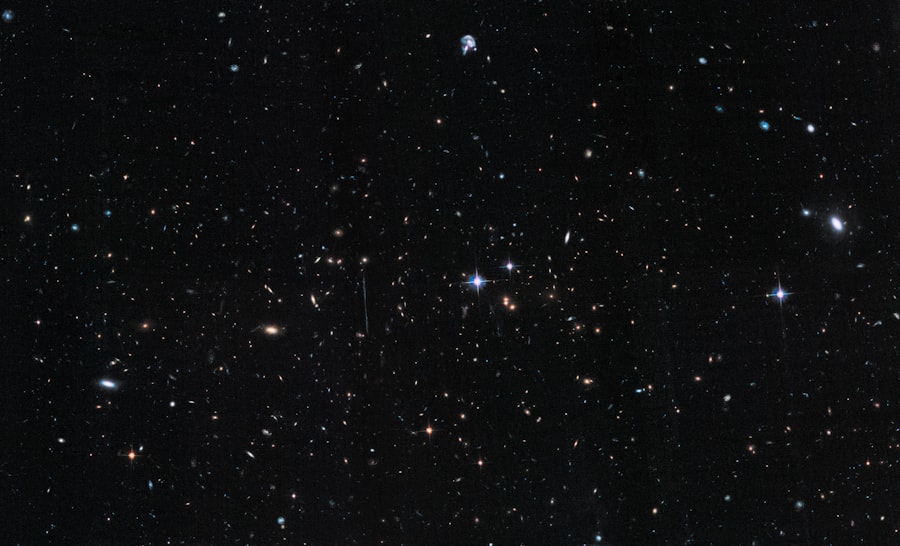
Evidence for merger history can be found across various stellar populations within galaxies. For instance, studies have shown that elliptical galaxies often exhibit signs of past mergers through their smooth light profiles and older stellar populations. These galaxies typically contain a mix of stars with varying ages and metallicities, suggesting a history marked by multiple merger events that contributed to their current state.
In contrast, spiral galaxies often display more distinct features indicative of recent interactions or mergers. The presence of tidal tails or streams—elongated structures formed by gravitational interactions—can reveal ongoing or past merger activity. Additionally, young star clusters found in these galaxies may be remnants of starbursts triggered by recent mergers.
By analyzing these features across different types of galaxies, researchers can piece together a comprehensive picture of how merger history shapes stellar populations.
Implications for Understanding the Formation of Galaxies
The study of merger history in stellar populations has significant implications for understanding galaxy formation processes. It provides insights into how galaxies grow over time through hierarchical merging and how this growth influences their structural properties. The varying characteristics observed in different types of galaxies—such as elliptical versus spiral—can often be traced back to their unique merger histories.
Furthermore, understanding merger history helps clarify the role of dark matter in galaxy formation. Dark matter halos provide the gravitational scaffolding necessary for galaxies to form and merge. By studying how these halos interact during mergers, researchers can gain insights into the distribution and behavior of dark matter within galaxies.
This knowledge is crucial for developing comprehensive models that explain not only how individual galaxies form but also how they fit into the larger cosmic web.
Challenges in Studying Merger History in Stellar Populations
Despite advancements in observational techniques and theoretical modeling, studying merger history in stellar populations presents several challenges. One significant hurdle is the timescales involved; many merger events occur over billions of years, making it difficult to capture them in real-time observations. As a result, much of what is known about merger history relies on indirect evidence and simulations rather than direct observation.
Additionally, distinguishing between different types of interactions—such as minor mergers versus major ones—can be complex due to overlapping signatures in observational data. The presence of various environmental factors also complicates interpretations; for example, interactions with neighboring galaxies or gas inflows can influence star formation independently of merger events. Researchers must carefully disentangle these factors to accurately reconstruct a galaxy’s merger history.
Future Directions in Research on Merger History
As technology continues to advance, future research on merger history in stellar populations is poised to make significant strides. Upcoming space telescopes like the James Webb Space Telescope (JWST) will provide unprecedented views into distant galaxies, allowing astronomers to observe merger events at earlier cosmic times than ever before. This capability will enhance understanding of how mergers influence galaxy evolution across different epochs.
Moreover, improvements in computational power will enable more sophisticated simulations that incorporate a wider range of physical processes involved in mergers. These models will help refine predictions about how different types of mergers affect stellar populations and galactic structures over time. Collaborative efforts between observational astronomers and theorists will be essential for integrating new data with existing models to create a more cohesive understanding of merger history.
Applications of Understanding Merger History in Stellar Populations
Understanding merger history has practical applications beyond academic curiosity; it informs various fields within astrophysics and cosmology. For instance, insights gained from studying stellar populations can aid in refining models used to estimate dark matter distribution within galaxies. This knowledge is crucial for understanding galaxy dynamics and evolution on both small and large scales.
Additionally, understanding how mergers influence star formation rates can have implications for studies related to galaxy feedback mechanisms and chemical enrichment processes within the universe. By comprehending these relationships better, researchers can develop more accurate models that describe not only individual galaxies but also large-scale structures like galaxy clusters.
Conclusion and Summary of Key Findings
In conclusion, the study of stellar populations and their merger histories offers profound insights into the evolution of galaxies throughout cosmic time. By examining how different types of mergers shape stellar distributions and influence star formation processes, researchers can piece together a comprehensive narrative about galaxy formation and evolution. Observational techniques such as spectroscopy and advanced imaging play crucial roles in uncovering evidence for merger histories across various stellar populations.
Theoretical models provide essential frameworks for interpreting these observations while highlighting the complex interplay between merging galaxies and their environments. Despite challenges in studying merger history—such as long timescales and overlapping signatures—future research promises to enhance understanding through advanced technology and collaborative efforts across disciplines. Ultimately, grasping the intricacies of merger history not only enriches knowledge about individual galaxies but also contributes to broader cosmological theories regarding the structure and evolution of the universe itself.
In the study of merger history and stellar populations, understanding the impact of galactic interactions is crucial. A related article that delves into these topics can be found on My Cosmic Ventures, which explores the intricate relationships between galaxy mergers and the evolution of stellar populations. For more insights, you can read the article [here](https://www.mycosmicventures.com/).
WATCH THIS! 🧠 The Universe Is A Brain. And It’s Having A Stroke.
FAQs
What is meant by “merger history” in the context of stellar populations?
Merger history refers to the record of past interactions and collisions between galaxies that have influenced the formation and evolution of their stellar populations. These mergers can significantly affect the distribution, age, and chemical composition of stars within a galaxy.
How do mergers affect stellar populations in galaxies?
Mergers can trigger new star formation by compressing gas clouds, redistribute existing stars, and alter the overall structure of a galaxy. They often lead to a mix of stellar populations with varying ages and metallicities, reflecting the combined histories of the merging systems.
What methods are used to study the merger history of stellar populations?
Astronomers use a combination of observational data, such as spectroscopy and photometry, to analyze the ages, chemical abundances, and motions of stars. Simulations and models of galaxy formation also help interpret these observations and reconstruct merger histories.
Why is understanding merger history important for studying stellar populations?
Understanding merger history provides insights into how galaxies grow and evolve over time. It helps explain the diversity of stellar populations observed in galaxies and sheds light on the processes that shape their structure and composition.
Can merger history be observed directly?
While past mergers cannot be observed directly, their effects can be inferred from features such as tidal tails, stellar streams, and distinct stellar populations with different ages and metallicities. These signatures serve as evidence of previous merger events.
Do all galaxies have a merger history?
Most galaxies have experienced some form of merger or interaction during their lifetime, although the frequency and impact vary. Larger galaxies, like the Milky Way, have complex merger histories, while some smaller or isolated galaxies may have fewer or less significant mergers.
How does merger history influence the chemical composition of stellar populations?
Mergers can introduce stars and gas with different chemical abundances, leading to a more heterogeneous chemical composition within a galaxy. This mixing affects the metallicity distribution and can provide clues about the origins and timing of merger events.
What role do mergers play in the formation of elliptical galaxies?
Elliptical galaxies are often thought to form through the merger of smaller galaxies. These mergers can disrupt disk structures and lead to the formation of a more spheroidal stellar distribution, with older and more dynamically mixed stellar populations.