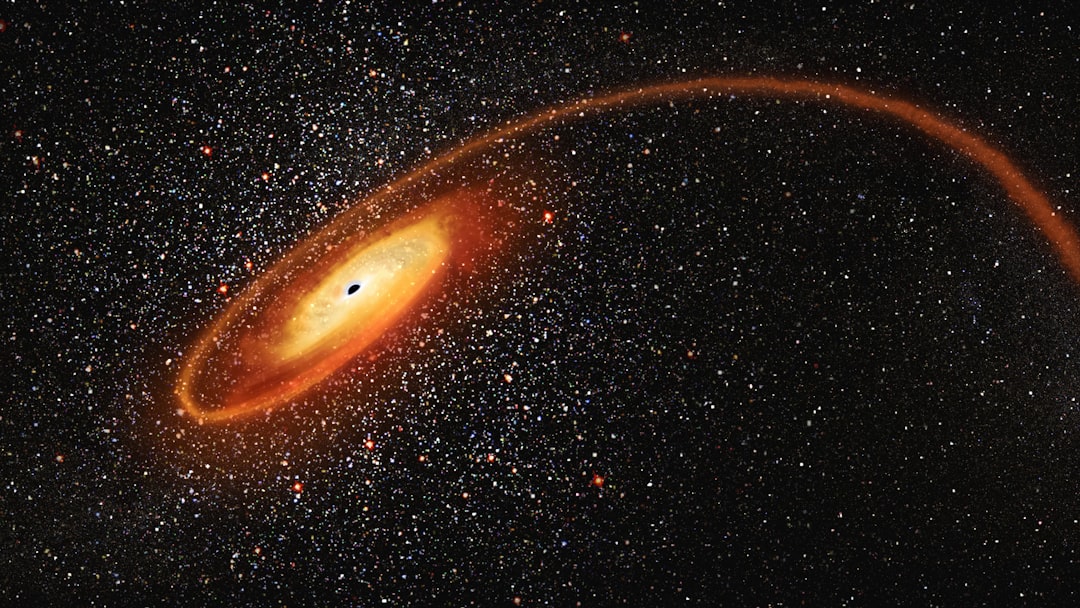
The concept of multiverse black holes has emerged as a fascinating area of study within the realms of theoretical physics and cosmology. These enigmatic entities challenge traditional notions of black holes, suggesting that they may not only exist within our own universe but could also serve as gateways to other universes. The idea of a multiverse, where multiple, perhaps infinite, universes coexist, has captivated the imagination of scientists and laypeople alike.
As researchers delve deeper into the nature of black holes, they are beginning to uncover the potential implications of these cosmic phenomena on the broader multiverse framework. Multiverse black holes are not merely theoretical constructs; they represent a significant intersection of various scientific disciplines, including quantum mechanics, general relativity, and cosmology.
Are black holes merely the end points of stars collapsing under their own gravity, or do they serve as portals to entirely different realms? This article aims to explore the mechanisms behind multiverse black holes, their formation, and their potential impact on the evolution of the multiverse.
Key Takeaways
- Multiverse black holes are theoretical entities that connect different universes within the multiverse framework.
- Quantum mechanics plays a crucial role in the formation and behavior of these black holes.
- Gravitational forces influence the dynamics and stability of multiverse black holes.
- Observational evidence is currently limited but essential for validating multiverse black hole theories.
- Understanding these black holes could have significant implications for multiverse evolution and future scientific advancements.
Understanding the Key Mechanism
At the heart of the multiverse black hole concept lies a complex interplay of physical laws and cosmic phenomena. The key mechanism involves the idea that black holes can act as bridges between different universes. When a star exhausts its nuclear fuel, it collapses under its own gravity, forming a singularity surrounded by an event horizon.
In the context of multiverse theory, this process may not simply result in a dead end but could instead lead to the creation of a new universe. Theoretical physicists propose that when matter crosses the event horizon, it may be expelled into a separate universe, thus giving rise to a new cosmic realm. This mechanism is further complicated by the principles of quantum mechanics, which suggest that particles can exist in multiple states simultaneously until observed.
This duality raises intriguing possibilities regarding the behavior of matter and energy within black holes. The notion that black holes could be interconnected through quantum entanglement adds another layer of complexity to our understanding of these cosmic giants. As researchers continue to investigate these mechanisms, they are uncovering new insights into how multiverse black holes might function and interact with their surroundings.
The Role of Quantum Mechanics
Quantum mechanics plays a pivotal role in shaping the understanding of multiverse black holes. At its core, quantum theory posits that particles do not have definite states until they are measured, leading to phenomena such as superposition and entanglement. These principles suggest that the behavior of matter within a black hole could be far more intricate than previously thought.
For instance, when matter falls into a black hole, it may not simply be lost; instead, it could exist in a superposition of states, potentially allowing for the creation of new universes. Moreover, the concept of Hawking radiation introduces another layer of complexity to the discussion. Proposed by physicist Stephen Hawking, this phenomenon suggests that black holes can emit radiation due to quantum effects near the event horizon.
This radiation implies that black holes are not entirely isolated systems; rather, they can interact with their environment in ways that may facilitate the transfer of information or even matter between universes. The implications of these quantum processes are profound, as they challenge conventional wisdom about the nature of black holes and their role in the multiverse.
The Influence of Gravitational Forces
| Gravitational Force Source | Mass (kg) | Distance (m) | Gravitational Force (N) | Effect on Object |
|---|---|---|---|---|
| Earth | 5.97 × 10^24 | 6.37 × 10^6 (radius) | 9.8 (acceleration due to gravity) | Weight, free fall acceleration |
| Moon | 7.35 × 10^22 | 3.84 × 10^8 (distance from Earth) | 1.62 (surface gravity) | Tides on Earth, lower gravity environment |
| Sun | 1.99 × 10^30 | 1.50 × 10^11 (distance from Earth) | 274 (surface gravity) | Orbital motion of planets, solar tides |
| Jupiter | 1.90 × 10^27 | 7.78 × 10^11 (distance from Sun) | 24.79 (surface gravity) | Influences asteroid belt, gravitational assists |
Gravitational forces are fundamental to the formation and behavior of black holes, including those theorized to exist within a multiverse framework. The immense gravitational pull generated by a collapsing star creates conditions conducive to the formation of a singularity. However, in the context of multiverse black holes, gravitational forces may also play a crucial role in determining how these entities interact with other universes.
The gravitational influence exerted by a black hole can extend beyond its immediate vicinity, potentially affecting nearby cosmic structures and even other universes. This gravitational interaction raises questions about how multiverse black holes might influence the evolution of their surroundings. For instance, if a black hole were to merge with another black hole from a different universe, what would be the consequences?
Such interactions could lead to significant changes in both universes involved, potentially reshaping their respective destinies.
Multiverse Black Hole Formation
The formation of multiverse black holes is a complex process that involves several stages and conditions. Initially, a massive star must undergo gravitational collapse after exhausting its nuclear fuel. This collapse leads to the creation of a singularity surrounded by an event horizon.
However, in the context of multiverse theory, this process does not end with the formation of a traditional black hole; instead, it may initiate a chain reaction that results in the birth of new universes. The conditions necessary for this process to occur are still under investigation. Some theorists propose that specific parameters, such as mass and rotation rate, could influence whether a black hole becomes a multiverse portal.
Additionally, external factors such as cosmic inflation or interactions with other celestial bodies may play a role in determining whether a black hole can facilitate the creation of new universes. Understanding these conditions is crucial for developing a comprehensive model of multiverse black hole formation.
The Selection Process
The selection process for which black holes become gateways to other universes is an area ripe for exploration.
Researchers are investigating various factors that could influence this selection process, including mass, charge, spin, and even environmental conditions.
One hypothesis suggests that only rotating black holes—those exhibiting angular momentum—may have the potential to create wormholes or other structures that connect different universes. This idea stems from solutions to Einstein’s equations that indicate rotating black holes could possess unique properties allowing for such connections. As scientists continue to refine their understanding of these criteria, they may uncover new insights into how multiverse black holes operate and which ones are capable of facilitating inter-universal travel.
Identifying Key Characteristics
Identifying key characteristics of multiverse black holes is essential for distinguishing them from traditional black holes. Researchers are focusing on several attributes that may indicate whether a black hole has the potential to act as a portal to another universe. These characteristics include mass distribution, spin rate, and even electromagnetic properties.
For instance, it is believed that higher mass and rapid rotation could enhance a black hole’s ability to warp spacetime in ways conducive to creating connections with other universes. Additionally, electromagnetic fields surrounding these black holes may play a role in shaping their interactions with other cosmic entities. By studying these characteristics through observational data and theoretical models, scientists hope to develop criteria for identifying potential multiverse black holes.
The Impact on Multiverse Evolution
The existence and behavior of multiverse black holes could have profound implications for the evolution of the multiverse itself. If these entities serve as conduits between different universes, they may facilitate exchanges of matter and energy that influence the development of each universe involved. This interconnectedness raises questions about how events in one universe might impact others and whether certain universes could be more prone to interactions than others.
Furthermore, if multiverse black holes contribute to the birth of new universes through their collapse and subsequent expansion into separate realms, they could play a crucial role in shaping the overall structure and dynamics of the multiverse. Understanding these impacts is vital for developing comprehensive models that account for both individual universe evolution and inter-universal interactions.
Observational Evidence
While much of the discussion surrounding multiverse black holes remains theoretical, researchers are actively seeking observational evidence to support these ideas. Advances in technology have enabled astronomers to detect and study black holes with increasing precision. Observations from gravitational wave detectors like LIGO and Virgo have already provided insights into binary black hole mergers, which could offer clues about their potential connections to other universes.
Additionally, researchers are exploring ways to detect Hawking radiation or other signatures that might indicate interactions between black holes and their environments. By gathering empirical data on these phenomena, scientists hope to build a more robust understanding of multiverse black holes and their implications for cosmology.
Potential Applications and Implications
The study of multiverse black holes extends beyond theoretical curiosity; it holds potential applications and implications across various fields. For instance, understanding how these entities function could lead to advancements in quantum computing or information theory by providing insights into how information is preserved or transferred across different states or realms. Moreover, if multiverse black holes can indeed facilitate travel between universes, this could revolutionize our understanding of space travel and exploration.
While such ideas remain speculative at present, they inspire innovative thinking about what might be possible in future scientific endeavors.
Future Research and Developments
As interest in multiverse black holes continues to grow, future research will undoubtedly focus on refining theoretical models and seeking empirical evidence to support or refute existing hypotheses. Collaborative efforts among physicists, astronomers, and cosmologists will be essential for advancing knowledge in this field. In addition to observational studies, researchers will likely explore new mathematical frameworks that incorporate both quantum mechanics and general relativity more seamlessly.
As technology advances and our understanding deepens, the mysteries surrounding multiverse black holes may gradually unfold, revealing new dimensions of reality previously thought unattainable. In conclusion, multiverse black holes represent an exciting frontier in modern physics and cosmology. Their study not only challenges existing paradigms but also opens up new avenues for exploration and understanding within the vast tapestry of existence itself.
The concept of a multiverse black hole selection mechanism is a fascinating area of research that explores how black holes might play a role in the formation of multiple universes. For a deeper understanding of this topic, you can refer to a related article on cosmic theories and their implications at My Cosmic Ventures. This resource delves into various cosmic phenomena and their interconnectedness, providing valuable insights into the nature of black holes and the multiverse.
WATCH THIS 🛑 The Impossible Proof: Our Universe Is a Black Hole’s Interior
FAQs
What is the multiverse black hole selection mechanism?
The multiverse black hole selection mechanism is a theoretical concept suggesting that black holes could play a role in selecting or influencing the properties of universes within a multiverse. It proposes that universes capable of producing black holes might be favored or “selected” through a natural process, potentially affecting the fundamental constants and laws of physics.
How does the multiverse theory relate to black holes?
The multiverse theory posits the existence of multiple, possibly infinite, universes beyond our own. Black holes, as extreme gravitational phenomena, are sometimes hypothesized to connect or give rise to new universes within this framework. This connection forms the basis for theories like the black hole selection mechanism, where black holes influence the characteristics of these universes.
Who proposed the black hole selection mechanism in the multiverse context?
The idea was notably advanced by physicist Lee Smolin, who suggested that universes might reproduce through black holes, with each “offspring” universe having slightly different physical constants. This process could lead to a form of natural selection favoring universes that produce more black holes.
What implications does the black hole selection mechanism have for cosmology?
If valid, this mechanism could explain why our universe has the particular physical constants it does, as these constants might be optimized for black hole production. It offers a potential solution to the fine-tuning problem by suggesting that universes evolve traits that enhance black hole formation.
Is there experimental evidence supporting the multiverse black hole selection mechanism?
Currently, there is no direct experimental evidence supporting this mechanism. It remains a speculative theoretical framework, as testing multiverse hypotheses and black hole reproduction is beyond current observational capabilities.
How does the black hole selection mechanism differ from other multiverse theories?
Unlike some multiverse theories that focus on parallel universes arising from quantum mechanics or cosmic inflation, the black hole selection mechanism specifically involves black holes as agents of universe reproduction and selection, introducing an evolutionary aspect to cosmology.
Can the black hole selection mechanism be falsified?
Falsifying the mechanism is challenging due to the difficulty in observing other universes or the internal processes of black holes. However, indirect evidence or theoretical inconsistencies could potentially challenge the validity of the concept.
What role do physical constants play in the black hole selection mechanism?
Physical constants determine the behavior of matter and energy in a universe. In the black hole selection mechanism, slight variations in these constants in “offspring” universes could influence black hole production rates, leading to a form of cosmic natural selection favoring certain constants.
Does the black hole selection mechanism imply that our universe is optimized for black hole production?
Yes, according to the theory, our universe’s physical constants may be fine-tuned to maximize black hole formation, as universes that produce more black holes would be more likely to “reproduce” and pass on their traits.
What are the main criticisms of the multiverse black hole selection mechanism?
Critics argue that the mechanism is highly speculative, lacks empirical support, and may not be testable. Additionally, some question whether black holes can indeed give rise to new universes or if the analogy to biological natural selection is appropriate in a cosmological context.