Kerr black holes represent a fascinating and complex aspect of astrophysics, emerging from the solutions to Einstein’s field equations in general relativity. Unlike their simpler Schwarzschild counterparts, which are non-rotating and spherically symmetric, Kerr black holes are characterized by their rotation and the unique properties that arise from this motion. Named after the New Zealand mathematician Roy P.
Kerr, who first described them in 1963, these celestial objects have become a focal point for researchers seeking to understand the nature of gravity, spacetime, and the fundamental laws governing the universe. The significance of Kerr black holes extends beyond theoretical physics; they provide insights into the behavior of matter and energy in extreme gravitational fields. As rotating black holes, they possess an additional parameter—angular momentum—that influences their structure and the surrounding spacetime.
This rotation leads to intriguing phenomena such as frame dragging, where spacetime itself is pulled along with the rotating mass. The study of Kerr black holes not only enhances our understanding of black hole physics but also has profound implications for cosmology and the evolution of galaxies.
Key Takeaways
- Kerr black holes are rotating black holes characterized by unique mathematical properties and complex structures like the event horizon and ergosphere.
- The ergosphere enables energy extraction through the Penrose process, highlighting frame dragging effects caused by the black hole’s rotation.
- The innermost stable circular orbit (ISCO) defines the closest stable orbit for matter around a Kerr black hole, influencing accretion disk dynamics.
- Observations of the black hole shadow provide critical insights into the geometry and spin of Kerr black holes, supporting tests of the no-hair theorem.
- Understanding Kerr black holes has significant implications for astrophysics and cosmology, including black hole growth, galaxy evolution, and gravitational wave research.
The Mathematics of Kerr Black Holes
The mathematical framework underlying Kerr black holes is rooted in the equations of general relativity, which describe how mass and energy warp spacetime. The Kerr solution introduces two key parameters: mass (M) and angular momentum (J). These parameters define the geometry of the black hole and dictate its behavior.
The metric tensor associated with a Kerr black hole is more complex than that of a Schwarzschild black hole, reflecting the additional intricacies introduced by rotation. In mathematical terms, the Kerr metric can be expressed in Boyer-Lindquist coordinates, which elegantly encapsulate the effects of rotation on spacetime. The equations reveal that the event horizon of a Kerr black hole is not a perfect sphere but rather an oblate shape due to its spin.
This deviation from spherical symmetry leads to various interesting properties, such as the existence of an ergosphere—a region outside the event horizon where objects cannot remain stationary relative to distant observers.
Understanding the Event Horizon

The event horizon of a Kerr black hole marks the boundary beyond which no information or matter can escape the gravitational pull of the black hole. It is a critical feature that defines the limits of a black hole’s influence on its surroundings.
This results in an oblate structure that differs from the spherical event horizon of non-rotating black holes. The significance of the event horizon extends beyond its physical characteristics; it also plays a crucial role in our understanding of causality in the universe. Once an object crosses this threshold, it is effectively cut off from the rest of spacetime, leading to intriguing questions about the fate of information and matter.
The nature of the event horizon challenges conventional notions of reality and raises philosophical inquiries about what lies beyond this enigmatic boundary.
Exploring the Ergosphere
| Metric | Description | Typical Value | Unit |
|---|---|---|---|
| Ergosphere Radius (Equatorial) | Radius of the outer boundary of the ergosphere at the equator | 1.5 | Times the Schwarzschild radius (Rs) |
| Ergosphere Radius (Polar) | Radius of the outer boundary of the ergosphere at the poles | 1.0 | Times Rs |
| Spin Parameter (a*) | Dimensionless spin of the black hole (angular momentum per unit mass) | 0.9 | Dimensionless (0 to 1) |
| Frame Dragging Angular Velocity | Angular velocity induced by the rotating black hole within the ergosphere | 0.3 | Radians per unit time |
| Energy Extraction Efficiency | Maximum theoretical efficiency of energy extraction via the Penrose process | 29 | Percent (%) |
| Ergosphere Volume | Approximate volume enclosed by the ergosphere | 4.2 | Times the volume of the event horizon sphere |
Surrounding the event horizon of a Kerr black hole lies the ergosphere, a region where spacetime is dragged around by the rotating mass. Unlike the event horizon, which represents a point of no return, the ergosphere allows for some interaction with external observers. Within this region, objects cannot remain stationary; they are compelled to move in the direction of the black hole’s rotation due to the intense frame-dragging effects.
The ergosphere’s unique properties open up intriguing possibilities for energy extraction from a black hole. The Penrose process, for instance, allows particles to gain energy by interacting with the rotating spacetime within this region. This phenomenon highlights not only the dynamic nature of Kerr black holes but also their potential as sources of energy in theoretical astrophysical scenarios.
The exploration of the ergosphere thus reveals a rich tapestry of interactions between matter and gravitational forces in extreme environments.
Investigating the Singularity
At the heart of every black hole lies a singularity—a point where gravitational forces become infinitely strong and spacetime curvature becomes infinite. In Kerr black holes, this singularity takes on a unique form due to their rotation. Instead of being a point-like entity as in non-rotating black holes, the singularity in a Kerr black hole is ring-shaped, reflecting its angular momentum.
The nature of singularities poses profound challenges to our understanding of physics. Current theories break down at this point, leading to questions about what happens to matter and energy as they approach such extreme conditions. The study of singularities in Kerr black holes not only deepens our understanding of gravity but also raises fundamental questions about the fabric of spacetime itself and whether new physics may emerge under such extreme conditions.
Observing Frame Dragging Effects
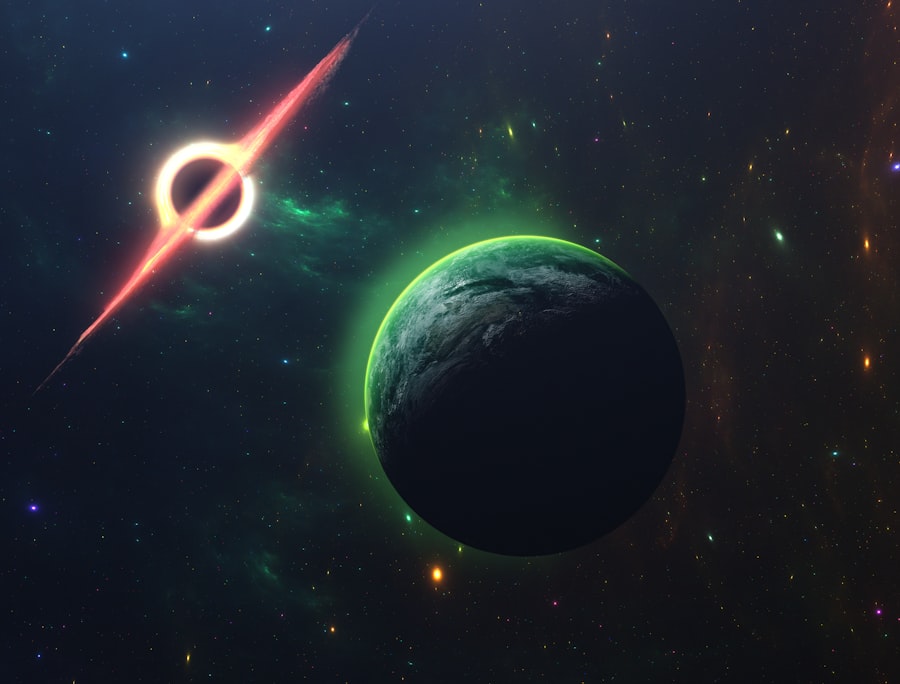
One of the most intriguing consequences of a rotating black hole is frame dragging, a phenomenon that occurs due to the rotation of massive objects distorting spacetime around them. In the vicinity of a Kerr black hole, this effect becomes pronounced, causing nearby objects and even light to be dragged along with the rotating spacetime. This leads to observable consequences that can be studied through astrophysical observations.
Frame dragging has been confirmed through various experiments and observations, including those involving satellites orbiting Earth and measurements related to gravitational waves. In the context of Kerr black holes, frame dragging can influence the orbits of stars and gas clouds in their vicinity, providing valuable insights into their dynamics and behavior. Understanding frame dragging not only enhances our knowledge of black holes but also contributes to our broader comprehension of gravitational interactions in the universe.
Analyzing the Innermost Stable Circular Orbit
The innermost stable circular orbit (ISCO) represents a critical threshold for objects orbiting a Kerr black hole. It marks the closest distance at which an object can maintain a stable orbit without spiraling into the black hole. The ISCO is influenced by both the mass and angular momentum of the black hole, leading to variations in its location compared to non-rotating counterparts.
For astrophysicists, understanding ISCO is essential for predicting how matter behaves in extreme gravitational fields. Accretion disks around rotating black holes often extend to this limit, where material can emit intense radiation before crossing into the event horizon. The study of ISCO not only aids in modeling accretion processes but also provides insights into high-energy phenomena observed in active galactic nuclei and X-ray binaries.
Examining the Penrose Process
The Penrose process offers a tantalizing glimpse into how energy can be extracted from a rotating black hole’s ergosphere. Proposed by physicist Roger Penrose in 1969, this process involves sending particles into the ergosphere where they can split into two: one particle falls into the black hole while another escapes with greater energy than it initially possessed. This mechanism highlights how rotating black holes can serve as potential sources of energy.
The implications of the Penrose process extend beyond theoretical considerations; they suggest that under certain conditions, it may be possible to harness energy from these enigmatic objects. While practical applications remain speculative at this stage, understanding this process enriches our knowledge of energy dynamics in extreme environments and opens avenues for future research into advanced propulsion systems or energy generation methods based on astrophysical phenomena.
Probing the Black Hole Shadow
The shadow cast by a Kerr black hole provides a unique observational signature that can be studied through advanced astronomical techniques. When light from distant stars or gas clouds passes near a black hole, it can be bent by its intense gravitational field, creating a dark region against a backdrop of bright material—this is known as the black hole shadow. The shape and size of this shadow are influenced by both the mass and spin of the black hole.
Recent advancements in observational technology have allowed astronomers to capture images of black hole shadows, most notably through projects like the Event Horizon Telescope (EHT). These observations provide critical data for testing theoretical models and enhancing our understanding of black hole properties. By analyzing variations in shadow size and shape, researchers can glean insights into angular momentum and other characteristics that define Kerr black holes.
Studying the No-Hair Theorem
The no-hair theorem posits that all information about a black hole’s formation—such as its charge, mass, and angular momentum—can be summarized by just these three parameters. This theorem suggests that once formed, all other characteristics or “hair” are lost to external observers. In essence, it implies that two black holes with identical mass, charge, and spin are indistinguishable from one another.
This concept has profound implications for our understanding of information loss in black holes and challenges traditional notions about information preservation in physics. The no-hair theorem raises questions about what happens to information that falls into a black hole and whether it can ever be recovered or if it is irretrievably lost to the universe. As researchers continue to explore these ideas, they delve deeper into fundamental questions about reality and our understanding of quantum mechanics.
Implications for Astrophysics and Cosmology
The study of Kerr black holes has far-reaching implications for both astrophysics and cosmology. By providing insights into extreme gravitational environments, these objects help researchers understand phenomena such as galaxy formation, stellar evolution, and high-energy astrophysical processes. The unique properties associated with rotating black holes challenge existing theories and encourage new approaches to understanding gravity’s role in shaping cosmic structures.
Moreover, investigating Kerr black holes contributes to broader discussions about fundamental physics, including quantum gravity and information theory. As scientists grapple with questions surrounding singularities and information loss, they are pushed toward developing new frameworks that may unify general relativity with quantum mechanics. Ultimately, exploring Kerr black holes not only enriches our understanding of these enigmatic objects but also propels humanity’s quest for knowledge about the universe’s most profound mysteries.
The study of Kerr black hole interior cosmology geometry offers fascinating insights into the nature of spacetime and singularities. For a deeper understanding of these concepts, you can explore the related article on this topic at this link. This resource delves into the intricate mathematical frameworks that describe the unique properties of rotating black holes and their implications for our understanding of the universe.
WATCH THIS 🛑 The Impossible Proof: Our Universe Is a Black Hole’s Interior
FAQs
What is a Kerr black hole?
A Kerr black hole is a type of rotating black hole described by the Kerr metric, a solution to Einstein’s field equations in general relativity. Unlike non-rotating (Schwarzschild) black holes, Kerr black holes have angular momentum, causing them to have a more complex structure.
What distinguishes the interior of a Kerr black hole from other black holes?
The interior of a Kerr black hole is characterized by the presence of an inner and outer event horizon, as well as a ring-shaped singularity. Its rotating nature leads to frame-dragging effects and a more intricate causal structure compared to non-rotating black holes.
How does cosmology relate to the interior of a Kerr black hole?
Cosmology in the context of Kerr black hole interiors explores how the geometry and dynamics inside the black hole might resemble or inform cosmological models of the universe, such as expanding or contracting regions, and how spacetime behaves under extreme conditions.
What is the geometry of the Kerr black hole interior?
The geometry inside a Kerr black hole is described by the Kerr metric extended beyond the event horizons. It includes regions where time and space coordinates interchange roles, and the singularity forms a ring rather than a point, leading to unique causal and geometric properties.
Can anything escape from inside a Kerr black hole?
No information or matter can escape from inside the outer event horizon of a Kerr black hole to the outside universe. However, the complex interior structure allows for theoretical paths within the black hole, but these do not permit escape to the external universe.
What role does the ring singularity play in Kerr black hole interior cosmology?
The ring singularity is a one-dimensional ring-shaped region where curvature becomes infinite. It influences the internal geometry and causal structure, and some theoretical models suggest it could connect to other regions of spacetime, though such ideas remain speculative.
Are there any observable effects of Kerr black hole interiors on the universe?
Direct observation of the interior of Kerr black holes is not possible due to the event horizon. However, their rotation affects the spacetime outside the horizon, influencing phenomena such as relativistic jets and gravitational waves, which can be observed.
How does the study of Kerr black hole interiors contribute to physics?
Studying Kerr black hole interiors helps physicists understand the behavior of spacetime under extreme conditions, test theories of gravity, explore quantum gravity effects, and investigate possible connections between black holes and cosmology.