Black holes have long captivated the imagination of scientists and the public alike, serving as enigmatic entities that challenge the very fabric of our understanding of the universe. Defined as regions in space where the gravitational pull is so intense that nothing, not even light, can escape, black holes are the ultimate manifestation of gravitational collapse. Their existence was first theorized in the early 20th century, but it wasn’t until the latter half of the century that substantial evidence began to emerge, confirming their presence in the cosmos.
The study of black holes has since evolved into a dynamic field of astrophysics, revealing insights not only about these mysterious objects but also about the broader workings of the universe. The fascination with black holes extends beyond their peculiar nature; they are also pivotal in shaping galaxies and influencing cosmic evolution. As researchers delve deeper into the properties and behaviors of black holes, they uncover a complex interplay between these entities and their surrounding environments.
This article aims to explore various aspects of black hole mass evolution, from their formation in the early universe to their growth through accretion and the impact they have on galaxy evolution. By examining observational evidence and theoretical models, one can gain a comprehensive understanding of how black holes evolve and their significance in the grand tapestry of cosmic history.
Key Takeaways
- Black holes form early in the universe and grow primarily through accretion and galaxy mergers.
- Observations confirm that black hole mass evolves over time, closely linked to their host galaxies.
- Black hole feedback significantly influences galaxy evolution by regulating star formation and gas dynamics.
- Theoretical models and environmental factors are crucial for understanding the diverse growth patterns of black holes.
- Studying black hole mass evolution offers key insights into the broader evolution of the universe.
Early Universe and Black Hole Formation
The origins of black holes can be traced back to the very beginnings of the universe, shortly after the Big Bang.
These fluctuations could have led to regions where matter collapsed under its own gravity, creating black holes with masses ranging from a few times that of our Sun to thousands or even millions of solar masses.
The existence of these primordial black holes remains a topic of active research, as they could provide crucial insights into the nature of dark matter and the evolution of cosmic structures. As the universe expanded and cooled, stars began to form from clouds of gas and dust. The life cycle of massive stars ultimately leads to their demise in spectacular supernova explosions, which can leave behind stellar black holes.
These stellar remnants are typically several times more massive than our Sun and represent a significant pathway for black hole formation.
Understanding how these black holes form is essential for piecing together the timeline of cosmic evolution and the subsequent growth of supermassive black holes found at the centers of galaxies.
Growth of Black Holes through Accretion
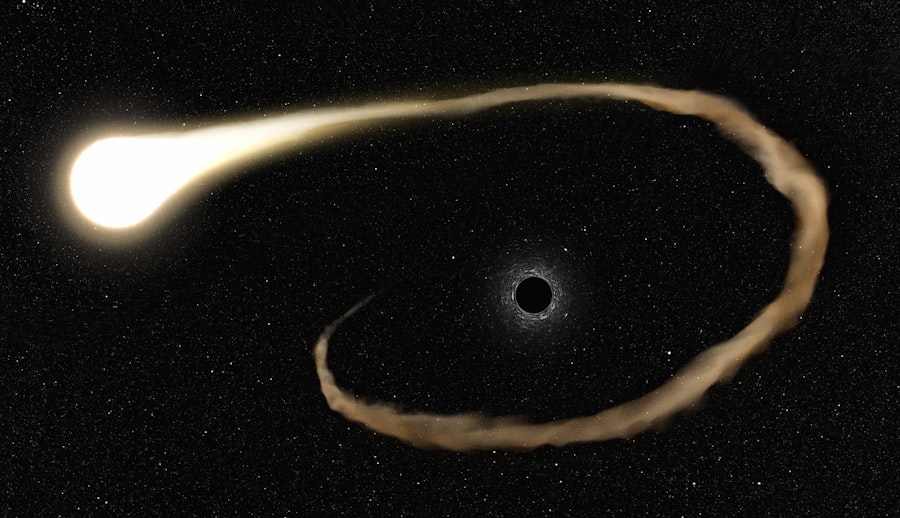
Once formed, black holes can grow significantly through a process known as accretion. This phenomenon occurs when a black hole draws in surrounding matter, such as gas and dust from its environment. As this material spirals inward, it forms an accretion disk—a rotating disk of matter that heats up due to friction and gravitational forces.
The energy released during this process can be immense, often resulting in powerful jets and radiation that can outshine entire galaxies. Accretion is not only a means for black holes to increase their mass but also plays a crucial role in regulating star formation within galaxies. The rate at which a black hole accretes matter can vary widely depending on its environment.
In regions with abundant gas, such as those found in active galactic nuclei (AGN), black holes can grow rapidly, consuming vast amounts of material over relatively short timescales. Conversely, in less dense environments, accretion may occur at a much slower pace. This variability in growth rates has significant implications for understanding the mass evolution of black holes and their influence on galaxy dynamics.
By studying accretion processes, astronomers can gain insights into how black holes interact with their surroundings and how these interactions shape the evolution of galaxies over cosmic time.
Observational Evidence of Black Hole Mass Evolution
| Study | Redshift Range | Black Hole Mass Range (Solar Masses) | Key Findings | Methodology |
|---|---|---|---|---|
| McConnell & Ma (2013) | 0 – 0.3 | 10^6 – 10^10 | Local universe black holes show tight correlation with host galaxy bulge mass | Stellar and gas kinematics |
| Trakhtenbrot et al. (2011) | 1.5 – 3.5 | 10^8 – 10^10 | Evidence for rapid black hole growth at high redshift | Broad emission line widths and continuum luminosity |
| Schulze & Wisotzki (2014) | 0.3 – 2.0 | 10^7 – 10^9 | Black hole mass function evolves with redshift, indicating mass growth over time | Virial mass estimators from quasar spectra |
| Kelly & Shen (2013) | 0.3 – 5.0 | 10^7 – 10^10 | Mass distribution shifts to higher masses at earlier cosmic times | Statistical modeling of quasar luminosity and mass distributions |
| Vestergaard et al. (2008) | 0.1 – 6.0 | 10^7 – 10^10 | Black holes reach billion solar masses by redshift ~6 | Single-epoch virial mass estimates using UV emission lines |
The quest to understand black hole mass evolution has been bolstered by a wealth of observational evidence gathered through advanced telescopes and instruments. One of the most compelling pieces of evidence comes from observations of quasars—extremely luminous objects powered by supermassive black holes at the centers of distant galaxies. These quasars provide a glimpse into the early universe when black holes were rapidly growing and can be used to estimate their masses based on their luminosity and spectral characteristics.
Additionally, gravitational wave detections from events such as black hole mergers have opened a new window into studying black hole populations. The LIGO and Virgo observatories have successfully detected ripples in spacetime caused by merging black holes, allowing researchers to infer their masses and spins. These observations have revealed a diverse range of black hole masses, challenging previous assumptions about their formation and growth pathways.
By compiling data from various sources, astronomers are beginning to construct a more comprehensive picture of how black hole masses evolve over time.
The Role of Galaxy Mergers in Black Hole Growth
Galaxy mergers represent another critical factor influencing black hole growth. When two galaxies collide, their central supermassive black holes can also merge, leading to an increase in mass for the resulting black hole. This process is not merely a straightforward addition; it involves complex dynamics that can result in significant energy release and the ejection of stars from the merged system.
The merger process can trigger intense bursts of star formation as gas clouds are compressed during the collision, further enriching the environment around the newly formed black hole. The frequency of galaxy mergers throughout cosmic history has implications for understanding the growth patterns of supermassive black holes. Observations suggest that many massive galaxies have undergone multiple mergers over time, contributing to their central black hole’s mass.
By studying these interactions, researchers can gain insights into how often such events occur and how they influence both black hole evolution and galaxy formation. The interplay between galaxy mergers and black hole growth underscores the interconnectedness of cosmic structures and highlights the dynamic nature of the universe.
Black Hole Feedback and its Impact on Galaxy Evolution
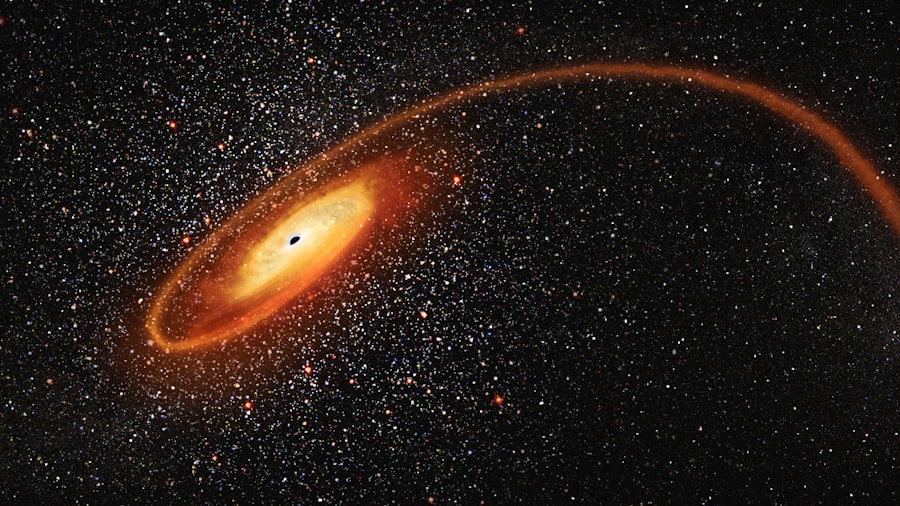
The influence of black holes extends beyond their immediate vicinity; they also play a significant role in shaping galaxy evolution through feedback mechanisms. When matter falls into a black hole, it releases energy in various forms, including radiation and powerful outflows known as jets. These energetic phenomena can have profound effects on their host galaxies by regulating star formation rates and influencing gas dynamics.
For instance, feedback from an active supermassive black hole can heat surrounding gas, preventing it from cooling and collapsing into new stars. This process can lead to a suppression of star formation in massive galaxies, creating a feedback loop that affects their overall evolution. Understanding these feedback mechanisms is crucial for constructing accurate models of galaxy formation and evolution, as they highlight how black holes can act as both consumers and regulators within their ecosystems.
The Relationship Between Black Hole Mass and Galaxy Properties
A well-established correlation exists between black hole mass and various properties of host galaxies, particularly their bulge mass or stellar velocity dispersion. This relationship suggests that as galaxies evolve, so too do their central black holes, indicating a co-evolutionary process between these two entities. The precise nature of this relationship remains an area of active research, with various theories proposed to explain how these correlations arise.
One prevailing hypothesis is that feedback from supermassive black holes influences star formation within galaxies, thereby affecting their growth and structure. As galaxies merge or interact with one another, their central black holes may also grow in tandem with their host galaxies. This interconnectedness raises intriguing questions about the mechanisms driving this co-evolution and how it shapes the overall landscape of cosmic structures.
Theoretical Models of Black Hole Mass Evolution
To better understand black hole mass evolution, researchers have developed various theoretical models that incorporate different growth mechanisms and environmental factors. These models aim to simulate how black holes evolve over time based on initial conditions such as mass distribution, gas density, and merger rates. By comparing model predictions with observational data, scientists can refine their understanding of how different processes contribute to mass evolution.
One prominent model is the “merger-driven growth” scenario, which emphasizes the role of galaxy mergers in facilitating rapid increases in black hole mass. Other models focus on accretion processes or feedback mechanisms as primary drivers of growth. By integrating multiple factors into these models, researchers hope to create a more holistic view of how black holes evolve within their cosmic environments.
The Influence of Environment on Black Hole Growth
The environment surrounding a black hole plays a crucial role in determining its growth trajectory. Factors such as gas density, proximity to other galaxies, and local gravitational interactions can significantly influence accretion rates and merger probabilities. For instance, black holes located in dense clusters may experience more frequent mergers due to higher interaction rates among galaxies compared to those in isolated regions.
Additionally, environmental conditions can affect the availability of gas for accretion. In regions with abundant cold gas, such as star-forming regions or interacting galaxies, black holes may experience rapid growth through accretion processes. Conversely, in environments where gas is heated or expelled due to feedback from star formation or active galactic nuclei, accretion may be suppressed.
Understanding these environmental influences is essential for constructing accurate models of black hole mass evolution.
Future Directions in Studying Black Hole Mass Evolution
As technology advances and observational techniques improve, future research on black hole mass evolution promises to yield exciting discoveries. Upcoming telescopes like the James Webb Space Telescope (JWST) will provide unprecedented insights into distant galaxies and their central black holes, allowing researchers to probe earlier epochs in cosmic history than ever before. These observations will enhance our understanding of how supermassive black holes formed and evolved during critical periods in the universe’s development.
Moreover, continued advancements in gravitational wave astronomy will enable scientists to detect more merging black holes across various mass ranges. This data will help refine models of binary evolution and provide insights into how different populations contribute to overall mass evolution trends. By integrating findings from multiple observational platforms—ranging from electromagnetic observations to gravitational wave detections—researchers will be better equipped to unravel the complexities surrounding black hole mass evolution.
Implications for Understanding the Universe’s Evolution
The study of black hole mass evolution holds profound implications for our understanding of the universe’s evolution as a whole. By examining how these enigmatic objects grow and interact with their environments, scientists can gain insights into fundamental processes governing galaxy formation and cosmic structure development. The intricate relationships between black holes and galaxies reveal a dynamic interplay that shapes not only individual systems but also the larger cosmic landscape.
Furthermore, understanding black hole mass evolution may shed light on critical questions regarding dark matter’s role in cosmic structure formation and the fate of galaxies over time. As researchers continue to explore these connections, they will contribute to a more comprehensive understanding of how our universe has evolved from its earliest moments to its current state—a journey marked by complexity, interconnectivity, and wonderment at the vastness beyond our own planet.
Recent studies on black hole mass evolution over cosmic time have shed light on the intricate relationship between black holes and their host galaxies. For a deeper understanding of this fascinating topic, you can explore the article available at this link. This resource provides valuable insights into how black holes grow and evolve alongside the universe, offering a comprehensive overview of current research findings.
WATCH THIS 🛑 The Impossible Proof: Our Universe Is a Black Hole’s Interior
FAQs
What is black hole mass evolution over cosmic time?
Black hole mass evolution over cosmic time refers to the study of how the masses of black holes change and grow throughout the history of the universe, from shortly after the Big Bang to the present day.
How do black holes grow in mass?
Black holes grow primarily by accreting matter from their surroundings, such as gas and dust, and by merging with other black holes. These processes increase their mass over time.
What factors influence the rate of black hole mass growth?
The rate of black hole mass growth depends on the availability of nearby matter to accrete, the environment of the black hole (such as galaxy type and density), and the frequency of black hole mergers.
Why is studying black hole mass evolution important?
Studying black hole mass evolution helps scientists understand galaxy formation and evolution, the role of black holes in cosmic structure, and the history of the universe itself.
How do astronomers measure black hole masses at different cosmic times?
Astronomers use various methods such as observing the motion of stars and gas near black holes, analyzing X-ray and radio emissions, and studying gravitational waves from black hole mergers to estimate black hole masses across different epochs.
What is the relationship between black hole mass and galaxy evolution?
There is a strong correlation between the mass of supermassive black holes and the properties of their host galaxies, suggesting that black hole growth and galaxy evolution are interconnected processes.
Do all black holes grow at the same rate over cosmic time?
No, black hole growth rates vary widely depending on factors like environment, availability of matter, and cosmic epoch. Some black holes grow rapidly in the early universe, while others grow more slowly or remain relatively small.
What role do black hole mergers play in mass evolution?
Black hole mergers contribute significantly to mass growth, especially for supermassive black holes, by combining the masses of two black holes into a larger one, often triggered by galaxy collisions.
Can black holes lose mass over time?
While black holes primarily gain mass, they can lose a tiny amount through Hawking radiation, but this effect is negligible for astrophysical black holes over cosmic timescales.
How does cosmic time affect black hole mass distribution?
Over cosmic time, the distribution of black hole masses changes as smaller black holes merge and accrete matter to become more massive, leading to a population of supermassive black holes in the centers of galaxies today.