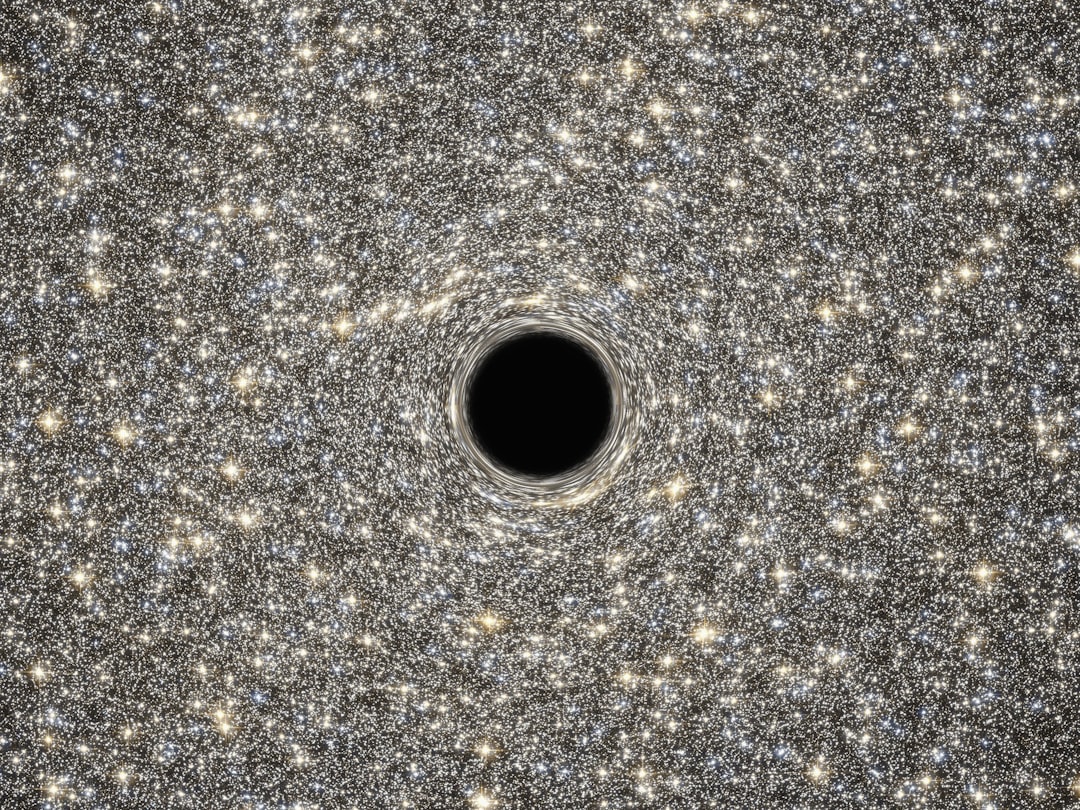
The Black Hole Information Paradox stands as one of the most intriguing and perplexing dilemmas in modern theoretical physics. It arises from the intersection of general relativity and quantum mechanics, two pillars of contemporary physics that, while successful in their respective domains, seem to clash when it comes to the nature of black holes. The paradox centers on the question of whether information that falls into a black hole is lost forever or if it can be recovered in some form.
This conundrum not only challenges the foundations of physics but also raises profound questions about the nature of reality itself. As scientists delve deeper into the mysteries of black holes, they encounter a fundamental conflict: general relativity suggests that anything crossing the event horizon of a black hole is irretrievably lost, while quantum mechanics posits that information cannot be destroyed. This contradiction has sparked intense debate and research, leading to various theories and hypotheses aimed at reconciling these two frameworks.
The implications of resolving this paradox extend beyond black holes, potentially reshaping our understanding of the universe and the laws that govern it.
Key Takeaways
- The Black Hole Information Paradox challenges the compatibility of black hole physics with quantum mechanics regarding information loss.
- Hawking radiation suggests black holes can evaporate, raising questions about whether information is destroyed or preserved.
- Various theoretical solutions, including string theory and the firewall hypothesis, attempt to resolve how information escapes or is retained.
- Recent advances focus on unitarity and quantum effects to reconcile information preservation with black hole evaporation.
- Experimental and observational efforts aim to provide evidence to support or refute proposed resolutions, guiding future research directions.
Theoretical Background: Black Holes and Information Loss
To comprehend the Black Hole Information Paradox, one must first understand the nature of black holes themselves. Formed from the remnants of massive stars that have undergone gravitational collapse, black holes are regions in space where gravity is so intense that nothing, not even light, can escape their grasp. The boundary surrounding a black hole is known as the event horizon, which marks the point of no return.
Once an object crosses this threshold, it is believed to be lost to the universe, leading to the notion that information about the object’s physical state is also obliterated. This idea of information loss contradicts a fundamental principle of quantum mechanics known as unitarity, which asserts that information must be preserved in any physical process. According to quantum theory, every particle carries information about its state, and this information should remain intact even after interactions or transformations.
The apparent loss of information in black holes poses a significant challenge to physicists, as it suggests that the laws governing quantum mechanics may not hold true in extreme gravitational environments.
Proposed Solutions to the Paradox

In response to the Black Hole Information Paradox, physicists have proposed several potential solutions, each with its own implications for our understanding of reality. One prominent idea is that information is not lost but rather encoded on the event horizon itself, a concept known as holography. This theory suggests that all the information about matter falling into a black hole is preserved in a two-dimensional format at the boundary, allowing it to be retrieved in some manner.
Another proposed solution involves the idea of black hole complementarity, which posits that different observers may perceive different realities regarding information loss. According to this view, an outside observer would see information being lost as an object crosses the event horizon, while an infalling observer would maintain that they can still access that information. This duality raises questions about the nature of reality and observation in quantum mechanics, suggesting that our understanding of information may be more complex than previously thought.
Hawking Radiation and its Role in the Paradox
| Metric | Description | Value / Range | Unit | Relevance to Paradox |
|---|---|---|---|---|
| Hawking Temperature | Temperature of black hole radiation emitted due to quantum effects | ~1.2 x 10^-8 (for a solar mass black hole) | Kelvin | Determines the rate of radiation and evaporation, key to information loss debate |
| Black Hole Mass | Mass of the black hole emitting Hawking radiation | 1 – 10^9 | Solar masses | Mass inversely affects Hawking temperature and evaporation time |
| Evaporation Time | Time taken for a black hole to evaporate completely via Hawking radiation | ~10^67 (for solar mass black hole) | Years | Long timescale challenges observation of information recovery |
| Radiation Spectrum | Energy distribution of emitted Hawking radiation | Blackbody spectrum | N/A | Thermal nature leads to paradox about information encoding |
| Information Paradox | Conflict between quantum mechanics and general relativity about information loss | Ongoing debate | N/A | Hawking radiation’s thermal nature suggests information loss, challenging unitarity |
| Entropy of Black Hole | Measure of information content related to black hole surface area | ~1.5 x 10^77 (for solar mass black hole) | Bits | Links thermodynamics to quantum information, central to paradox resolution |
Hawking radiation plays a crucial role in discussions surrounding the Black Hole Information Paradox. Proposed by physicist Stephen Hawking in 1974, this phenomenon describes how black holes can emit radiation due to quantum effects near their event horizons. As virtual particle pairs form near the event horizon, one particle may fall into the black hole while the other escapes, leading to a gradual loss of mass and energy from the black hole over time.
The implications of Hawking radiation are profound, as it suggests that black holes are not entirely black but can emit detectable radiation. This raises further questions about information loss: if a black hole can evaporate through Hawking radiation, what happens to the information contained within it? Some theorists argue that as a black hole emits radiation, it may also encode information about its past states within this radiation, potentially allowing for the recovery of lost information.
However, this remains a contentious point among physicists.
Quantum Mechanics and its Implications for Black Holes
The intersection of quantum mechanics and black holes introduces a host of complexities that challenge conventional understandings of physics. Quantum mechanics operates on principles that differ significantly from classical physics, emphasizing probabilistic outcomes and wave-particle duality. When applied to black holes, these principles raise questions about how information behaves under extreme gravitational conditions.
One significant implication is the concept of entanglement, where particles become interconnected in such a way that the state of one particle instantaneously influences another, regardless of distance. In the context of black holes, entangled particles could provide insights into how information is preserved or lost during gravitational collapse. Some researchers propose that entanglement may play a role in encoding information on the event horizon or even facilitate communication between particles inside and outside the black hole.
Recent Developments in Resolving the Paradox

Recent advancements in theoretical physics have led to renewed interest in resolving the Black Hole Information Paradox. Researchers have explored various avenues, including advancements in string theory and quantum gravity, which aim to unify general relativity and quantum mechanics. These theories offer new perspectives on how information might be preserved or transformed within black holes.
One notable development involves the study of “soft hair,” a concept introduced by physicists who suggest that black holes may possess additional degrees of freedom at their event horizons. This idea posits that these “soft hairs” could encode information about particles that fall into a black hole, potentially allowing for its recovery even after evaporation through Hawking radiation. Such findings have sparked further investigation into how these additional features might alter our understanding of black holes and their relationship with information.
The Role of String Theory in Understanding Black Holes
String theory has emerged as a leading candidate for unifying general relativity and quantum mechanics, offering insights into the nature of black holes and their associated paradoxes. In string theory, fundamental particles are not point-like objects but rather one-dimensional strings vibrating at different frequencies. This framework allows for a more comprehensive understanding of gravity and quantum phenomena.
Within string theory, researchers have explored how black holes can be described as configurations of strings and branes. This perspective provides new tools for analyzing black hole thermodynamics and entropy, shedding light on how information might be encoded within these structures. By examining black holes through the lens of string theory, physicists hope to uncover mechanisms for preserving information and reconciling it with established principles of quantum mechanics.
Information Preservation and the Firewall Paradox
The concept of firewalls has emerged as a controversial yet intriguing aspect of discussions surrounding information preservation in black holes. Proposed by researchers seeking to address inconsistencies between general relativity and quantum mechanics, firewalls suggest that an energetic barrier exists at the event horizon of a black hole.
While firewalls offer a potential solution to the paradox, they also raise significant questions about causality and the nature of spacetime. Critics argue that introducing firewalls contradicts established principles of general relativity, which assert that crossing an event horizon should not result in any dramatic physical effects for an infalling observer. The debate over firewalls highlights the ongoing struggle to reconcile conflicting theories and emphasizes the complexity inherent in understanding black holes.
The Debate Over Unitarity and the Fate of Information in Black Holes
At the heart of the Black Hole Information Paradox lies the debate over unitarity—the principle that physical processes should preserve information over time. Proponents of unitarity argue that any loss of information contradicts fundamental tenets of quantum mechanics and undermines our understanding of reality. Conversely, those who support theories suggesting information loss contend that certain extreme conditions may allow for exceptions to this rule.
This debate has significant implications for theoretical physics and our understanding of the universe. If unitarity holds true even in extreme environments like black holes, it would necessitate a reevaluation of existing theories and models. Conversely, if information can indeed be lost under certain conditions, it could lead to a paradigm shift in how physicists approach fundamental questions about reality and existence.
Experimental Evidence and Observational Constraints on Information Loss
While much of the discourse surrounding the Black Hole Information Paradox has been theoretical, experimental evidence and observational constraints play a crucial role in shaping our understanding.
Observations from gravitational wave detections and electromagnetic signals from merging black holes provide valuable data for testing theoretical predictions regarding information loss.
These observations may help confirm or refute various hypotheses surrounding Hawking radiation and its implications for information preservation. As researchers continue to gather empirical evidence, they hope to shed light on this enigmatic paradox and refine existing theories accordingly.
Future Directions in Resolving the Black Hole Information Paradox
The quest to resolve the Black Hole Information Paradox remains an ongoing endeavor within theoretical physics. As researchers explore new avenues such as quantum gravity, holography, and advancements in string theory, they are gradually piecing together a more comprehensive understanding of black holes and their relationship with information. Future directions may involve collaborative efforts across disciplines, integrating insights from cosmology, particle physics, and quantum mechanics to develop unified theories capable of addressing this paradox comprehensively.
As scientists continue to push the boundaries of knowledge and technology, they remain hopeful that breakthroughs will emerge—potentially transforming our understanding of reality itself and illuminating one of nature’s most profound mysteries: what truly happens to information when it falls into a black hole?
The black hole information paradox has long puzzled physicists, raising questions about the fundamental nature of information and its preservation in the universe. A recent article discusses potential resolutions to this paradox, exploring various theories and their implications for our understanding of black holes. For more in-depth insights, you can read the article here: Black Hole Information Paradox Resolution.
WATCH THIS! The Universe Has a Resolution Limit (And We’ve Hit It)
FAQs
What is the black hole information paradox?
The black hole information paradox is a puzzle resulting from the conflict between quantum mechanics and general relativity. It questions whether information that falls into a black hole is permanently lost, which would violate the principle of quantum theory that information must be conserved.
Why is the black hole information paradox important?
The paradox challenges our understanding of fundamental physics, particularly how gravity and quantum mechanics interact. Resolving it is crucial for developing a consistent theory of quantum gravity.
What are some proposed resolutions to the black hole information paradox?
Several proposals exist, including the idea that information is encoded in Hawking radiation, the holographic principle suggesting information is stored on the black hole’s event horizon, and the concept of black hole complementarity. More recent approaches involve quantum entanglement and the firewall hypothesis.
What role does Hawking radiation play in the paradox?
Hawking radiation is thermal radiation predicted to be emitted by black holes, causing them to lose mass and eventually evaporate. The paradox arises because this radiation appears to carry no information about the matter that fell into the black hole, implying information loss.
Has the black hole information paradox been resolved?
While there is no universally accepted solution, significant progress has been made. Many physicists now believe that information is not lost but rather encoded in subtle correlations within Hawking radiation, preserving quantum information.
What is the holographic principle in relation to black holes?
The holographic principle suggests that all the information contained within a volume of space can be represented as encoded data on the boundary of that space. Applied to black holes, it implies that information about the interior is stored on the event horizon, potentially resolving the paradox.
What is black hole complementarity?
Black hole complementarity is a theoretical framework proposing that information is both reflected at the event horizon and passes through it, but no single observer can witness both processes simultaneously, thus avoiding contradictions.
Why does the black hole information paradox matter for physics?
It highlights the need for a unified theory that reconciles quantum mechanics with general relativity. Understanding how information behaves in black holes could lead to breakthroughs in quantum gravity and our comprehension of the universe.