
Black holes have long captivated the imagination of scientists and the public alike, serving as a profound enigma in the realm of astrophysics. These cosmic phenomena, formed from the remnants of massive stars that have undergone gravitational collapse, possess gravitational fields so intense that nothing, not even light, can escape their grasp. The very nature of black holes challenges our understanding of physics, particularly at the intersection of general relativity and quantum mechanics.
As researchers delve deeper into the mysteries surrounding black holes, they uncover layers of complexity that provoke questions about the fundamental laws governing the universe. The allure of black holes lies not only in their mysterious formation but also in their potential implications for our understanding of space and time. The event horizon, a boundary beyond which nothing can return, serves as a threshold that separates the known universe from the unknown.
Within this boundary, the laws of physics as we know them appear to break down, leading to paradoxes that challenge established theories. As scientists continue to explore these enigmatic entities, they are compelled to confront profound questions about the nature of reality itself and the limits of human understanding.
Key Takeaways
- Black hole firewalls are a theoretical concept proposed to resolve the paradox of information loss in black holes.
- Observational evidence for firewalls remains inconclusive, fueling ongoing scientific debate.
- Quantum mechanics plays a crucial role in understanding and modeling black hole firewalls.
- Resolving the firewall paradox is key to developing a unified theory combining black holes and quantum mechanics.
- Future research aims to test firewall existence and explore their implications for fundamental physics and the universe.
Theoretical Predictions of Black Hole Firewalls
In recent years, the concept of black hole firewalls has emerged as a significant theoretical prediction that seeks to address some of the paradoxes associated with black holes. The firewall hypothesis posits that an observer falling into a black hole would encounter a searing wall of energy at the event horizon, effectively incinerating anything that crosses this boundary. This radical idea challenges the traditional view that an observer would experience a smooth passage through the event horizon without any dramatic effects.
The implications of firewalls are profound, as they suggest a fundamental alteration in our understanding of how information behaves in extreme gravitational fields. The theoretical underpinnings of black hole firewalls stem from attempts to reconcile quantum mechanics with general relativity. According to quantum theory, information cannot be destroyed; however, when matter falls into a black hole, it seems to vanish from the observable universe.
This apparent contradiction has led to the proposal of firewalls as a potential solution. By introducing a barrier of high-energy particles at the event horizon, firewalls could preserve the integrity of information while simultaneously adhering to the principles of quantum mechanics. This radical shift in perspective has sparked intense debate among physicists, as it challenges long-held beliefs about the nature of black holes and their interaction with quantum information.
Observational Evidence for Black Hole Firewalls
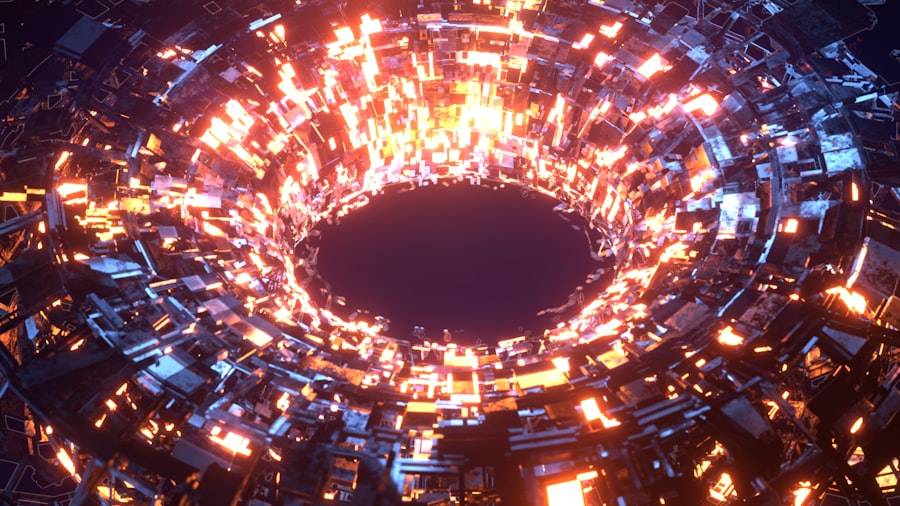
While the concept of black hole firewalls remains largely theoretical, researchers have sought observational evidence to support or refute this hypothesis. One avenue of investigation involves studying the behavior of matter and radiation near black holes, particularly in the vicinity of their event horizons. Observations from powerful telescopes and gravitational wave detectors have provided valuable insights into the dynamics of accretion disks and jets emitted by supermassive black holes.
These observations may offer indirect evidence for the existence of firewalls by revealing anomalies in the behavior of particles and radiation as they approach the event horizon. Additionally, advancements in technology have enabled scientists to probe deeper into the nature of black holes than ever before. For instance, the Event Horizon Telescope’s groundbreaking imaging of the supermassive black hole at the center of the Milky Way has opened new avenues for understanding these cosmic giants.
By analyzing the emitted radiation and its interactions with surrounding matter, researchers hope to glean insights into whether firewalls exist and how they might influence the behavior of particles near black holes. While definitive observational evidence remains elusive, ongoing research continues to push the boundaries of our understanding.
The Paradox of Black Hole Information Loss
| Metric | Description | Value / Status |
|---|---|---|
| Black Hole Entropy (S) | Measure of information content related to the event horizon area | Proportional to horizon area (A/4 in Planck units) |
| Hawking Radiation Temperature (T) | Temperature at which black holes emit radiation | Inverse proportional to black hole mass (T ∝ 1/M) |
| Information Loss Paradox | Conflict between quantum mechanics and general relativity about information preservation | Unresolved / Subject of ongoing research |
| Page Time | Time when half of the black hole’s entropy has been radiated away | Approximately half of black hole evaporation time |
| Evaporation Time | Time taken for a black hole to completely evaporate via Hawking radiation | Proportional to M³ (mass cubed) |
| Unitarity | Principle that quantum information is preserved in time evolution | Presumed valid, but challenged by classical black hole models |
| Firewall Hypothesis | Proposed solution suggesting a high-energy zone at the event horizon | Controversial and debated |
At the heart of the black hole firewall debate lies the paradox of black hole information loss, a conundrum that has perplexed physicists for decades. According to quantum mechanics, information is preserved; however, when matter falls into a black hole, it appears to be irretrievably lost once it crosses the event horizon. This contradiction raises fundamental questions about the nature of reality and challenges our understanding of causality and determinism in physics.
The implications are staggering: if information can be lost, it undermines one of the cornerstones of quantum theory. The information loss paradox has prompted extensive discussions among physicists regarding its implications for our understanding of black holes and quantum mechanics. Some theorists argue that information is not truly lost but rather encoded in subtle correlations between particles emitted during Hawking radiation—the theoretical radiation emitted by black holes due to quantum effects near their event horizons.
Others propose that firewalls could serve as a mechanism for preserving information while still adhering to quantum principles. This ongoing debate highlights the complexity and richness of black hole physics, as researchers grapple with reconciling seemingly contradictory ideas.
Proposed Solutions to the Black Hole Information Paradox
In response to the black hole information loss paradox, various proposed solutions have emerged from the scientific community. One prominent idea is that information is not lost but rather transformed or encoded in some way during its journey into a black hole. This perspective aligns with theories suggesting that Hawking radiation carries information away from black holes, allowing it to be recovered over time.
However, this notion raises further questions about how this encoding occurs and whether it can be practically observed. Another proposed solution involves modifications to our understanding of spacetime itself.
This idea aligns with concepts from string theory and loop quantum gravity, which posit that spacetime is composed of discrete units rather than being continuous. Such modifications could provide a framework for reconciling quantum mechanics with general relativity while addressing issues related to information loss.
The Role of Quantum Mechanics in Understanding Black Hole Firewalls
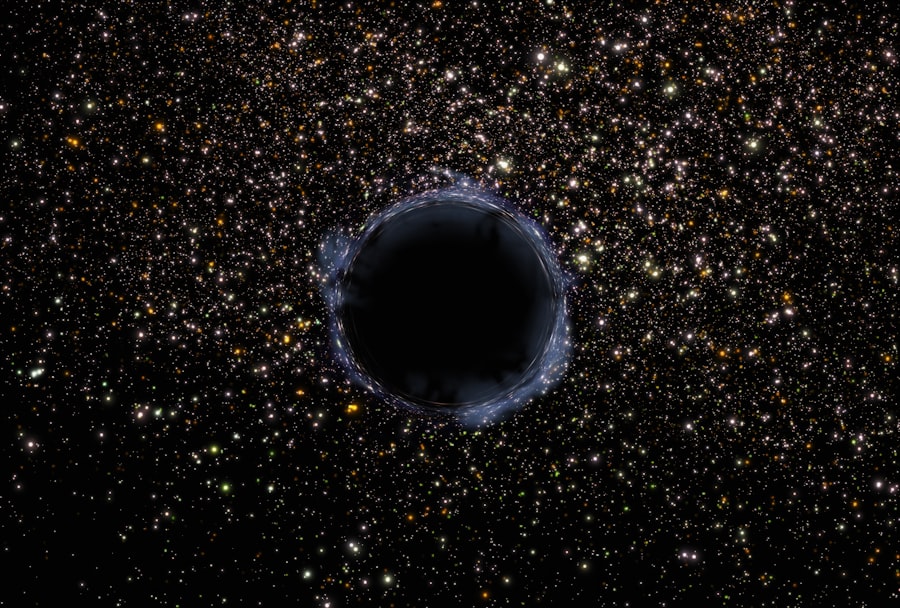
Quantum mechanics plays a pivotal role in shaping our understanding of black hole firewalls and their implications for fundamental physics. The principles governing quantum behavior challenge classical intuitions about reality, particularly when applied to extreme environments like those surrounding black holes. Quantum entanglement, for instance, suggests that particles can be interconnected in ways that defy classical notions of locality and separability.
This phenomenon has led researchers to explore how entangled states might relate to information preservation in black holes. Moreover, quantum mechanics introduces concepts such as superposition and uncertainty that further complicate our understanding of black holes. The idea that particles can exist in multiple states simultaneously raises questions about how information is represented within a black hole’s gravitational field.
As physicists grapple with these complexities, they are compelled to rethink traditional notions of causality and determinism—core tenets that underpin much of classical physics.
Testing the Existence of Black Hole Firewalls
Testing the existence of black hole firewalls presents significant challenges due to their elusive nature and extreme environments. However, researchers are exploring various experimental approaches to probe this phenomenon indirectly. One avenue involves simulating conditions akin to those near a black hole using high-energy particle collisions in particle accelerators like the Large Hadron Collider (LHC).
By recreating extreme gravitational fields and studying particle interactions under these conditions, scientists hope to glean insights into whether firewalls could exist. Additionally, advancements in observational astronomy may provide opportunities for testing predictions related to firewalls. For instance, monitoring high-energy emissions from accretion disks around supermassive black holes could reveal anomalies consistent with firewall behavior.
As technology continues to evolve, researchers remain optimistic about uncovering evidence that could either support or challenge the existence of firewalls.
The Debate Over the Existence of Black Hole Firewalls
The existence of black hole firewalls has sparked intense debate within the scientific community, with proponents and skeptics presenting compelling arguments on both sides. Advocates for firewalls argue that they offer a viable solution to the information loss paradox while preserving key principles of quantum mechanics. They contend that without firewalls, one must accept a violation of fundamental laws governing information conservation—a notion many physicists find untenable.
Conversely, critics argue that introducing firewalls complicates our understanding of black holes without providing definitive evidence for their existence. Some physicists maintain that traditional views regarding smooth event horizons should not be discarded lightly and caution against jumping to conclusions based solely on theoretical predictions. This ongoing discourse reflects broader tensions within theoretical physics as researchers grapple with reconciling established theories with emerging ideas.
The Implications of Black Hole Firewalls for Our Understanding of the Universe
The implications of black hole firewalls extend far beyond theoretical physics; they challenge fundamental assumptions about reality itself and our place within the universe. If firewalls exist, they could fundamentally alter our understanding of causality and determinism—concepts deeply ingrained in both classical and quantum physics. Such changes would necessitate a reevaluation of how scientists approach not only black holes but also other extreme phenomena in astrophysics.
Moreover, firewalls may have profound implications for our understanding of spacetime itself. If information is preserved through mechanisms like firewalls or other proposed solutions, it could lead to new insights into the fabric of reality and how it interacts with quantum phenomena. As researchers continue to explore these ideas, they are likely to uncover new connections between seemingly disparate areas of physics—potentially paving the way for groundbreaking discoveries.
Future Research Directions in Exploring Black Hole Firewalls
As scientists continue their quest to understand black hole firewalls and their implications for fundamental physics, several promising research directions are emerging. One area ripe for exploration involves further investigations into quantum entanglement and its relationship with black holes. By studying entangled states in controlled environments, researchers may gain insights into how information behaves under extreme gravitational conditions.
Additionally, interdisciplinary collaborations between physicists and mathematicians could yield new mathematical frameworks for addressing issues related to firewalls and information loss. By developing novel models that incorporate both quantum mechanics and general relativity, researchers may uncover deeper connections between these two pillars of modern physics—ultimately leading toward a more unified understanding.
The Quest for a Unified Theory of Black Holes and Quantum Mechanics
The quest for a unified theory that reconciles black holes with quantum mechanics represents one of the most profound challenges facing contemporary physics. As researchers grapple with concepts like firewalls and information loss, they are compelled to rethink traditional paradigms and explore new avenues for understanding reality itself. This pursuit not only holds promise for advancing theoretical physics but also has far-reaching implications for our comprehension of the universe at large.
Ultimately, unraveling the mysteries surrounding black holes and their potential firewalls may lead to groundbreaking discoveries that reshape our understanding of space, time, and matter. As scientists continue their explorations into these enigmatic phenomena, they remain driven by an insatiable curiosity—a desire to uncover truths hidden within the cosmos and illuminate pathways toward a more comprehensive understanding of existence itself.
In exploring the intriguing concept of black hole firewalls, one can gain further insights by reading the article available at mycosmicventures.
com/sample-page/’>this link. The discussion surrounding whether we can observe a black hole firewall raises fundamental questions about the nature of black holes and the fabric of spacetime, making it a captivating topic for both physicists and enthusiasts alike.
WATCH THIS! The Paradox That Broke Physics: Quantum vs. Black Holes
FAQs
What is a black hole firewall?
A black hole firewall is a hypothetical phenomenon proposed in theoretical physics, suggesting that an observer falling into a black hole would encounter a high-energy zone or “firewall” at the event horizon, contradicting the traditional idea that crossing the event horizon is uneventful.
Why is the concept of a black hole firewall important?
The firewall concept challenges the conventional understanding of black holes and quantum mechanics, particularly the principle of “no drama” at the event horizon, and aims to resolve paradoxes related to information loss in black holes.
Can we directly observe a black hole firewall?
Currently, we cannot directly observe a black hole firewall because it would occur at the event horizon, a region from which no information or light can escape to reach observers outside the black hole.
What methods do scientists use to study black hole firewalls?
Scientists use theoretical models, simulations, and indirect observations of black hole behavior, such as radiation patterns and gravitational waves, to study the possibility of firewalls and their implications.
Have any experiments or observations confirmed the existence of black hole firewalls?
No experimental or observational evidence has confirmed the existence of black hole firewalls; the concept remains a theoretical proposal debated among physicists.
How does the firewall hypothesis relate to the information paradox?
The firewall hypothesis was proposed as a potential solution to the black hole information paradox, which questions how information is preserved when matter falls into a black hole.
Are there alternative theories to the black hole firewall?
Yes, alternative theories include the idea that information is preserved through quantum entanglement without a firewall, or that new physics beyond current understanding may resolve the paradox without requiring a firewall.
What role does quantum mechanics play in the firewall debate?
Quantum mechanics is central to the firewall debate because it governs the behavior of particles at the event horizon and challenges classical descriptions of black holes, leading to conflicting predictions about what an infalling observer would experience.
Is the firewall concept widely accepted in the scientific community?
The firewall concept is controversial and not universally accepted; it remains a topic of active research and debate among physicists studying black holes and quantum gravity.
Can future technology help us observe or test the firewall hypothesis?
Future advancements in observational technology, such as more sensitive telescopes and gravitational wave detectors, may provide indirect evidence to support or refute the firewall hypothesis, but direct observation remains unlikely due to the nature of black holes.